
One frame. That’s all it takes to lose a round.
In competitive shooters, a tiny spike in input lag or a blur during a fast flick can flip the outcome. That is why the ROG PGL partnership for the PGL 2026 season deserves attention beyond a headline.
At first, it looks like another brand logo on a tournament stage. But this move goes deeper. Every match station will run the same high refresh rate gaming monitor, the same esports peripherals, and the same tournament-grade PC hardware. That improves consistency, fairness, and performance at the highest level.
As technology experts with over 20 years of experience in hardware and application research and development, we analyze each product based on real-world performance, durability, and value for money. Our goal is to help readers find the best product in every category—budget, performance, reliability, and long-term use. Our recommendations are based on extensive research, component analysis, real-world usability, and industry expertise.
This breakdown is built for:
- Esports athletes and serious ranked players
- Competitive gamers chasing stable high FPS
- PC builders planning a tournament-ready PC
- Buyers researching the best gaming monitor for esports
- Fans who care about clean, sharp broadcasts
We focus on what actually changes, how the hardware performs under pressure, and whether this setup makes sense outside the arena.
1. Introduction
Close rounds are not decided by hype. They are decided by timing and clarity.
Starting in 2026, every PGL tournament setup will use a standardized ROG hardware stack. That means identical low latency monitors, matched input devices, and high-end PC components across all player stations.
This matters for three reasons.
First, competitive fairness improves. When every player uses the same calibrated display and peripherals, no one gains an unintended hardware edge.
Second, performance stability increases. Consistent refresh rates and low input delay reduce unexpected behavior mid-match.
Third, viewers benefit. Cleaner motion handling and reduced blur improve broadcast quality.
For players at home, the real question is simple:
Is this esports tournament hardware worth investing in for ranked play?
We break down the system, explain the technical details in plain language, and help readers decide whether this gear fits their needs and budget.
2. Technical Specifications at a Glance
Every station in the PGL 2026 season runs the same hardware. That removes hardware variability from the competitive equation.
Here is the full setup and why each component matters.
| Component | Model/Spec | Key Features | Benefits for Players |
|
Monitor |
ROG Strix XG248QSG Ace |
24.1-inch FHD Super TN panel, 610Hz refresh rate (overclocked), 0.1ms response time, 0.8ms input
lag |
Cuts motion blur in sprays and flicks, keeps edges sharp under bright lights—ideal for esports athletes hardware
chasing every frame. |
|
Mouse |
ROG Harpe II Ace |
Ultralight 47g design, 42,000 dpi optical sensor, tri-mode connectivity (wired, 2.4GHz, Bluetooth), 95-hour battery |
Featherweight for quick swings, precise tracking without drag—suits competitive esports peripherals users who play
long sessions. |
|
Keyboard |
ROG Falchion Ace 75 HE |
Magnetic switches, Hall effect tech, 8,000Hz polling, compact 75% layout, tri- mode wireless | Adjustable actuation for rapid inputs, no debounce delay—great for professional gaming accessories in tight-
spaced tournaments. |
|
Headset |
ROG Delta II |
Tri-mode wireless, 110-hour battery, high-res audio drivers, AI noise cancel mic | Clear comms and immersion without cords—perfect for high-resolution audio
headsets in noisy arenas. |
|
Processor |
AMD Ryzen 7 9800X3D |
8-core, high-cache design for gaming |
Stable frames in team shooters, handles multitasking—key for
tournament-ready PCs. |
|
Graphics |
GeForce RTX 5080
(as specified in official tournament hardware disclosures) |
Advanced NVIDIA architecture, high VRAM |
Designed to push high frame rates in esports tournament hardware, with support for ray tracing if required. |
|
Motherboard |
TUF
Gaming X870E-Plus WiFi 7 |
Robust VRM, WiFi 7 support |
Low-latency networking, overclock stability—fits WiFi 7 motherboard needs for
practice rigs. |
|
RAM |
32GB DDR5-6000
(2x16GB) |
High-speed modules |
No stutters at peak loads— essential for overclocking
gaming hardware. |
|
PSU |
TUF
Gaming 1000W Gold |
Military-grade efficiency |
Powers full loads reliably— avoids crashes in tournament rig marathons. |
Note: The 610Hz specification refers to the overclocked mode stated by ASUS.
Summary
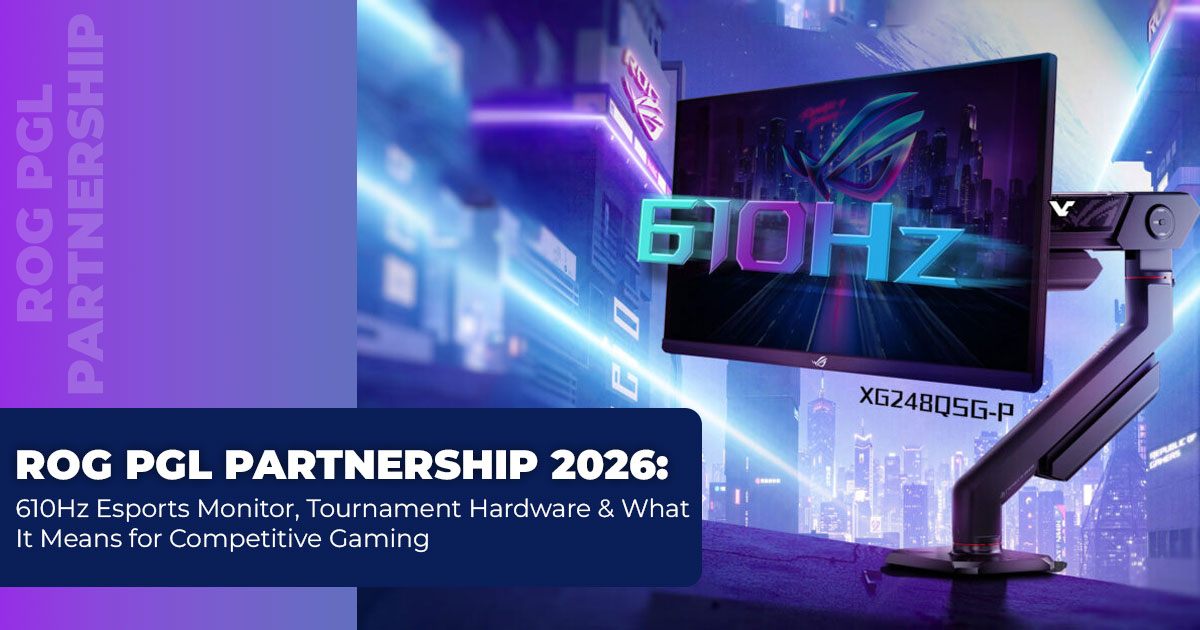
The ROG PGL partnership standardizes all PGL tournament setups with ultra-fast, consistent hardware. The headline feature is the ROG Strix XG248QSG Ace with its 610Hz refresh rate and Extreme Low Motion Blur technology.
This lineup targets:
- Professional esports players
- Serious ranked competitors
- Gamers pushing extreme FPS builds
It prioritizes speed, consistency, and competitive fairness.
3. Why This Review Is Essential
Many announcements focus on branding. They rarely explain the real impact.
Hardware inconsistency has caused complaints in past tournaments across the industry. Small differences in panel calibration or latency can disrupt muscle memory and affect player confidence.
This analysis addresses the practical questions:
- What does the ROG PGL partnership actually change?
- How do standardized low latency monitors improve fairness?
- Is the ROG Ace esports collection worth buying for home setups?
- Does tournament hardware translate to a real ranked advantage?
User reviews matter because real-world performance often differs from spec sheets. We focus on how these components perform under stress, extended sessions, and high-FPS scenarios.
For readers researching what is ROG PGL partnership or comparing the best gaming monitor for esports, this context fills the gaps left by surface-level coverage.
4. What You Will Learn from This Review
- A clear breakdown of ROG Strix XG248QSG features, including how a 610Hz refresh rateimpacts motion clarity
- How esports peripherals performance influences competitive consistency
- Practical buying guidance for the best ultralight gaming mouse and best gaming monitor for esports
- A simple explanation of ROG monitor refresh rate explained without unnecessary complexity
- Insights into how the ROG and PGL collaboration 2026 could influence future tournament hardware standards
Competitive gaming is not just about skill. It is also about removing variables. Standardized
esports tournament hardware reduces those variables.
And that shift could shape how competitive gaming evolves over the next few seasons.
5. ROG PGL Partnership 2026: Sponsorship Noise or Real Competitive Upgrade?
When a hardware brand signs a tournament deal, the first reaction is often skepticism. Is this just branding, or does it change how matches are played?
The ROG PGL partnership goes beyond logo placement. Starting with the PGL esports season 2026, every stage setup will use the same ROG Strix XG248QSG Ace monitor, full ROG Ace esports collection peripherals, and standardized tournament PCs.
That consistency matters.
In past events across the industry, players sometimes had to adjust to slight differences in refresh rate, panel tuning, or input response between venues. Even small changes can disrupt muscle memory in games like Counter-Strike 2 (CS2), where milliseconds decide rounds.
With uniform PGL tournament monitor standards:
- Pros no longer adapt mid-event
- Competitive integrity improves
- Broadcast quality becomes more predictable
For home gamers, this partnership also acts as a reference point. It shows what a professional gaming setup looks like at the highest level.
- Key takeaway: The ROG and PGL collaboration 2026 standardizes high-performance esports equipment, reducing hardware variables in elite competition.
6. Who’s Behind the ROG PGL Partnership — And Why It Matters for Competitive Gaming
Understanding the impact requires knowing both sides of the deal.
6.1 ROG Esports Monitors and Professional Gaming Hardware
ROG (Republic of Gamers) has built its reputation on speed-focused displays and low-latency gear. Its use of Super TN panels, overclocked refresh rates, and blur reduction technology has made ROG displays common in competitive circuits.
The introduction of the 610Hz refresh rate monitor in the ROG Strix XG248QSG Ace pushes that focus further. For esports players, panel speed and motion clarity directly affect tracking precision.
By anchoring the PGL 2026 season around ROG hardware, the brand positions itself at the center of esports monitor standards.
This strengthens:
- ROG gear for pros
- Credibility in tournament environments
- Visibility across global esports broadcasts
6.2 PGL Tournaments and Global Esports Events
PGL is known for organizing major global tournaments, including high-profile CS2 Majors and large-scale Dota competitions. Events hosted in venues such as Cluj-Napoca, Romania, draw global audiences and deliver strong broadcast production.
While production quality has been consistent, hardware uniformity has varied across esports organizers in the broader industry.
The PGL tournament monitor uniformity introduced through this partnership addresses that gap.
For competitive gaming, standardized hardware:
- Strengthens fairness
- Reduces disputes over input delay
- Improves trust in event conditions
This is not just operational convenience. It affects competitive legitimacy.
7. What Changes with the ROG PGL Partnership in Esports Tournament Hardware
This is where the deal moves from announcement to impact.
7.1 Standardized Esports Tournament Hardware Across Events
Every station in the global esports circuit under PGL will run matching hardware specifications.
That includes:
- Identical high refresh rate gaming monitors
- Uniform mouse and keyboard configurations
- Consistent PC performance tiers
Removing variation in esports station hardware specs eliminates subtle differences in:
- Input delay
- Motion blur levels
- Display tuning
For pro players, this reduces uncertainty. Performance depends on skill rather than hardware adaptation.
7.2 610Hz Refresh Rate Explained: Performance Impact for Pro Players
Understanding the ROG monitor refresh rate explained in simple terms helps clarify why this matters.
A 610Hz refresh rate means the display updates 610 times per second. Higher refresh rates reduce perceived motion blur and improve visual clarity during rapid movement.
Here’s how refresh levels compare:
| Refresh Rate | Motion Clarity | Use Case | Player Benefit |
|
240Hz |
Solid |
Entry-level tournaments | Noticeable smoothness over
144Hz |
| 360Hz | Strong | Competitive semi-pro play | Reduced blur in fast duels |
| 610Hz (ROG
Strix XG248QSG Ace) |
Elite tier |
PGL esports tournaments 2026 |
Minimal motion blur and reduced perceived latency |
When paired with Extreme Low Motion Blur (ELMB 2) technology:
- Enemy tracking becomes clearer
- Ghosting artifacts reduce
- Stage lighting interference becomes less disruptive
For esports athletes and hardware enthusiasts, this level of clarity can support tighter crosshair control.
7.3 Esports Broadcast Quality and Viewer Experience
The partnership also improves the spectator side.
Cleaner panel performance means:
- Smoother camera captures
- Fewer visible motion artifacts
- More stable overlays during rapid gameplay
For fans watching PGL arena events, including tournaments held in Cluj-Napoca, improved motion clarity translates into a sharper viewing experience.
In competitive gaming, broadcast quality shapes fan engagement. Hardware consistency supports that experience.
- Summary: Players benefit from hardware Viewers benefit from visual clarity.
8. The Hardware Arms Race: How the ROG PGL Partnership Reflects Competitive Gaming Trends
The jump from 360Hz to 610Hz refresh rate monitors signals a broader trend.
Esports hardware is moving toward:
- Higher refresh ceilings
- Lower measurable input latency
- Stronger blur reduction methods
The high refresh rate monitor market continues to push limits because competitive titles reward fast reaction windows.
Is this partnership strategic branding? Yes.
Is it also part of ongoing display innovation? Yes.
By aligning with PGL, ROG strengthens its role in defining esports event sponsorship hardware standards.
For players and PC builders, it sets a benchmark for what tournament-level hardware now looks like.
9. What the ROG Ace Esports Collection Means for Everyday Competitive Gamers
The most practical question remains: should home gamers follow this setup?
The ROG Ace collection used in the PGL esports season 2026 is retail-available hardware. There are no secret tournament-only modifications.
9.1 Mouse and Keyboard Breakdown
- The ROG Ace mouse features a 42,000 DPI optical sensor, supporting high-precision
- The keyboard uses Hall effect switches, allowing adjustable actuation points for faster key response.
For players running PCs capable of 400+ FPS, higher refresh monitors like the ROG Strix XG248QSG Ace can improve visual clarity.
For others, the gains may be minimal.
9.2 Practical Buying Guidance by Budget
| Price Tier | Recommended Setup | Why It Fits | Target Audience |
| Under $300 | 240Hz monitor + basic gaming mouse | Affordable step into smooth gameplay | New ranked players |
|
$400–$600 |
360Hz monitor +
quality wireless peripherals |
Strong balance of speed and value |
Competitive hobbyists |
|
$700+ |
610Hz ROG Strix XG248QSG Ace + ROG
Ace esports collection |
Maximum motion clarity and input
precision |
Aspiring pros and streamers |
If your system cannot consistently exceed 360 FPS, investing in a 610Hz esports monitor may not deliver proportional gains.
Understanding your performance ceiling matters more than copying a pro setup.
9.3 Final Perspective on the ROG and PGL Collaboration 2026
This partnership strengthens:
- Esports hardware standardization
- Competitive fairness in PGL tournaments
- Visibility for ROG esports monitors
- Expectations for future esports tournament hardware
For professionals, it reduces variables. For fans, it improves broadcast quality.
For ranked players, it offers a clear reference point — but not a mandatory upgrade.
The real shift is the normalization of ultra-high refresh displays as competitive infrastructure.
10. Business Strategy Behind the ROG PGL Partnership in Esports
The ROG PGL partnership is not only about hardware deployment. It is a calculated move that benefits both sides in measurable ways.
For ROG esports hardware, elite tournament exposure builds credibility that advertising alone cannot buy. When professional players compete on a 610Hz refresh rate monitor under stage pressure, it validates the performance claims behind the product. Tournament visibility strengthens trust in ROG esports monitors and the wider ROG Ace esports collection.
For PGL tournaments, the advantage is operational and reputational. Standardized esports tournament hardware simplifies deployment logistics and reduces technical inconsistencies across global events. A fully uniform setup reinforces a premium identity in the competitive scene.
This alignment creates:
- Greater brand authority for ROG gear for pros
- Reliable infrastructure for PGL esports season 2026
- Stronger positioning in the global esports circuit
In business terms, the partnership supports long-term positioning rather than short-term visibility.
11. The Future of Esports Tournament Hardware Partnerships
Exclusive hardware deals may become more common across major tournament organizers.
As refresh rates climb from 360Hz to 610Hz, tournament standards influence product development. If professional feedback highlights specific performance gains, manufacturers may refine future high refresh rate gaming monitors based on competitive data rather than consumer trends.
Possible long-term shifts include:
- Higher refresh ceilings beyond current overclocking records
- Enhanced blur reduction tuned for arena lighting
- Tournament-calibrated firmware profiles
- Standardized low-latency monitor benchmarks across circuits
This direction could redefine expectations for the best monitors for PGL tournaments and reshape how brands compete in esports.
Tournament environments now function as testing grounds for next-generation ultra-high refresh display development.
12. Competitive Landscape: How the ROG PGL Setup Compares
Different organizers follow different hardware models. Here is how major tournament approaches differ:
| Organizer | Hardware Approach | Refresh Rate Standard | Standout Difference |
|
PGL |
Exclusive ROG
esports hardware kit |
610Hz |
Full uniformity across events |
| BLAST | Mixed supplier
strategy |
360–540Hz | Flexible vendor model |
| ESL | Partner-specific
hardware |
360Hz | Established
infrastructure |
The ROG Strix XG248QSG Ace sets a new ceiling with its 610Hz refresh rate, giving PGL a measurable advantage in display speed.
While other organizers maintain stable tournament environments, the ROG PGL partnership
currently leads in raw refresh rate capability and full hardware uniformity.
In terms of best high refresh rate monitor dominance, ROG moves ahead within the tournament ecosystem.
13. What Actually Improves Competitive Performance in Esports
Hardware alone does not create elite players.
A 610Hz refresh rate monitor reduces motion blur and minimizes perceived visual delay. That helps trained players react more precisely. But it does not replace skill development.
Real performance gains come from:
- Structured practice routines
- Reaction training
- Map knowledge
- Team coordination
Where hardware makes a difference is consistency.
High-quality esports peripherals performance ensures:
- Stable input registration
- Predictable tracking
- Reduced input delay
The most meaningful upgrades focus on low-latency monitors and consistent frame pacing.
Before investing in high-end gear:
- Confirm your PC can sustain high FPS
- Test different refresh levels
- Match hardware upgrades to your skill level
Key Takeaways
- Gear enhances trained reflexes, not raw
- Prioritize low-latency gaming monitors for measurable
- Hardware consistency improves confidence and
- Test before committing to a full ROG Ace esports collection
The ROG and PGL collaboration 2026 sets a new hardware benchmark for competitive play. But performance still depends on preparation, discipline, and execution.
14. FAQ: ROG PGL Partnership, PGL 2026 Season Hardware, and 610Hz Esports Monitors
Before investing in new gear or following tournament trends, most readers want straight answers. Below are short, search-focused responses to common questions about the ROG PGL partnership, the PGL 2026 season hardware setup, and the ROG Strix XG248QSG 610Hz monitor. These answers address real buying intent, competitive gaming concerns, and tournament hardware curiosity.
Q. What is the ROG PGL partnership?
- The ROG PGL partnership is an official agreement that makes ROG (Republic of Gamers) the exclusive hardware provider for the PGL 2026 season. Every tournament station uses standardized ROG esports monitors, peripherals, and PC components, ensuring consistent performance and competitive fairness.
Q. What monitor is used in PGL tournaments 2026?
- The official display is the ROG Strix XG248QSG Ace, a 610Hz high refresh rate gaming monitor built for esports. It features a Super TN panel, ultra-low input lag, and Extreme Low Motion Blur (ELMB 2) technology for clearer tracking in fast-paced games.
Q. What are the key ROG Strix XG248QSG features?
- Key ROG Strix XG248QSG features include a 610Hz refresh rate (overclocked, as specified by ASUS), 0.1ms response time, 0.8ms input lag, Super TN panel speed, ELMB 2 blur reduction, VRR support, and HDMI 2.1 connectivity. It is designed for competitive players pushing very high FPS.
Q. What hardware is included in the PGL 2026 season setup?
- The PGL 2026 season hardware includes the full ROG Ace esports collection (mouse, keyboard, headset) and tournament PCs powered by GeForce RTX 5080 graphics (as speciffed in offfcial tournament hardware disclosures), AMD Ryzen 7 9800X3D processor, 32GB DDR5 RAM, and a high-efficiency PSU designed for stable, high-frame-rate performance.
Q. What are the ROG Ace esports collection specs?
- The ROG Ace esports collection specs include:
- ROG Harpe II Ace mouse: 47g ultralight gaming mouse with a 42,000 DPI optical sensor (Amazon Worldwide | Amazon India)
- ROG Falchion Ace 75 HE keyboard: magnetic Hall effect switches with adjustable actuation (Amazon Worldwide | Amazon India)
- ROG Delta II headset: tri-mode wireless headset with long battery life and noise- canceling microphone (Amazon Worldwide | Amazon India)
These are retail-available products, not custom tournament-only builds.
Q. Does a 610Hz refresh rate improve competitive gaming performance?
- A 610Hz refresh rate monitor reduces motion blur and perceived visual delay, which can improve tracking precision in fast shooters like CS2. However, real improvement depends on whether your PC can sustain very high FPS and whether you already play at a competitive level.
Q. Is the ROG PGL tournament hardware worth buying for home gamers?
- The PGL tournament hardware setup benefits serious ranked players running 360–500+ FPS systems. For casual players or mid-range PCs, a 240Hz or 360Hz monitor may offer better value. Matching hardware to your performance level is more important than copying a full pro setup.
Q. What PC components power the ROG PGL esports setup?
- The official tournament PCs are powered by RTX 5080 GPUs, Ryzen 9800X3D processors, high-speed DDR5 memory, and stable power delivery systems. This configuration supports sustained high FPS in competitive esports titles.
15. Final Take: Meaningful Shift in Esports Hardware or Smart Brand Move?
The ROG PGL partnership does two things at once.
It strengthens brand visibility for ROG, and it improves hardware consistency across the PGL esports season 2026. Both can be true.
From a competitive standpoint, standardized esports tournament hardware removes variables. Identical high refresh rate gaming monitors, matching peripherals, and consistent PC builds help ensure that results depend on skill, not setup differences. That matters in elite tournaments where tiny timing gaps can decide outcomes.
From a business standpoint, ROG secures long-term exposure in front of serious competitive audiences. When players see the ROG Strix XG248QSG Ace 610Hz monitor used in top-tier events, it reinforces the brand’s position in esports monitor leadership.
So, is this just marketing? No.
Is it also strategic branding? Yes.
For pros, it raises the baseline for tournament consistency. For serious ranked players, it sets a new hardware benchmark. For casual gamers, it’s a reference point — not a requirement.
If you’re building or upgrading a high-FPS system and want to explore the offfcial tournament monitor, here are the purchase links:
Before upgrading, make sure your PC can consistently push high frame rates. A 610Hz esports monitor shows its strength when paired with strong CPU and GPU performance.
Have questions about your setup? Considering a refresh rate upgrade? Share your build details, and we’ll help you ffgure out what makes sense for your goals.
***Disclaimer***
This blog post reflects our own research, testing, and personal opinions. It should not be taken as the official position of any brand, manufacturer, or company mentioned here. While we aim to keep information accurate and up to date, product details, pricing, and availability can change. We recommend double-checking important details before making a purchase.
Some links in this article may be affiliate links. If you choose to buy through these links, we may earn a small commission at no extra cost to you. This helps support our work and allows us to keep publishing in-depth, unbiased reviews. Our recommendations are never influenced by affiliate partnerships.
Comments shared by readers reflect their own views and not ours. We are not responsible for outcomes resulting from the use of information on this site. Please seek professional advice where appropriate.
All product names, logos, and brands mentioned are the property of their respective owners. These names are used for identification and informational purposes only and do not imply endorsement.