
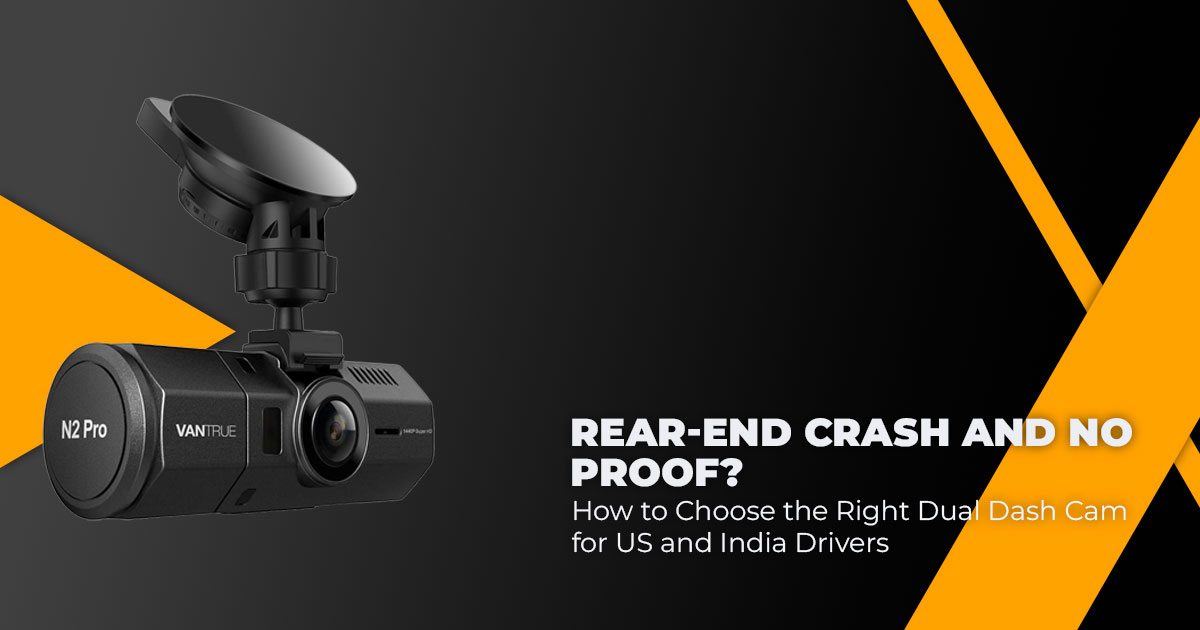
A reliable dual channel dash cam with capacitor power, strong night vision dash cam performance, stable loop recording dash cam support, and dependable parking mode dash cam features gives real protection for daily drivers. Most people don’t need the most expensive model. What matters is clear accident evidence recording, heat durability, and consistent front and rear capture—often available under $250 USD or ₹20,000 INR.
Click here to buy from Official Vantrue Dash Cam Store
1. Introduction: Why Front + Rear Recording Matters More Than Ever
A rear-end collision. A sudden brake dispute. A parking lot dent with no note. These moments happen fast, and they usually turn into arguments. Without proof, it becomes one driver’s word against another.
That is where a dual channel dash cam changes the outcome. A proper front and rear dash cam records both angles at the same time. It captures the full story, not just half of it. When impact happens, the built-in impact detection sensor dash cam system triggers a G sensor lock dash cam function that saves the clip automatically. The file is protected from overwrite. That small detail makes a major difference during insurance claims.
Many drivers in India deal with tight traffic, unpredictable lane changes, and crowded parking areas. In the United States, long highway drives and wide parking lots bring a different set of risks. But the need is the same: clear, usable road incident footage dash cam evidence.
This guide explains what actually matters when choosing a 4K dash cam front and rear, how a capacitor dash cam survives extreme heat better than battery models, and why strong night vision dash cam performance affects license plate clarity at night.
As technology experts with over 20 years of experience in hardware and application research and development, we deeply analyze each product based on real-world performance, durability, and value for money. Our goal is to help drivers find the best product in every category—budget, performance, reliability, and long-term usage. For daily commuters, highway drivers, families, ride-share operators, and weekend travelers across the US and India, our recommendations are based on extensive research, component analysis, real-world usability, and industry expertise.
Most reviews list resolution numbers. Few explain what happens in actual road conditions. This guide focuses on real protection, not just technical claims.
If you’re comparing options right away, you can explore current Vantrue dual channel dash cam models on the Official US Store or check availability on the Official India Store to see which front and rear dash cam fits your budget and driving style.
- View Vantrue Dash Cams on the Official US Store
- Explore Vantrue Dash Cams on the Official India Store
- View Vantrue Valentine’s Deals (US Readers)
2. Technical Specifications at a Glance
Most modern dual channel dash cams include the following:
- Front resolution from 1080p up to 4K dash cam front and rear
- Rear resolution typically 1080p or 2K
- Advanced night vision dash cam sensors for low-light clarity
- Super capacitors instead of batteries for better heat resistance
- Multiple parking mode dash cam options: impact detection, motion detection, or time- lapse
- Built-in WiFi dash cam connectivity for fast phone access
- Reliable loop recording dash cam system with automatic emergency lock
- Support for high-endurance memory cards up to 512GB
These specifications are not just numbers. They determine whether your accident evidence recording clearly shows a number plate in rain or glare. They decide whether your footage survives months of high cabin temperatures. They influence how long your continuous video capture dash cam records before overwriting older files.
3. Why This Guide Matters
Drivers do not search for megapixels. They search for protection.
Questions often sound like this:
- Will this camera clearly record a plate at night?
- Will it survive the heat inside a parked car?
- Does it save footage after impact?
- Is dash cam footage valid for insurance?
A weak rear collision recording dash cam defeats the purpose of buying one. Many models reduce rear quality to cut costs. That makes footage less useful when rear-end accidents happen.
We focus on real-world performance across Indian city roads and US highways. The goal is to help readers choose the best dual channel dash cam that fits their budget—whether that means the best dash cam under $200 or a solid dash cam under ₹15000—without compromising essential protection.
4. What You’ll Learn
Choosing the right dual channel dash cam should not feel confusing. The goal is simple: clear proof when something goes wrong. In this section, we break down what actually matters for everyday drivers—whether that means better rear collision recording dash cam clarity, dependable parking mode dash cam protection, or stable continuous video capture dash cam performance for long highway drives.
Instead of technical overload, we focus on practical decisions that help you choose a front and rear dash cam that fits your driving style, budget, and long-term needs.
4.1 Why Front-Only Cameras Fall Short
A single-lens model misses half the story. Rear-end impacts and brake disputes often require full-angle coverage. A proper front and rear dash cam closes that gap.
4.2 Must-Have Features for Clear Rear Recording
Resolution alone does not guarantee clarity. Frame rate stability, glare handling, and wide dynamic range dash cam performance matter more in real traffic.
4.3 Choosing Based on Driving Style
City commuters benefit from strong parking mode dash cam protection. Highway drivers need a stable, long-duration recording. Ride-share operators require dependable, continuous video capture dash cam support.
4.4 Installation Without Confusion
Understanding hardwire kit installation basics ensures the parking mode works correctly. Poor installation often leads to feature failure.
4.5 Long-Term Reliability Tips
Formatting memory cards regularly, checking lens alignment, and using high-endurance storage help prevent corrupted files and lost footage.
5. The Core Advantage: Clear Evidence Without Arguments
A proper evidence camera for a car removes uncertainty. When an incident occurs, the saved clip provides context, timing, and visual proof. That clarity shortens disputes and strengthens insurance claims.
The value of a dual channel dash cam is not measured by resolution alone. It is measured by whether it captures usable footage during stressful moments. Strong file overwrite protection, dash cam logic, stable loop recording dash cam systems, and reliable heat resistance determine long-term trust.
Drivers invest in protection because uncertainty is expensive. Choosing the right front and rear dash cam ensures that when something happens, the story is already recorded.
6. Dual Channel Dash Cam Protection: The Real Road Risks in the US and India
Every driver faces risk, but the type of risk changes by environment. City traffic in India brings tight lanes and sudden braking. US highways bring high speeds and multi-lane merges. A dual channel dash cam protects against both.
- Hit-and-runs in traffic
In heavy congestion, side scrapes and rear taps happen fast. Many drivers leave before you step out. A front and rear dash cam often captures the rear number plate that a front-only camera misses. That detail decides insurance outcomes.
- Insurance disputes over fault
When two drivers disagree about who braked first, timing matters. A synced continuous video capture dash cam records distance, speed, flow, and lane position from both angles. That context strengthens accident evidence recording.
- False driving claims
Drivers are sometimes accused of sudden lane changes or reversing into another vehicle. Recording both the front and back of the car footage removes doubt. Clear timestamps and synced angles provide structured proof.
- Parking lot damage
Door dents, shopping cart impacts, and low-speed hits happen when the owner is not present. A reliable parking mode dash cam with motion or impact detection records these moments without draining the battery.
- Night driving visibility issues
Headlight glare and dark roads reduce clarity. Cameras with glare reduction recording and wide dynamic range dash cam support keep plates readable under street lighting and uneven exposure.
A single camera cannot cover these angles. Most real disputes involve rear-end or parked incidents. That is why a proper dual channel dash cam setup matters.
7. What Is a Dual Channel Dash Cam? Front and Rear Recording Explained
A dual channel dash cam runs two cameras at the same time. One records forward through the windshield. The other mounts on the rear glass and records traffic behind.
The system uses loop recording dash cam technology. When storage fills up, it overwrites the oldest non-protected clips. During sudden movement, a built-in G sensor lock dash cam or impact detection sensor dash cam locks the file automatically.
Both cameras stay synced with timestamps. That means front and rear clips align perfectly. In multi-car accidents or chain collisions, that synced footage becomes critical.
For drivers searching “how does a dual dash cam work” or “difference between front and rear dash cam,” the answer is simple: it records the full story from two angles at once.
8. How a Front and Rear Dash Cam Solves Real Insurance and Safety Problems
Specs matter only if they solve real problems. Here is how a properly built front and rear dash cam delivers value.
- Clear footage in changing light
- Driving from bright sunlight into tunnels can wash out weak Cameras with wide dynamic range dash cam support adjust exposure and maintain plate clarity. That improves real-world road incident footage dash cam usability.
- Footage insurers accept
- Insurance companies need unedited clips with visible timestamps and clear plate A stable, continuous video capture dash cam produces structured files that are easy to export without quality loss.
- Quick access at the scene
- A WiFi dash cam connects directly to a smartphone. Clips can be reviewed or downloaded That helps when police or insurers request proof on the spot.
- Built for heat and cold
- A capacitor dash cam handles extreme heat common in Indian summers and freezing US winters. Unlike battery-powered units, capacitors resist swelling and failure during parked conditions.
These benefits combine into real protection, not just feature claims.
9. Best Dual Channel Dash Cam Buying Guide: 7 Things to Check Before You Buy
Before choosing the best front and rear dash cam, focus on what affects evidence quality and long-term reliability.
9.1 4K Dash Cam Front and Rear Video Quality That Captures Plates
Resolution affects clarity at distance. 1080p works for close traffic. A 4K dash cam front and rear setup captures plates farther away, especially on highways. Balance both front and rear specs for stronger accident evidence recording.
9.2 Night Vision Dash Cam Performance That Reduces Glare
Good sensors reduce headlight flare and brighten dark roads. Test samples should show readable plates under normal street lighting. Many entry-level night vision dash cam options struggle here.
9.3 Rear Collision Recording Dash Cam Quality Matters
Rear-end crashes are common worldwide. Avoid models that reduce rear resolution to cut cost. Clear rear collision recording dash cam footage protects against brake-check disputes and tailgating claims.
9.4 Parking Mode Dash Cam With True 24/7 Protection
Choose between impact detection, motion detection, or time-lapse parking mode dash cam recording. Hardwiring unlocks full-time monitoring and buffered recording that captures seconds before impact.
9.5 Capacitor Dash Cam Stability in Extreme Temperatures
A capacitor dash cam survives cabin temperatures above 70°C and cold winter starts. Battery units are more prone to failure in extreme climates.
9.6 Loop Recording Dash Cam With File Overwrite Protection
Smart loop recording dash cam systems protect emergency clips. Reliable file overwrite protection dash cam logic prevents locked files from being erased. Pair with high-endurance memory cards for long-term reliability.
9.7 WiFi Dash Cam Connectivity for Fast Footage Access
A strong WiFi dash cam app reduces friction when downloading clips. Simple interface and fast transfer matter after an accident.
- Key Takeaway: Focus on capacitor build, strong night clarity, and proper parking mode dash cam over chasing the highest megapixel count.
Click here to buy from Official Vantrue Dash Cam Store
10. Best Front and Rear Dash Cam by Driving Style
Different drivers need different strengths from a dual channel dash cam.
10.1 Daily City Commuter – Compact Dual Channel Dash Cam for Urban Traffic
Stop-and-go traffic requires quick event locking and strong heat resistance. Compact setups with effective glare handling perform well in crowded city roads.
10.2 Highway Driver – High Resolution Continuous Video Capture Dash Cam
Long highway stretches benefit from higher front resolution for distant plate clarity. Larger storage supports extended continuous video capture dash cam recording without frequent overwrite.
10.3 Family Car or Ride-Share Driver – Night Vision Dash Cam for Passenger Safety
Consistent night vision dash cam clarity protects passengers and drivers alike. Optional interior recording adds an extra layer of documented safety for ride-share drivers.
10.4 Weekend Traveler – Wide Angle Dash Cam for Multi-Lane Coverage
A wide-angle dash cam captures more lanes and side activity. Durable builds handle long drives across varied climates without overheating.
11. Dual Channel Dash Cam Comparison: Quick Feature Map for Smart Buying
Below is a simplified way to compare the best dual channel dash cam tiers based on real needs.
|
Model Tier |
Front Resolution |
Rear Resolution |
Parking Mode |
Night Vision |
Heat Endurance (Capacitor) | Price Tier (USD / INR
approx.) |
Best Use Case |
| Entry- Level Dual |
2K |
1080p |
Impact + Motion |
Good |
Yes |
$150– 200 /
₹12,000– 16,000 |
City commuters |
|
Mid- Range |
2.7K–4K |
1080p–2K |
Buffered
+ Time- Lapse |
Excellent |
Yes |
$220– 300 /
₹18,000– 25,000 |
Highway, family, ride-share |
|
Premium Dual |
4K HDR |
2K+ |
Advanced Motion + AI
Detection |
Top-tier |
Yes |
$350+ / ₹28,000+ |
Long trips, all conditions |
This structure helps readers quickly identify the best front and rear dash cams based on budget, usage, and required features.
Choosing a dual channel dash cam is not about chasing the highest resolution. It is about securing dependable footage that holds up during insurance review, legal disputes, and unexpected road incidents. Clear video, strong heat resistance, reliable parking mode, and synced front and rear recording define true protection.
12. Dash Cam for Insurance Claim USA and India: How Dual Channel Dash Cam Footage Protects You
Accidents are stressful. What makes them worse is not knowing how to prove what happened. That is where a dual channel dash cam makes a real difference.
Insurance companies in both countries accept dash cam footage for insurance claims in the USA and India when the files are clear, original, and timestamped.
What they look for is simple:
- Unedited video files
- Clear timestamps
- Visible number plates
- Full context before and after impact
A front and rear dash cam removes confusion. When both angles are recorded, the fault becomes easier to determine. Rear-end collisions, sudden braking disputes, and unsafe lane changes are easier to verify with synced footage.
A stable, continuous video capture dash cam ensures nothing important is missing. Proper accident evidence recording shows the full sequence, not just the moment of impact. That context matters.
In some US regions, insurers may offer incentives for installing a dash cam for a car safety monitoring system. While not universal, it reflects growing trust in recorded proof.
Exporting footage correctly is just as important. A WiFi dash cam allows quick transfer to a phone at the scene. Files can also be copied directly from the memory card. Always share original clips to preserve credibility.
- Important: Clear, timestamped dual-angle footage strengthens your position and reduces long claim disputes.
13. Hardwire Kit Installation Dash Cam Guide: Power Options and Parking Mode Setup
Installation affects how your dual channel dash cam performs every day. The power source determines whether advanced features work properly.
13.1 Plug-In Power Setup
Using the cigarette socket is the simplest method. It supports basic recording while driving. However, this setup usually limits full parking mode dash cam functionality once the ignition is off.
This option works for drivers who only want to record during trips.
13.2 Hardwire Kit Installation: Dash Cam to Fuse Box
A proper hardwire kit installation dash cam setup connects the camera directly to the fuse box.
This unlocks:
- Continuous parking mode dash cam protection
- Impact and motion detection while parked
- Buffered recording that captures moments before impact
- Stable power delivery for continuous video capture dash cam systems
Drivers searching for how to install a front and rear dash cam often choose between DIY and professional installation. DIY is possible with the correct fuse tap tools and clear guides.
Professional installers route cables along the headliner and pillars for a clean finish.
A secure hardwired setup also improves long-term reliability, especially in hot climates where loose connections may cause recording gaps.
- Important: If parking protection matters, hardwiring is the correct
14. Dual Channel Dash Cam Maintenance: Keep Loop Recording and Emergency Video Lock Working
A dual channel dash cam is reliable when maintained properly. Basic checks prevent recording failures when you need proof most.
14.1 Format Memory Cards Regularly
Formatting the memory card inside the camera every one to two months prevents file corruption. This protects the loop recording dash cam system and maintains proper file overwrite protection dash cam function.
14.2 Clean Lenses for Clear Footage
Dust or fingerprints reduce clarity. Gently clean lenses with a microfiber cloth to maintain sharp road incident footage dash cam quality and reliable accident evidence recording.
14.3 Check Firmware Updates
Firmware updates may improve stability, compatibility, or WiFi dash cam performance. Keeping software updated supports consistent operation.
14.4 Test Emergency Video Lock Function
Lightly tap the camera mount to trigger the emergency video lock dash cam feature. Confirm that the clip locks correctly. This ensures the impact detection sensor dash cam system responds when required.
- Important: Routine maintenance ensures your front and rear dash cam continues to deliver dependable footage year after year.
Reliable insurance documentation, proper installation, and consistent maintenance turn a dual channel dash cam into a long-term protection tool. Clear video, stable power, and protected files define true road security.
Click here to buy from Official Vantrue Dash Cam Store
15. Dual Channel Dash Cam FAQs: Insurance, Parking Mode, 4K vs 1080p, and Battery Concerns
Before buying a dual channel dash cam, most drivers want straight answers. They search things like “is dash cam footage valid for insurance,” “does dash cam record when car is off,” or “difference between 1080p and 4K dash cam.” Below are clear, practical responses based on real-world use in the US and India.
Q. How does a dual dash cam work?
- A dual channel dash cam runs two cameras at the same time—one recording the road ahead and one recording behind the vehicle. Both videos stay synced with timestamps. This creates a complete front and rear dash cam context, which is important for accident disputes and insurance claims.
Q. Why do I need a front and rear dash cam?
- Most road disputes involve rear impacts, tailgating, or parking damage. A single front camera misses half the event. A front and rear dash cam captures the full sequence, making accident evidence recording stronger and easier to defend.
Q. Is dash cam footage valid for insurance in the USA and India?
- Yes. Insurers in both countries accept dash cam footage for insurance claims when the footage is original, timestamped, and unedited. A dual channel dash cam strengthens credibility because both angles reduce doubt.
Q. How does parking mode work in a dash cam?
- A parking mode dash cam activates when the car is turned off, usually through a hardwire kit installation dash cam setup. It switches to low-power monitoring and saves clips when it detects impact, motion, or uses time-lapse recording. This protects the vehicle when parked.
Q. What is the difference between 1080p and 4K dash cam recording?
- A 4K dash cam front and rear captures finer detail, including distant number plates at highway speeds. A 1080p setup works for basic coverage. Many drivers find that 2K or 4K provides better clarity for reliable road incident footage dash cam use without sacrificing too much storage.
Q. Capacitor vs battery dash cam: which is better?
- A capacitor dash cam handles extreme heat and cold more reliably than battery-powered models. Capacitors resist swelling and failure, which is important for cars parked in hot Indian summers or freezing US winters.
Q. How long does dash cam footage last before it loops?
- With a 256GB high-endurance card, a loop recording dash cam can store roughly 10 to 20 hours of high-quality video before overwriting older files. Locked clips from the G sensor lock dash cam feature remain protected and do not get erased.
Q. Does a dash cam record when the car is off?
- Yes, if it supports parking mode dash cam features and is properly hardwired. It records only when motion or impact is detected, using minimal power.
Q. Does a dash cam drain the car battery?
- A properly installed hardwire kit installation dash cam setup includes voltage cut-off protection. This prevents the camera from draining the battery below safe levels.
16. Final Buying Mindset: Protect Without Overthinking
A good dual channel dash cam is not about owning another gadget. It is about removing doubt when something goes wrong. Clear front and rear dash cam footage protects you during hit-and-run incidents, helps prevent insurance fraud with dash cam evidence, and shields you from false claims.
You do not need the most expensive setup. You need reliable recording, strong night vision dash cam clarity, stable parking mode dash cam coverage, and a build that lasts in real driving conditions.
If you are ready for dependable protection, compare the current 4K front and rear dash cam with parking mode options and check verified listings here:
Search Dual channel Dash Cams on Amazon.
Want to explore directly from the source?
- View Vantrue Dash Cams on the Official US Store
- Explore Vantrue Dash Cams on the Official India Store
- View Vantrue Valentine’s Deals (US Readers)
Already using a dual channel dash cam? Share your experience. Have questions about installation or choosing the right model for city trafffc, highways, or family driving? We are here to help.
Drive with clarity. Drive with proof.
***Disclaimer***
This blog post reflects our own research, testing, and personal opinions. It should not be taken as the official position of any brand, manufacturer, or company mentioned here. While we aim to keep information accurate and up to date, product details, pricing, and availability can change. We recommend double-checking important details before making a purchase.
Some links in this article may be affiliate links. If you choose to buy through these links, we may earn a small commission at no extra cost to you. This helps support our work and allows us to keep publishing in-depth, unbiased reviews. Our recommendations are never influenced by affiliate partnerships.
Comments shared by readers reflect their own views and not ours. We are not responsible for outcomes resulting from the use of information on this site. Please seek professional advice where appropriate.
All product names, logos, and brands mentioned are the property of their respective owners. These names are used for identification and informational purposes only and do not imply endorsement.