
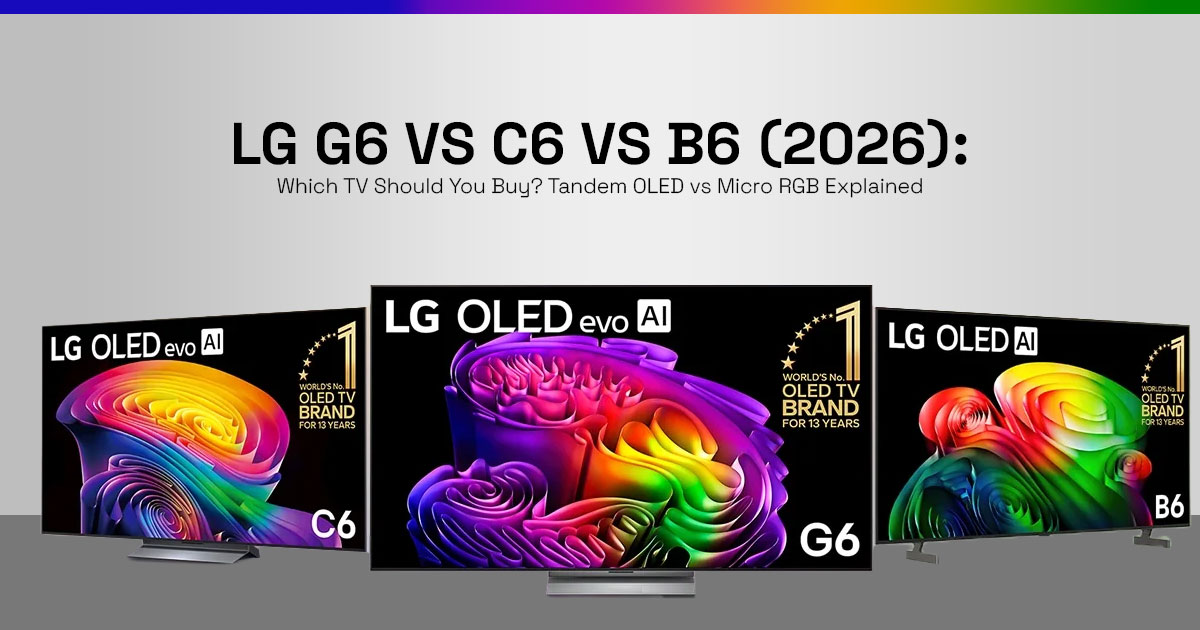
1. Introduction: The 2026 Television Revolution
Walk into any electronics store today, and the TV section feels overwhelming. Every screen looks sharp, every brand claims “next-level brightness,” and every box throws around terms like Tandem OLED, Micro RGB, and AI TV. You just want a great TV—but suddenly you’re comparing technologies that sound like they belong in a lab, not your living room.
And that’s the real problem: most people don’t lack options—they lack clarity.
In 2026, TVs have moved far beyond the old LED vs OLED debate. Now you’re choosing between dual-layer OLED panels, next-gen Micro RGB displays, and AI-powered smart platforms with built-in assistants like Microsoft Copilot and Google Gemini. LG’s latest lineup—OLED evo G6, C6, B6, and the experimental Micro RGB evo—shows just how fast things are moving.
But here’s the catch: more innovation doesn’t always mean better value for you.
- Is the Tandem OLED in the G6 actually worth paying extra?
- Does Micro RGB technology fix OLED’s long-standing brightness limits?
- And do these AI features genuinely improve your day-to-day viewing—or just add noise?
That’s exactly what this guide answers. No fluff, no spec-sheet copying—just clear, practical insights you can use before spending your money.
1.1 Product/Category Overview
This guide focuses on LG’s 2026 TV lineup, one of the most talked-about releases in the premium TV market right now.
It includes:
- OLED evo G6 – flagship model with Tandem OLED panel
- OLED evo C6 – balanced performance and price
- OLED B6 – entry-level OLED option
- LG’s experimental Micro RGB technology – LG’s bold move beyond OLED
We’ll break down how these technologies actually perform in real-world use, not just in demo rooms.
1.2 Why User Reviews Matter More Than Ever
Spec sheets don’t tell you everything.
A TV might look incredible under showroom lights, but what happens after a month of use? Or during long gaming sessions? Or when watching content in a bright room?
That’s where real users come in.
We’ve studied discussions from platforms like AVSForum and Reddit, where people share honest experiences—good and bad. We’ve also cross-checked those insights with CES 2026 benchmarks and technical data.
Because the truth is simple:
–− Real-world feedback shows what marketing doesn’t.
It reveals:
- How brightness holds up in daily use
- Whether AI features are helpful or annoying
- If a TV is built to last or just looks good on day one
And that’s what you need before making a decision.
1.3 Our Approach (Why You Can Trust This Guide)
As technology experts with over 20 years of experience in hardware and application research and development, we look beyond surface-level specs.
We break things down based on:
- Real-world performance
- Durability over time
- Component-level analysis
- Value for money
Our goal is simple: help you find the best TV for your needs—whether that’s budget, performance, reliability, or long-term use.
Every recommendation here comes from extensive research, hands-on insights, and industry experience—not marketing claims.
1.4 Who This Guide Is For
This isn’t just for tech enthusiasts. It’s built for anyone trying to make a smart buying decision:
- Movie lovers who care about picture accuracy, contrast, and cinematic quality
- Gamers looking for high refresh rates, low latency, and HDMI 2.2 readiness
- Families who want a reliable, easy-to-use TV that works for everything
- Value-focused buyers trying to avoid overspending on features they won’t use
- Tech-aware users curious about AI TVs, smart features, and privacy trade-offs
If you’re trying to balance price vs performance, this will help.
1.5 What You Will Learn From This Blog
Here’s what we’ll break down in simple terms:
- The “Tandem OLED” Advantage
Why dual-layer OLED panels matter—and whether you’ll actually notice the difference - Micro RGB vs OLED
A clear comparison between two of the most advanced display technologies in 2026 - LG 2026 Model Breakdown
What separates the G6, C6, B6, and W6, and which one fits your use case - Gaming Performance Explained
How 165Hz refresh rates, VRR, and rumored HDMI 2.2 affect real gameplay - The Reality of AI TVs
What webOS 26, Copilot, and Gemini integration actually do—and what to watch out for - Smart Buying Advice
Clear “best for X” recommendations, plus an easy comparison table to save you time
1.6 A New Way to Look at TVs in 2026
Here’s the part most reviews miss:
–− The best TV isn’t the most advanced one.
–− It’s the one that fits how you actually watch.
Some people need peak brightness for bright rooms. Others care more about deep blacks for movies.
Gamers want speed and responsiveness.
And many just want something that works well for everything. And that’s why this guide matters.
Quick Take
- TV buying in 2026 is more complex than ever—new tech like Tandem OLED and Micro RGB changes the game
- LG’s G6, C6, and B6 offer very different value depending on your needs
- Tandem OLED improves brightness and lifespan, but it’s not always worth the premium
- Micro RGB could solve OLED brightness limits, but it’s still early-stage
- AI features sound exciting, but their real value depends on how you use your TV
- Real-world performance matters more than specs—and that’s what this guide focuses on
If you’re planning to upgrade your TV this year, don’t rush. A small detail—like panel type or refresh rate—can make a big difference over time.
And once you understand how these pieces fit together, choosing the right TV becomes much easier.
2. Understanding the Technology (The “Evo” Evolution)
New display tech sounds complex, but the differences are easier than they seem. This section explains what actually changes your viewing experience.
2.1 Tandem OLED: The Game Changer
The biggest upgrade in LG’s 2026 TVs is the Tandem OLED panel, featured in the OLED evo G6
and C6.
This tech isn’t brand new—it was first used in high-end automotive displays and premium tablets. But now it’s finally here in TVs.
So what’s different?
Instead of a single light-emitting layer, Tandem OLED stacks two layers on top of each other. That simple change directly improves brightness, lifespan, and color stability.
The Benefits:
- Double the Brightness
By splitting the workload between two layers, the G6 can hit peak brightness close to 3,000 nits (in small highlights). That’s a huge jump for OLED, which used to struggle in bright scenes. - Longer Lifespan (Less Burn-In Risk)
Each layer works less to produce the same light. That means less stress on the panel, reducing the chances of burn-in and helping the TV last longer. - Better Color at High Brightness
Older WOLED panels tend to lose color punch when brightness goes up.
With Tandem OLED, colors stay rich and saturated, even in bright HDR scenes.
–− In simple terms: brighter, more durable, and better-looking OLED.
2.2 LG’s experimental Micro RGB technology: The OLED Killer?
For the first time, LG is pushing a serious alternative to OLED—Micro RGB technology.
Instead of using a white backlight, this technology uses millions of tiny Red, Green, and Blue LEDs. That changes how brightness and color are produced.
Here’s how it compares to OLED evo (G6/C6):
| Feature | OLED evo (G6/C6) | Micro RGB Technology |
| Light Source | Self-emissive pixels | Microscopic RGB LEDs |
| Peak Brightness | ~3,000 nits | ~5,000+ nits (expected for emerging RGB LED tech) |
| Black Levels | Perfect (infinite contrast) | Near-perfect (advanced local dimming) |
| Color Accuracy | 100% DCI-P3 | Up to 100% BT.2020 / Adobe RGB |
| Best Environment | Dark or dim rooms | Bright or sunlit rooms |
What this means for you:
- Micro RGB technology is much brighter, making it ideal for bright living rooms
- OLED still wins in perfect blacks and contrast, especially for movies
- Color coverage is wider on Micro RGB, but OLED still looks more natural to many eyes
–− Right now, Micro RGB isn’t replacing OLED yet—but it’s getting close.
3. The 2026 Model Breakdown
Specs alone don’t tell you which TV to buy—real use cases do.
3.1 LG OLED evo G6: The Cinephile’s Dream
The LG OLED evo G6 sits at the top of the lineup—and it shows.
It comes with LG’s Gallery Design, so it mounts flat against the wall like a picture frame.
Key highlights:
- Processor: α11 AI Processor 4K Gen3
- Features: Hyper Bright Booster, anti-reflection coating (Reflection Free Premium) What stands out:
The HDR performance is exceptional. Small details—like stars in a night sky or reflections in water—look sharp without the usual glow or “blooming.”
The Verdict:
If you’re building a home theater and want the best picture quality LG offers, this is it.
3.2 LG OLED evo C6: The Smart Money Choice
The C-series has always been LG’s sweet spot, and the C6 continues that trend.
It uses the same Tandem OLED panel as the G6 but skips some premium design extras.
Why people choose it:
- You get almost identical picture quality
- Costs around 30% less than the G6 Gaming performance:
- 4 HDMI 1a ports
- Supports 4K at 165Hz
- Excellent for PC and console gaming Trade-offs:
- Slightly thicker design
- No anti-reflection coating (Reflection Free Premium) (though glare handling is still very good)
The Verdict:
–− A strong value option in the 2026 lineup if you want high-end performance without overspending.
3.3 LG OLED evo B6: Entry-Level OLED Done Right
The B6 is built for people who want the OLED experience at a lower price. It uses:
- A standard OLED panel (no Tandem tech)
- The α9 AI Processor What to expect:
In a dark room, the difference between B6 and C6 isn’t huge—especially with regular streaming content like Netflix.
Where it falls short:
- Struggles in bright rooms
- Max refresh rate is 120Hz (no 165Hz support)
The Verdict:
–− A solid pick if you mostly watch in low-light conditions and don’t need top-tier gaming specs.
3.4 LG Wireless OLED W6: The Wallpaper TV
The W6 is all about design.
At just 9mm thin, it looks like it’s part of the wall. No visible cables.
It connects wirelessly to LG’s Zero Connect Box, which handles all inputs.
What’s new:
- Smaller Zero Connect Box (35% reduction)
- Improved wireless stability
- Supports 4K at 165Hz with no noticeable lag The catch:
- You’re paying for the design and experience, not just performance
The Verdict:
–− This is a luxury TV—focused more on design and clean setup than overall value.
4. The AI Revolution (webOS 26)
AI is now built deep into LG’s webOS 26, powered by Microsoft Copilot and Google Gemini. But does it actually help?
4.1 AI Concierge & Smart Search
Search has changed completely.
Instead of typing exact titles, you can say things like:
–− “Find a movie like Interstellar but under 2 hours.”
And the TV understands the request, then pulls options from across your streaming apps.
What works well:
- Faster content discovery
- Less scrolling, more watching
4.2 The Privacy Debate
Not everyone is comfortable with this level of AI.
One major concern is the non-removable Copilot shortcut, which has sparked debate online.
The concern:
- Potential data tracking
- Always-on AI integration
LG’s response:
- Introduced LG Shield, a built-in security system
- Focus on protecting user data and privacy
–− Bottom line:
The AI features are useful—but you’ll need to decide how much access you’re comfortable with.
5. Gaming in 2026
If you’re a gamer, LG’s 2026 TVs are a big step forward.
Key Upgrades:
- 165Hz Refresh Rate
Current consoles like PS5 and Xbox Series X stop at 120Hz.
But the G6 and C6 are ready for next-gen consoles and high-end PCs. - Future HDMI upgrades (beyond HDMI 1a)
Future-proof connectivity for upcoming hardware - Dolby Atmos FlexConnect
Place wireless speakers anywhere in the room, and the TV uses AI to automatically adjust sound positioning
–− No complicated wiring. The system adapts to your space.
What This Means in Real Use
- Smoother gameplay with higher refresh rates
- Better responsiveness for competitive gaming
- Simpler audio setup without sacrificing quality
If you care about gaming performance, the C6 and G6 are easily among the most future-ready TVs available right now.
6. Final Recommendations & Comparison Table
If you just want a quick answer, this section saves time. Compare models and pick based on your needs.
6.1 Quick Comparison Table
| Model | Panel Type | Refresh Rate | Best For | Price Range (Est.) |
| B6 | Standard OLED | 120Hz | Budget OLED seekers | $1,200 – $2,500 |
| C6 | Tandem OLED | 165Hz | Gamers & families | $1,800 – $3,500 |
| G6 | Tandem OLED (Gallery design) | 165Hz | Home theater enthusiasts | $2,800 – $6,000 |
| W6 | Wireless OLED | 165Hz | Luxury interior design setups | $10,000+ |
| Micro RGB | Micro RGB technology | 165Hz | Bright living rooms | $4,000 – $15,000 |
- The “Best For” Guide
- Best for Movies: LG The Tandem OLED’s contrast and brightness are unbeatable for HDR10+ and Dolby Vision content.
- Best for Gaming: LG The 165Hz support and low input lag make it the most versatile gaming display on the market.
- Best for Bright Rooms: LG Micro RGB technology. OLED may struggle in bright rooms— this is where Micro RGB performs better.
- Best Value: LG B6. If you only watch TV at night and don’t game competitively, save your money and get the B6.
7. Frequently Asked Questions (FAQs)
Quick answers to the most common buying questions. Helps clear last-minute doubts before you decide.
Q. Is Tandem OLED really better than regular OLED in 2026 TVs?
Yes—Tandem OLED panels are a clear upgrade over standard OLED.
They deliver higher brightness (up to ~3,000 nits), better color at high brightness, and longer lifespan with reduced burn-in risk.
–− If you’re comparing LG G6 vs C6 vs B6, this is one of the biggest differences that actually matters in real use.
Q. What is Micro RGB technology, and is it better than OLED?
Micro RGB technology uses millions of RGB LEDs instead of OLED pixels.
- Brighter than OLED (great for bright rooms)
- Near-perfect blacks, but not fully OLED-level
- Wider color range (2020 / Adobe RGB)
–− For bright living rooms, Micro RGB can be better.
–− For movies and dark-room viewing, OLED still wins.
Q.Which LG 2026 TV is best for gaming—G6, C6, or B6?
- Best overall gaming TV: LG OLED evo C6
- Premium gaming + best visuals: LG G6
- Budget option: LG B6 (limited to 120Hz)
Both G6 and C6 support 4K at 165Hz, HDMI 2.1a, and are ready for next-gen consoles and high- end PC gaming.
Q. Are the new AI features (Copilot and Gemini) actually useful on LG TVs?
Yes, but it depends on how you use your TV.
- AI search helps you find content faster (no exact titles needed)
- AI picture tuning improves display settings automatically
But:
- Some users are concerned about privacy and data tracking
- The Copilot shortcut cannot be removed
–− Useful for convenience, but not essential for everyone.
Q. Is the LG C6 worth buying over the G6?
For most people, yes.
The LG C6 offers nearly the same picture quality as the G6 because both use Tandem OLED panels.
You only miss:
- Premium Gallery Design
- Slightly better anti-reflection coating
–− If you want the best value for money, the C6 is the smart choice.
8. Conclusion: Is 2026 the Year to Upgrade?
If you’re still using a TV from before 2023, this is the upgrade cycle that actually makes sense.
The shift to Tandem OLED panels and improved anti-reflection coatings directly fixes the two biggest complaints people have had for years—low brightness and screen glare. And this isn’t just marketing. Real improvements in panel design and processing are driving it.
At the same time, LG has pushed things further with Micro RGB technology, ultra-thin designs like the W6, and smarter software through webOS 26. If your current TV still struggles with brightness or glare, you’ll notice the upgrade immediately. That’s where 2026 TVs stand out.
But here’s the honest take:
- The hardware upgrades (panel + processor) are the real reason to upgrade
- The AI features (Copilot, Gemini) are useful—but not essential for everyone
- The biggest visible difference comes from brightness, contrast, and reflection handling
–− In short: this is a hardware-driven upgrade cycle—not just software hype
So, Which TV Should You Actually Buy?
- Best overall value: LG OLED evo C6
- Best picture quality (no compromises): LG G6
- Budget OLED option: LG B6
- Bright room alternative: Micro RGB evo (if available in your region)
–− For most buyers, the C6 hits the sweet spot—you get Tandem OLED performance without overpaying for design extras.
Availability Reality (Amazon US & India)
Here’s what matters before you click “Buy Now”:
- The LG G6 and C6 (2026 models) are just launching globally, with pre-orders starting in the US and wider retail rollout expected through 2026.
- As of now, Amazon US and India listings are limited or not fully live yet for these exact 2026 models
–− That means: you may not reliably find G6/C6 on Amazon right now
Smart Buying Move (Right Now)
Until full availability stabilizes, the smarter play is to look at proven models:
Recommended Alternatives (Still Excellent in 2026)
-
- Amazon Worldwide: LG OLED evo C3 / C4 series
- Still delivers excellent OLED picture quality
- Strong gaming support (4K 120Hz, HDMI 2.1)
- Often available at heavy discounts on Amazon
- Considered one of the best value OLED TVs even in 2025–2026
- Amazon India: LG G3 / G4 series
- Brighter than older OLEDs
- Premium build and performance
- Good option if you want a near-flagship experience at a lower cost
- Amazon Worldwide: LG OLED evo C3 / C4 series
Key insight:
You’re getting 80–90% of the experience of 2026 TVs at a much lower price.
Final Verdict
- If you want the latest tech and future-proof features → wait or buy G6 / C6
- If you want the best value TV in 2026 today → go for C3 / C4 deals on Amazon
- If your TV is older than 3–4 years → upgrade now, you’ll notice the difference instantly
Bottom Line
2026 is not just another TV update—it’s a meaningful step forward.
But you don’t have to chase the newest model to enjoy it.
–− The smart buyer doesn’t just ask “What’s the best TV?”
–− They ask “What’s the best TV for my money right now?”
And that’s where most people win.
***Disclaimer***
This blog post reflects our own research, testing, and personal opinions. It should not be taken as the official position of any brand, manufacturer, or company mentioned here. While we aim to keep information accurate and up to date, product details, pricing, and availability can change. We recommend double-checking important details before making a purchase.
Some links in this article may be affiliate links. If you choose to buy through these links, we may earn a small commission at no extra cost to you. This helps support our work and allows us to keep publishing in-depth, unbiased reviews. Our recommendations are never influenced by affiliate partnerships.
Comments shared by readers reflect their own views and not ours. We are not responsible for outcomes resulting from the use of information on this site. Please seek professional advice where appropriate.
All product names, logos, and brands mentioned are the property of their respective owners. These names are used for identification and informational purposes only and do not imply endorsement.