
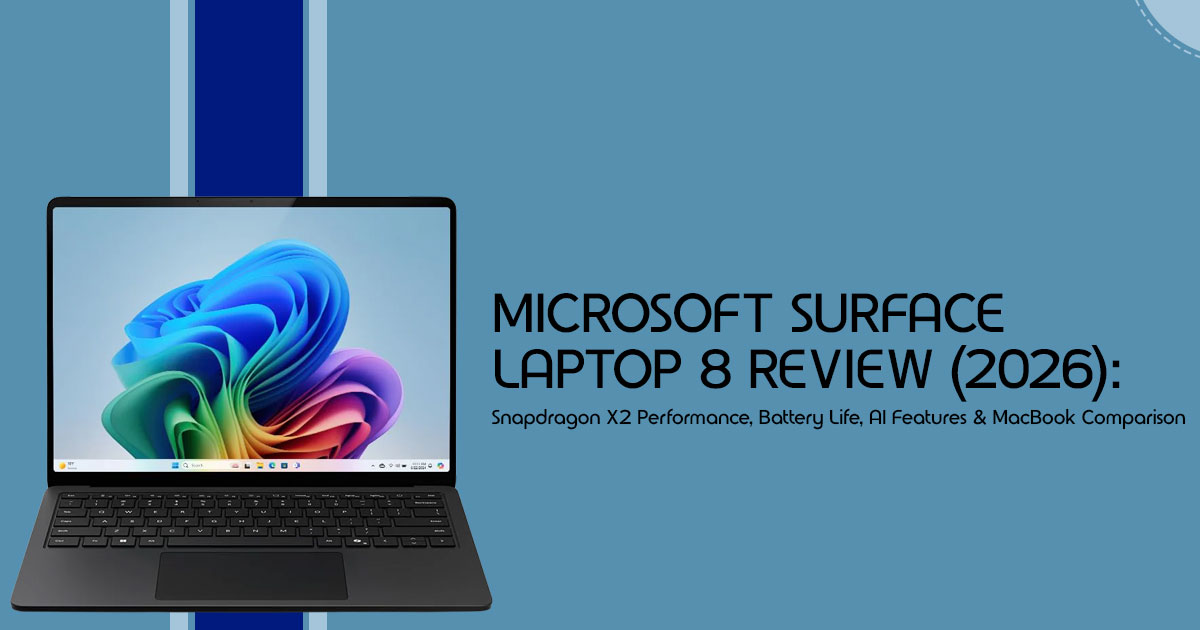
Editorial Note: The Microsoft Surface Laptop 8, Snapdragon X2, specifications, performance figures, and availability information discussed in this article are based on official announcements, launch materials, early reports, and industry analysis available at the time of writing. Final specifications, performance results, pricing, and regional availability may vary as independent reviews and additional information become available.
1. Introduction
Buying a new laptop used to be simple. Today, it’s a much bigger decision. With prices climbing and new technologies arriving faster than ever, most people don’t want another device that looks impressive on paper but falls short in daily use. They want a laptop that is fast, reliable, lasts for years, and genuinely makes work and life easier.
That’s what makes the Microsoft Surface Laptop 8 so interesting.
This isn’t just another yearly upgrade. It’s part of a larger shift that could change how people think about Windows laptops. Powered by the new Snapdragon X2 processor, the Surface Laptop 8 promises something many users have wanted for years: the performance of a premium laptop, the battery life of a tablet, and built-in AI capabilities that actually serve a purpose.
The bigger question isn’t whether the Surface Laptop 8 is powerful. The real question is whether Windows on ARM has finally reached a point where it can compete with traditional Intel laptops, AMD laptops, and even Apple’s popular MacBook Air and MacBook Pro models.
That question matters because most buyers don’t care about processor names or benchmark charts. They care about whether their laptop can last through a full workday, run the apps they need, stay responsive under pressure, and remain useful several years from now. Nobody wants to spend premium money only to discover they bought the wrong machine.
This guide is written for:
- Students looking for a lightweight laptop with excellent battery life.
- Business professionals who need a dependable productivity machine.
- Remote workers who spend their day in Microsoft 365, Teams, and web applications.
- Frequent travelers who want portability without sacrificing performance.
- Content creators seeking a premium Windows experience.
- AI enthusiasts interested in Copilot+ PC features and on-device AI processing.
- Anyone considering a Surface Laptop, MacBook, or premium Windows ultrabook in 2026.
As technology experts with over 20 years of experience in hardware and application research and development, we evaluate products based on what matters most to real users: performance, durability, battery life, software compatibility, repairability, and long-term value for money. Our goal is to help readers find the best product in every category—whether they prioritize budget, performance, reliability, portability, or future-proofing. Every recommendation is based on extensive research, component analysis, real-world usability, and industry expertise.
In this review, we’ll examine where the Microsoft Surface Laptop 8 excels, where it falls short, who should buy it, who should avoid it, and whether it truly represents the future of Windows computing or simply another ambitious step in that direction.
Quick Answer: Should You Buy Surface Laptop 8?
Best For:
- Students who need a lightweight, long-lasting laptop for research, notetaking, and video lectures.
- Business professionals relying on Microsoft Teams, Excel, PowerPoint, and Copilot for productivity.
- Frequent travelers seeking exceptional battery life and a portable design.
- AI-focused users eager to leverage local AI processing and advanced Copilot+ PC features.
Skip If:
- Heavy gamers who demand top-tier graphics performance for demanding titles.
- Users of legacy enterprise software with strict x86 dependencies.
- Those with specialized engineering workloads that require specific hardware acceleration not yet optimized for ARM.
Verdict in 60 Seconds
The Surface Laptop 8 is one of the most significant Windows laptop launches in recent years, offering unprecedented battery life and AI performance thanks to the Snapdragon X2 chip. It’s sleek, powerful for everyday tasks, and a fantastic choice for productivity and on-the-go use. However, it’s not for everyone. If your workflow involves heavy gaming or niche x86-only applications, you might want to hold off. For most users, though, this is a compelling package that truly delivers on the promise of Windows on ARM.
2. What Is the Surface Laptop 8?
At its core, the Surface Laptop 8 is Microsoft’s latest flagship laptop, designed from the ground up to showcase the power of Windows on ARM. It’s not just a hardware refresh; it showcases Microsoft’s strategy for combining ARM processors, AI acceleration, and long battery life in future Windows devices. This machine is built to feel familiar yet perform in ways that might surprise you, especially if you’re used to traditional x86 laptops.
2.1 Key Specifications at a Glance
Here’s a quick overview of what makes the Surface Laptop 8 tick. We’ll dive into each of these in more detail, but this table gives you the essential facts without getting bogged down in jargon.
| Feature | Detail |
| Processor | Qualcomm Snapdragon X2 Plus or Snapdragon X2 Elite |
| Memory (RAM) | 16GB, 24GB, 32GB, or 64GB LPDDR5X |
| Storage | 256GB, 512GB, or 1TB PCIe NVMe SSD |
| Display | 13.8-inch or 15-inch PixelSense touchscreen display |
| Refresh Rate | Up to 120Hz adaptive refresh rate |
| Operating System | Windows 11 with Copilot+ AI features |
| Connectivity | Wi-Fi 7, Bluetooth 5.4, USB-C, Surface Connect |
| Starting Price | US$1,599 |
2.2 Processor Options
The heart of the Surface Laptop 8 is the Snapdragon X2 processor. Based on currently available information, buyers can expect configurations built around the Snapdragon X2 Plus and Snapdragon X2 Elite, with each model targeting different performance and efficiency needs.
2.3 RAM Options
Current reports indicate that configurations may be available with 16GB, 24GB, 32GB, and up to 64GB of RAM, giving users flexibility depending on their workload requirements.
However, if you’re planning to run local AI models or heavy creative software, the 32GB or 64GB options are worth considering.
2.4 Storage
The Surface Laptop 8 features a removable SSD, which is a huge win for repairability and future upgrades. You can choose from various capacities, but knowing you can swap it out later provides peace of mind.
2.5 Display
The display is a standout feature. Whether you choose the 13.8-inch or the 15-inch model, you get a gorgeous PixelSense touchscreen display with a 120Hz refresh rate. The 15-inch model even boasts a sharper 262 PPI resolution. This means smoother scrolling, crisper text, and a generally more pleasant viewing experience, whether you’re reading documents or watching videos.
3. Snapdragon X2 Explained
So, what exactly is the Snapdragon X2, and why should you care? In simple terms, it’s a processor built on ARM architecture, similar to what powers your smartphone. This architecture is inherently more power-efficient than the traditional x86 architecture used by Intel and AMD.
3.1 What Changed From Snapdragon X Elite?
The jump from the first-generation Snapdragon X Elite to the Snapdragon X2 Elite is significant. It’s not just a minor speed bump; it’s a comprehensive overhaul.
- CPU Improvements: Early reports suggest the Snapdragon X2 Elite may offer a higher core count, potentially reaching 18 cores on certain high-performance variants, along with improvements in per-core performance. If these figures hold true, users can expect faster multitasking, quicker application launches, and smoother overall responsiveness.
- GPU Improvements: The integrated Adreno GPU has seen a substantial uplift, offering better graphics performance per watt. While it won’t replace a dedicated gaming laptop, it handles everyday graphics tasks and light gaming much better than its predecessor.
- AI Engine Improvements: The Neural Processing Unit (NPU) is significantly more powerful, enabling faster and more efficient local AI processing for features like Copilot and Studio Effects.
- Battery Efficiency Improvements: Despite the performance gains, the X2 architecture remains incredibly efficient, contributing to the Surface Laptop 8’s impressive battery life claims.
3.2 Why This Matters Daily
For the average user, these improvements mean a laptop that wakes up instantly, runs cool and quiet, and lasts all day without needing a charger. It means you can have dozens of browser tabs open, run Microsoft Office applications seamlessly, and use AI features without draining your battery in a couple of hours.
4. Surface Laptop 8 vs Surface Laptop 7
If you’re wondering whether to upgrade from the previous generation, the differences are stark.
4.1 Side-by-Side Comparison
| Feature | Surface Laptop 8 (Snapdragon X2) | Surface Laptop 7 (Snapdragon X) |
| Performance | Significantly faster CPU and GPU performance with the newer Snapdragon X2 platform. | Strong everyday performance, but noticeably slower than the latest generation. |
| Battery Life | Up to 20 hours under typical usage. | Up to 15 hours under typical usage. |
| AI Features | Enhanced Copilot+ experiences with a more powerful NPU and expanded on-device AI capabilities. | Supports the initial generation of Copilot and basic AI-powered features. |
| Display | 120Hz PixelSense display with higher resolution on the 15-inch model for smoother visuals. | 60Hz PixelSense display with standard resolution. |
| Starting Price | US$1,599 | US$999 |
| Best For | Power users, professionals, developers, and anyone wanting the latest AI-powered Windows experience. | Students, office users, and buyers looking for a more affordable premium Windows laptop. |
4.2 Upgrade Recommendation Matrix
- If you have a Surface Laptop 7: Unless you desperately need the extra battery life or the advanced AI features, you can probably hold off.
- If you have an older Intel Surface Laptop: The upgrade to the Surface Laptop 8 will feel like a massive leap in performance and battery It’s highly recommended.
5. Surface Laptop 8 vs MacBook Air M4
This is the comparison everyone is making. Can Microsoft finally beat Apple at its own game?
5.1 Design
Both laptops are stunning. The MacBook Air M4 retains its iconic wedge shape, while the Surface Laptop 8 offers a sleek, modern design with a slightly more traditional laptop feel. The Surface’s 3:2 aspect ratio is arguably better for productivity.
5.2 Performance
The Snapdragon X2 Elite is designed to go toe-to-toe with the Apple M4. Early benchmark reports suggest the Snapdragon X2 Elite may be competitive with Apple’s M4 in several workloads. While some early results indicate strong multi-core performance, independent testing remains limited, so real-world comparisons should be viewed as preliminary.
5.3 Battery Life
Apple has long been the king of battery life, but the Surface Laptop 8 is a serious challenger. Both laptops offer true all-day battery life, meaning you can leave the charger at home for most workdays.
5.4 AI Features
This is where Microsoft has an edge. The Surface Laptop 8 is a Copilot+ PC, meaning it has deep, system-level AI integration that the MacBook Air currently lacks.
5.5 App Ecosystem
Apple still wins here. The macOS ecosystem is mature and fully optimized for Apple Silicon. While Windows on ARM has improved dramatically, you might still encounter occasional compatibility issues with niche or older software on the Surface Laptop 8.
5.6 Value for Money
The Surface Laptop 8 starts at a higher price point ($1,599) compared to the base MacBook Air M4. However, you often get more RAM and storage in the base Surface configuration.
5.7 Which One Wins for Most Users?
If you’re deeply entrenched in the Apple ecosystem, stick with the MacBook Air. The Surface Laptop 8 may be the better choice for users who prefer Windows, want a touchscreen display, and plan to use Microsoft’s latest AI features.
6. Surface Laptop 8 vs Dell XPS 13 vs HP OmniBook Ultra 14
How does the Surface Laptop 8 stack up against its Windows peers?
| Feature | Surface Laptop 8 | Dell XPS 13 | HP OmniBook Ultra 14 |
| Performance | Excellent performance with Snapdragon X2, delivering strong AI acceleration and outstanding power efficiency. | Fast everyday performance suitable for productivity, office work, and professional applications. | Excellent multitasking performance with powerful hardware for demanding workloads. |
| Battery Life | Excellent—among the longest-lasting Windows ultrabooks. | Good, but generally trails the Surface Laptop 8 and HP OmniBook Ultra 14. | Excellent endurance thanks to efficient hardware and battery optimization. |
| Ports | Minimalist connectivity focused mainly on USB-C. | Limited port selection typical of premium ultrabooks. | More flexible connectivity options depending on the configuration. |
| Display | 13.8-inch 3:2 PixelSense display optimized for productivity and document work. | Premium display with optional OLED panel offering rich colors and deep contrast. | Bright display with strong HDR support and excellent outdoor visibility. |
| Portability | Lightweight and travel-friendly with an ideal balance of screen size and portability. | Extremely compact, slim, and premium-looking chassis. | Portable, although slightly larger than some competing ultrabooks. |
| Best For | Professionals, students, business users, and AI-focused productivity workflows. | Users who value premium craftsmanship, compact size, and OLED visuals. | Users prioritizing display quality, HDR content, and multimedia experiences. |
| Main Strength | Outstanding balance of performance, battery life, AI capabilities, and productivity. | Premium industrial design with excellent OLED display options. | Excellent HDR display, high brightness, and long battery life. |
| Potential Drawback | Limited port variety compared to some competitors. | Battery life generally falls behind the best ARM-based Windows laptops. | Less premium brand recognition than Microsoft’s Surface lineup or Dell’s XPS series. |
Quick Recommendation
| User Type | Best Choice |
| Best Overall Windows Laptop | Microsoft Surface Laptop 8 |
| Best Display & HDR Experience | HP OmniBook Ultra 14 |
| Best Design & OLED Screen | Dell XPS 13 |
| Best for AI Features | Microsoft Surface Laptop 8 |
| Best for Frequent Travelers | Microsoft Surface Laptop 8 |
| Best for Creative Media Consumption | HP OmniBook Ultra 14 |
| Best Premium Design | Dell XPS 13 |
7. Real-World Performance Scenarios
Numbers on a spec sheet are one thing, but how does the Surface Laptop 8 actually perform when you’re trying to get things done? Let’s break down some common workflows.
7.1 Student Workflow
For students, the Surface Laptop 8 offers a strong combination of portability, battery life, and performance. Imagine a full day of classes, lectures, and study sessions without ever needing to hunt for an outlet. Its long battery life means you can power through:
- Research: Browsing countless academic papers and websites.
- Notetaking: Using OneNote or other digital ink apps with a Surface Pen (sold separately).
- Video lectures: Streaming high-resolution content without a hitch.
The Snapdragon X2 handles these tasks with ease, keeping things snappy even with multiple apps open. The lightweight design makes it easy to carry between classes, and the bright display is perfect for reading textbooks.
7.2 Business Workflow
Business professionals will find the Surface Laptop 8 a reliable partner. The integration with Microsoft’s ecosystem is seamless, making it ideal for:
- Teams: Video calls are smooth, and the NPU enhances features like background blur and eye contact correction.
- Excel & PowerPoint: Complex spreadsheets and presentations load quickly and run without lag.
- Copilot: This AI assistant becomes invaluable for drafting emails, summarizing documents, and generating ideas, all powered efficiently by the Snapdragon X2.
Its instant-on capability means you’re always ready to go, and the robust security features are a plus for corporate environments.
7.3 Developer Workflow
This is often where ARM-based machines face scrutiny. However, the Surface Laptop 8 is surprisingly capable for many developers:
- VS Code: Runs natively and is a joy to use.
- GitHub Copilot: The AI engine on the Snapdragon X2 accelerates this coding assistant, making suggestions faster and more relevant.
- WSL (Windows Subsystem for Linux): Provides a powerful Linux environment for development, running efficiently on ARM.
- Docker: While some Docker images might still require x86 emulation, many are now ARM-native, and performance is improving rapidly.
Mini Conclusion: For web and cloud development, the Surface Laptop 8 is a strong contender. For highly specialized, low-level development that relies on specific x86 libraries, you might still encounter hurdles.
7.4 Creator Workflow
For creators, the Surface Laptop 8 offers a compelling mix of performance and portability:
- Photoshop & Lightroom: Adobe apps are increasingly optimized for ARM, offering excellent performance for photo editing.
- Canva: Web-based design tools run flawlessly.
- DaVinci Resolve: While not a dedicated video editing powerhouse, for lighter video projects, the Snapdragon X2 can handle it, especially with the improved GPU.
Quick Verdict: For photographers and graphic designers, the Surface Laptop 8 is a solid choice. Video editors working with complex timelines might still prefer a more powerful x86 or Apple Silicon machine, but for casual editing, it’s surprisingly good.
8. Can Snapdragon X2 Run Your Software?
This is one of the most common questions buyers ask when considering a Windows on ARM device. The good news is that app compatibility has come a long, long way.
8.1 App Compatibility Guide
- Works Perfectly (Native ARM64): Most modern apps, especially those from the Microsoft Store, web browsers like Edge and Chrome, and productivity suites like Microsoft Office, run natively on ARM64. This means they are optimized for the Snapdragon X2 and deliver the best performance and battery life.
- Works Through Emulation (x86-64 Emulation): Many older or less optimized apps run through a built-in emulation layer. Microsoft has significantly improved this, and for most everyday software, you won’t even notice it’s running in emulation. Performance is generally good, though it might be slightly slower and consume a bit more battery than native apps.
- Potential Problems: Very specific, low-level applications, device drivers, or older games that rely on deep x86 hooks might still struggle or not run at all. This is becoming rarer, but it’s still a possibility.
8.2 Check Before Buying
Our advice? If you rely on a critical, niche application, do a quick search to see if it has known Windows on ARM compatibility issues. For 95% of users, the Surface Laptop 8 will run everything they need without major issues.
9. AI Workloads: What 64GB RAM Actually Enables
While 16GB or 32GB of RAM is sufficient for most users, the 64GB RAM option on the Surface Laptop 8 is specifically for those pushing the boundaries of AI workloads.
- Running Local LLMs (Large Language Models): With 64GB of RAM, you can run smaller Large Language Models directly on your device, enabling private, offline AI interactions without relying on cloud services.
- Private AI Assistants: Develop and deploy your own custom AI assistants that operate entirely on your laptop, keeping sensitive data secure.
- Offline Knowledge Bases: Create and query vast offline knowledge bases for instant information retrieval, ideal for researchers or professionals dealing with proprietary
- RAG Workflows (Retrieval Augmented Generation): Power advanced AI applications that combine information retrieval with generative AI, all locally.
- AI Coding Assistants: For developers, 64GB RAM can significantly enhance the performance of local AI coding assistants, providing faster code suggestions and analysis.
Quick Verdict: Unless you’re a serious AI developer or researcher, 64GB RAM is likely overkill. For everyone else, 16GB or 32GB will be more than enough.
10. Battery Life Reality Check
Microsoft makes bold claims about the Surface Laptop 8’s battery life, promising up to 20 hours. The battery life estimates discussed below are based on manufacturer claims, early reports, and comparisons with similar Snapdragon-powered laptops. Actual results will vary depending on workload, display settings, software usage, and power profiles.
10.1 Microsoft’s Claims
Microsoft advertises up to 20 hours of typical device usage. This is usually based on specific, controlled test scenarios, often involving light web browsing or video playback.
10.2 Typical Office Use
Based on available information and performance patterns from comparable Snapdragon-powered Windows laptops, users can reasonably expect battery life within the following ranges under typical usage conditions.
10.3 Video Streaming
Streaming video continuously, especially at high resolutions, will naturally consume more power. Based on current information and comparable Snapdragon-powered systems, users may see approximately 10-12 hours of continuous video playback, depending on brightness levels, network usage, and streaming quality.
10.4 Development Work
Running compilers, IDEs, and virtual environments will be more demanding. Based on comparable Snapdragon-powered laptops, developers may see roughly 8-10 hours of battery life, depending on workload intensity and software usage.
10.5 Creative Work
Intensive photo editing or light video editing will also reduce battery life. Creative workloads such as photo editing and light video editing may reduce battery life to approximately 7-9 hours, depending on project complexity and display settings.
10.6 Travel Day Estimates
For a typical travel day involving mixed use, you can confidently leave your charger at home. The Surface Laptop 8 is a true all-day laptop for most users.
11. Common Buying Mistakes
Don’t fall into these traps when considering the Surface Laptop 8.
11.1 Overspending on RAM
As we discussed, 64GB of RAM is for very specific AI workloads. Most users will be perfectly happy with 16GB or 32GB. Don’t pay for what you don’t need.
11.2 Ignoring App Compatibility
While rare, assuming every x86 application will run flawlessly is a mistake. If you have mission-critical software, verify its Windows on ARM compatibility.
11.3 Assuming MacBook-Like Ecosystem
While the Surface Laptop 8 competes with MacBooks in performance and battery, the software ecosystems are still distinct. Don’t expect a one-to-one experience, especially with niche apps.
11.4 Choosing the Wrong Configuration
Carefully consider your needs. Don’t just buy the cheapest or most expensive model. Match the processor, RAM, and storage to your actual usage patterns.
12. Which Configuration Should You Buy?
Let’s simplify the decision-making process.
12.1 Best Budget Configuration
For students or light users, the Snapdragon X2 Plus with 16GB RAM and 256GB or 512GB SSD is an excellent choice. It offers fantastic battery life and performance for everyday tasks without breaking the bank.
12.2 Best Value Configuration
Most users, including business professionals and casual creators, will find the Snapdragon X2 Elite with 16GB or 24GB RAM and 512GB SSD to be the sweet spot. It balances performance, AI capabilities, and cost effectively.
12.3 Best Professional Configuration
For developers and more demanding business users, the Snapdragon X2 Elite with 32GB RAM and 1TB SSD provides ample power for multitasking and more intensive applications.
12.4 Best AI Workstation Configuration
If you’re an AI researcher or developer planning to run local LLMs and complex AI workloads, the Snapdragon X2 Elite with 64GB RAM and 1TB or 2TB SSD is the way to go. This is a specialized configuration for those who truly need it.
13. Frequently Asked Questions
Let’s tackle some of the most common questions we hear about the Surface Laptop 8 and Snapdragon X2.
Is Snapdragon X2 Faster Than Intel?
A: Yes, early performance reports suggest the Snapdragon X2 Elite may compete closely with, and in some workloads potentially outperform, comparable Intel processors, particularly in efficiency-focused and AI-assisted tasks.
Is Snapdragon X2 Faster Than M4?
A: It’s incredibly close. Early benchmarks suggest the Snapdragon X2 Elite is competitive with, and in some cases, can even surpass the Apple M4 in certain CPU benchmarks. The M4 still has a more mature native app ecosystem, but the X2 is a strong rival.
Can It Run Steam Games?
A: Some, but not all. Many older or less demanding games will run through emulation, but performance can vary. For serious heavy gamers, an x86 gaming laptop is still the better choice. The Surface Laptop 8 is not designed as a primary gaming machine.
Can It Run Adobe Software?
A: Yes, most modern Adobe applications like Photoshop and Lightroom are now optimized for Windows on ARM and run very well. Premiere Pro and other more demanding video editing suites are also improving rapidly.
Does 64GB RAM Matter?
A: Only for very specific, AI-intensive workloads like running local LLMs or complex data analysis. For the vast majority of users, 16GB or 32GB is more than sufficient and offers better value.
Is Surface Laptop 8 Good for Programming?
A: Yes, for many programming tasks, especially web development, cloud development, and using tools like VS Code and WSL, the Surface Laptop 8 is an excellent choice. The Snapdragon X2’s efficiency and the growing Windows on ARM ecosystem make it a strong contender. However, for highly specialized x86-dependent development, you might need to verify compatibility.
Is Windows on ARM Ready Yet?
A: Yes, for most users, Windows on ARM is ready. The Surface Laptop 8 with its Snapdragon X2 processor offers a fantastic experience with excellent app compatibility, battery life, and AI features. The ecosystem has matured significantly, making it a viable and often superior alternative to traditional x86 laptops for everyday use.
Is the Surface Laptop 8 Worth Buying in 2026?
For most students, professionals, remote workers, and productivity-focused users, the Surface Laptop 8 offers an excellent balance of battery life, portability, AI features, and everyday performance. Users who rely on specialized software or heavy gaming workloads should verify compatibility before purchasing.
13.1 Pros and Cons
Pros
- Excellent battery life
- Strong AI performance and Copilot+ features
- Premium build quality
- Improved Windows on ARM compatibility
- Quiet and efficient operation
- High-quality touchscreen display
- Removable SSD for future upgrades
Cons
- Premium pricing
- Some legacy software may still require emulation
- Not designed for serious gaming
- Limited port selection
- Long-term ARM software compatibility continues to evolve
13.2 Quick Buying Advice
Buy Now If:
- You want a premium Windows laptop with excellent battery life.
- You regularly use Microsoft 365, Copilot, or web-based applications.
- You value portability and quiet operation.
Consider Alternatives If:
- Gaming is your main priority.
- You rely on specialized legacy software.
- You need dedicated graphics for professional workloads.
14. Final Verdict
After examining the Microsoft Surface Laptop 8 from every angle, one thing is clear: this device represents a major step forward for Windows on ARM. By combining long battery life, strong performance, quiet operation, and built-in AI capabilities, Microsoft has created one of the most compelling Windows laptops available today.
While it won’t completely replace every Intel or AMD laptop overnight, it delivers an excellent experience for users whose workloads align with Microsoft’s vision for AI-powered computing.
Who Should Buy the Surface Laptop 8?
The Surface Laptop 8 is an excellent choice for:
- Students who need all-day battery life and a lightweight design.
- Business professionals who value portability, reliability, and premium build quality.
- Remote workers who spend most of their day in Microsoft 365, Teams, browsers, and productivity apps.
- AI-focused users interested in Copilot+ PC features and on-device AI processing.
- Anyone looking for a quiet, cool-running laptop with excellent battery efficiency.
Who Should Wait?
You may want to hold off if you:
- Play demanding AAA games regularly.
- Depend on older x86 software that may not run optimally on ARM.
- Require specialized enterprise applications that have not yet been validated for Windows on ARM.
- Are shopping on a strict budget and need the best performance per dollar.
Who Should Choose a MacBook Instead?
A MacBook may be the better choice if you:
- Are already heavily invested in the Apple ecosystem.
- Prefer macOS over Windows.
- Rely on macOS-exclusive creative software or professional applications.
- Need seamless integration with iPhone, iPad, Apple Watch, and other Apple devices.
Who Should Choose an Intel or AMD Laptop Instead?
A traditional x86 laptop remains the safer option if you:
- Need maximum software compatibility.
- Use older business applications, proprietary software, or legacy hardware.
- Require dedicated graphics for gaming, 3D rendering, CAD, or engineering workloads.
- Want the broadest hardware and driver support available today.
Availability
At the time of writing, direct retail listings for the Microsoft Surface Laptop 8 are not available on Amazon US or Amazon India.
The device is currently available through the Official Microsoft Store and Microsoft’s authorized retail partners.
Alternative Recommendations
Best Display Experience: Lenovo Yoga Slim 7x
If display quality is your top priority, the Lenovo Yoga Slim 7x is one of the strongest alternatives. Its OLED display, excellent color accuracy, and premium design make it particularly appealing to content creators, designers, and media enthusiasts.
Amazon Worldwide and Amazon India
Best Ultra-Portable Alternative: Dell XPS 13
For users who prioritize portability, premium aesthetics, and a compact footprint, the Dell XPS 13 remains one of the most refined Windows ultrabooks available.
Amazon Worldwide and Amazon India
The Surface Laptop 8 isn’t simply another annual refresh. It demonstrates how far Windows on ARM has evolved and offers a glimpse into the future of AI-powered personal computing.
For most students, professionals, and everyday users, it delivers one of the best combinations of battery life, portability, performance, and AI functionality currently available in a Windows laptop.
If your software requirements align with the ARM ecosystem, the Surface Laptop 8 is among the most compelling premium laptops of 2026.
Surface Laptop 8 Rating Summary
| Category | Rating |
| Performance | 9/10 |
| Battery Life | 9.5/10 |
| Display | 9/10 |
| Portability | 9/10 |
| AI Features | 9.5/10 |
| Gaming | 6.5/10 |
| Value for Money | 8/10 |
| Overall Score | 9/10 |
Still unsure if the Surface Laptop 8 is right for you? Drop your questions in the comments below, and we’ll be happy to help you make the right choice.
***Disclaimer***
This blog post reflects our research, analysis, and opinions based on available product information, user feedback, and industry knowledge. It should not be taken as the official position of any brand, manufacturer, or company mentioned here. While we aim to keep information accurate and up to date, product details, pricing, and availability can change. We recommend double-checking important details before making a purchase.
Some links in this article may be affiliate links. If you choose to buy through these links, we may earn a small commission at no extra cost to you. This helps support our work and allows us to keep publishing in-depth, unbiased reviews. Our recommendations are never influenced by affiliate partnerships.
Comments shared by readers reflect their own views and not ours. We are not responsible for outcomes resulting from the use of information on this site. Please seek professional advice where appropriate.
All product names, logos, and brands mentioned are the property of their respective owners. These names are used for identification and informational purposes only and do not imply endorsement.