
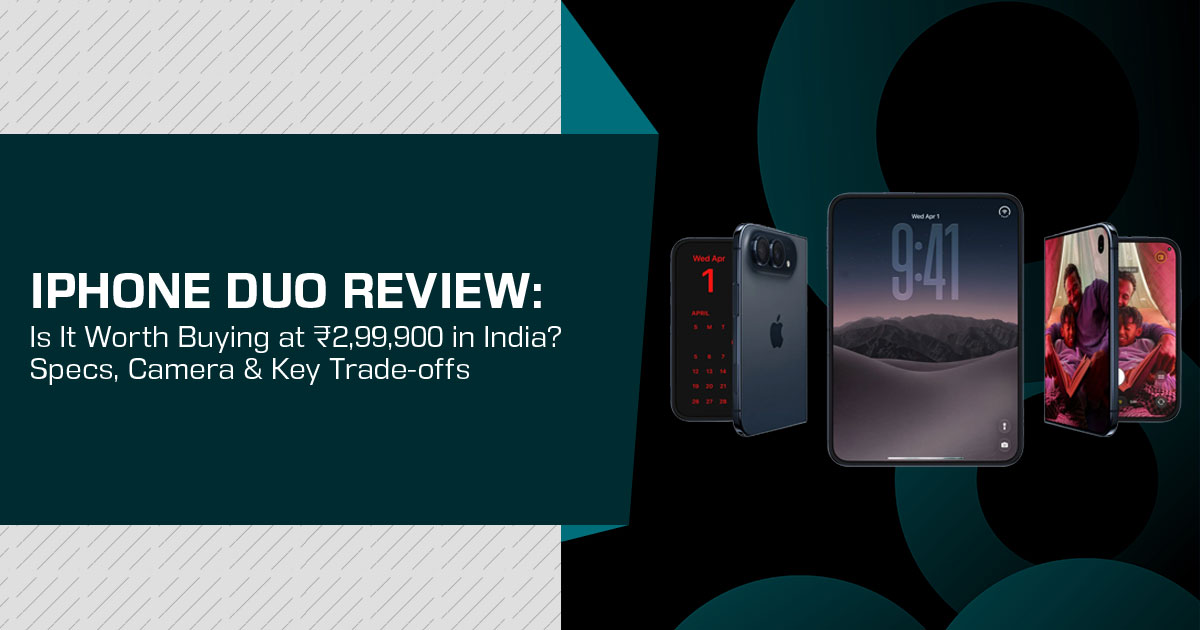
Apple entered the foldable phone market on 9 September 2026 with the iPhone Duo, a book-style foldable that starts at ₹2,99,900 in India. That makes it the most expensive iPhone Apple has ever sold in the country, putting Apple into a category Samsung has largely led since 2019.
But the price is not the most important part of the iPhone Duo. The bigger question is what Apple has chosen to leave out.
The iPhone Duo has no Face ID, no dedicated telephoto camera, no physical SIM tray and no Action button— features that the cheaper iPhone 18 Pro Max includes. In return, Apple gives you a 7.6-inch inner display, the largest display area Apple has put on an iPhone, an uninterrupted inner screen, Apple Pencil support and IP68 dust and water resistance.
That trade-off is the real buying decision. You are paying almost ₹3 lakh for Apple’s first foldable iPhone, while giving up several features found on a conventional iPhone that costs less. If you have saved for this phone, are upgrading from an older iPhone, or simply want Apple’s most ambitious iPhone hardware, those compromises matter.
As technology experts with over 20 years of experience in hardware and application research and development, we deeply analyze each product based on real-world performance, durability, and value for money. Our goal is to help you find the best product in every category — whether you care most about budget, performance, reliability, or long-term use. This analysis is written for Indian iPhone users, Apple fans, professionals, technology enthusiasts, and premium smartphone buyers who are deciding whether the iPhone Duo is worth spending nearly ₹3 lakh on. Our recommendations are based on extensive research, component analysis, real-world usability, and industry expertise.
In this iPhone Duo review and buying guide, we look beyond Apple’s launch presentation and focus on the details that matter once the phone is in your hand. We cover the iPhone Duo specifications, its price in India, all four storage variants, and how it compares with the Samsung Galaxy Z Fold8 and iPhone 18 Pro Max.
We also answer the practical questions Indian buyers are likely to have before placing an order, including eSIM support, SIM compatibility, launch offers, EMI options, storage choices and whether the iPhone Duo offers enough value at its ₹2,99,900 starting price.
When you are spending this much money on a smartphone, the real question is not simply “Is the iPhone Duo impressive?” It is “Is it worth your money?”
iPhone Duo at a Glance
| Specification | iPhone Duo |
|---|---|
| Price in India | From ₹2,99,900 for 256GB to ₹4,49,900 for 2TB |
| Inner Display | 7.6-inch Super Retina XDR OLED, 1878 × 2670 resolution, 430 ppi |
| Outer Display | 5.4-inch Super Retina XDR OLED, 1398 × 2034 resolution, 460 ppi |
| Processor | A20 Pro, 2nm process, 6-core CPU, 7-core GPU, and dual 16-core Neural Engine |
| Rear Cameras | 48MP Fusion Main (f/1.6) + 48MP Fusion Ultra Wide (f/2.2) |
| Front Cameras | 12MP Center Stage camera on the outer display + under-display FaceTime camera on the inner display |
| Biometric Unlock | Touch ID integrated into the side button; no Face ID |
| Battery | Dual-cell battery with up to 24 hours of typical use |
| Fast Charging | Up to 50% charge in approximately 20 minutes using a 60W or higher power adapter |
| Build & Protection | Titanium construction, Ceramic Shield 2 front, and IP68 protection |
| Weight & Thickness | 254g; 11.3mm folded and 5.2mm unfolded |
| SIM | eSIM only worldwide |
| Software | iOS 27.1 with Split View multitasking |
| Pre-Order Date | 16 October 2026 at 5:30 p.m. IST |
| On-Sale Date | 23 October 2026 |
Source: Apple India technical specifications page, retrieved 11 September 2026.
Product Overview: Where the iPhone Duo Sits in Apple’s 2026 Line-Up
Apple announced six products at its “Surprise and Shine” event. The iPhone Duo was the only new product category among them, and its India sale date is 23 October 2026. Alongside it came the iPhone 18 Pro and iPhone 18 Pro Max, the Apple Watch Series 12, the Apple Watch Ultra 4 and the AirPods 5.
Two details about the launch matter to buyers.
First, there is no standard iPhone 18 this year. Apple is splitting its iPhone calendar, and reporting points to the iPhone 18, iPhone 18e and iPhone Air 2 arriving in spring 2027. If a buyer is waiting for a non-Pro iPhone, the Duo and the Pro models are not the phones they are waiting for.
Second, the event was the first major launch led by John Ternus, who became CEO on 1 September. Tim Cook moved to executive chairman. It is context rather than a specification, but it explains why Apple took a risk on a new form factor now.
The Apple foldable iPhone also carries a name nobody predicted. Months of leaks called it the iPhone Ultra or the iPhone Fold. Neither is correct, which is worth knowing when searching for accessories, cases or insurance later.
Key Features Explained: What Actually Matters
The folding display and why the crease is the main question
Open the iPhone Duo and the inner panel measures 7.6 inches diagonally. Apple describes it as the largest display ever used on an iPhone. Its display area is about 50 per cent larger than the iPhone 18 Pro Max, even though the diagonal measurement is only 0.7 inches larger.
The crease is the fair question, because it is the complaint that has followed every foldable so far. Apple uses a nano-texture finish — the same treatment it sells on high-end MacBook Pro and iPad Pro displays — and says the surface is “perceptually flat”. Beneath the panel, optically clear adhesives let the display layers slide against each other during folding, which Apple says limits how much the crease deepens over time.
Hands-on reporting from the launch event is broadly positive but not absolute. MacRumors described the crease as still present but barely noticeable, and better hidden than Samsung’s. What nobody has yet published is long-term data. Foldable creases tend to become more visible with months of use, and the Duo has not been in anyone’s pocket long enough to know.
What it means for the buyer: the crease looks well controlled at launch. It has not been proven to stay that way.
Two screens, and how the software uses both
The 5.4-inch outer display carries 90 per cent of the screen area of an iPhone 18 Pro, according to Apple’s marketing chief Greg Joswiak. In practice it behaves like a compact iPhone — calls, messages, notifications and the camera all work with the device shut.
The inner screen is where the software work shows. iOS 27 on the Duo supports Split View, which runs two apps side by side, and lets a buyer save app pairs. Safari can show two windows at once. The phone also props itself into a tent position on a table for video, and StandBy works in that orientation.
Apple Pencil support is confirmed for both displays, though it arrives later in 2026 rather than at launch. No iPhone has supported a stylus before.
Touch ID returns, and Face ID does not
The iPhone Duo unlocks with a fingerprint sensor built into the side button. Apple has not fitted the TrueDepth array that Face ID needs.
Apple has not said that space constraints are the specific reason Face ID was left out. What we do know is that the Duo uses Touch ID in the side button instead of the TrueDepth system used for Face ID. Inside a folding phone, every component has to fit around the hinge, displays and batteries, so the change has a clear effect on daily use.
What it means for the buyer: Touch ID is familiar and works well when your finger is clean and dry, but it is not an upgrade over Face ID. Buyers who rely on Face ID for banking apps, password autofill or quick authentication should treat this as a real change in daily use, not a footnote.
The camera system and the lens that is missing
The iPhone Duo camera setup is a 48MP Fusion Main at f/1.6 with sensor-shift optical stabilization, plus a 48MP Fusion Ultra Wide at f/2.2 covering a 120-degree field. The main sensor also enables a 12MP 2x optical-quality Telephoto view.
There is no dedicated telephoto lens. The iPhone 18 Pro Max carries a 48MP tetraprism telephoto with 4x optical and 8x optical-quality reach. The Duo provides a 2x optical-quality zoom from its main camera, with a 4x optical-quality zoom range and digital zoom up to 10x, but it does not give you a dedicated long-range lens.
The Duo also uses a fixed aperture. The 18 Pro’s main camera moves between f/1.48, f/1.8, f/2.8 and f/4.0, which gives control over low-light gathering and depth of field that the Duo cannot match in hardware.
Two fold-specific camera features are worth naming. Duo Preview shows the subject a live view on the outer display while the rear cameras are used, so the person being photographed can frame themselves. Dual Capture records from the front and rear cameras at the same time.
What it means for the buyer: for everyday photography and video, the Duo is well equipped, and its main camera can record 4K Dolby Vision at up to 120 fps. For anyone who shoots concerts, sports, wildlife or family members from the back row, the missing telephoto is a genuine downgrade from Apple’s own Pro line at a lower price.
An inner camera that is not a hole in the screen
The front camera on the outer display is a 12MP Center Stage unit at f/2.2. Inside, the FaceTime camera sits beneath the display panel, recording at 1080p through an f/1.8 lens.
An under-display camera removes the cutout that interrupts the inner screen on most foldables. The trade-off is that light has to pass through display layers, which historically has cost image quality. Apple has not published the resolution of the inner camera or sample images from it, so the quality claim cannot be checked yet.
Design and Build Quality
Apple has used a titanium frame and a 3D-printed recycled titanium hinge cover. The front is Ceramic Shield 2 and the back is Ceramic Shield. The rating is IP68, tested to six metres for 30 minutes.
That rating matches the Google Pixel 11 Pro Fold, which is also rated IP68, and is higher than the Samsung Galaxy Z Fold8, which carries IP48. IP48 protects against solid objects larger than 1 mm and water immersion up to 1.5 metres for 30 minutes. The Duo is rated for immersion to 6 metres for 30 minutes.
The hinge itself contains more than 100 components. Apple’s hardware chief Johny Srouji said the company uses AI algorithms during manufacturing to match each hinge to its best-fit housing for alignment. Apple has not published a hinge cycle rating, so there is no official figure for how many folds the mechanism is rated for.
The difficult number is weight.
| Foldable | Weight | Folded Thickness | Unfolded Thickness |
|---|---|---|---|
| iPhone Duo | 254 g | 11.3 mm | 5.2 mm |
| Samsung Galaxy Z Fold8 | 201 g | 9.7 mm | 4.5 mm |
| Samsung Galaxy Z Fold8 Ultra | 215 g | 8.9 mm | 4.1 mm |
| Google Pixel 11 Pro Fold | 239 g | 10.1 mm | 5.0 mm |
Samsung and Google figures are the published specifications for those models. Apple’s iPhone Duo figures are from its India specification page.
The iPhone Duo is heavier and thicker when folded than the three foldables listed above: 53 grams more than the Galaxy Z Fold8 and 15 grams more than the Pixel 11 Pro Fold.
Samsung addressed this directly before the event, telling WIRED that competition from Apple was “absolutely welcome” and that keeping weight down is the single most important factor in getting people to adopt foldables. That makes weight one of the clearest points of comparison for the Duo.
What it means for the buyer: at 254 grams, the Duo is only 5 grams heavier than the iPhone 18 Pro Max, but it is 2.55 mm thicker when folded. Buyers who hold a phone open one-handed to read may notice the difference. Buyers who mostly use the outer screen and keep the device in a jacket pocket may care less.
Display: Specifications and What They Mean
| Specification | Inner Display | Outer Display |
|---|---|---|
| Display Size | 19.26 cm (7.6-inch) | 13.62 cm (5.4-inch) |
| Resolution | 1878 × 2670 | 1398 × 2034 |
| Pixel Density | 430 ppi | 460 ppi |
| Panel Type | Folding OLED with nano-texture | OLED |
| Refresh Rate | ProMotion, up to 120Hz | ProMotion, up to 120Hz |
| Peak Outdoor Brightness | 3,000 nits | 3,000 nits |
| HDR Peak Brightness | 1,600 nits | 1,600 nits |
| Typical Brightness | 1,000 nits | 1,000 nits |
| Minimum Brightness | 1 nit | 1 nit |
Both panels support Always-On, HDR, True Tone, wide P3 colour, ProMotion adaptive refresh and Apple Pencil support coming later in 2026. Both also use a Dynamic Island adapted to the foldable design.
Two points are worth separating. The outer display has the higher pixel density at 460 ppi, so text on the folded phone should look marginally sharper than on the unfolded one. And the brightness figures match the iPhone 18 Pro models, which matters for readability in direct sunlight.
The inner panel’s aspect ratio works out to roughly 1.42:1, close to a small tablet. That is the shape that makes Split View usable rather than cramped.
Performance: A20 Pro, Cooling and the AI Question
The A20 Pro chip is built on a 2 nm process, with a 6-core CPU split into two performance and four efficiency cores, a 7-core GPU with Neural Accelerators, and a dual 16-core Neural Engine — 32 cores of neural processing in total. Apple also added hardware-accelerated ray tracing.
The chip is paired with a custom vapour chamber. Apple’s claim is up to 35 per cent better sustained performance than the iPhone 17 Pro, which is a thermal claim rather than a peak-speed claim, and it matters more in long gaming or video editing sessions than in opening apps.
Apple says the CPU is up to 20 per cent faster than the A19 Pro, the GPU up to 40 per cent faster, and the Neural Engine has twice the compute power for on-device AI models.
One thing Apple has not published is the iPhone Duo RAM figure. Supply-chain reporting before the launch pointed to 12GB, and some reports linked that figure to the memory demands of newer on-device Apple Intelligence features. Until a teardown or diagnostic tool confirms it, 12GB should be treated as reported information rather than an official specification.
What it means for the buyer: the silicon is the same family as the iPhone 18 Pro, so nothing here is a compromise. The vapour chamber is the more relevant detail for a folding phone, because a thin chassis has less room to shed heat.
Battery Life: The Three Numbers Apple Published
Apple rates the iPhone Duo battery three different ways, and quoting only one of them gives a misleading picture.
| Usage Scenario | Apple’s Battery Life Rating |
|---|---|
| Typical use with both displays used roughly equally | Up to 24 hours |
| Video playback using the outer display | Up to 44 hours |
| Video playback using the inner display | Up to 31 hours |
| Streamed video using the outer display | Up to 37 hours |
| Streamed video using the inner display | Up to 26 hours |
The architecture is unusual. Rather than one cell wrapped around the display, Apple fitted a battery in each half of the device and uses software to manage them as a single power source.
Charging reaches 50 per cent in about 20 minutes with a 60W-capable adapter or higher, sold separately. With MagSafe or Qi2, Apple says 50 per cent takes about 30 minutes; the technical specification calls for a 35W or higher adapter with MagSafe. Wireless charging is supported at up to 25W.
The box contains the phone and a 1 m USB-C cable. There is no charger.
What it means for the buyer: the 44-hour figure only applies to someone who keeps the phone shut. Open the 7.6-inch screen and the rating drops by 13 hours. The 24-hour typical-use figure is the number that reflects mixed daily use, and it is the one to plan around.
Connectivity: eSIM-Only and What That Means in India
The iPhone Duo is eSIM-only worldwide. Apple’s specification page states it is not compatible with physical SIM cards. It runs two active eSIMs and stores eight or more.
Apple lists Airtel, Jio and Vi as supporting carriers for the device in India. The practical differences are narrower than they sound but not zero:
- Moving from an old phone means transferring an eSIM through the carrier instead of sliding a card across.
- Travellers to countries with slow eSIM activation, or who buy local physical SIMs on arrival, lose the quick option.
- A dead or replaced phone cannot be fixed by moving a SIM into a spare handset.
Apple says the eSIM-only design saves internal space, which can be used to maximise battery capacity. The trade-off is convenience: you cannot move a physical SIM directly into another phone if the Duo is unavailable.
The contrast with the rest of Apple’s 2026 line-up is sharp. The Indian iPhone 18 Pro and iPhone 18 Pro Max keep a physical nano-SIM tray alongside eSIM. Apple’s India specification page lists them as “Dual SIM (nano-SIM and eSIM)”. Only the Duo is tray-less.
Wireless connectivity uses Apple’s C2 cellular modem. Apple says it can deliver uploads up to 50 per cent faster than C1X in selected markets while using less battery, and its N1 chip handles Wi-Fi 7, Bluetooth 6 and Thread. The phone also includes a second-generation Ultra Wideband chip, and the USB-C port supports USB 3 speeds up to 10 Gbps with DisplayPort output.
Software: iOS 27 Rebuilt Around Two Screens
The iPhone Duo ships with iOS 27.1. Apple has redesigned the software around the two-screen format, rather than simply stretching the regular iPhone interface.
The interface has been repositioned rather than stretched. Controls move depending on whether the phone is folded, half-open or flat, which is the detail that decides whether a foldable feels designed or improvised.
On the AI side, Siri AI runs in beta and can use personal context from messages, mail and photos to take actions inside supported apps. Apple Intelligence also uses on-device processing and Private Cloud Compute for supported tasks. The important point for Duo buyers is that the large inner display gives these tools more room to work alongside other content.
There is also Apple Reference Image on the iPhone 18 Pro models, which signs photo data at the pixel level at the moment of capture and stores an unalterable version alongside the editable photo. It is listed on the 18 Pro specification page and is not listed for the Duo.
iPhone Duo Pros and Cons
| Pros | Cons |
|---|---|
| Largest iPhone display to date at 7.6 inches. | At 254 g, it is heavier than current rival foldable phones. |
| The display crease was reported as barely visible in launch hands-on impressions. | No Face ID; biometric authentication relies on Touch ID. |
| IP68 protection, compared with IP48 on the Galaxy Z Fold8. | No dedicated telephoto camera; limited to 2× optical-quality Telephoto. |
| An under-display inner camera keeps the folding screen free from a visible camera cutout. | Fixed f/1.6 aperture with no ProRAW or ProRes support. |
| Powered by the same A20 Pro chip used in the iPhone 18 Pro. | eSIM only, with no physical SIM tray. |
| Apple Pencil support is planned for both the inner and outer displays. | Apple Pencil support is not available at launch. |
| Rated for 24 hours of typical use and up to 44 hours of video playback using the outer display. | AppleCare+ costs ₹51,900. |
| Premium titanium construction combined with Ceramic Shield 2. | No charging adapter is included in the box. |
| Goes on sale on 23 October, roughly five weeks after the iPhone 18 Pro. | Long-term hinge reliability and display-crease durability have yet to be established. |
iPhone Duo vs Samsung Galaxy Z Fold8
Samsung has been shipping book-style foldables for seven years, and the comparison is not one-sided.
| Specification | iPhone Duo | Galaxy Z Fold8 |
|---|---|---|
| Weight | 254 g | 201 g |
| Folded Thickness | 11.3 mm | 9.7 mm |
| Unfolded Thickness | 5.2 mm | 4.5 mm |
| Inner Display | 7.6-inch OLED, 1878 × 2670, 430 ppi | 7.6-inch LTPO AMOLED, 1848 × 2448, 403 ppi |
| Outer Display | 5.4-inch OLED | 5.5-inch LTPO AMOLED |
| Processor | A20 Pro, 2 nm | Snapdragon 8 Elite Gen 5 for Galaxy, 3 nm |
| Rear Cameras | 48MP + 48MP, no dedicated telephoto | 50MP + 50MP, no dedicated telephoto |
| Inner Camera | Under-display camera | 10MP hole-punch camera |
| Water & Dust Resistance | IP68 | IP48 |
| Frame Material | Grade 5 titanium | Armour Aluminium |
| Stylus Support | Apple Pencil, expected later in 2026 | None |
| Battery | Apple does not publish the battery capacity | 4,800 mAh |
| Wired Charging | 60W-class; approximately 50% charge in 20 minutes | 45W |
| Wireless Charging | 25W MagSafe / Qi2 | 20W |
| Software Support | Minimum 5 years of security updates | 7 years of OS and security updates |
| Multitasking | Up to two apps or two windows simultaneously | Up to three apps plus a floating window, with Samsung DeX support |
| Starting Price | $1,999 / ₹2,99,900 | $1,899.99 |
Samsung wins on weight, thickness, multitasking depth and the length of its update promise. Apple wins on ingress protection, the uninterrupted inner screen, Apple Pencil support and the titanium frame.
Neither phone has a telephoto lens, which is worth noting given how many Android foldables at lower prices do include one.
iPhone Duo vs iPhone 18 Pro Max: The ₹1,20,000 Question
For an Indian buyer already spending above ₹1.5 lakh, the more relevant comparison is inside Apple’s own line-up. The gap between the two is exactly ₹1,20,000 at every storage tier.
| Feature | iPhone 18 Pro Max | iPhone Duo |
|---|---|---|
| Price (256GB) | ₹1,79,900 | ₹2,99,900 |
| Display | 6.9-inch, 2868 × 1320, 460 ppi | 7.6-inch inner display + 5.4-inch outer display |
| Chip | A20 Pro | A20 Pro |
| Main Camera | 48MP with variable aperture (f/1.48–f/4.0) | 48MP with fixed f/1.6 aperture |
| Telephoto Camera | 48MP, 4× optical zoom and 8× optical-quality zoom | No dedicated telephoto camera; 2× optical-quality Telephoto from the main camera |
| Front Camera | 18MP Center Stage camera with autofocus | 12MP Center Stage camera on the outer display + under-display FaceTime camera on the inner display |
| Biometric Unlock | Face ID | Touch ID |
| Video Formats | ProRes up to 4K120, ProRes RAW, and Apple Log 2 | HEVC and H.264 |
| Apple Reference Image | Yes | Not listed |
| Action Button & LiDAR | Both included | Neither included |
| SIM Support (India) | nano-SIM + eSIM | eSIM only |
| Weight & Thickness | 249g, 8.75mm | 254g, 11.3mm when folded |
| Battery Life (India Model) | Up to 43 hours video playback; 29 hours typical use | Up to 44 hours on the outer display / 31 hours on the inner display; 24 hours typical use |
| On Sale | 18 September | 23 October |
One India-specific note on battery: Apple’s India specification page rates the iPhone 18 Pro at 34 hours of video playback and the Pro Max at 43 hours, with typical use of 23 and 29 hours respectively. The longer 36-hour and 45-hour figures apply to eSIM-only models in markets where those versions are sold. The Indian models retain the nano-SIM tray.
What it means for the buyer: the Pro Max is the better camera, the more convenient unlock and the longer video battery, for ₹1,20,000 less. The Duo is the larger screen, the multitasking and the stylus. These are different products with an overlapping price ceiling rather than two versions of the same phone.
Who Should Buy the iPhone Duo
Based on the specifications and the trade-offs above, the audience is narrower than the marketing suggests.
The iPhone Duo suits:
- Buyers moving from an iPad-and-iPhone pair who want one device for both
- Anyone who reads, edits documents or reviews spreadsheets on a phone and finds 9 inches insufficient.
- Buyers already inside the Apple ecosystem with a Mac, Watch and AirPods, where Continuity features carry across.
- People who specifically want Apple Pencil on a phone-sized
- Early adopters who accept first-generation compromises as the cost of
Buyers who should look elsewhere:
- Anyone upgrading from an iPhone 16 Pro or 17 The Duo is a lateral move on camera and a downgrade on zoom, unlock and video formats.
- Buyers who shoot telephoto subjects — sports, stage events,
- People who depend on Face ID
- Frequent international travellers who rely on physical
- Anyone for whom 254 grams in a shirt pocket is a
- Budget-led The iPhone 18 Pro at ₹1,64,900 offers more camera hardware per rupee.
Check the iPhone 18 Pro Max on Amazon India — since the decision usually comes down to these two, it is worth seeing both live prices and exchange values side by side before committing: iPhone 18 Pro Max on Amazon India →
Waiting for a later generation may make sense if weight, crease visibility or hinge durability are your main concerns, because those are three areas where the Duo leaves room for improvement.
iPhone Duo Price in India: All Variants, EMI and Offers
The figures below are Apple’s official India launch prices, listed on its India store and checked on 11 September 2026. They are standard prices inclusive of taxes, not discounted prices. Reseller pricing and launch promotions can differ once stock arrives.
| Storage | Price in India | 6-Month EMI | Price in US |
|---|---|---|---|
| 256GB | ₹2,99,900 | ₹48,817 per month | $1,999 |
| 512GB | ₹3,24,900 | ₹52,983 per month | $2,199 |
| 1TB | ₹3,74,900 | ₹61,317 per month | $2,599 |
| 2TB | ₹4,49,900 | ₹73,817 per month | $3,199 |
Colours are Star White and Night Sky. The jump from 256GB to 512GB is ₹25,000, from 512GB to 1TB is ₹50,000, and from 1TB to 2TB is ₹75,000.
There are three ways to reduce the upfront cost — instant cashback, no-cost EMI and trade-in. Eligibility and the final saving depend on the card, tenure and device you trade in.
| Cost-Saving Option | Details |
|---|---|
| Instant Cashback | Get up to ₹7,000 instant cashback on eligible American Express, Axis Bank, and ICICI Bank cards. A minimum transaction value of ₹10,001 applies, with the offer limited to two orders per card within a rolling 90-day period. |
| No-Cost EMI | Available for up to 6 months, typically with 3- or 6-month EMI tenures from most leading card issuers. Business customers are not eligible for this option. |
| Trade-In | Receive up to ₹81,500 for eligible iPhone models, depending on the device model and condition. Eligible Android smartphones can receive a trade-in value of up to ₹40,000. |
Using the maximum published trade-in value and the ₹7,000 cashback against the 256GB model gives a theoretical effective cost of about ₹2,11,400. Actual trade-in value depends on the device you submit and its condition, so buyers should not assume they will receive the maximum.
Accessories and protection:
| Item | Price |
|---|---|
| iPhone Duo Case | ₹8,900 |
| iPhone Duo Folio with Kickstand | ₹14,900 |
| AppleCare+ | ₹51,900, or from ₹8,650 per month |
AppleCare+ deserves a separate note. On a standard phone it can feel optional. On a first-generation folding device with a 100-component hinge and a flexible display, the extra protection may be easier to justify. At ₹51,900, AppleCare+ is roughly 17 per cent of the base Duo price.
There is also a practical detail in the box contents. The Duo ships with the phone and a 1 m USB-C cable, but no power adapter. The quoted 20-minute wired charge requires a 60W-capable adapter or higher, so buyers who do not already own one should budget for it.
Compare MagSafe and 60W USB-C chargers on Amazon India → Chargers and accessories — worth checking wattage and Qi2 compatibility, since the Duo charges at up to 25W wirelessly.
iPhone 18 Pro and Pro Max India prices, for comparison
| Storage | iPhone 18 Pro | iPhone 18 Pro Max |
|---|---|---|
| 256GB | ₹1,64,900 | ₹1,79,900 |
| 512GB | ₹1,89,900 | ₹2,04,900 |
| 1TB | ₹2,39,900 | ₹2,54,900 |
| 2TB | ₹3,14,900 | ₹3,29,900 |
Colours are black, silver, glacier and burgundy. Pre-orders open at 5:30 p.m. IST on 12 September, with sales from 18 September. Both Pro models cost about ₹15,000 more than their iPhone 17 Pro equivalents.
A note on leasing
Apple launched Apple Upgrade in the US on 28 July 2026 as a leasing programme provided by Klarna. It is currently US-only. There is no announced India launch, so Indian buyers are left with options such as no-cost EMI, card cashback and trade-in.
Where to Buy the iPhone Duo
The iPhone 18 Pro and iPhone 18 Pro Max can be pre-ordered through the Apple Store app and website, and Apple has announced availability through selected retail partners. For the Duo, Apple’s India store is confirmed, and Apple says the phone will also be available through selected partner stores from 23 October, subject to availability.
For the iPhone Duo, Apple’s India store is the confirmed direct channel, with pre-orders from 5:30 p.m. IST on 16 October and sales from 23 October. Apple says India is among the first-wave markets, with more markets following on 30 October.
Check the iPhone Duo on Amazon India
Amazon India can be useful for comparing seller pricing, exchange values and card offers against Apple’s own store. Check the seller, delivery date, return terms and final price before placing an order.
Check the iPhone Duo price and offers on Amazon India →
Worth comparing before purchase: the exchange value offered against Apple’s trade-in range, which bank cards are covered by the instant discount, and whether the seller’s delivery estimate beats Apple’s.
Check the iPhone Duo on Amazon US
For US buyers, Apple’s own store, US carriers and authorised resellers are the confirmed launch channels for the 2026 iPhone range. Third-party listings can vary, so check the seller and warranty terms before buying.
Search the iPhone Duo on Amazon US →
If no listing appears, Apple’s US store has the 256GB Duo at $1,999, with pre-orders from 16 October. US buyers can also check Apple’s available financing or Apple Upgrade options.
Also worth checking
| Product | Starting Price in India |
|---|---|
| Apple Watch Series 12 | ₹56,900 (Aluminum), ₹99,900 (Titanium), and ₹1,24,900 (Ceramic) |
| Apple Watch Ultra 4 | ₹1,09,900 |
| AirPods 5 | ₹14,900, or ₹17,900 with the wireless charging case |
All three went on pre-order immediately after the event, with sales from 18 September.
Frequently Asked Questions
How much does the iPhone Duo cost in India?
The iPhone Duo price in India starts at ₹2,99,900 for 256GB and reaches ₹4,49,900 for 2TB. Pre-orders open 16 October 2026 and sales begin 23 October.
Does the iPhone Duo have Face ID?
No. It uses Touch ID in the side button and can also be unlocked with a paired Apple Watch. Apple does not state in its technical specifications that saving internal space is the specific reason Face ID was removed.
Is the iPhone Duo eSIM-only in India?
Yes, in every market. Apple lists Airtel, Jio and Vi as supporting carriers. There is no physical SIM tray, unlike the Indian iPhone 18 Pro models.
Is the iPhone Duo crease-free?
No. Apple says the nano-texture finish minimizes crease visibility. Launch hands-on reports describe the crease as barely visible and better hidden than Samsung’s, but there is no long-term durability data yet.
How heavy is the iPhone Duo?
254 grams, and 11.3 mm thick when folded. That is heavier and thicker when closed than the Samsung Galaxy Z Fold8 at 201 g and 9.7 mm, and the Google Pixel 11 Pro Fold at 239 g and 10.1 mm.
What is the iPhone Duo battery life?
Up to 24 hours of typical use, 44 hours of video playback on the outer display and 31 hours on the inner display. Charging reaches 50 per cent in about 20 minutes with a 60W or higher adapter, which is not included.
Does the iPhone Duo have a telephoto camera?
No. It has a 48MP main and a 48MP ultra-wide, plus a 12MP 2x optical-quality Telephoto view from the main camera. The iPhone 18 Pro Max has a dedicated 4x telephoto with 8x optical-quality reach.
Does the iPhone Duo support Apple Pencil?
Yes. iPhone Duo supports Apple Pencil (USB-C) on both displays, but Apple says the feature is coming later in 2026 and has not published a specific release date.
Is the iPhone Duo worth buying over the iPhone 18 Pro Max?
For most buyers, the iPhone 18 Pro Max is the more capable phone at ₹1,20,000 less, with Face ID, a telephoto lens, variable aperture, ProRes video and a physical SIM tray. The Duo makes sense when the 7.6-inch screen and Split View multitasking are the reason for the upgrade.
Can Indian buyers lease an iPhone through Apple Upgrade?
No. Apple Upgrade launched in the US in July 2026 and has no announced India availability. Indian buyers have no-cost EMI, instant cashback and trade-in instead.
Final Verdict
The iPhone Duo is a serious first attempt rather than a cautious one. Apple matched the category on display quality, added IP68 protection, reduced crease visibility at launch and put the same A20 Pro silicon inside it as its best conventional iPhone.
It also arrived heavier than the listed rival foldables, without Face ID, without a dedicated telephoto lens and without a physical SIM tray, at a price ₹1,20,000 above Apple’s own best all-round phone.
For a buyer who genuinely wants a tablet-class screen in a pocket and lives inside the Apple ecosystem, the Duo is defensible, particularly when trade-in and cashback can bring the 256GB model’s theoretical effective price near ₹2.11 lakh. That saving depends on eligibility and the device being traded in.
For everyone else, the iPhone 18 Pro Max does more of what an iPhone is expected to do and costs materially less. If neither phone feels right, waiting for a later generation is also reasonable, especially if weight, crease visibility or hinge durability are your main concerns.
Our recommendation: compare the iPhone Duo and the iPhone 18 Pro Max side by side against your actual daily use before deciding. Check the current price, trade-in value and offer terms at the time you buy, because launch promotions can change quickly.
If you are considering buying the iPhone Duo, we would love to hear what you think. Is the ₹2,99,900 starting price justified, or would you choose the iPhone 18 Pro Max or Galaxy Z Fold8 instead? Share your thoughts, questions or concerns in the comments. If you have doubts about the iPhone Duo specifications, price, eSIM, cameras, durability, EMI options or which model is right for you, ask us — we’ll be happy to help.
And if you want more honest, research-based smartphone and technology analysis, follow us for our latest reviews, comparisons and buying guides.
Disclaimer

This blog post reflects our research, analysis, and opinions based on available product information, user feedback, and industry knowledge. It should not be taken as the official position of any brand, manufacturer, or company mentioned here. We make every effort to keep this guide accurate, but product specifications, pricing, and availability may change after publication. We recommend double-checking important details before making a purchase.

Some links in this article may be affiliate links. If you choose to buy through these links, we may earn a small commission at no extra cost to you. This helps support our work and allows us to keep publishing in-depth, unbiased reviews. Affiliate partnerships never influence our recommendations.

Opinions expressed by readers are their own and do not necessarily reflect ours. We are not responsible for outcomes resulting from the use of information on this site. Please seek professional advice where appropriate.

All product names, logos, and brands mentioned are the property of their respective owners. These names are used for identification and informational purposes only and do not imply endorsement.