
Introduction
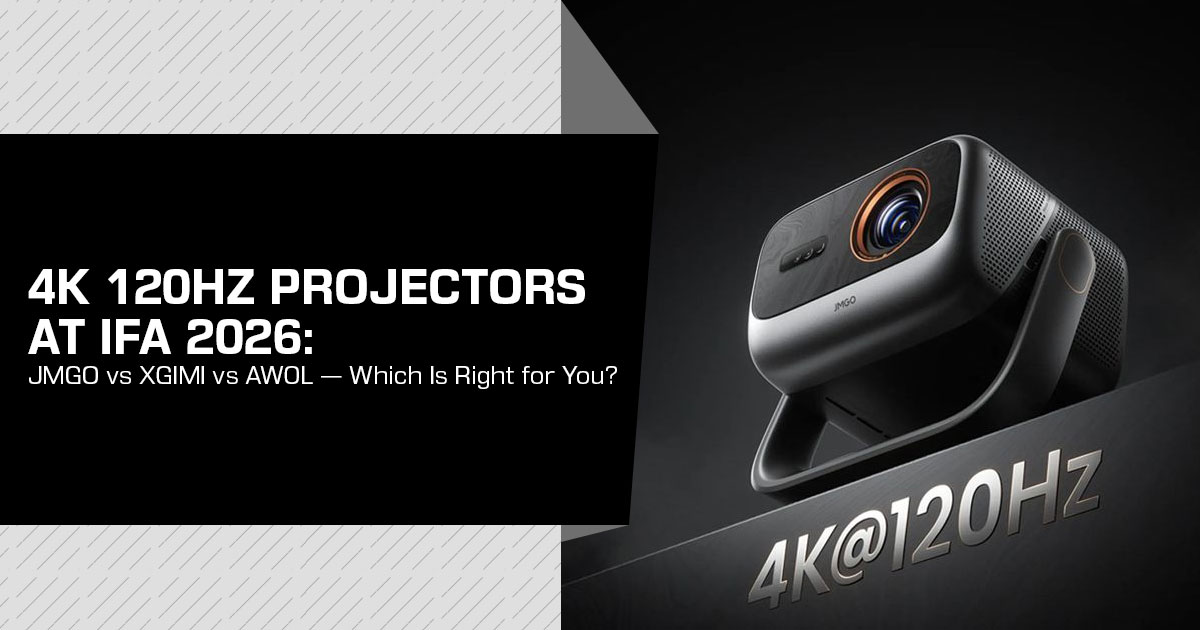
For several years, most premium lifestyle projectors were limited to 4K at 60Hz. At IFA Berlin 2026, held at Messe Berlin from September 4–8, JMGO, XGIMI and AWOL introduced new projector models built around 4K 120Hz performance.
This comparison covers five models: JMGO IRIS Ultra Max, JMGO IRIS Ultra, XGIMI AURA 3 Max, XGIMI AURA 3 Pro, and AWOL LuxVision. They share the headline 4K 120Hz capability, but they target different rooms and installation styles. JMGO uses a long-throw design with optical zoom and lens shift, while XGIMI and AWOL use ultra-short-throw (UST) designs for large living-room screens.
We built the fact sheet from official manufacturer product pages, stores and launch material. When sources disagreed, we gave the manufacturer’s current official specification priority. Third-party sources are used only to add technical context or flag information that still needs confirmation.
If you’re looking for a 4K 120Hz gaming projector for a PS5, Xbox Series X|S or high-performance gaming PC, refresh rate is only one part of the decision. Input latency, HDMI bandwidth, the supported resolution at 120Hz, HDR support, VRR, ALLM, motion processing and room brightness all matter. A projector advertised as 4K 120Hz does not automatically provide the same gaming response as a dedicated gaming monitor or TV.
The same applies if you’re considering a 4K UST projector, a Laser TV replacement or a large-screen home theater projector. Throw distance, screen size, brightness, contrast, installation flexibility, built-in audio and smart features can matter more to your everyday experience than one headline specification.
With more than 20 years of experience in technology hardware and application research and development, we assess products from a practical perspective. We look at performance, component architecture, durability, usability, features and value for money, while separating manufacturer claims from results that still need independent testing.
This guide is for home-theater enthusiasts, console gamers, PC gamers, movie lovers, technology buyers and families planning a premium living-room upgrade. It is especially useful if you’re comparing a 4K 120Hz projector for PS5 or Xbox, deciding between a long-throw and UST setup, or considering whether a Laser TV can replace a large-screen television.
Our recommendations are based on extensive research, specification and architecture analysis and industry experience. We distinguish between verified specifications, manufacturer claims and points that still require independent measurement so you can judge the numbers in context.
The aim is straightforward: help you decide which 4K 120Hz projector makes the most sense for your room, gaming setup, viewing habits and budget—and whether moving from 4K 60Hz to 4K 120Hz is worth the extra cost.
Quick Comparison of IFA 2026 Projectors
| Model | Type | Brightness | Native Contrast | Throw Ratio / Optical Placement | Gaming & High-Refresh Features | Price |
|---|---|---|---|---|---|---|
| JMGO IRIS Ultra Max | Long-throw smart projector | 6,500 ISO lumens | 10,000:1 | 0.88–1.7:1 with optical zoom | 4K@120Hz, VRR, ALLM, Dolby Vision at 4K 120Hz, and claimed 1ms HDMI latency | US$2,999 Early-Bird; US$3,499 MSRP |
| JMGO IRIS Ultra | Long-throw smart projector | 4,500 ISO lumens | 7,000:1 | 0.88–1.7:1 with optical zoom | 4K@120Hz, VRR, ALLM, Dolby Vision at 4K 120Hz, and claimed 1ms HDMI latency | US$1,899 Early-Bird; US$2,399 MSRP |
| XGIMI AURA 3 Max | 4K 120Hz UST projector | 5,700 ISO lumens | 8,000:1 | 0.163:1 throw ratio | 4K 120Hz playback, HDMI 2.1 source requirement, VRR, ALLM, AMD FreeSync, and claimed 1ms response | US$2,199 Super Early Bird; US$4,999 MSRP; $50 refundable deposit |
| XGIMI AURA 3 Pro | 4K 120Hz UST projector | 4,100 ISO lumens | 7,000:1 | Ultra-short throw; exact final throw ratio requires confirmation from the product datasheet | 4K 120Hz playback; based on the AURA 3 platform, with final input specifications requiring confirmation | US$1,999 Super Early Bird; US$3,999 MSRP |
| AWOL LuxVision | Flagship UST projector | 6,000 ISO lumens | Not disclosed in the referenced official IFA information | 0.18:1 throw ratio; supports screen sizes up to 200 inches | 4K 120Hz, claimed 1ms input lag, VRR, ALLM, Dolby Vision Gaming, 3× HDMI 2.1, and DisplayPort | US$5,999 / €5,999 / £4,999 MSRP |
Note: Prices are listed at the time of writing and refer to US market unless otherwise labeled. Early-bird and Super Early Bird prices are temporary launch offers, not standard prices.
Why 4K at 120Hz Is Relevant for Buyers
What changes from 60Hz to 120Hz
A projector that accepts and displays a 4K 120Hz signal can refresh the image up to 120 times per second at 3840 × 2160. The actual frame rate still depends on the source, game, projector mode and signal path.
- Gaming: Many PS5 and Xbox Series X|S games offer 120fps performance modes. A compatible projector can display those higher-refresh signals when the console, game, HDMI connection and projector mode all support the required That does not mean every game runs at native 4K and 120fps.
- Sports and fast video: Higher refresh can make fast pans and moving objects look smoother. JMGO lists MEMC at 120Hz on the IRIS Ultra Max and IRIS Ultra; XGIMI also lists 4K 120Hz MEMC on the AURA 3 Max.
- Input timing: A 120Hz display refreshes more often than a 60Hz display, reducing the time between frames. That can improve perceived responsiveness, but total gaming latency also depends on the projector’s processing pipeline, game mode, source device and signal path.
Connectivity requirements
Connectivity requirements: JMGO lists two HDMI 2.1 ports with 4K 120Hz support on both IRIS models. XGIMI states that AURA 3 4K 120Hz playback requires a compatible HDMI 2.1 source device. AWOL LuxVision lists three HDMI 2.1 ports plus DisplayPort and 4-channel HDMI Multiview. For a soundbar or receiver, eARC support can also matter.
VRR (Variable Refresh Rate) lets the display adjust its refresh timing to the source frame rate, which can reduce tearing. ALLM (Auto Low Latency Mode) can switch a compatible display into a low-latency mode when gaming content is detected. Availability varies by model and input mode.
JMGO IRIS Ultra Max
Official product name verification
The manufacturer’s official product page uses JMGO IRIS Ultra Max. We use this exact name throughout.
Core specifications (verified from JMGO US official page)
- Resolution: 4K via a 47-inch DMD, listed as 4K@120Hz
- Refresh: 4K@120Hz, MEMC at 120Hz, Dolby Vision (4K 120Hz)
- Architecture: DLPC8545 x2 controllers, SoC MT9679 (listed on official spec table), 47-inch DMD
- Light source: Triple Laser, MALC 0 Triple Laser Engine (marketing name for engine), 110% BT.2020, ΔE≤0.7
- Brightness: 6,500 ISO lumens (manufacturer rated)
- Contrast: 10,000:1 Native contrast, Dual IRIS 0-F7.0, 15-Blade (6+9) design mentioned in press materials, 6-level iris adjustment, AI Dynamic Black Level
- Lens: Throw Ratio 88~1.7:1, Lens Shift ±130%V / ±53%H, Four-Way optical lens shift
- Gimbal: Smart Gimbal Motion ±150%V / ±360%H, AI Screen Fitting, AI Spatial Image Memory, Auto Focus Auto (TOF+CMOS)
- Gaming: VRR, Gaming Mode and 1ms HDMI input latency are listed by JMGO as manufacturer specifications. JMGO also lists ALLM support in its gaming documentation. The published 1ms figure should not be treated as an independently measured result.
- Smart: Google TV 0, Wi-Fi 6 / BT 5.4, RAM 4GB, ROM 64GB, built-in Netflix, Prime Video
- Audio: Dolby Audio, DTS-X decoding, Dolby Atmos decoding (official FAQ notes Atmos decoding supported, passthrough supported, but Atmos sound effects not built into projector UI)
- Noise: ≤26dB
- Power: 300W, Dimensions 308×230×274mm, Weight 7kg
What these specs mean in practice
- The triple-laser light source and 110% BT.2020 coverage indicate wide color-gamut capability on paper. Actual perceived color still depends on calibration, screen or wall surface and ambient
- The 0.88–1.7:1 optical zoom and ±130%V / ±53%H lens shift give the IRIS Ultra Max unusually broad placement Optical adjustment can preserve more image detail than relying heavily on digital keystone correction.
- Smart Gimbal Motion with AI Spatial Image Memory is designed to remember positions for different walls. This can reduce setup time if you project on multiple surfaces.
Limitations and unverified points
- Real-world brightness can differ from a manufacturer’s ISO-lumen Independent measurements under defined conditions are needed for a direct brightness comparison.
- JMGO lists 1ms HDMI input latency, but that is a manufacturer The measurement conditions and whether the number applies to every 4K 120Hz/VRR combination are not established in the published specification, so independent latency testing is still important.
- As a single-chip DLP projector, some viewers may notice rainbow The model lists Hardware-Level Anti-RBE to reduce this.
JMGO IRIS Ultra
Official product name verification
Official name is JMGO IRIS Ultra. It is distinct from JMGO IRIS Ultra Max.
Core specifications (verified)
- Same core platform as the Ultra Max: 4K@120Hz, DLPC8545 ×2, 47-inch DMD, triple laser, MALC 6.0, 110% BT.2020, ΔE≤0.7, 0.88–1.7:1 throw ratio, ±130%V / ±53%H lens shift, Google TV 5.0, Wi-Fi 6 / Bluetooth 5.4, Dolby Vision (4K 120Hz), VRR, 120Hz MEMC, Dual IRIS F2.0–F7.0, 6-level iris adjustment and ≤26dB noise.
- Key differences: 4,500 ISO lumens, 7,000:1 native contrast, 3GB RAM, 7kg weight, ±160%V / ±360%H manual gimbal, 240W power and no Image Positioning. The Ultra does retain Spatial Image Memory, but the Max adds the AI Spatial Image Memory label.
Buying consideration
The lower brightness rating can make the Ultra a sensible choice for a controlled room where 4,500 ISO lumens is enough. At the time of our price check, JMGO listed an Early-Bird price of $1,899 for the Ultra and $2,999 for the Ultra Max. These are launch offers, not permanent prices.
XGIMI AURA 3 Series – AURA 3 Max and AURA 3 Pro
Official product name verification
Official blog uses AURA 3 Max and AURA 3 Pro, under series name AURA 3 Series. Brand is XGIMI. Full official references: XGIMI AURA 3 Max and XGIMI AURA 3 Pro.
Core specifications (verified from current XGIMI official material)
- Resolution: 4K UHD
- Motion & Refresh Rate: 4K 120Hz Playback (both models)
- Light Source: RGB Triple Laser (both)
- Brightness: 5700 ISO Lumens (Max), 4100 ISO Lumens (Pro)
- Contrast: 8,000:1 Native Contrast (Max), 7,000:1 Native Contrast (Pro)
- Image Enhancement: Dual Dynamic Iris + DBLE (both)
- AI Image Processing: X-VISION AI Image Processor (both)
- Supported Formats: IMAX Enhanced & Dolby Vision (both)
- Reservation: $50.00 USD refundable deposit to unlock VIP price on Kickstarter and extra $200 off
- Pricing listed on same page: AURA 3 Max: $2,199 Super Early Bird Price (MSRP $4,999), AURA 3 Pro: $1,999 Super Early Bird Price (MSRP $3,999) – these are Super Early Bird prices, not standard prices
Additional features now shown on XGIMI material include Google TV, Harman Kardon audio, Dolby Atmos, DTS Virtual:X, Wi-Fi 6, Bluetooth 5.2, 3D support, Filmmaker Mode, dynamic tone mapping, Dolby Vision Gaming, VRR, ALLM and 1ms response claims. Because launch pages can change, buyers should check the final product specifications for the exact feature set of the Max and Pro.
What these specs mean in practice
- A UST projector sits close to the screen or wall, which can avoid ceiling mounting and simplify cable routing in many living rooms. It is often more practical than a long-throw projector when throw distance is limited.
- RGB triple laser projection can support a wide color gamut without relying on a traditional color wheel. Dual Dynamic Iris + DBLE is designed to improve black levels by controlling light output.
- Super Early Bird pricing at $2,199 USD and $1,999 USD is a launch Standard pricing is listed as $4,999 USD and $3,999 USD respectively on the same official page.
Limitations
- XGIMI now publishes a 163:1 throw ratio for the AURA 3 Max and describes 120-inch projection from about 8 inches away. Earlier reservation material did not show the ratio, so this specification should be treated as an updated official figure.
- XGIMI lists 1ms response, VRR, ALLM and AMD FreeSync on current AURA 3 Max Because these are manufacturer specifications rather than independent measurements, real-world latency at 4K 120Hz should still be verified.
AWOL LuxVision
Official product name verification
Official blog title: ‘AWOL Vision Debuts LuxVision at IFA 2026: World’s First 4K 120Hz UST with Optical Shift.’ That ‘world’s first’ wording is AWOL’s claim, not an independent industry award. We use AWOL LuxVision as the model name and AWOL Vision when referring to the brand.
Core specifications (verified from AWOL Vision official blog)
- Type: Flagship ultra-short-throw projector
- Resolution and refresh: 4K at 120Hz, with AWOL stating that the projector processes nearly one billion pixels per second.
- Brightness: 6,000 ISO lumens (stated in blog lead)
- Light source: RGB triple-laser projection
- Throw ratio: 18:1, screens up to 200 inches
- Gaming: 4K 120Hz, 1ms input lag, ALLM, VRR and Dolby Vision Gaming are manufacturer claims. Independent testing is needed to establish actual latency under specific 4K 120Hz
- Connectivity: Three HDMI 1 ports, DisplayPort, 4-channel HDMI Multiview
- Color: 110% 2020, Dynamic Tone Mapping, 7-level dynamic IRIS
- HDR: Dolby Vision, IMAX Enhanced, Filmmaker Mode, 3D support
- Installation: One-touch vertical optical lens shift (optical shift preserves native detail vs digital keystone)
- Visual comfort: Second-Generation Anti-RBE technology, TÜV Harmful Light Reduction
- Design: Inspired by Parthenon column rhythm, customizable CMF options
- Price and availability: AWOL lists an MSRP of $5,999 USD / €5,999 / £4,999, with launch expected around October 2026. The official IFA blog lists Booth H22-113.
What these specs mean in practice
- The 18:1 throw ratio and vertical optical lens shift give LuxVision more placement flexibility than a UST projector that relies only on digital correction. Optical lens shift can preserve image detail while moving the projected image to match a screen or cabinet position.
- The 6,000 ISO-lumen rating is intended for large-screen use, including screens up to 200 inches. Actual brightness will depend on screen material, image mode, throw geometry and ambient
- The 1ms input-lag figure is a manufacturer The launch article does not provide independent test conditions, so buyers should wait for measured results before using the number to compare gaming performance.
Technology Overview: How 4K at 120Hz Is Implemented
JMGO lists two DLPC8545 controllers and the MT9679 SoC for the IRIS Ultra Max. A technical analysis from Heimkinowelten describes the dual-controller architecture and its role in driving the 0.47-inch DMD at high refresh rates. Because that controller-level implementation is not fully documented in JMGO consumer specifications, we treat the third-party explanation as technical context rather than a primary-source fact.
- JMGO press material also describes a HyperPulse actuator operating at 480 shifts per This is part of JMGO’s explanation of how it maintains 4K detail at 120Hz and should be read as a manufacturer description of the system.
- JMGO’s current official specification lists the MediaTek MT9679 Earlier coverage cited MT9681, so the current official specification is the version used here.
A third-party technical analysis from Heimkinowelten describes the IRIS Ultra Max as using a four-phase XPR pixel-shifting approach with its 0.47-inch DMD to produce a 4K UHD image. JMGO itself lists the 0.47-inch DMD and 4K@120Hz capability, but its consumer specification table does not provide the same level of controller-and-actuator detail. The distinction between a pixel-shifted 4K UHD implementation and a native 4K imaging chip remains technically relevant when comparing projector architectures.
Real-World Considerations Before Buying
Room conditions: ISO lumens are useful for comparing manufacturer ratings, but screen gain, throw distance, picture mode and ambient light affect perceived brightness. A 5,700-ISO-lumen UST paired with a suitable ALR screen may produce a more convincing daytime image than a higher-rated long-throw projector on a plain wall, depending on screen gain and room conditions.
Contrast vs brightness: Black level and contrast matter more in a dark room, while brightness becomes increasingly important as ambient light rises. Neither number alone predicts overall picture quality.
Rainbow effect: Single-chip DLP projectors can produce brief color flashes that some viewers notice. Anti-RBE systems are intended to reduce the effect, but sensitivity varies from person to person.
UST screen choice: An ALR screen is not mandatory, but a screen designed for UST projection can improve perceived contrast and reject some ambient light. It also adds to the total system cost.
Pros and Cons – Based on Verified Specs
| Aspect | Observed Strengths (From Official Specs) | Limitations / Needs Verification |
|---|---|---|
| JMGO IRIS Ultra Max | 6,500 ISO lumens, manufacturer-rated 10,000:1 native contrast, 0.88–1.7:1 optical zoom, ±130% vertical / ±53% horizontal lens shift, Smart Gimbal Motion, and 4K at 120Hz support. | Brightness and claimed 1ms latency require independent measurement. The single-chip DLP design may also produce rainbow artifacts for sensitive viewers. |
| JMGO IRIS Ultra | 4K at 120Hz, VRR, Dolby Vision at 4K 120Hz, a lower launch price, and the same 0.88–1.7:1 optical zoom range. | Rated at 4,500 ISO lumens and 7,000:1 native contrast, both below the Ultra Max. It also offers less automated placement flexibility. |
| XGIMI AURA 3 Max / Pro | 4K 120Hz playback, RGB triple-laser technology, Dual Dynamic Iris + DBLE, IMAX Enhanced, Dolby Vision, and convenient ultra-short-throw (UST) placement. | Final model-specific specifications and measured input latency should be verified independently. Launch pricing may also reflect promotional rather than regular retail pricing. |
| AWOL LuxVision | 6,000 ISO lumens, 0.18:1 throw ratio, support for screens up to 200 inches, optical lens shift, 3× HDMI 2.1, and DisplayPort connectivity. | The $5,999 MSRP places it firmly in the premium segment. Brightness and 1ms latency remain manufacturer claims pending independent testing. |
Who May Consider Each Model
JMGO IRIS Ultra Max could make sense for buyers who want a bright long-throw projector with optical zoom, extensive lens shift, smart gimbal movement and support for screens up to 300 inches.
JMGO IRIS Ultra could make sense for buyers who want the same core 4K@120Hz platform, VRR and Dolby Vision support at a lower launch price and have a room where 4,500 ISO lumens is sufficient.
XGIMI AURA 3 Max could make sense for living rooms where UST placement is preferred. Its 5,700 ISO-lumen rating and 8,000:1 native contrast rating are higher than the Pro model on the manufacturer’s published comparison.
XGIMI AURA 3 Pro could make sense for similar UST setups where 4,100 ISO lumens and 7,000:1 native contrast are sufficient and the lower launch price matters more than the Max model’s higher ratings.
AWOL LuxVision could make sense for buyers who want a premium UST design with vertical optical lens shift, DisplayPort, HDMI Multiview and a 6,000-ISO-lumen rating, and who are comfortable paying a premium while waiting for independent testing.
Pricing and Availability – Verified Labels
- JMGO IRIS Ultra Max: $2,999 Early-Bird price, $3,499 MSRP, listed on the JMGO US store at the time of our price check. JMGO lists pre-order availability and an October 19, 2026 shipping date in its launch material.
- JMGO IRIS Ultra: $1,899 Early-Bird price, $2,399 MSRP, listed on the JMGO US store at the time of our price check.
- XGIMI AURA 3 Max: $2,199 Super Early Bird price and $4,999 MSRP were listed in the launch reservation material used for this comparison. XGIMI currently describes the $50 deposit as fully refundable and says Kickstarter is scheduled for October 20, 2026, with shipping expected to begin in December. Dates are estimates.
- XGIMI AURA 3 Pro: $1,999 Super Early Bird price and $3,999 MSRP were listed in the same launch material. The offer is promotional and can change.
- AWOL LuxVision: $5,999 USD / €5,999 / £4,999 MSRP, with launch expected around October 2026 according to AWOL’s official IFA announcement.
Prices, launch offers and delivery dates can change. Check the manufacturer’s current listing before purchasing.
Frequently Asked Questions
Which 4K 120Hz projector models were announced at IFA 2026?
The five models covered here are the JMGO IRIS Ultra Max, JMGO IRIS Ultra, XGIMI AURA 3 Max, XGIMI AURA 3 Pro and AWOL LuxVision. JMGO lists 4K@120Hz, while XGIMI uses the wording 4K 120Hz Playback and AWOL states 4K at 120Hz.
What is the difference between XGIMI AURA 3 Max and Pro?
XGIMI rates the AURA 3 Max at 5,700 ISO lumens and 8,000:1 native contrast, while the Pro is rated at 4,100 ISO lumens and 7,000:1. Both list 4K 120Hz Playback, RGB Triple Laser, Dual Dynamic Iris + DBLE, X-VISION AI Image Processor, IMAX Enhanced and Dolby Vision.
Does JMGO IRIS Ultra Max support Dolby Vision at 4K 120Hz?
Yes. JMGO’s current official specification table lists Dolby Vision (4K 120Hz). This is a manufacturer specification rather than an independent test result.
What is the throw ratio of the JMGO IRIS Ultra Max?
JMGO lists a 0.88–1.7:1 throw ratio with ±130%V / ±53%H lens shift.
What throw ratio does AWOL LuxVision use?
AWOL lists a 0.18:1 throw ratio and support for screens up to 200 inches.
What SoC does JMGO IRIS Ultra Max use?
JMGO lists the MediaTek MT9679 SoC and two DLPC8545 controllers.
Can these projectors be used with PS5 and Xbox Series X at 120Hz?
These projectors are built around high-refresh gaming, but 4K 120Hz console compatibility depends on the exact input mode, HDMI implementation, game, console settings and cable. JMGO explicitly lists HDMI 2.1 support for 4K 120Hz; XGIMI states that AURA 3 4K 120Hz playback requires a compatible HDMI 2.1 source; AWOL lists three HDMI 2.1 ports. Check the final specification for the exact mode supported by the model you buy.
Do I need an ALR screen for UST models?
No. An ALR screen is not required, but a UST-specific ALR screen can improve perceived contrast and help reject ambient light. It adds to the total cost.
Final Assessment
Our research shows that IFA 2026 brought 4K 120Hz into both long-throw lifestyle projection and UST Laser TV designs, but the five models take different approaches. Because we have not independently tested them, the positions below are research-based buying guidance, not laboratory awards.
- JMGO IRIS Ultra Max — strongest long-throw option on paper: 6,500 ISO lumens, 10,000:1 manufacturer-rated native contrast, 88–1.7:1 optical zoom, extensive lens shift and Smart Gimbal Motion.
- JMGO IRIS Ultra — the lower-cost JMGO option on paper: it keeps the core 4K@120Hz, VRR and Dolby Vision features while reducing brightness, contrast and some placement automation.
- XGIMI AURA 3 Max — the stronger XGIMI UST option on paper: 5,700 ISO lumens, 8,000:1 native contrast, RGB Triple Laser, Dual Dynamic Iris + DBLE and a broad gaming feature Its launch pricing is promotional and subject to change.
- XGIMI AURA 3 Pro — the value-oriented XGIMI UST option on paper: 4,100 ISO lumens and 7,000:1 native contrast with the same core AURA 3 platform, at a lower launch price than the Max.
- AWOL LuxVision — the premium UST option on paper: 6,000 ISO lumens, 0.18:1 throw ratio, vertical optical lens shift, three HDMI 2.1 ports and DisplayPort. Its higher price makes independent brightness and latency measurements especially important before purchase.
Where to Check Current Prices
Prices and availability are changing quickly because these projectors are entering the market through pre-orders, launch offers and Kickstarter reservations. Check the manufacturer’s official listing first, then compare the current price and warranty terms with authorized retailers in your region. If an Amazon or regional retailer link is added later, verify that it matches the exact model and configuration.
Have a question about any of these projectors? Tell us what you are considering in the comments. If you are unsure about 4K 120Hz gaming, UST vs. long-throw projection, PS5 or Xbox compatibility, screen size, brightness, or any other specification, ask us and we will help you make sense of it. If you found this comparison useful, follow us for more technology reviews, comparisons and buying guides.
Disclaimer

This article reflects our research, analysis and opinions based on available product information, manufacturer specifications and supporting industry sources. It is not the official position of any brand, manufacturer or company mentioned here. Specifications, pricing, availability and software features can change after publication. We recommend checking important details on the manufacturer’s current product page before making a purchase. We have not independently tested these projectors, so manufacturer brightness, contrast and latency claims should not be treated as laboratory measurements.

Some links in this article may be affiliate links. If you buy through one, we may earn a small commission at no extra cost to you. Affiliate relationships do not determine our product assessments.

Opinions expressed by readers are their own and do not necessarily reflect ours. We are not responsible for outcomes resulting from the use of information on this site. Please seek professional advice where appropriate.

All product names, logos, and brands mentioned are the property of their respective owners. These names are used for identification and informational purposes only and do not imply endorsement.