
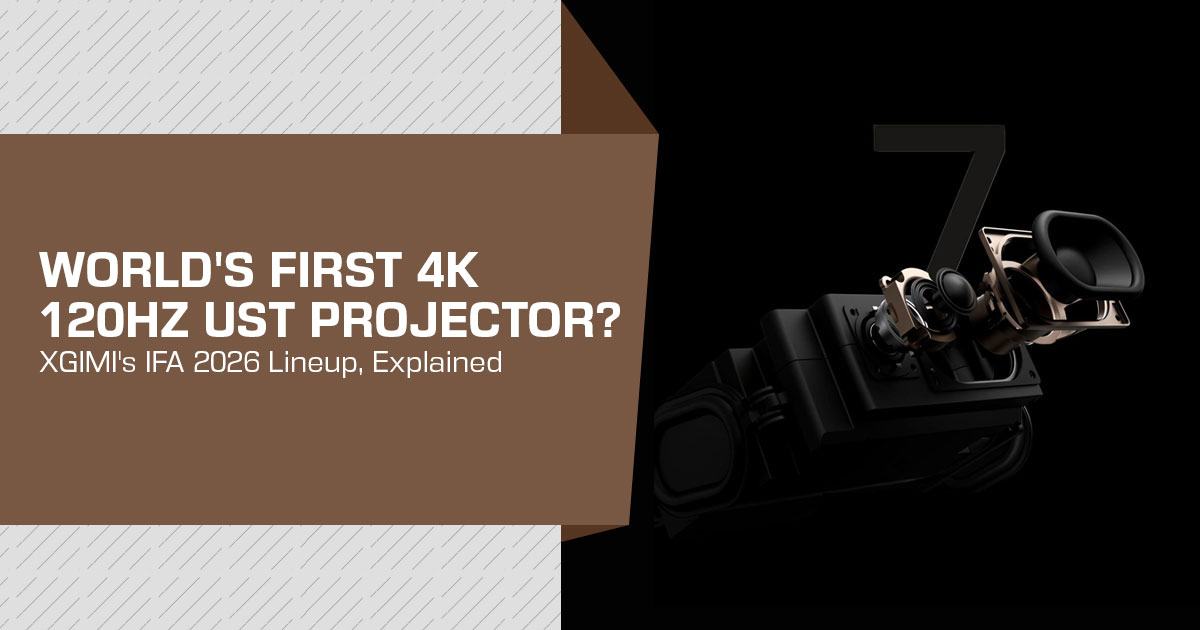
At IFA Berlin 2026, XGIMI made a strong push into the high-end projector market, showcasing three notable projector offerings: the Aura 3 Max, the Titan Noir Ultra Max, and the Horizon 30 Series. The Aura 3 Max is the headline product, with XGIMI calling it the world’s first 4K 120Hz ultra short throw (UST) projector. The Titan Noir Ultra Max sits at the top of the company’s range as a 3D-capable flagship, while the Horizon 30 Series brings 4K 120Hz to a more traditional standard-throw projector design. All three models come with built-in Harman Kardon sound, making them aimed at buyers who want a big-screen setup without building a separate audio system.
The numbers are certainly eye-catching. XGIMI says the Aura 3 Max delivers 4K at 120Hz, reaches 5,700 ISO lumens, and offers up to 8,000:1 native contrast. In the US, the company has announced a $2,399 standard Kickstarter price, with a Super Early Bird offer of $2,199 for customers who place the stated refundable $50 deposit. Based on the specifications published so far, we found no other UST model listing this exact combination of 4K/120Hz, 5,700 ISO lumens, and 8,000:1 claimed native contrast.
But impressive specifications do not automatically make a projector the right choice. A projector at this price needs to deliver more than numbers on a specification sheet. Buyers need to know how much of that performance matters in a real living room, whether the 4K 120Hz capability is useful beyond gaming, how the brightness translates to everyday viewing, whether the built-in speakers are good enough, and whether the overall package justifies the price.
That is where our analysis comes in.
As technology experts with over 20 years of experience in hardware and application research and development, we deeply analyze each product based on real-world performance, durability, and value for money. Our goal is to help you find the best product in every category—budget, performance, reliability, and long-term usage. This analysis is especially useful for home-theater buyers, serious movie and sports viewers, gamers looking for 4K 120Hz performance, and anyone considering replacing a large TV with a premium projector. Our recommendations are based on extensive research, component analysis, real-world usability, and industry expertise.
We have not tested these projectors ourselves. This article is based on XGIMI’s published specifications, official product information, IFA 2026 show-floor reporting, and hands-on video from creator Steven Divish. Wherever a figure comes directly from XGIMI rather than an independent measurement, we make that clear. That distinction matters, especially when you are considering spending thousands of dollars on a projector.
So, are these new XGIMI projectors really a major step forward for home cinema, or are the headline specifications more impressive on paper than they are in everyday use? Let’s look closely at what XGIMI has announced, what these projectors actually offer, and which type of buyer should consider them.
Watch the hands-on: Steven Divish filmed all three projectors at the XGIMI IFA Berlin booth — World's First 4K 120Hz Projector! (YouTube)
What XGIMI Announced at IFA 2026: The Full Lineup
| Product | Type | Headline Specification | Status at Time of Writing |
|---|---|---|---|
| Aura 3 Max | Ultra-short-throw laser TV | 4K UHD 120Hz playback and 5,700 ISO lumens | $50 deposit reservations open; Kickstarter launches October 20, 2026 |
| Aura 3 Pro | Ultra-short-throw laser TV | 4K UHD 120Hz playback and 4,100 ISO lumens | $50 deposit reservations open; Kickstarter launches October 20, 2026 |
| Titan Noir Ultra Max | Long-throw flagship projector | 8,000 ISO lumens with 3D support | €5,499 European price listed at IFA 2026 |
| Horizon 30 Series | Long-throw projector series with multiple performance tiers | 4K 120Hz support with an iris system derived from the Titan Noir | Complete international specifications are pending; European availability is expected in late 2026 |
The video that prompted this article walks through all three, and the order matters. The Titan Noir Ultra Max is the home-cinema flagship. The Aura 3 Max is the one aimed at replacing a television. The Horizon 30 Series is where the same 4K 120Hz technology should eventually reach lower price points.
XGIMI Aura 3 Max and Aura 3 Pro: The Claimed World’s First 4K 120Hz UST Projectors
The Aura 3 series is the reason this announcement got attention. The two models share the same core platform, but brightness and native contrast differ: the Aura 3 Max is rated at 5,700 ISO lumens and 8,000:1 native contrast, while the Aura 3 Pro is rated at 4,100 ISO lumens and 7,000:1. XGIMI’s world-first claim is specific to the ultra short throw format. Our cross-check of published rival specifications supports that narrower claim, while the broader 4K/120Hz claim belongs to a different category.
Aura 3 Series Specification Summary
| Specification | Aura 3 Max | Aura 3 Pro |
|---|---|---|
| Resolution / Refresh Rate | 4K UHD at up to 120Hz | 4K UHD at up to 120Hz |
| Light Engine | RGB Triple Laser | RGB Triple Laser |
| Brightness | 5,700 ISO lumens (manufacturer rating) | 4,100 ISO lumens (manufacturer rating) |
| Native Contrast | 8,000:1 | 7,000:1 |
| Contrast System | Dual Dynamic Iris + DBLE | Dual Dynamic Iris + DBLE |
| Image Processor | X-VISION AI Image Processor | X-VISION AI Image Processor |
| Throw Ratio / Maximum Image | 0.163:1 / up to 200 inches | 0.163:1 / up to 200 inches |
| Input Lag | 1ms at 1080p/240Hz in Game Mode (XGIMI specification) | 1ms at 1080p/240Hz in Game Mode (XGIMI specification) |
| Gaming Features | VRR and ALLM | VRR and ALLM |
| HDR / Picture Modes | Dolby Vision, HDR10+, HLG, IMAX Enhanced, and Filmmaker Mode | Dolby Vision, HDR10+, HLG, IMAX Enhanced, and Filmmaker Mode |
| Audio | 80W Harman Kardon audio system | 80W Harman Kardon audio system |
| Smart Platform | Google TV with Netflix, Prime Video, YouTube, and other streaming apps | Google TV with Netflix, Prime Video, YouTube, and other streaming apps |
| 3D Support | Supported; two pairs of 3D glasses included | Supported; two pairs of 3D glasses included |
| Rated Light Source Life | Approximately 20,000 hours | Approximately 20,000 hours |
Manufacturer ratings, not independent measurements. 4K 120Hz playback is supported through compatible HDMI 2.1 sources; the Aura 3 has three HDMI inputs, with HDMI 2 also supporting eARC. Dolby Vision Gaming is additionally reported in EU press coverage of the launch.
4K at 120Hz — Why This Is New for UST Projectors
A quick explanation, because several brands are making “world’s first” claims this season.
Many earlier projectors that accepted 4K 120Hz signals either displayed them at a lower refresh rate or limited high-refresh modes to 1080p. The Hisense PX3-PRO, for example, accepts a 4K 120Hz signal through its HDMI 2.1 ports, but its high-refresh display modes top out at 1080p at 240Hz. That distinction matters because accepting a 4K 120Hz signal is not the same as displaying it at 4K and 120Hz.
XGIMI says the Aura 3 series supports 4K at 120Hz, using two image controllers in parallel to handle the processing load. Launch specifications also identify a 0.47-inch DMD using XPR4 pixel shifting, so the 4K label refers to the projector’s 4K UHD display mode rather than a native 3840 × 2160 DMD. Techlicious, which cross-checked the claim against rival specifications ahead of IFA, concluded that XGIMI’s narrower UST world-first claim “appears to hold up.” We compare XGIMI’s claim with JMGO’s broader 4K/120Hz claim and AWOL Vision’s optical-lens-shift claim below.
What this means for the buyer: XGIMI says the projector can accept a console or PC’s 4K 120Hz output without dropping the refresh rate. In practice, the game itself and the source device still need to support 4K at 120Hz. For film viewing, 120Hz can also handle 24fps content with a clean 5:5 cadence in principle. Whether the Aura 3 handles every 24fps source that way in practice is something independent testing will need to confirm. If you mainly watch movies and never game, 120Hz may not be a feature worth paying extra for.
Brightness: What 5,700 ISO Lumens Means for Daytime Viewing
Brightness is the number that decides whether a projector works in a real living room or only in a dark one.
The previous Aura 2 was rated at 2,300 ISO lumens, and Techlicious’s reviewer — who owns one — identified brightness in lit rooms as a weak point. XGIMI rates the Aura 3 Max at 5,700 ISO lumens — roughly two and a half times its predecessor — and the Pro at 4,100 ISO lumens, about 1.8 times the Aura 2’s rating. These are manufacturer ratings, not independent measurements, so they should be treated as figures to verify in reviews rather than as a promise of a specific real-world brightness level.
What this means for the buyer: on paper, the 5,700-ISO-lumen Max moves the Aura 3 closer to the brightness expected from a TV replacement. It will not overcome direct sunlight falling on a white wall, and the screen surface still matters. The rating suggests a much stronger position for daytime viewing than the Aura 2, but independent measurements are needed to know how much usable brightness reaches the screen.
Contrast: 8,000:1 Native and the Dual Dynamic Iris
Native contrast describes the difference between the darkest and brightest parts a projector can produce under a defined test condition. It is an important part of picture quality, but projector contrast figures are not always directly comparable because manufacturers can use different measurement methods and dynamic systems.
The Aura 2 was rated at 1,400:1. XGIMI rates the Aura 3 Max at up to 8,000:1 native contrast and the Aura 3 Pro at up to 7,000:1. XGIMI attributes the improvement to a Dual Dynamic Iris — two physical irises in the light path that adjust the amount of light — working with its DBLE (Dynamic Black Level Enhancement) system. XGIMI has used a dual-iris approach in the Titan Noir line and is bringing it to its UST range here.
What this means for the buyer: the numbers look promising for darker movie scenes, but they do not guarantee OLED-like blacks. For context, the Hisense PX3-PRO is rated at 3,000:1. How the iris behaves in practice — including brightness changes during scenes and any audible movement — is something only independent testing can confirm.
Ultra Short Throw: A 120-Inch Picture From 8 Inches Away
The Aura 3 Max has a 0.163:1 throw ratio. In plain terms, it sits on a TV console almost touching the wall and throws the picture upward: a 120-inch image from roughly 8 inches (about 20 cm) away, with a maximum picture size of 200 inches.
This is the point Steven Divish highlighted in his IFA video: because the projector sits at the wall, people can walk through the room without casting shadows across the image — the classic long-throw problem, removed by design. There is no ceiling mount and no cable run across the room; setup amounts to placing the unit on a console and plugging it in.
What this means for the buyer: two honest caveats. First, UST picture quality depends heavily on the wall — flat and smooth at minimum, and an ALR (ambient light rejecting) screen is strongly recommended for lit rooms, which adds cost. Second, this class of projector is sometimes called a laser TV for exactly this reason: it behaves like a very large television, not like a traditional projector install.
Gaming Features: HDMI 2.1, 1ms Input Lag, VRR, and ALLM
- XGIMI rates game-mode input lag as low as 1ms at 1080p/240Hz; updated launch specifications also list 2.2ms at 1080p/120Hz and 3ms at 4K/60Hz. These are manufacturer figures and need independent verification.
- VRR (variable refresh rate) — matches the projector’s refresh rate to the console’s frame rate to reduce screen tearing.
- ALLM (auto low latency mode) — the projector switches to its fastest game settings automatically when you start playing.
- XGIMI lists Dolby Vision, HDR10+, HLG, IMAX Enhanced, and Filmmaker Mode support; EU press coverage of the launch additionally reports Dolby Vision Gaming.
What this means for the buyer: this is a strong feature set for console and PC gaming. XGIMI says compatible sources can use 4K at 120Hz with VRR and ALLM, while the projector’s supported screen sizes make that useful on a much larger image than a typical gaming monitor.
Sound: 80W Harman Kardon Built-in
Both Aura 3 models carry an 80W Harman Kardon speaker system, with Dolby Atmos support reported in launch coverage. That gives the projector more built-in audio power than many compact projectors, but wattage alone does not tell us how the system will sound. For a TV-replacement setup, the appeal is simple: the projector can handle both the picture and everyday audio without requiring a separate soundbar.
What this means for the buyer: at this stage, the realistic expectation is adequate sound for everyday TV, streaming, and casual gaming. Home-cinema buyers who already own an AV receiver or soundbar will simply bypass it.
Smart Platform: Google TV Built-In
The Aura 3 series runs Google TV and supports major streaming services including Netflix, Prime Video, and YouTube. That means buyers using it as a TV replacement do not need a separate streaming stick for basic streaming, although app availability can vary by region.
3D Support and the Rainbow Effect Question
Both models support 3D playback, and XGIMI includes two pairs of 3D glasses in the box. The more interesting spec for videophiles is Anti-RBE: XGIMI’s own spec sheet lists “significantly reduced RBE,” and Trusted Reviews notes the Anti-RBE technology works in both 2D and 3D viewing. RBE — the rainbow effect — is the occasional red-green-blue flashing that single-chip DLP projectors can show on high-contrast edges. Until the Aura 3 is measured outside a showroom, treat RBE reduction as a stated goal, not a settled fact.
Design and Setup: What We Know
The Aura 3 units shown at IFA sit low and wide — closer to a soundbar’s footprint than a traditional projector’s. XGIMI demonstrated the Aura 3 Max at the show paired with its Ascend floor-rising screen, which retracts out of sight when not in use, keeping the living room looking like a living room rather than a home cinema.
Setup features include automated keystone, focus, and screen alignment. One limitation worth stating plainly: the published Aura 3 specifications do not list optical lens shift. That matters because UST projectors are sensitive to placement. AWOL Vision’s LuxVision, by comparison, adds vertical optical lens shift to its 4K 120Hz UST design. With the Aura 3, getting the projector physically aligned with the screen remains important.
What We Have Not Tested — And Why We’re Saying So
No full independent reviews of the Aura 3 series appear to be published yet, and the Kickstarter campaign does not open until October 20. Every performance number in this article is a manufacturer rating or show-floor observation, not a lab measurement. We would rather state that clearly than repeat spec-sheet claims as verified fact. The picture quality questions that actually decide this purchase — real-world brightness, iris behavior, input lag confirmation, rainbow effect — get answered when independent reviews publish. We will update this article as that happens.
The Rest of the Lineup: Titan Noir Ultra Max and Horizon 30
Titan Noir Ultra Max: The 3D Flagship
The Titan Noir Ultra Max is XGIMI’s flagship long-throw model, listed at €5,499 and rated at 8,000 ISO lumens with an RGB triple laser engine in German AV publication AREA DVD’s IFA coverage — the same outlet that gave it an innovation award in the premium 4K projector category at the show. At IFA, XGIMI demonstrated two Titan Noir Ultra Max projectors as a passive 3D setup. It carries the dual-iris contrast system that the Aura 3 inherits in UST form. On the Titan Noir models reviewed to date, there is no built-in smart TV OS, so buyers add their own streaming device — worth confirming for the Ultra Max specifically before buying.
Horizon 30 Series: 4K 120Hz Goes Mainstream
The Horizon 30 Series is the international counterpart to the RS30 range XGIMI launched in China earlier in 2026. It brings 4K 120Hz support and the company’s newer iris technology to a standard-throw design, with a QuaLas42 RGB triple-laser engine using 20 laser diodes. Published specifications for the range put brightness between 3,600 and 6,800 ISO lumens depending on the model. Early international reports also point to optical lens shift on the Horizon 30 range, but final regional specifications and pricing should be confirmed before purchase. Europe is expected toward the end of 2026.
Who Really Made the “World’s First” 4K 120Hz Projector?
Three brands used versions of this claim within one month. Here is the fine print, because each claim is about something different:
| Product | Actual Claim | First Shown / Sold | Price |
|---|---|---|---|
| JMGO IRIS Ultra Max | Claimed as the first projector with 4K/120Hz. | China: May 2026 US / Europe: September 2026 (per Forbes) |
Not confirmed in the reviewed sources |
| XGIMI Aura 3 Max | Claimed as the first ultra-short-throw (UST) projector with 4K/120Hz. | Shown at IFA in September 2026; Kickstarter launches October 20, 2026. | US$2,399 Kickstarter price / US$2,199 with deposit in the US |
| AWOL Vision LuxVision | Claimed as the first 4K/120Hz UST projector with optical lens shift. | Shown at IFA in September 2026, with launch scheduled for October 2026. | US$5,999 / €5,999 / £4,999 |
JMGO has the earliest launch date: Forbes reports that the IRIS Ultra Max launched in China in May, followed by its US and European launch in September. JMGO’s claim is broader — it calls the IRIS Ultra Max the world’s first 4K/120Hz projector. XGIMI’s claim is narrower: the Aura 3 is positioned as the first UST projector with 4K/120Hz. AWOL Vision makes a separate first claim for the first 4K/120Hz UST with optical lens shift. These claims are not mutually exclusive because they describe different categories or features. For buyers, the more useful question is which combination of features, price, and availability fits the room.
Aura 3 Max vs Aura 3 Pro vs the Competition
| Feature | XGIMI Aura 3 Max | XGIMI Aura 3 Pro | Hisense PX3-PRO | AWOL Vision LuxVision | JMGO IRIS Ultra Max |
|---|---|---|---|---|---|
| Projector Type | UST laser TV | UST laser TV | UST laser TV | UST laser TV | Long-throw projector |
| Displays 4K at 120Hz | Yes (XGIMI claim) | Yes (XGIMI claim) | No — accepts the input but displays up to 1080p at 240Hz | Yes (AWOL claim) | Yes (JMGO claim) |
| Brightness | 5,700 ISO lumens | 4,100 ISO lumens | 3,000 lumens | 6,000 ISO lumens | 6,500 ISO lumens |
| Native Contrast | 8,000:1 | 7,000:1 | 3,000:1 | TBA | 10,000:1 |
| Input Lag | 1ms (1080p/240Hz specification) | 1ms (1080p/240Hz specification) | TBA | 1ms (manufacturer specification) | TBA |
| Optical Lens Shift | No | No | No | Yes | TBA |
| Smart OS | Google TV | Google TV | Google TV | TBA | TBA |
| Price | $2,399 Kickstarter / $4,999 MSRP (US) | $2,199 Kickstarter / $3,999 MSRP (US) | $2,499.99 sale / $3,499.99 list (US) | $5,999 (US) | $2,999 (US) |
| Availability | October 20, 2026 (Kickstarter) | October 20, 2026 (Kickstarter) | Shipping now | October 2026 | China since May 2026; US and Europe since September 2026 |
“TBA” means not confirmed in our sources at the time of writing. All other figures are manufacturer ratings or press-reported. The Hisense figure is its listed sale price at the time of Techlicious’s September check, not its standard list price.
Pros and Cons
| Pros | Cons |
|---|---|
| ✔ Claimed to be the first UST projector with 4K at 120Hz, based on XGIMI’s announcement and published specifications for competing models. | ✖ No independent reviews, benchmarks, or professional measurements are available yet. |
| ✔ Rated at 5,700 ISO lumens, representing a substantial brightness increase over the Aura 2. | ✖ The post-campaign retail price is considerably higher, with a US MSRP of $4,999 for the Max. |
| ✔ Claimed 8,000:1 native contrast with Dual Dynamic Iris, an impressive specification on paper for an ultra-short-throw projector. | ✖ Published specifications do not list optical lens shift, making accurate projector and screen placement important. |
| ✔ Supports low-latency gaming, VRR, and ALLM, providing a strong feature set for modern gaming consoles. | ✖ An ALR screen may be needed to achieve the best image quality in brighter rooms, adding to the overall setup cost. |
| ✔ Integrated 80W Harman Kardon audio and Google TV reduce the need for separate streaming and audio hardware. | ✖ Reduced rainbow effect is currently a manufacturer claim and has not yet been independently measured. |
| ✔ Includes two pairs of 3D glasses, adding value for viewers interested in 3D content. | ✖ India availability has not been announced. |
Who Should Buy the XGIMI Aura 3 Series
Buy the Aura 3 Max if: you want a TV replacement that throws a 100-to-200-inch picture from a console, you game on a PS5, Xbox Series X, or PC, and you want the 4K 120Hz feature set at the lowest price currently attached to it.
Buy the Aura 3 Pro if: you watch mostly in the evening or in a controlled-light room. You keep the same 4K 120Hz platform and audio system, while the Max’s 8,000:1 rating becomes 7,000:1 on the Pro. You give up 1,600 ISO lumens of rated brightness and save $200 at the standard Kickstarter price.
Wait if: you need optical lens shift (look at the AWOL Vision LuxVision), you want hardware that is shipping now (the Hisense PX3-PRO is on sale, and the long-throw JMGO IRIS Ultra Max claims the overall 4K/120Hz first), or you are uncomfortable backing hardware through Kickstarter. XGIMI has run crowdfunding launches before — its Titan Noir campaign earlier in 2026 targeted June delivery to backers. A crowdfunding launch is still a pre-order with a wait, not a retail purchase with a same-week return window.
Skip the category if: your wall takes direct, uncontrolled sunlight through the day and a screen purchase is not in the budget.
Pricing and Availability: How the Kickstarter Launch Works
| Pricing Tier | Aura 3 Max | Aura 3 Pro |
|---|---|---|
| Super Early Bird (with $50 deposit) | $2,199 | $1,999 |
| Standard Kickstarter Price | $2,399 | $2,199 |
| MSRP After Campaign | $4,999 | $3,999 |
| UK / Australia (Approx.) | £1,775 / AU$3,335 | £1,626 / AU$3,057 |
US prices unless a currency is shown. UK/Australia figures are reported approximations and may vary by region, taxes, and final campaign terms.
The mechanics, as published on XGIMI’s official store:
- Place a $50 deposit on com. XGIMI states that the deposit is fully refundable.
- On October 20, 2026, deposit holders receive the Kickstarter launch link and can use the same email address to secure the applicable early-bird benefits.
- Retail availability and pricing follow the The large gap between the $2,199 Super Early Bird price and the $4,999 stated MSRP is the main financial reason to consider reserving early.
The sensible reading: XGIMI says the deposit is fully refundable, but the Kickstarter itself still carries the normal crowdfunding risks. October 20 is the important date because the campaign terms, final pledge options, and shipping details will be clearer. Waiting for independent hands-on coverage is the lower-risk move; the trade-off is that early pricing may no longer be available.
XGIMI Aura 3 Series: India Availability
XGIMI sells officially in India through Amazon India, with the current lineup led by the Horizon 20 series — the Horizon 20 Max (4K RGB triple laser, listed with the same 5,700 ISO lumen rating as the Aura 3 Max, in a standard-throw design) was listed at ₹2,79,999 at the time of writing, and the Horizon 20 at ₹1,89,999.
The Aura 3 series has not been announced for India at the time of writing, and there is no confirmed India price or launch date. Indian buyers wanting the 4K 120Hz ultra short throw format today have no local option yet. The practical move is watching XGIMI’s Amazon India store page for the addition, or importing — which brings warranty and service caveats we would not recommend on a product in this price bracket.
Where to Buy the XGIMI Aura 3 Series
Official Pre-Order (US and Europe)
At the time of writing, the only live channel is XGIMI’s own $50 deposit reservation, which locks the early-bird pricing for the October 20 Kickstarter launch. Reserve the Aura 3 series on XGIMI’s official store →
Amazon US
The Aura 3 series is not yet listed on Amazon US at the time of writing. XGIMI’s Titan Noir line reached Amazon after its campaign at its standard list price ($3,999 at the time of Techlicious’s September check), so the Aura 3 would be expected to list nearer its $4,999 MSRP than the Kickstarter pricing.
If you would rather buy through Amazon with their returns process, the wait is the cost of that safety. Check current XGIMI projector prices and availability on Amazon US → the Aura 2 and Titan Noir lines are already listed there (the Aura 2 at $2,239 in that same pricing check, down from its $2,699 launch price), and they cover much of what the Aura 3 does if 4K 120Hz is not a priority.
Amazon India
No Aura 3 listing exists in India yet. What you can buy today is the current generation: Check XGIMI projector prices on Amazon India → the Horizon 20 series is the closest currently listed option: 4K RGB triple laser, Harman Kardon sound, a listed 300-inch maximum image, and local warranty coverage. We would suggest watching that store page rather than importing the Aura 3.
Frequently Asked Questions
What is the world’s first 4K 120Hz projector?
Based on the published claims and launch reporting available at the time of writing, the three statements describe different milestones: JMGO claims the overall 4K/120Hz first; XGIMI claims the first 4K/120Hz UST; and AWOL Vision claims the first 4K/120Hz UST with optical lens shift. These should not be presented as one universal “world’s first” claim.
Can projectors display true 4K at 120Hz?
Yes. Several 2026 projector models now claim 4K at 120Hz output. The important distinction is whether a projector merely accepts a 4K/120Hz input or actually outputs a 4K/120Hz display mode. For DLP models such as the Aura 3, the 4K image is produced with XPR pixel shifting rather than a native 3840 × 2160 DMD. XGIMI, JMGO, and AWOL Vision all claim 4K/120Hz output on their respective models, but independent measurements are still the best way to verify those claims.
How much does the XGIMI Aura 3 cost?
US pricing: $2,399 for the Aura 3 Max and $2,199 for the Aura 3 Pro during the Kickstarter campaign starting October 20, 2026, dropping to $2,199 / $1,999 with a refundable $50 deposit. Post-campaign MSRP is $4,999 / $3,999. What Hi-Fi reports approximate prices of £1,775 / AU$3,335 for the Max.
Does the XGIMI Aura 3 work with PS5 and Xbox Series X?
XGIMI says the Aura 3 accepts 4K 120Hz input on its HDMI 2.1 ports and supports VRR and ALLM. Its claimed 1ms input lag applies to 1080p/240Hz; the updated specifications also list 3ms at 4K/60Hz. The console and game need to support 4K at 120Hz for you to see the full benefit.
Do ultra short throw projectors cast shadows?
No — that is their main practical advantage over long-throw designs. Because a UST projector like the Aura 3 sits almost against the wall, nobody walking through the room blocks the light path, and no ceiling mount is needed.
Is the XGIMI Aura 3 available in India?
Not at the time of writing. XGIMI’s current India lineup on Amazon includes the Horizon 20 series; an Aura 3 India launch has not been announced.
Is backing the Aura 3 Kickstarter risky?
It carries the usual crowdfunding caveats — no independent reviews of final hardware yet, and a wait for delivery. The $50 deposit is stated by XGIMI as refundable; check the campaign terms on October 20 before pledging.
Final Verdict
The XGIMI Aura 3 series is a significant ultra short throw announcement because it brings 4K 120Hz, a high brightness rating, and a dual-iris contrast system into a UST design at a much lower starting price than AWOL Vision’s LuxVision. The Aura 3 Max‘s $2,199 Super Early Bird price is $3,800 below the LuxVision’s current $5,999 US MSRP.
The caveats are equally specific. The Aura 3 has not been independently measured by us, the launch runs through Kickstarter rather than normal retail, and buyers who wait for reviews may miss the early pricing. XGIMI says the $50 deposit is fully refundable, so it can hold the stated Super Early Bird price with limited financial commitment, but the purchase decision should still be based on the final campaign terms and independent testing.
Reserve the XGIMI Aura 3 Max on the official store →
Check XGIMI projectors on Amazon US →
Check XGIMI projectors on Amazon India →
Prices and availability were checked on September 11, 2026, and are current at the time of writing. This article is based on manufacturer specifications and press reporting; we have not tested the hardware.
What do you think about the new XGIMI projectors? Would you consider the Aura 3 Max, Titan Noir Ultra Max, or Horizon 30 Series for your home setup? Share your thoughts in the comments—especially if you are already using an XGIMI projector or are planning to buy one.
If you found this analysis useful, follow us for more honest technology reviews, buying guides, and product comparisons. And if you have any doubts about 4K projectors, UST projectors, 4K 120Hz gaming, brightness, picture quality, or which model is right for you, leave your question in the comments. We’ll help you make sense of it before you spend your money.
Disclaimer

This blog post reflects our research, analysis, and opinions based on available product information, user feedback, and industry knowledge. It should not be taken as the official position of any brand, manufacturer, or company mentioned here. We make every effort to keep this guide accurate, but product specifications, pricing, and availability may change after publication. We recommend double-checking important details before making a purchase.

Some links in this article may be affiliate links. If you choose to buy through these links, we may earn a small commission at no extra cost to you. This helps support our work and allows us to keep publishing in-depth, unbiased reviews. Affiliate partnerships never influence our recommendations.

Opinions expressed by readers are their own and do not necessarily reflect ours. We are not responsible for outcomes resulting from the use of information on this site. Please seek professional advice where appropriate.

All product names, logos, and brands mentioned are the property of their respective owners. These names are used for identification and informational purposes only and do not imply endorsement.