
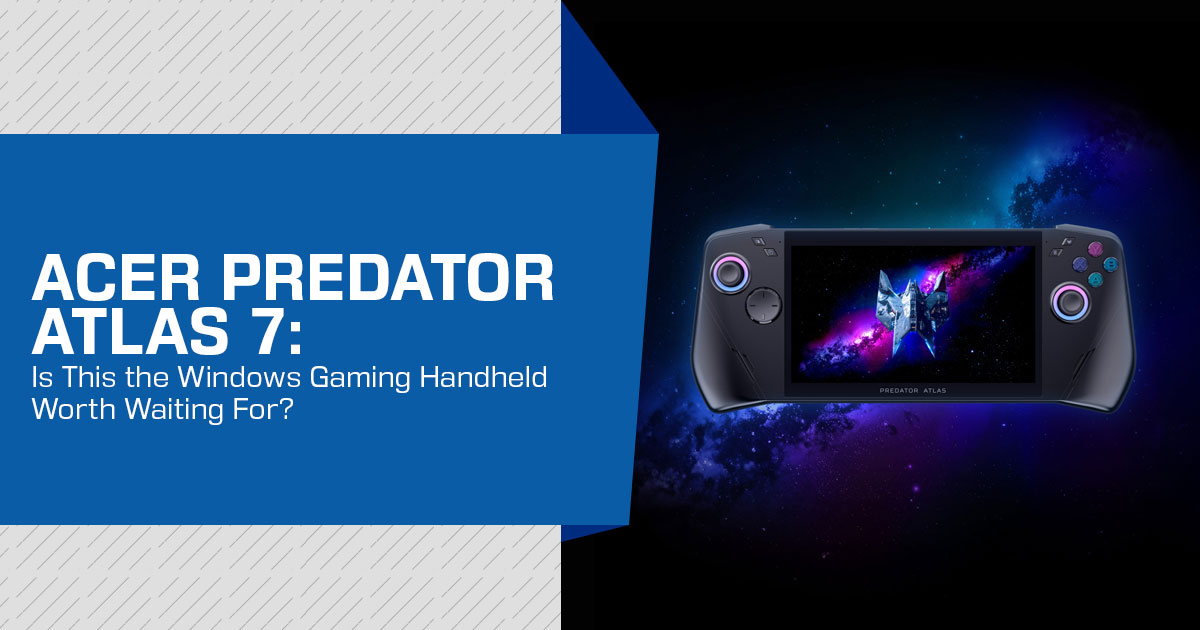
Acer’s IFA 2026 announcements introduce two very different ideas for the future of gaming handhelds. The Predator Atlas 7 is a planned Windows 11 Home gaming handheld PC built around a 7-inch FHD touchscreen, 120Hz refresh rate, variable refresh rate (VRR), and Intel Arc graphics options. Alongside it, Acer has shown the Project DualPlay Mini, an 8-inch 2-in-1 gaming handheld concept that combines familiar handheld gaming controls with a built-in backlit keyboard.
Before getting excited about either device, buyers need to understand one important difference: the Predator Atlas 7 is a planned retail product, while the Project DualPlay Mini is still a concept. Acer says the Atlas 7 will be available in North America from Q4 2026 and in EMEA from November 2026. For the DualPlay Mini, Acer has not announced a confirmed retail price, production schedule, or final specification list.
As technology experts with over 20 years of experience in hardware and application research and development, we deeply analyze each product based on real-world performance, durability, and value for money. Our goal is to help you find the best product in every category—whether you care most about price, gaming performance, reliability, portability, or long-term use. This guide is especially useful for PC gamers, handheld gaming enthusiasts, Steam and Windows gamers, frequent travellers, students, and buyers looking for a portable gaming PC that can also handle everyday computing tasks.
Our recommendations are based on extensive research, component analysis, real-world usability, and industry expertise. With the Predator Atlas 7 and Project DualPlay Mini aimed at different needs, understanding what Acer has actually announced—and what remains uncertain—can help you avoid making a purchase decision based on early marketing claims alone.
Predator Atlas 7 vs Project DualPlay Mini at a glance
| Product | Product Type | Screen | Main Purpose | Retail Status |
|---|---|---|---|---|
| Predator Atlas 7 | Windows gaming handheld PC | 7-inch FHD, 120Hz, VRR | Portable PC gaming with the flexibility of the Windows ecosystem | North America from Q4 2026; EMEA from November 2026 |
| Project DualPlay Mini | 2-in-1 gaming handheld concept | 8-inch | Combines handheld gaming with laptop-style productivity | Concept device with no confirmed retail launch |
The Predator Atlas 7 is the product to evaluate when its price and independent tests become available. The Project DualPlay Mini should be treated as a design concept rather than a product that can currently be ordered.
What is the Predator Atlas 7?
The Predator Atlas 7 is a compact portable gaming PC built around a 7-inch display and Intel Arc hardware. Acer lists Intel Arc G3 processor options, up to an Intel Arc G3 Extreme processor, with Intel Arc B390 graphics at the top configuration and Intel Arc B370 on other configurations. The official product page identifies the operating system as Windows 11 Home.
Windows gives the device access to PC game libraries, launchers, applications, and accessories. It also means the experience may involve more desktop-style setup than a handheld built around a console-focused operating system. That flexibility is useful for some buyers, but it does not guarantee a simple setup for every game.
Acer also lists Intel XeSS 3 support in compatible games. XeSS is an upscaling technology that can produce a higher-quality output image from lower-resolution rendering when the game, driver, and configuration support it. But this feature does not establish a particular frame rate for the Atlas 7.
Predator Atlas 7 specifications
| Specification | Published Detail | What It Means for Buyers |
|---|---|---|
| Operating System | Windows 11 Home | Supports major PC game stores, Windows desktop applications, and a broad range of compatible external accessories. |
| Processor | Intel Arc G3 options, up to Intel Arc G3 Extreme | Real-world performance will depend on the selected configuration, power limits, cooling, drivers, and game settings. |
| Graphics | Up to Intel Arc B390, with Arc B370 available on other configurations | Gaming performance will vary according to GPU configuration, power limits, driver optimization, resolution, and graphics settings. |
| Display | 7-inch FHD (1920 × 1080), 16:9 touchscreen | Keeps the handheld more compact than many larger-screen alternatives, although the smaller panel provides less workspace for desktop applications. |
| Refresh Rate | 120Hz with VRR support | VRR can reduce visible tearing and provide smoother-looking gameplay when frame rates fluctuate within the supported range. |
| Brightness & Color | Up to 500 nits brightness; 100% sRGB coverage listed by Acer | Provides a defined brightness and color target, although actual results can vary with display settings, content, and viewing conditions. |
| Memory | Up to 24GB LPDDR5X-7467 | Higher-memory configurations can provide additional headroom for demanding games, background applications, and multitasking. |
| Storage | Up to 1TB PCIe Gen 4 NVMe SSD | Provides more space for large PC game installations and applications than lower-capacity configurations. |
| Battery | 60Wh or up to 80Wh, depending on the model | Battery capacity varies by configuration and should not be treated as a guarantee of any specific gaming or mixed-use runtime. |
| Controls | Available TMR joysticks, Hall-effect analog triggers, rear macro buttons, and quick-access controls | Provides additional control options for gaming, but buyers should verify the exact controller configuration for their model and region. |
| Ports | Two Thunderbolt 4 ports and a microSD card reader | Supports compatible docks, external displays, peripherals, and additional storage, making the handheld more flexible at a desk. |
| Wireless | Wi-Fi 7 and Bluetooth 5.4 | Supports modern wireless networking and Bluetooth peripherals when paired with compatible equipment. |
| Audio | Dual 2W speakers with DTS Virtual:X Ultra | Provides integrated stereo audio with virtual surround processing for supported content and configurations. |
The 7-inch 120Hz VRR display
The 7-inch 1080p gaming display is one of the clearest design choices in the Atlas 7. A smaller panel can help keep the handheld’s overall footprint under control, but it also gives Windows interfaces less room than an external monitor or a larger portable screen.
The 120Hz refresh rate describes how frequently the panel can update. VRR helps the display adapt to changing frame output from supported content. This can make uneven frame delivery less distracting, but it does not create additional performance by itself.
Acer lists 500 nits of peak brightness and 100% sRGB color gamut. The panel also uses Corning Gorilla Glass Victus with DXC surface treatment. These are display specifications, not a substitute for independent measurements of color accuracy, response time, reflections, or outdoor visibility.
Intel Arc G3 performance: what remains unknown
The Intel Arc G3 Extreme processor and Intel Arc B390 graphics at the top configuration give the Atlas 7 a distinct hardware platform, while Intel Arc B370 graphics are used on other configurations. Acer also lists Intel Xe3 graphics architecture and XeSS 3 support on the official product page.
Those labels do not establish how the handheld will perform in individual games. A meaningful evaluation needs tests at several power modes, with frame rates, frame-time consistency, fan noise, surface temperature and sustained performance. Drivers and game compatibility will also influence results.
A buyer should therefore treat the published processor and graphics specifications as an indication of the hardware configuration, not as a promise of a particular FPS result. The exact model, power settings and game should be included in any later comparison with current handhelds.
Controls: TMR joysticks and Hall-effect triggers
Acer lists TMR joystick options on select models, along with Hall-effect analog triggers, rear macro buttons, and quick-access controls. TMR, or tunneling magnetoresistance, uses magnetic sensing rather than the contact-based sensing found in many traditional potentiometer sticks.
The main advantage is reduced dependence on physical contact at the sensing point. It does not prove that every Atlas 7 configuration will have the same stick hardware, tension, or calibration. Acer identifies TMR joysticks as available on select models, so buyers should confirm the exact configuration before ordering.
Hall-effect analog triggers are designed to provide pressure-sensitive input. This can matter in racing games and other titles that use a range of trigger movement. Independent testing is still needed to assess travel, consistency, and firmware behavior.
Cooling and battery capacity
The dual-fan gaming handheld cooling system uses a Predator AeroBlade metal fan and a second fan. Acer lists an 89-blade metal fan with 0.1 mm blade thickness and Vortex Flow tuning. Acer’s published airflow improvement of up to 10% is an internal comparison between its metal fan and a plastic fan under stated test conditions; it is not an independent temperature or performance result.
Battery choices include 60Wh and up to 80Wh models. Capacity can help explain potential endurance differences between configurations, but it cannot be converted into a guaranteed number of gaming hours. Game workload, brightness, power mode, processor configuration, and software all affect runtime.
Battery capacity may also affect the final weight and price. Acer lists the Atlas 7 at under 750g with the 80Wh battery and under 700g with the 60Wh battery. The exact weight still depends on the configuration.
Ports, wireless features and Windows software
Two Thunderbolt 4 ports give the Atlas 7 a path to compatible docks, displays, storage and other accessories. The microSD reader provides another storage option, although card performance depends on the card and the software workload.
Acer lists Wi-Fi 7 and Bluetooth 5.4. The official page also identifies PredatorSense controls for system monitoring, performance modes, fan and limit settings, graphics options, and RGB lighting. These features make the Atlas 7 useful beyond handheld-only play, but accessory compatibility still needs to be checked individually.
A fingerprint reader is integrated into the power button for Windows Hello login, according to Acer’s official announcement. The device also includes dual microphones and Acer PurifiedVoice features, whose results can vary with the application and environment.
What isProject DualPlay Mini?
Project DualPlay Mini is an 8-inch 2-in-1 gaming handheld concept from Acer’s Predator brand. It is designed to switch between handheld gaming and laptop-style productivity. The concept uses familiar handheld controls and then opens to reveal a built-in backlit keyboard.
Acer describes laptop mode as suitable for email, documents and everyday productivity. The product page also describes pairing the keyboard with a Bluetooth mouse for a keyboard-and-mouse setup in first-person shooters. External-display support is included in Acer’s published description.
The flip-and-swivel mechanism is the concept’s defining idea. It addresses a practical limitation of handheld PCs: gamepad controls are convenient for play, while a keyboard and mouse are more suitable for some games and desktop tasks.
Is Project DualPlay Mini available to buy?
No. The verified sources do not provide a confirmed retail launch, price, production schedule or final specification list. Project DualPlay Mini should not be presented as an available product or used as a direct purchase alternative to a current Windows gaming handheld.
Independent hands-on coverage also noted that the prototype did not include a trackpad. That means a Bluetooth mouse may be useful for precise laptop-style navigation.
Predator Atlas 7compared with current handheld categories
A product-to-product performance comparison would be premature because Acer has not announced the Atlas 7 price and independent tests are not available. The table below compares decision factors without assigning unverified specifications to competing models.
| Buying Factor | Predator Atlas 7 | Current Handheld Alternatives | What Buyers Should Verify |
|---|---|---|---|
| Operating System | Windows 11 Home | Windows or SteamOS, depending on the model | Check game launcher compatibility, software support, and initial setup requirements. |
| Display | 7-inch FHD display with 120Hz refresh rate and VRR | Screen size, resolution, panel technology, and refresh rate vary by model | Decide whether compact portability or a larger viewing area matters more for your gaming habits. |
| Graphics | Intel Arc G3 graphics options, up to Arc B390 | GPU architecture and performance vary by platform and configuration | Compare independent gaming benchmarks at similar resolutions, graphics settings, and power limits. |
| Battery | 60Wh or up to 80Wh, depending on configuration | Battery capacity and efficiency vary considerably between models | Check independently tested gaming runtime, charging performance, battery capacity, and total device weight. |
| Controls | TMR sticks on select models, Hall-effect analog triggers, and programmable rear macro buttons | Stick, trigger, haptic, and rear-button hardware varies by handheld | Evaluate stick feel, trigger response, ergonomics, and rear-button placement before choosing a configuration. |
| Connectivity | Two Thunderbolt 4 ports, Wi-Fi 7, and microSD expansion | USB, display output, wireless connectivity, and storage expansion vary by model | Confirm compatibility with your preferred docks, external displays, storage devices, and other accessories. |
| Price | Not announced in verified sources | Existing handhelds have established retail pricing | Compare the complete purchase cost, including warranty coverage, storage configuration, docks, cases, and other required accessories. |
For context, the relevant alternatives include the Steam Deck, ASUS ROG Ally family, and Lenovo Legion Go family. Those names cover different product lines and generations, so a fair comparison requires the exact model, regional price, and tested configuration. This article does not assign competitor specifications without a verified model-specific source.
Predator Atlas 7 price and release date
Acer says the Predator Atlas 7 will be available in North America from Q4 2026 and in EMEA from November 2026. No official price is listed in the verified sources used for this article.
That missing price prevents a value judgment. The Atlas 7 includes a 120Hz VRR display, Intel Arc graphics options, up to 24GB memory, up to 1TB storage, an 80Wh battery option, and two Thunderbolt 4 ports. Whether those features justify the final cost will depend on independent performance, battery tests, regional configuration, and warranty terms.
When listings appear, buyers should check the exact graphics, memory, storage, battery, and joystick configuration.
“Up to” specifications do not mean that every model includes the highest configuration.
Potential strengths and limitations
| Potential Strengths | Limitations to Keep in Mind |
|---|---|
| 7-inch Full HD touchscreen with a 120Hz refresh rate and VRR support | Pricing has not yet been announced in the verified sources. |
| Multiple Intel Arc G3 graphics options, including configurations with Intel Arc G3 Extreme and Arc B390, plus Arc B370 on other models | No independent gaming benchmarks, thermal tests, or battery-runtime results are available in the referenced material. |
| Up to 24GB of memory and 1TB PCIe Gen 4 NVMe SSD storage | Memory, storage, graphics, and other specifications may vary by model and region. |
| 60Wh and up to 80Wh battery configurations provide relatively large capacity options for a handheld PC. | Battery capacity alone does not determine real-world gaming runtime; performance settings, display brightness, and workload also matter. |
| Available TMR joystick option combined with Hall-effect triggers for more precise controls | TMR joysticks are listed only for select models rather than every configuration. |
| Two Thunderbolt 4 ports and Wi-Fi 7 provide modern high-speed wired and wireless connectivity. | Taking full advantage of Thunderbolt connectivity may require compatible docks, accessories, and high-bandwidth cables. |
| Windows 11 Home provides broad PC game compatibility, while PredatorSense offers device and performance controls. | Windows may require more configuration and desktop-style interaction than a dedicated console-focused handheld interface. |
Who should wait for the Predator Atlas 7?
The 7-inch Windows gaming handheld makes sense for readers who want a compact Windows PC with a high-refresh display, modern connectivity, and Intel Arc hardware. It may also suit users who plan to connect a handheld to a monitor, dock, or external storage.
Waiting is less practical for readers who need a device immediately, have a fixed budget, or require verified battery performance. Those buyers should compare currently available products using current prices and independent tests rather than relying on an unpriced future model.
Project DualPlay Mini is relevant to readers interested in a handheld with a built-in keyboard, but it is not currently a purchase option.
Frequently asked questions
What is the Predator Atlas 7?
The Predator Atlas 7 is a planned Windows 11 Home gaming handheld PC with a 7-inch FHD 120Hz VRR touchscreen and Intel Arc processor and graphics options.
What are the Predator Atlas 7 specifications?
Published details include up to an Intel Arc G3 Extreme processor, up to Intel Arc B390 graphics with Intel Arc B370 on other configurations, up to 24GB LPDDR5X memory, up to 1TB PCIe Gen 4 NVMe storage, 60Wh or up to 80Wh battery options, two Thunderbolt 4 ports, Wi-Fi 7, and Bluetooth 5.4. Specifications may vary by model and region.
How much does the Predator Atlas 7 cost?
The Predator Atlas 7 price has not been announced in the verified sources used for this article. Check Acer and authorized retailers after regional listings become available.
When will the Predator Atlas 7 be released?
Acer states that the device is planned for North America from Q4 2026 and EMEA from November 2026.
What is Project DualPlay Mini?
Project DualPlay Mini is an Acer 2-in-1 gaming handheld concept with an 8-inch display, handheld controls and a built-in backlit keyboard for laptop-style productivity.
Can Project DualPlay Mini be purchased?
No confirmed retail launch, price or final specification list is available in verified sources. It remains a concept.
Does the Atlas 7 have a 120Hz display?
Yes. Acer lists a 7-inch FHD touchscreen with 120Hz refresh and VRR support.
Does the Atlas 7 use TMR joysticks?
Acer lists available TMR joystick options on select models, along with Hall-effect analog triggers. Buyers should verify the exact configuration for the intended region.
Is the Atlas 7 better than a Steam Deck, ASUS ROG Ally or Lenovo Legion Go?
That cannot be established from the current information. The Atlas 7 needs a confirmed price and independent tests covering performance, runtime, noise, ergonomics, and software behavior before a reliable model-specific comparison can be made.
Amazon US and Amazon India price-check sections
Check Amazon US for Predator Atlas 7 availability
The Predator Atlas 7release timing is planned for North America from Q4 2026, but the verified sources do not provide a confirmed Amazon US listing or price. When a listing becomes available, check the model number, graphics, memory, storage, battery and joystick configuration before purchasing.
Check Amazon India for Acer handheld availability
Acer states that EMEA availability is planned from November 2026. India-specific availability, pricing, and model configuration are not established in the verified sources. Check the seller, warranty region, and exact model before using an Amazon India Acer Predator handheld listing.
Final verdict
The Predator Atlas 7 is the more relevant product for buyers because Acer has published a product page, a core specification set, and a regional availability window. Its main points of interest are the 7-inch 120Hz VRR display, Intel Arc configuration options, up to 80Wh battery, available TMR joystick option, and dual Thunderbolt 4 ports.
A sensible buying recommendation must wait for the final price, regional configuration, and independent testing. Those checks will determine whether the Atlas 7 offers a sensible balance between performance, battery capacity, size, noise, weight, and software convenience.
Project DualPlay Mini is a different kind of announcement. Its built-in keyboard and flip-and-swivel design address the gap between handheld controls and desktop input, but the concept has no confirmed retail path. It is worth following as a hardware idea, not treating it as a product that can currently be purchased.
Have a question or doubt about either gaming handheld? Leave a comment below—we’ll be happy to help. If you find our practical technology guides useful, follow us for more honest product analysis, buying advice, and technology updates.
Disclaimer

This blog post reflects our research, analysis, and opinions based on available product information, user feedback, and industry knowledge. It should not be taken as the official position of any brand, manufacturer, or company mentioned here. We make every effort to keep this guide accurate, but product specifications, pricing, and availability may change after publication. We recommend double-checking important details before making a purchase.

Some links in this article may be affiliate links. If you choose to buy through these links, we may earn a small commission at no extra cost to you. This helps support our work and allows us to keep publishing in-depth, unbiased reviews. Affiliate partnerships never influence our recommendations.

Opinions expressed by readers are their own and do not necessarily reflect ours. We are not responsible for outcomes resulting from the use of information on this site. Please seek professional advice where appropriate.

All product names, logos, and brands mentioned are the property of their respective owners. These names are used for identification and informational purposes only and do not imply endorsement.