
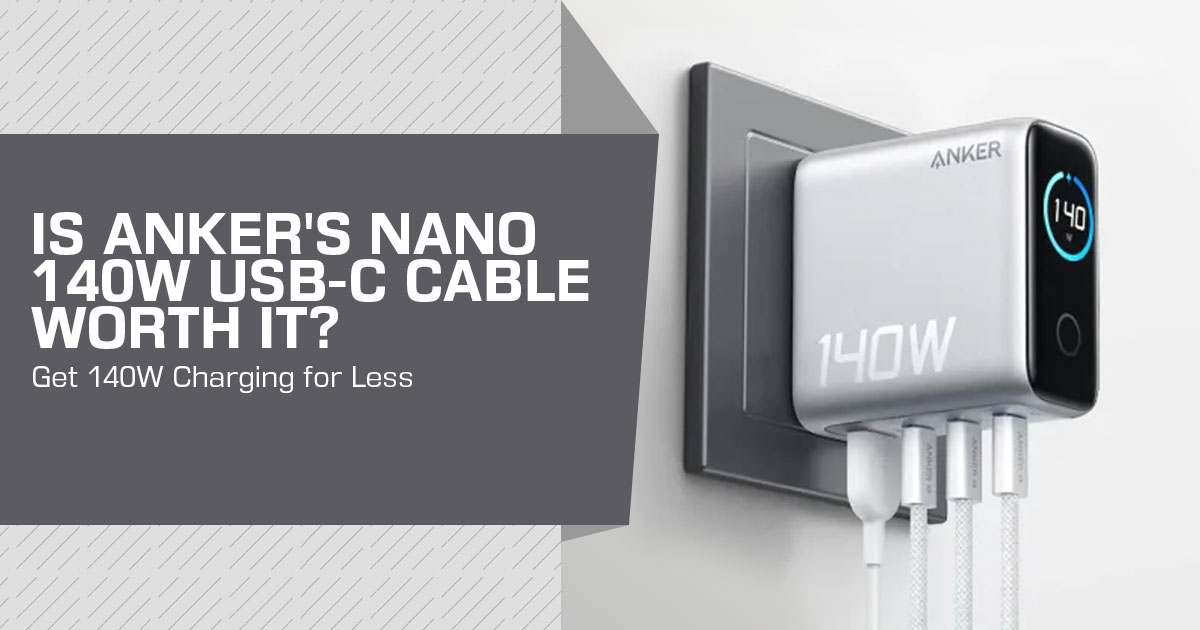
If you have shopped for a USB-C to USB-C cable in the past couple of years, you have likely noticed a pattern. Cables that can fast-charge a laptop often cost around $12–$20, while options under $8 are usually limited to 60W or 100W and may not carry USB-IF certification.
A new release from Anker in China appears to challenge that price gap. The company has launched a 140W USB-C cable starting at roughly $5 — a price normally associated with lower-wattage charging cables. That makes it interesting for laptop users, tablet owners, smartphone users, and anyone looking for a reliable high-wattage USB-C cable without spending too much.
In this article, we look at what is confirmed about the Anker 140W USB-C cable, how it compares with existing Anker cables and other budget USB-C cables, who should consider buying it, who may be better off with a different cable, and what we know about its global availability.
As technology experts with more than 20 years of experience in hardware and application research and development, we carefully evaluate products based on real-world performance, durability, safety, and value for money. Our goal is simple: help you find the right product for your needs, whether you care most about price, performance, reliability, or long-term use.
For this cable, that means looking beyond the headline 140W charging claim and asking the questions that matter to everyday buyers: Can it safely handle high-power charging? Is it durable enough for daily use? Does the low price come with compromises? And is it actually a better choice than spending more on an established cable?
Our recommendations are based on extensive research, component analysis, real-world usability, and industry expertise. We focus on what the product means for people who actually use these cables every day — from students and home users to professionals, laptop owners, frequent travelers, and anyone replacing an old or unreliable charging cable.
——————————————————————————————
Product Overview
The new cable is being sold in China under the name Nano Anti-Dirty Fast Charging Cable. This appears to be a machine translation of the Chinese product name, and an official English name for international markets has not yet been announced.
A note on the model number: The model number is listed as A8060, but Anker already uses A8060 internationally for its existing 240W USB-C to USB-C cable, sold as the Anker Zolo in some regions and as the Anker USB-C to USB-C Cable (240W) on Anker’s own EU store. The A8060 model number is used for both the new 140W China listing and the existing 240W international cable. That makes the model number alone unreliable for identifying the wattage. If you’re buying the cable, check the wattage printed on the packaging and product listing.
The cable offers:
- 140W maximum charging through USB Power Delivery 1, with PPS and QC protocol support
- USB-IF certification
- An e-marker chip with trickle-charging behavior above 80% battery, according to Anker
- A braided, dirt-resistant outer jacket rated for more than 10,000 bends
- Two lengths: 3 ft / 1 m and 6 ft / 1.8 m
- Four colors: black, white, pink, and blue
- A China launch price starting at CNY 90 (roughly $5.20 USD)
On paper, that combination of charging performance, durability, and a roughly $5 starting price makes the cable an interesting option in the budget charging-cable market. The important question is whether the real-world performance and availability match those specifications.
——————————————————————————————
Confirmed Specifications
| Category | Details |
|---|---|
| Reported Product Name | Nano Anti-Dirty Fast Charging Cable (machine-translated English name) |
| Model Number | A8060 — reportedly used for both the 140W China model and the existing 240W international cable |
| Connectors | USB-C male to USB-C male |
| Maximum Charging Power | 140W |
| Charging Protocols | USB PD 3.1, PPS, and QC |
| Certification | USB-IF certified |
| E-Marker Chip | Yes; Anker states that the cable supports trickle charging above 80% |
| Outer Material | Braided exterior with a dirt-resistant nano coating |
| Bend Durability | 10,000+ bends claimed by Anker |
| Available Lengths | 1.0m (3 ft) and 1.8m (6 ft) |
| Colors | Black, White, Pink, and Blue |
| Price Range | CNY 34.90–44.90, depending on cable length |
| Launch Market | China, through an official Anker Youzan listing |
| Global Availability | International availability remains unconfirmed as of September 2026 |
Several specifications are not confirmed in available source material and should not be assumed: data transfer speed, video or DisplayPort Alt Mode support, exact connector dimensions, internal wire construction, warranty length for the China-market variant, and pricing for the longer 6 ft variant. We will update this article if Anker publishes additional specifications.
——————————————————————————————
Key Features and What They Mean for Buyers
140W PD 3.1 Charging
The headline spec is 140W Power Delivery 3.1. For buyers trying to decide between a 140W cable and a 240W USB-C cable, the distinction matters more than many roundups suggest.
What this means in practice: a 140W rating matches the power rating of Apple’s 140W adapter for the 16-inch MacBook Pro, but Apple’s current guidance for USB-C fast charging on 16-inch models from November 2023 onward specifies a 240W USB-C Charge Cable. Anker’s 25-minute charging figure for the M3 model is a manufacturer claim, not an independent test. A 140W cable still provides more than enough power capacity for current smartphones, iPads, the MacBook Air, most 13–14 inch Windows laptops, and handhelds such as the Steam Deck and ROG Ally.
A 240W cable matters when a device can pull more than 140W over USB-C or when the manufacturer specifies a 240W-rated cable for its highest charging mode. This is mainly relevant to certain workstation and gaming laptops. For most other users, a good 140W USB-C cable covers day-to-day charging, while 240W mainly adds headroom for higher-power devices and future upgrades.
USB-IF Certification
USB-IF certification is worth calling out. The USB Implementers Forum says its cable certification program identifies cables that have passed the applicable compliance testing for their category. That is useful evidence of standards compliance, but it is not a blanket guarantee of safety or performance in every use case. Buyers should still check the cable’s stated power and data capabilities.
USB-IF certification at a ~$5 price point is unusual in the current market, and that is the detail that makes this launch worth attention.
PPS and QC Support
The cable supports PPS (Programmable Power Supply) and QC (Quick Charge) alongside PD 3.1, based on the available product reporting.
What that covers:
- PPS is used by Samsung’s Super Fast Charging (2.0/3.0) and by a number of Android devices from Google, OnePlus, and other manufacturers. A cable without PPS can still charge these phones, but may fall back to slower standard-PD rates.
- QC is largely a legacy standard at this point, but support helps with older accessories and some budget Android devices that still rely on it.
For iPhone owners this is mostly academic (iPhones use standard USB PD), but it broadens the cable’s usefulness in households with mixed devices.
E-Marker Chip and Trickle Charging
USB-C cables designed to carry more than 3A require an e-marker chip — a small controller inside the connector head that communicates the cable’s current and voltage capabilities to the charger. This is important for higher-power USB-C charging because the e-marker identifies the cable’s current capability to the source. Anker also describes the new cable as trickle-charging above 80% battery. Anker presents this as a charging-protection feature, but we have not independently tested how the cable and charger manage current near the end of a charge cycle.
Braided, Dirt-Resistant Exterior
The cable uses a braided, dirt-resistant jacket with a nano-coating, described as the same exterior treatment found on the existing 240W cable. Based on that existing product line, the coating is a treated nylon braid designed to resist oil and grime better than plain nylon — lighter colors tend to stay cleaner, and the cable wipes down more easily than untreated braid. It is a quality-of-life feature rather than a performance one, but it is one of the things that tends to separate cables that look new after a year from those that look worn after a few months in a bag.
10,000-Bend Durability
Anker quotes a 10,000-bend rating for the new cable. For context:
- Anker’s premium Prime 240W cable is rated for more than 300,000 bends.
- The new cable’s 10,000-bend rating is well below Anker’s 35,000-bend rating for the 765 140W cable and more than 300,000-bend rating for the Prime 240W cable.
A 10,000-bend rating is reasonable for a budget charging cable, but it is well below Anker’s higher-end durability ratings. Actual lifespan will depend on how the cable is bent, stored, and used.
Length and Color Options
The cable ships in two lengths: 3 ft (1 m) and 6 ft (1.8 m). The shorter length is convenient for portable chargers, car mounts, and bedside use; the 6 ft option is the more practical length for desks, couches, and hotel rooms.
Four colors are listed — black, white, pink, and blue. Color choice is a small feature, but it is useful for cable identification when you are juggling multiple cords.
——————————————————————————————
Real-World Charging Performance (Based on Manufacturer Claims)
Anker’s published figures for the cable include the following charge times when paired with a compatible charger:
| Device | Charge Milestone | Claimed Charging Time |
|---|---|---|
| iPhone 17 | 0% → 50% | 20 minutes |
| MacBook Pro 16-inch (M3) | 0% → 50% | 25 minutes |
These are Anker’s published figures; we have not independently verified them. A few practical notes:
- The cable itself does not set the charging speed; it must be paired with a charger capable of delivering the wattage the device accepts. Pairing this cable with a 20W phone charger will result in 20W charging.
- The 20-minute iPhone 17 figure assumes a 40W or higher adapter, matching Apple’s published fast-charging requirement.
- The 25-minute MacBook Pro figure is a manufacturer claim and assumes a compatible 140W-class power adapter. Apple separately specifies its own cable requirements for fast charging the 16-inch MacBook Pro.
What we cannot confirm at this stage: data transfer speed and video-out capability. On the existing 240W sibling, data runs at USB 2.0 speeds (480 Mbps) and the cable does not support video output / screen mirroring. We would not assume the Nano variant differs in this respect, but we are not stating those specs as confirmed for the new cable until Anker publishes them. Buyers who need external display support, 10Gbps+ data transfer, or Thunderbolt connectivity should look at USB4 or Thunderbolt 4 cables regardless.
——————————————————————————————
Design and Build Quality
Based on product imagery and its shared positioning with the existing 240W cable, the Nano appears to share the same braided exterior design and color palette.
What we can say based on available information:
- The braided nano-coating exterior is designed to resist oil and grime better than untreated nylon, based on Anker’s stated design.
- The four color options match the existing Zolo lineup, suggesting a shared What we cannot confirm without hands-on testing or an official spec sheet:
- Exact connector The existing 240W cable uses a 5.8 mm slim connector, but we cannot confirm the new 140W variant matches that.
- Long-term durability at the strain-relief that.
- Heat behavior under sustained 140W Compliance testing does not replace hands-on thermal testing under sustained real-world loads.
——————————————————————————————
How It Compares to Anker’s Existing 240W Cable
The existing 240W A8060 is the most direct comparison because it shares the model number and a similar dirt-resistant braided design. The table below uses the available specifications for the new China model and Anker’s official listing for the international 240W version.
| Feature | New Nano Anti-Dirty (China) | Anker USB-C to USB-C Cable, 240W (A8060, International) |
|---|---|---|
| Maximum Power | 140W | 240W |
| Charging Protocols | USB PD 3.1, PPS, QC | USB PD 3.1 and PPS (per Anker EU listing) |
| USB-IF Certified | Yes | Yes |
| E-Marker Chip | Yes, with support for controlled trickle charging above 80% | Yes |
| Outer Jacket | Braided construction with a dirt-resistant nano coating | Braided construction with a skin-friendly, anti-dirt nano coating |
| Bend Durability | 10,000+ bends | 10,000+ bends |
| Available Lengths | 3 ft and 6 ft | 3.2 ft and 6 ft |
| Colors | Black, White, Pink, Blue | Black, White, Pink, Blue |
| Data Transfer Speed | Not confirmed | Up to 480 Mbps (USB 2.0) |
| Video Output | Not confirmed | Not supported for video output or screen mirroring |
| Price Range | CNY 34.90–44.90 at the China launch | Varies by retailer and regional market |
Stated plainly: the new cable appears to offer the same build, durability, certification, and color options as the existing 240W model, at a lower wattage and a substantially lower price. For buyers whose devices top out at 140W or below, the trade-off may well be worth it; for anyone needing 240W, the existing cable remains the appropriate choice.
——————————————————————————————
How It Compares to the Wider Market
Pricing is shown only where a current retailer or official-store price was verified:
| Cable | Max Power | Price (Where Verified) | Key Features & Notes |
|---|---|---|---|
| Anker Nano Anti-Dirty (New) | 140W | CNY 34.90–44.90 | USB-IF certified, braided construction, and dirt-resistant design; available only in China at launch. |
| Anker USB-C to USB-C Cable, 240W (A8060) | 240W | Varies by retailer | Supports up to 240W charging and is rated to withstand more than 10,000 bends. |
| Anker 765 USB-C to USB-C Cable (A8866) | 140W | Varies by retailer | Supports 140W USB PD 3.1 charging and carries a 35,000-bend durability rating. |
| Anker New Nylon USB-C to USB-C Cable | 60W | $9.99 (Anker US, 2-pack) | Supports 60W charging, is rated for 12,000 bends, and is offered in 3 ft and 6 ft lengths. |
| Baseus Braided USB-C Cable | 100W | Varies by retailer | Supports 100W charging, up to 480Mbps data transfer, and a claimed 12,000+ bend durability test. |
| JSAUX Braided USB-C Cable | 100W | $5.99 (JSAUX, 6.6 ft, 1-pack) | Supports 100W charging and 480Mbps data transfer with a braided nylon exterior. |
| UGREEN Uno | 100W | $13.99 (UGREEN US, 3.3 ft) | Supports up to 100W charging and includes an integrated LED display. |
| Amazon Basics Braided USB-C Cable | 100W | Varies by retailer | Supports up to 100W charging with a durable braided nylon exterior. |
| Belkin BoostCharge USB-C to USB-C Cable | 100W | $25.99 (Belkin US) | Supports 100W USB-C PD charging and features a reinforced double-braided construction. |
| Anker Prime USB-C to USB-C Cable (A88E2) | 240W | $29.99 (Anker US, 3 ft) | Features an upcycled braided exterior, a claimed 300,000+ bend rating, 480Mbps data transfer, and no screen-mirroring support. |
Two observations stand out.
The clearest price comparison is within Anker’s own lineup: the new Nano starts at CNY 34.90 in China, while the established 765 is another 140W option and the Prime A88E2 reaches 240W. Several budget 100W cables also cost more than the Nano’s China launch price, although these prices come from different markets and retailers.
If the Nano reaches other markets at a price close to its China launch price, it could remain unusually cheap for a 140W-class cable. Until Anker announces international pricing, that remains an open question.
——————————————————————————————
What Buyers Should Know Before Purchasing
What Appears Strong
- A notably low China launch price for a reported USB-IF certified 140W PD 1 cable.
- Sufficient wattage for the majority of phones, tablets, and laptops currently in use, including the 16-inch MacBook Pro.
- PPS and QC support broadens compatibility with Android devices.
- The braided, dirt-resistant build and 10,000-bend rating are a step above smooth plastic cables at comparable budget prices.
- Four colors and two lengths provide some flexibility.
- The e-marker and reported trickle-charging behavior add useful charging-management features, although we have not independently tested them.
Considerations and Open Questions
- Availability is limited to China at Outside China, buyers will need to wait or import. Pricing in other markets is unconfirmed.
- 140W is not Owners of laptops that draw more than 140W over USB-C will want a 240W-rated cable.
- Several specifications are unconfirmed for this specific variant, including data transfer speed and video-out We would not purchase this cable for data or display use until those are published.
- The model number needs A8060 is used for the China 140W Nano listing and for the existing international 240W cable. Buyers should check the printed wattage rating on the packaging and product listing to confirm the version they are buying.
- Long-term reliability in the wild is not yet established.
——————————————————————————————
Who This Cable Is For
Based on the confirmed specifications, the Nano Anti-Dirty Fast Charging Cable is likely to be a good fit for:
- iPhone 15 / 16 / 17 owners looking for a durable fast-charging USB-C cable that resists discoloration.
- 16-inch MacBook Pro owners who want a spare or travel cable; however, the new cable’s full-speed USB-C charging compatibility with these Macs should be treated as a manufacturer claim until independently verified.
- MacBook Air, iPad Pro, and 13–14 inch laptop users who want a single cable that covers phone-to-laptop charging.
- Buyers who have had poor experiences with unbranded budget cables failing early — USB-IF certification at a ~$5 price point is uncommon.
- Multi-device households that need several color-coded spares for home, office, and travel.
- Anyone putting together a travel kit around a 140W GaN charger.
Who Should Look at Other Options
- Gaming or workstation laptop owners with 170W–240W power requirements — a 240W USB-C cable such as Anker’s existing 240W model (A8060) or the Anker Prime 240W (A88E2) is the more appropriate choice.
- Buyers who need video output or high-speed data transfer (external SSDs, docks, 4K monitors) should choose a cable whose data rate and video support match the USB4 or Thunderbolt 4 are good choices for high-bandwidth use, but they are not required for every monitor or SSD.
- Anyone who needs a cable immediately outside China — the cable is not yet available internationally.
- Buyers seeking a premium long-term cable with the highest bend rating and an extended warranty — Anker’s Prime line or third-party aramid/Kevlar-reinforced cables are positioned for that.
——————————————————————————————
Pricing and Availability
As of mid-September 2026, the cable is listed only in China. Anker’s official China Youzan storefront shows a CNY 34.90–44.90 price range for the available variants, with the 3 ft / 1 m model starting at CNY 34.90.
I found no official US, EU, or India launch date for the new 140W model. The existing 240W A8060 is already sold in other markets through Anker’s regional stores, but international pricing varies by market and retailer.
——————————————————————————————
Frequently Asked Questions
Is the new Anker cable USB-IF certified?
The cable is reported as USB-IF certified. USB-IF says products carrying its certification have passed the applicable compliance program testing. We have not independently located a certificate for this specific cable.
Is 140W enough for a 16-inch MacBook Pro?
The 16-inch MacBook Pro models introduced from 2021 onward use Apple’s 140W power adapter class. However, Apple currently specifies a 240W USB-C Charge Cable for fast charging the 16-inch MacBook Pro via USB-C on models from November 2023 onward. So this article should not promise full-speed USB-C charging from a 140W cable without additional confirmation.
Will a higher-wattage cable damage a phone?
No. USB-C devices negotiate the power level they draw. A 140W PD 3.1 cable will allow the device and charger to negotiate an appropriate power level. The cable’s 140W rating is a maximum capability, not a forced output. A higher-rated cable does not make a compatible phone draw 140W.
Do I need a 240W cable?
For most users, no. A 240W cable mainly matters when the device can draw more than 140W over USB-C or when the manufacturer specifies a 240W-rated cable for its highest charging mode. Phones, tablets, ultrabooks, and many laptops do not need 240W.
What does “anti-dirty” or “dirt-resistant” mean?
It refers to a nano-coating applied to the braided exterior that resists oil and grime, so lighter colors discolor more slowly and the cable wipes clean more easily than a standard untreated nylon braid.
Can I use this cable for data transfer or connecting to a monitor?
Data transfer speed and video-out support are not confirmed for this specific variant. The existing 240W A8060 supports USB 2.0 data at 480 Mbps and does not support screen mirroring. Until Anker confirms otherwise, choose a cable whose data rate and display support match your needs. For high-bandwidth use, USB4 or Thunderbolt 4 are strong options.
When will this cable be available on Amazon?
There is no confirmed Amazon or global launch date. We recommend checking Anker’s official storefronts and major retailers for updates rather than relying on rollout predictions.
——————————————————————————————
Final Verdict
Based on the available specifications, the Nano Anti-Dirty Fast Charging Cable is a straightforward product on paper. It appears to share the braided, dirt-resistant build, USB-IF certification, e-marker chip, color options, and length choices of Anker’s existing 240W cable (A8060), but with a 140W maximum instead of 240W and a much lower launch price in China.
For buyers whose devices do not require more than 140W, this is a useful trade-off. That covers most smartphones, tablets, ultrabooks, and many laptops. Households that need several charging cables and people putting together a travel charging kit could benefit the most if the low pricing reaches other markets.
There are some important caveats. Global availability is still unconfirmed outside China, several specifications have not been independently confirmed for this specific variant, and the A8060 model number overlaps with an existing international Anker product. Buyers should therefore check the wattage printed on the packaging rather than rely on the model number alone.
The cable is also not the right choice for everyone. If you need 240W charging, high-speed USB data transfer, or video output, you will need a different cable. But if your priority is charging a phone, tablet, or laptop, and you want PD 3.1, certification, a braided build, and a low price, this new cable could fill a gap that has been difficult to find from a major brand.
If you are in China, the cable is listed now at the prices mentioned above. If you are in the US or India and need a cable today, the closest established Anker option with a similar braided, dirt-resistant design is the existing Anker USB-C to USB-C 240W cable (A8060). It offers a 240W ceiling and more headroom, but it is a different wattage variant.
——————————————————————————————
Where to Buy
Amazon United States
The new Nano Anti-Dirty 140W cable is not currently listed on Amazon US based on our search. For buyers who want a comparable braided, dirt-resistant Anker cable, the existing 240W USB-C to USB-C Cable (A8060) is a comparable option:
If you specifically want 140W rather than 240W, the Anker 765 USB-C to USB-C Cable (140W, model A8866) is widely stocked:
If the Nano launches globally, check Anker’s official listings and major retailers for the 140W model and its current price.
Amazon India
The new Nano Anti-Dirty 140W cable is not currently listed on Amazon India based on our search. Buyers looking for a comparable braided Anker USB-C cable can browse Anker’s current India lineup:
When choosing, look for USB-IF certified models with a power rating appropriate for your devices — 100W for phones and ultrabooks, 140W or higher if your device requires that level of power. We will update this section with direct links if and when the Nano launches in India.
——————————————————————————————
*We cover charging accessories and USB-C technology regularly. This article will be updated as Anker announces global pricing and availability, and as additional specifications (data speeds, warranty terms, exact connector dimensions) are confirmed.*
Have you used a 140W USB-C cable before, or would you consider buying one at this price? Share your thoughts or experience in the comments — your feedback may help other readers make a better choice.
If you find our practical technology reviews and buying guides useful, follow us for more product analysis, comparisons, and honest recommendations.
And if you have any questions or doubts about this cable, USB-C charging, wattage, compatibility, or choosing the right cable for your laptop, phone, or tablet, leave a comment below. We’ll do our best to help.
Disclaimer

This blog post reflects our research, analysis, and opinions based on available product information, user feedback, and industry knowledge. It should not be taken as the official position of any brand, manufacturer, or company mentioned here. We make every effort to keep this guide accurate, but product specifications, pricing, and availability may change after publication. We recommend double-checking important details before making a purchase.

Some links in this article may be affiliate links. If you choose to buy through these links, we may earn a small commission at no extra cost to you. This helps support our work and allows us to keep publishing in-depth, unbiased reviews. Affiliate partnerships never influence our recommendations.

Opinions expressed by readers are their own and do not necessarily reflect ours. We are not responsible for outcomes resulting from the use of information on this site. Please seek professional advice where appropriate.

All product names, logos, and brands mentioned are the property of their respective owners. These names are used for identification and informational purposes only and do not imply endorsement.