
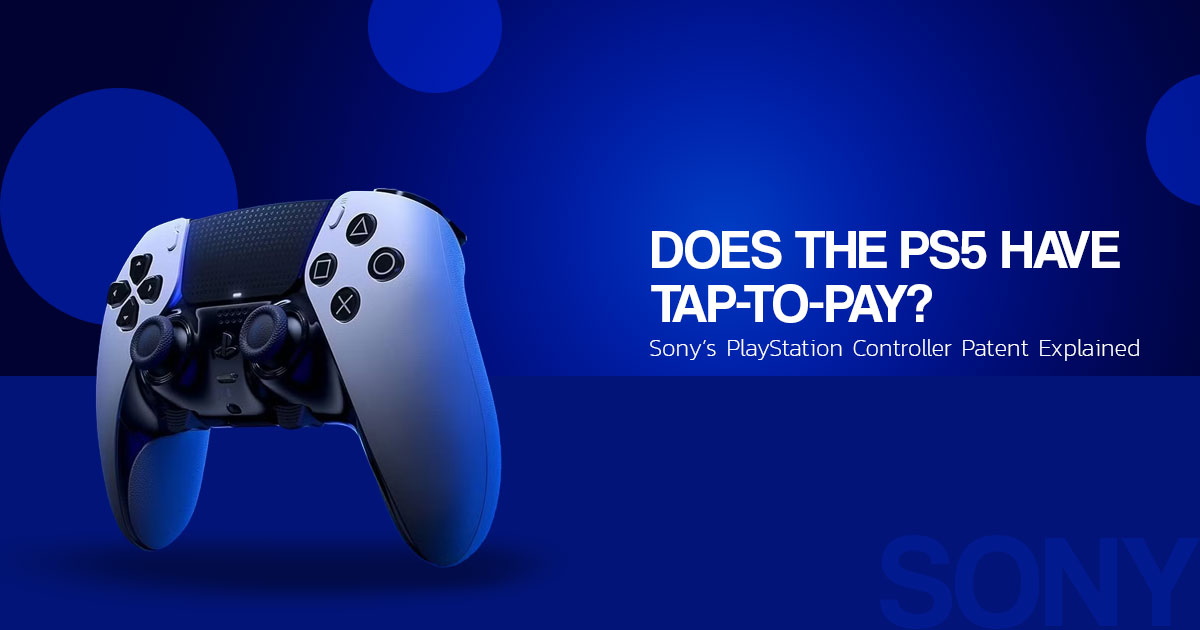
Sony is exploring a new way to handle payments on PlayStation. A pending Sony patent describes a system that could allow a nearby phone, credit card, or gift card to send payment information through a PlayStation controller to a console.
For PS5 owners, PlayStation gamers, and technology buyers, the patent raises a simple question: could a future DualSense controller do more than control games? The proposed system connects NFC-style payment technology with the controller, but there are still important details to understand about how it would work and what Sony has actually filed.
As technology experts with over 20 years of experience in hardware and application research and development, we analyze products based on real-world performance, durability, and value for money. Our goal is to help you find the right product for your needs across budget, performance, reliability, and long-term usage. Our readers include gamers, PS5 owners, PC users, technology enthusiasts, and buyers researching their next device before making a purchase.
Our recommendations are based on extensive research, component analysis, real-world usability, and industry expertise.
It is also important to separate the Sony patent from an actual product. Sony does not currently list a PlayStation controller with tap-to-pay support as an available product. The filing does not confirm a PS5 NFC payment feature, a new DualSense controller with NFC payments, or a PS6 payment system.
So, what does Sony’s patent actually describe, how would the controller-based payment system work, and what could it mean for future PlayStation hardware and digital purchases? Let’s look at the details.
Verified fact sheet: Sony’s PlayStation controller payment patent
| Item | Verified detail | What it means for readers |
| Patent title | “Video Game Controller-Driven Information Transfer” | The filing covers more than payments. |
| Application | US20260273403A1 | Readers can use this number to locate the patent record. |
| Applicant | Sony Interactive Entertainment LLC | This is a Sony Interactive Entertainment filing. |
| Filed | March 17, 2025 | The concept predates its public disclosure. |
| Published | September 17, 2026 | Publication made the application available for review. |
| Status | Pending | It is not proof of a shipping product. |
| Main concept | A controller detects a nearby device, receives information, and forwards it to a console | The controller is described as an intermediary; the filing does not establish a standalone card terminal. |
| Possible communication methods | NFC, Bluetooth, proximity detection, physical contact, and some QR-code scenarios are described across the filing and coverage | The final connection method, if any product appears, is not known. |
| Possible information types | Payment details, gift-card information, player IDs, and other account or content data | The concept extends beyond buying games. |
What Sony’s PlayStation controller patent actually describes
The clearest description is a PlayStation controller that could act as a bridge between a nearby phone or card and the console. The console would request information, the controller would detect the nearby device, and the controller would pass the relevant information to the console.
That workflow is different from saying that a controller would independently approve a purchase like a store’s payment terminal. The patent describes the controller as a bridge in the process. The console would still be involved in responding to the purchase request and handling the next step.
The filing’s abstract describes a controller detecting that an electronic device is within a set distance. The controller then emits a signal, receives confirmation from the nearby device, receives payment-method information, and sends that information to the connected console.
In practical terms, the proposed flow could look like this:
- A payment request or other relevant event appears on the console.
- The player brings a phone, payment card, or gift card close to the controller.
- The controller detects the device and signals that a connection may have been established.
- Payment or account information moves to the console for the relevant request.
- The console receives the information and can use it for the relevant purchase, redemption, login, or account action.
The patent and coverage mention light, sound, or vibration as possible confirmation signals. Those details describe possible embodiments, not a confirmed specification for a future controller.
How the proposed tap-to-pay feature could help players
Faster game and add-on purchases
The most obvious use is buying a game, expansion, cosmetic item, or in-game credits without entering card details with an on-screen keyboard. This could reduce typing, especially for players using a controller from several feet away from the television.
The convenience would matter most when a player has a supported phone or card nearby and has already completed the necessary security checks. It would not remove the need for account authentication, purchase authorization, or parental controls.
Easier gift-card redemption
The filing describes gift-card scenarios in which a physical card could be recognized and its information passed to the console. One example includes a gift-card confirmation and balance information.
That could be useful for players who currently type long redemption codes. However, the patent does not establish that every existing gift card would work with a future controller. Compatibility would depend on Sony’s final hardware, software, card format, and account rules.
A quicker way to join a multiplayer session
The proposed system could also transfer a player ID or help a guest join a multiplayer game. That is a different use case from payment, but it follows the same basic idea: bring a device near the controller and use it to transfer approved information.
This could be useful at local events, demonstrations, or shared-console sessions. It would also raise account-security questions if a phone can transfer identity information to a console.
Sharing screenshots and gameplay clips
The filing and related coverage discuss possible transfers involving screenshots, recordings, clips, and other content. The controller could therefore become a physical interaction point between a console and a phone rather than a device used only for purchases.
Payment is only one part of the invention described in the patent. The same information-transfer system covers other account and content uses.
Buying a game after a demo
One example involves a player trying a game at a store or gaming event. A purchase prompt could appear after the demo, and the player could bring a phone near the controller to add the game to their library for later download.
That model would connect physical demonstrations with digital game ownership. It remains an example in a patent application, not evidence that Sony has announced a new retail program.
The patent describes possible uses such as payment, gift cards, player IDs, multiplayer joining, and content transfer. The presence of an example in a patent does not mean Sony plans to implement every example.
Does the PS5 DualSense have NFC for tap-to-pay?
The safest answer to “Does the PS5 DualSense have NFC?” is that Sony’s current official DualSense® wireless controller page does not list NFC or tap-to-pay as a feature. That absence is not proof that no component in any PlayStation hardware can use NFC, but no reviewed official Sony product page confirms tap-to-pay support for the current controller.
The patent’s illustrations may show hardware resembling the PS5 and the DualSense® wireless controller, but drawings in a patent should not be treated as a product announcement. A future controller could use different hardware, and Sony could also abandon the concept.
As a result, there is no confirmed way to use a standard PS5 controller to tap a credit card and buy a game. A current DualSense® wireless controller may still suit ordinary PS5 gaming, but it should not be marketed as an NFC payment controller without an official Sony specification.
Will the PS6 support tap-to-pay?
There is no confirmed answer to whether the PS6 will support tap-to-pay. Sony has not announced that US20260273403A1 represents a PS6 feature. Some coverage connects the patent with possible next-generation hardware, but that connection remains speculation.
The practical distinction is simple:
| Claim | Evidence-based assessment |
| Sony has publicly described the concept in a patent application | Confirmed by the published application and patent record. |
| A future PlayStation controller could use NFC or another short-range method | Possible based on the described embodiments. |
| The current DualSense® wireless controller can accept tap-to-pay purchases | Not confirmed; current hardware should not be advertised this way. |
| The PS6 will include the feature | Not confirmed. |
| Sony will sell a controller with this feature | Not confirmed. |
Do not buy a current DualSense® wireless controller expecting DualSense tap-to-pay support. No reviewed source confirms that an available controller supports the patented payment workflow.
NFC, Bluetooth, and QR codes: why the connection details matter
NFC payment technology uses short-range wireless communication. It is the familiar technology behind many contactless cards and phone-wallet transactions. NFC is convenient because the devices generally need to be close together.
Bluetooth can support a different part of the interaction, such as communication between a phone and a controller or between a controller and another device. A QR code could provide another setup or verification route. The patent discusses multiple possible ways of detecting or communicating with a nearby device, so it should not be reduced to one guaranteed protocol.
For a buyer, the key point is that the presence of a word such as “NFC” in coverage does not establish compatibility with the current DualSense® wireless controller. The controller, console, phone application, payment network, and account system would all need to work together.
Security and parental-control questions
A tap-to-pay feature on a PlayStation controller would need safeguards before it could be practical for households. Removing manual typing could also make purchase controls more important.
Important implementation questions include:
- Would every purchase require confirmation on the console?
- Could a child trigger a purchase using a nearby phone or card?
- Would the phone need biometric approval or a wallet authorization step?
- How would Sony prevent an unwanted account or player-ID transfer?
- Could a stolen or unlocked phone be used with a controller?
- Would parents be able to disable contactless purchase flows?
- What transaction information would be stored on the phone, controller, or console?
These are not proof that the proposal is unsafe. They are the questions Sony would need to answer if the system became a real product.
If Sony ever ships this feature, buyers should enable purchase authentication, review wallet permissions, use parental controls where appropriate, and avoid treating a nearby unlocked phone as automatically trusted.
Sony tap-to-pay controller vs. current ways to buy PlayStation games
The proposed system would compete with existing purchase and redemption methods rather than replace every one of them.
| Method | Main advantage | Main limitation |
| Console on-screen keyboard | Available on current systems | Slow for long card details or codes. |
| PlayStation mobile app or web store | Can be used away from the television | Requires a separate device and account sign-in. |
| QR-code workflow | Fast when correctly implemented | Requires scanning and may involve several setup steps. |
| Physical gift-card code | Does not require a bank card | Long codes can be tedious to enter. |
| Proposed controller transfer | Could shorten the handoff between a nearby device and the console | Patent only; hardware, security, compatibility, and availability are unknown. |
This comparison explains why the idea is technically interesting without presenting it as a reason to replace a working controller today.
Should readers buy a current DualSense controller?
A current DualSense® wireless controller can suit someone who needs a replacement or an additional PS5 controller. Sony’s official product page lists features including adaptive triggers, haptic feedback, USB Type-C connectivity, Bluetooth connectivity, and support for PS5, PC, Mac, and mobile devices under stated conditions. The buying decision should be based on those documented uses, compatibility, price, and seller reliability.
It should not be based on the expectation of PS5 controller NFC, contactless payment, or access to a patent feature. Sony has not confirmed that existing DualSense® wireless controller models can be upgraded to support the described system.
Current DualSense® wireless controller buying checklist
- Confirm that the listing is for an official Sony DualSense® wireless controller.
- Check compatibility with the intended PS5, PC, or supported device.
- Compare the current price across reputable sellers.
- Review the seller, return policy, and warranty terms.
- Ignore listings that claim “tap-to-pay” or “NFC payments” without an official Sony specification.
- Treat special colors and bundles as cosmetic or package differences unless the listing states otherwise.
Pros and limitations of the patented concept
| Potential strengths | Known limitations |
| Could reduce typing during purchases | Still only a pending patent application. |
| Could simplify gift-card or wallet information transfer | No confirmed retail controller supports it. |
| Could support account, player-ID, or multiplayer workflows | Security and parental-control details are unresolved. |
| Could connect physical demos with digital purchases | NFC, Bluetooth, QR, and other methods are described as possibilities, not final specifications. |
| Could create a more direct phone-to-console interaction | It does not confirm a PS5 update or PS6 feature. |
Amazon US: current controller buying guidance
No reviewed source identifies an Amazon product for the patented PlayStation controller tap-to-pay feature, and Sony has not announced a controller with it. Readers who need a current PS5 controller can check listings for the official DualSense® wireless controller and compare the current price, seller, warranty, and return terms before purchasing.
Check current DualSense offers on Amazon US
That link is a general product-search link, not a claim that any listed DualSense® wireless controller includes DualSense tap-to-pay support.
Amazon India: current controller buying guidance
The same caution applies in India. A current DualSense® wireless controller may suit normal PS5 play, but readers should not pay extra for a listing that claims to include the unconfirmed PlayStation controller NFC patent feature.
Check current DualSense offers on Amazon India
Check the final price, seller, import or warranty terms, and return policy before ordering. Availability and pricing can change.
The Amazon links above are for current DualSense® wireless controller searches, not for a tap-to-pay controller. Verify the exact model and specifications on the product page before purchase.
Frequently asked questions about Sony’s PlayStation controller patent
Can you tap a credit card on a PlayStation controller today?
No reviewed source confirms that an available PlayStation controller supports this. The feature exists as a proposed system in Sony patent application US20260273403A1.
Can a PlayStation controller read gift cards?
The patent describes a possible gift-card use, including recognition and balance information. It does not confirm that current controllers can read gift cards or that Sony will ship the feature.
Is Sony adding NFC to the DualSense?
Sony has not announced an NFC-enabled DualSense® wireless controller based on this patent. Current PS5 owners should not assume that an existing controller supports contactless payments.
Is this a PS6 feature?
It may be relevant to future PlayStation hardware, but Sony has not confirmed that the PS6 will include it. The PS6 connection is an interpretation based on timing and hardware possibilities, not a stated product specification.
What is US20260273403A1?
It is the publication number for Sony Interactive Entertainment’s pending application titled “Video Game Controller-Driven Information Transfer.” The application was filed on March 17, 2025, and published on September 17, 2026.
Is the patented feature worth waiting for before buying a controller?
No purchasing decision should depend on it. The feature is not confirmed, and there is no indication that a current DualSense® wireless controller can receive it through an update. Buy a controller only for its currently documented compatibility and features.
Final verdict: interesting patent, not a current buying reason
Sony’s filing is more substantial than a simple PlayStation controller accepts credit cards headline suggests. It describes a possible bridge between a controller, a nearby phone or card, and a PlayStation console. The same system could potentially handle gift cards, account or player-ID transfers, multiplayer joining, and content sharing.
The buyer-facing conclusion is narrower: the PlayStation tap-to-pay controller is not a product that can be purchased today. The patent does not confirm a PS5 feature, a PS6 specification, or a future DualSense® wireless controller release. Readers shopping now should compare current controller prices and documented features, while treating the patent as a possible direction for future PlayStation hardware rather than a reason to buy immediately.
Still have questions about the Sony PlayStation payment patent, PS5, or the future of DualSense controllers? Leave your question in the comments. If there is something about the patent, payment system, or PlayStation hardware that you want us to look into, tell us what you want to know.
Your question could also help other readers who are trying to understand what this technology could mean for their next PlayStation purchase.
If you found this article useful, follow us for more PlayStation, gaming hardware, PC, and technology updates. We’ll keep breaking down new products and technologies in plain English, so you can make better-informed buying decisions.
Disclaimer

This article is based on our research, analysis, available product information, user feedback, and industry knowledge. It is not an official statement from any brand or manufacturer mentioned in the article. Product specifications, prices, software features, and availability can change. We do our best to keep the information up to date, but please check the latest details with the manufacturer or retailer before making a purchase.

Some links in this article may be affiliate links. If you buy something through one of these links, we may earn a small commission at no extra cost to you. These commissions help support the site and our work. They do not affect how we assess or discuss products. Comments and opinions shared by readers belong to the people who post them and do not necessarily represent our views. Information on this site is provided for general purposes, and we cannot guarantee a particular result from using it. Where professional advice is needed, consult a qualified professional.

All product names, logos, and trademarks belong to their respective owners. We use them only to identify the products and companies discussed and do not imply endorsement or affiliation.