
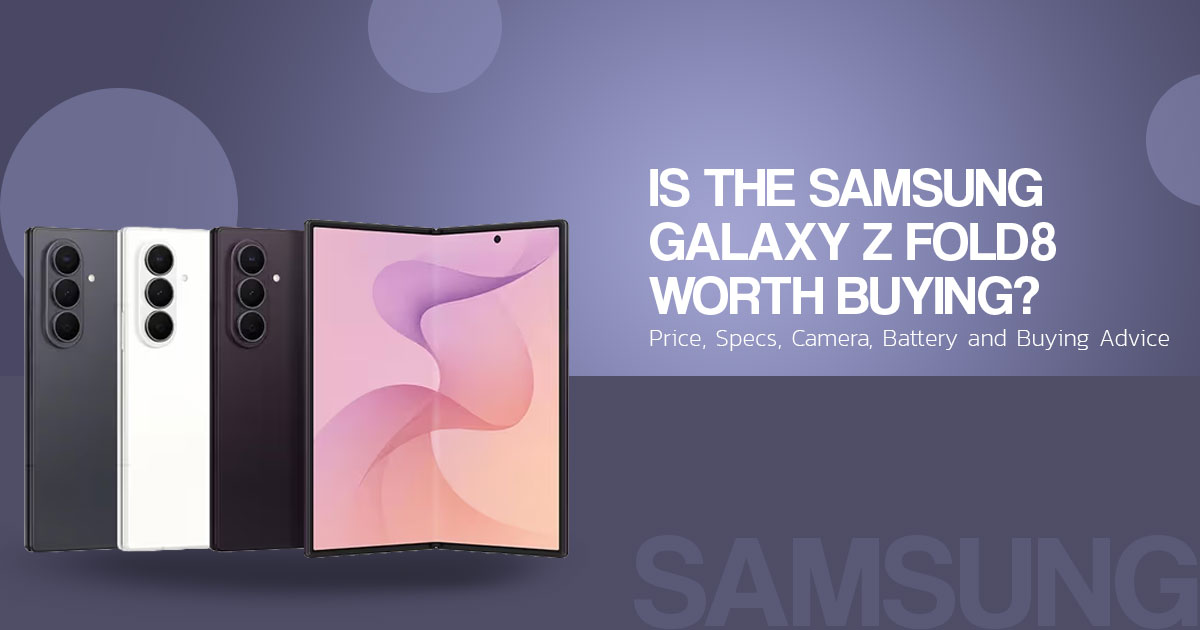
Samsung Galaxy Z Fold8: What You Need to Know Before Buying
The Samsung Galaxy Z Fold8 is aimed at buyers who want a foldable phone that works as both a smartphone and a larger-screen device. It has a 5.5-inch cover display for everyday phone use and a 7.6-inch inner AMOLED display that opens into a wider 4:3 layout for reading, video, work, and multitasking.
The wider design is one of the biggest changes, but it is not the only one. The 120Hz AMOLED display, flagship performance, Galaxy AI features, three-app multitasking, cameras, battery life, charging, and durability all play a part in whether the Fold8 makes sense for you.
That matters because the Galaxy Z Fold8 is a premium phone, and buyers at this price are likely to expect strong performance across the board. A missing feature or hardware compromise can make a bigger difference when compared with other flagship phones and foldables.
As technology experts with over 20 years of experience in hardware and application research and development, we analyze products based on real-world performance, durability, and value for money. Our goal is to help you choose the right product based on budget, performance, reliability, and long-term use.
For the Samsung Galaxy Z Fold8, this review is aimed at professionals, multitaskers, content consumers, frequent phone users, and buyers considering a premium foldable as their main device.
Our recommendations are based on extensive research, component analysis, real-world usability, and industry expertise.
In this review, we look at the Galaxy Z Fold8’s design, displays, performance, cameras, battery, software, durability, and everyday use to help you decide whether it belongs on your shortlist.
Wider foldable design: The Fold8 is built around a shorter, wider shape rather than the traditional tall book-style design. That can make typing, reading and video viewing more comfortable, although some apps show less content vertically on the outer screen.
The Galaxy Z Fold8 review is mainly about usability and form factor rather than a major camera upgrade. The regular Fold8 is aimed at buyers who value moving between a phone and a mini-tablet without carrying a separate device.
Samsung Galaxy Z Fold8 price and availability
Samsung’s US product page lists the Galaxy Z Fold8 price from $1,899.99 before trade-in. Samsung’s official India launch price for the 12GB/256GB model was ₹1,79,999. That difference should be checked against the live Samsung India or retailer listing before publication or purchase.
Samsung lists multiple storage configurations, but the exact selection depends on the market and retailer. The official specification table lists 256GB and 512GB versions with 12GB RAM, plus a 1TB version with 16GB RAM. Availability can vary by market.
At this price level, the Fold8 is considered alongside premium foldables such as the Motorola Razr Fold and Google Pixel 10 Pro Fold in independent comparison coverage. It also competes internally with the larger Galaxy Z Fold8 Ultra, which costs more but offers a different screen shape and a more advanced camera setup.
| Model | Starting price | Best suited to |
| Samsung Galaxy Z Fold8 | $1,899.99 US; ₹1,79,999 launch price in India | Buyers who want the lighter, wider regular Fold8 design |
| Galaxy Z Fold8 Ultra | $2,099.99 US in review coverage | Buyers who prioritise the largest work area and stronger camera hardware |
| Motorola Razr Fold | About $1,899.99 in PCMag’s comparison | Buyers who want more storage and faster charging at a similar US price |
| Google Pixel 10 Pro Fold | About $1,799 in PCMag’s comparison | Buyers who prefer Google’s software and Pixel camera processing |
Prices are market-sensitive and may include temporary offers. The table is for market positioning, not a live price guarantee.
Samsung Galaxy Z Fold8 specifications at a glance
| Specification | Samsung Galaxy Z Fold8 |
| Main display | 7.6-inch Dynamic AMOLED 2X, 120Hz, 1,848 × 2,448 pixels |
| Cover display | 5.5-inch Dynamic AMOLED 2X, 120Hz, 1,248 × 1,972 pixels |
| Peak brightness | Up to 3,000 nits on both displays |
| Processor | Snapdragon 8 Elite Gen 5 for Galaxy |
| RAM and storage | 12GB/256GB, 12GB/512GB or 16GB/1TB, depending on market |
| Rear cameras | 50MP wide + 50MP ultrawide |
| Front cameras | 10MP inner camera + 10MP cover camera |
| Battery | 4,800mAh typical capacity |
| Charging | 45W wired, 20W wireless |
| Weight | 201g |
| Folded thickness | 9.7mm |
| Unfolded thickness | 4.5mm, excluding the display frame |
| Water and particle resistance | IP48 |
| Connectivity | 5G, Wi-Fi 7 and Bluetooth 6.0 in the US specification table |
| Software | Android 17 with One UI 9 |
The listed specifications come from Samsung’s launch materials and official product information. The exact SKU and available configuration should be checked for the buyer’s market.
Design and build quality: a lighter, wider Samsung foldable
The Galaxy Z Fold8 weighs 201g. It measures 123.9 × 81.9 × 9.7mm when folded and 123.9 × 161.4 × 4.5mm when open. Those dimensions make it shorter and wider than the traditional Fold shape.
That change affects daily use in several ways. The outer screen has more horizontal room for typing and reading than a very narrow cover display. The folded phone can also feel closer to a compact notebook or passport in shape than a tall slab phone. The trade-off is that a wider body may not fit equally well in every narrow pocket, and one-handed use is not its strongest area.
Samsung uses an Armor Aluminum frame, Corning Gorilla Glass Ceramic 3 on the cover and Gorilla Glass Victus 2 on the back. The phone also uses Flex Titanium technology in the display structure, which Samsung says helps support a thinner design and reduce the visibility of the crease. Independent reviews generally describe the crease as much less noticeable than on earlier foldables, while noting that long-term wear cannot be judged from launch-period coverage alone.
201g foldable body: The Fold8 attempts to reduce the usual penalty of carrying a book-style foldable. The lighter construction benefits commuters and frequent readers, but the phone remains thicker than a conventional smartphone when folded.
The IP48 rating provides water resistance and protection against particles larger than 1mm under the stated test conditions. It should not be described as fully dustproof. Fine sand and grit remain important concerns for any foldable with a moving hinge and flexible display.
Galaxy Z Fold8 display: why the wider aspect ratio matters
The outer Galaxy Z Fold8 5.5-inch cover screen has a 120Hz refresh rate and a 1,248 × 1,972 resolution. It is suitable for calls, messaging, email, notifications and short-form video. Its wider shape can make typing less cramped than on a narrow cover screen.
However, the cover display is not necessarily the most useful screen for every task. Because it is shorter, some apps show less vertical information at once. Long lists, web pages and messaging threads may require more scrolling. This is one of the practical limitations readers should consider before buying.
Opening the phone reveals a 7.6-inch inner display with a 4:3 aspect ratio, 120Hz adaptive refresh and up to 3,000 nits of peak brightness. The 4:3 layout can reduce the black space seen with some video formats, while 16:9 video still shows black bars. It also creates a larger canvas for games, documents, ebooks and two- or three-app layouts.
Video-friendly inner display: The 4:3 main screen is not just larger. Its shape can reduce letterboxing around common video formats, making the phone more practical for streaming and gaming.
The Galaxy Z Fold8 3000 nits brightness claim refers to a peak figure under specified conditions. It does not mean the display remains at 3,000 nits continuously. In bright outdoor conditions, the high peak rating and Vision Booster support should help visibility, but real results depend on content, temperature and automatic brightness behavior.
Performance and gaming
The Fold8 uses the Snapdragon 8 Elite Gen 5 for Galaxy, a current flagship processor paired with up to 16GB RAM. Review coverage describes the phone as fast for everyday apps, demanding software and gaming.
The large inner display is useful for games that benefit from more room for controls and visual information. PCMag found the form factor particularly comfortable for mobile gaming, but its testing also showed that the Motorola Razr Fold could deliver higher graphics-test results. Android Central and 91mobiles both note that the phone can become warm under demanding gaming loads.
For productivity, One UI supports multi-window use and a three-app side-by-side layout on the main screen. That can be useful for viewing a document while keeping a browser and notes app open. It does not automatically turn the phone into a laptop, but it can reduce the need to switch between apps.
Three-app multitasking: The wider inner screen gives One UI enough room to show three apps side by side. This is useful for research, messaging, notes and reference work, but app scaling is not always perfect.
Galaxy Z Fold8 battery life and 45W charging
The phone has a 4,800mAh silicon-carbon battery. Samsung lists up to 67% charge in around 30 minutes with a compatible 45W adapter under its own test conditions. Wireless charging is rated at 20W. The adapter is sold separately.
Battery results depend heavily on which screen is used, brightness, mobile network conditions and gaming time. 91mobiles reports that the phone can last a full day with moderate use, especially when the cover display handles simpler tasks. PCMag recorded 16 hours and 30 minutes in a high-brightness 1080p video-loop test, while also noting that Samsung’s own endurance claim is based on a different method.
Galaxy Z Fold8 battery life is competitive for a thin foldable, but results vary with usage and testing methods. The Motorola Razr Fold offers faster charging, while the larger Fold8 Ultra has a 5,000mAh battery.
45W wired charging: The Fold8 supports up to 45W wired charging. Buyers should budget for a compatible charger if they do not already own one.
Galaxy Z Fold8 camera review: capable, but not camera-first
The rear system combines a 50MP wide camera with a 50MP ultrawide camera. There is no telephoto lens. The two 10MP front cameras serve the inner and cover screens.
In practical terms, the Galaxy Z Fold8 camera should handle everyday photos, landscapes, group shots and video calls well. Independent coverage describes good detail and color in common lighting conditions. It does not position the phone as the strongest fit for long-range zoom or specialist photography.
The absence of a telephoto camera matters for buyers who regularly photograph distant subjects, portraits or stage events. The Fold8 Ultra has a more advanced camera system, so the regular Fold8 is the better fit for buyers who value size and weight over maximum imaging hardware.
Samsung also adds software tools such as My FanCam, which can track a selected person and reframe existing footage, plus Dual Recording for capturing both sides of a scene. These features are more relevant to social video creators than to buyers who only want traditional camera specifications.
My FanCam and Dual Recording: The Fold8 uses its two-screen design and software to make reframing and front-and-rear capture easier. These tools add flexibility, but they do not replace a telephoto camera.
One UI 9, Galaxy AI and Samsung ecosystem features
The phone runs Android 17 with One UI 9. The software is adapted to the larger display, with multi-window tools, a taskbar and Samsung’s ecosystem functions. DeX can provide a desktop-style interface when the phone is connected to a larger display.
The Galaxy Z Fold8’s Galaxy AI feature set includes tools such as Transcript Assist, Photo Assist, Creative Studio, Now Nudge, Now Brief and My FanCam. Their usefulness depends on the workflow. Transcript Assist can help with meeting notes, while Photo Assist is useful for removing unwanted objects or making quick edits rather than replacing a dedicated editing application.
The software advantage is strongest for readers who already use Samsung tablets, laptops or accessories. File sharing, device continuity and Samsung Cloud can reduce friction across the ecosystem. Buyers who mainly use Google or cross-platform services should still check whether their preferred apps support the Fold8’s unusual screen layouts cleanly.
One important limitation is that apps do not always scale perfectly, and the Galaxy Z Fold8 does not support Flex Mode.
Galaxy Z Fold8 vs Galaxy Z Fold8 Ultra
The regular Fold8 and Fold8 Ultra serve different buyers. The Ultra is not simply a larger version of the same phone; it keeps a more traditional tall-and-squarish foldable design and adds higher-end camera hardware and a larger battery.
| Feature | Galaxy Z Fold8 | Galaxy Z Fold8 Ultra |
| Main display | 7.6-inch, 4:3 | 8.0-inch, more square layout |
| Cover display | 5.5-inch | 6.5-inch |
| Weight | 201g | 215g |
| Battery | 4,800mAh | 5,000mAh |
| Main camera | 50MP | 200MP |
| Telephoto | No | Yes, according to Samsung’s launch table |
| Charging | 45W wired, 20W wireless | 45W wired, 20W wireless |
| Best for | Portability, video, reading and balanced everyday use | Large-screen productivity and more advanced cameras |
Choose between the Galaxy Z Fold8 and Z Fold8 Ultra based on your needs rather than the name. The regular model is the more sensible choice for people who want the lighter body and wider media-oriented format. The Ultra is more appropriate for buyers who want the biggest canvas and a stronger camera system and are willing to pay more.
Galaxy Z Fold8 compared with other foldables
If you are searching for the best foldable phone 2026, the answer depends on the trade-offs that matter to you. The Fold8 focuses on a lighter body and wider 4:3 main display rather than leading every specification category.
- Motorola Razr Fold: Review comparisons highlight more RAM and storage at its starting US price, plus much faster charging. It may suit buyers who value charging speed and capacity over Samsung’s ecosystem and software tools.
- Google Pixel 10 Pro Fold: The Pixel offers a different software experience and strong computational photography. PCMag’s comparison coverage gives the Fold8 an advantage in battery testing, while the Pixel remains a relevant alternative for buyers who prefer Google’s camera and Android approach.
- Galaxy Z Fold8 Ultra: The closest internal It offers a larger display and better camera hardware, but the regular Fold8 is lighter and more compact.
- Galaxy Z Fold7: The Fold8’s wider form factor and brighter, more video-friendly inner display are the main reasons to choose it over an older Fold model. Owners of a recent Fold should compare trade-in value before upgrading.
Pros and cons of the Samsung Galaxy Z Fold8
| Pros | Cons |
| Wider and lighter foldable design | High starting price |
| 7.6-inch 4:3 display works well for video and reading | No telephoto camera |
| Strong flagship performance | Some apps still need layout adjustments |
| 45W wired and 20W wireless charging | Charger sold separately |
| Useful three-app multitasking | Can become warm during demanding gaming |
| Reduced crease visibility | IP48 is not full dust protection |
| Good Samsung ecosystem and AI tools | One-handed outer-screen use is not ideal for everyone |
Who should buy the Galaxy Z Fold8?
The Samsung Galaxy Z Fold8 is worth considering if these points match your priorities:
- You want a foldable phone that is lighter and wider than the classic Fold shape.
- You regularly read documents, watch video or play games on a larger screen.
- You need a phone that can show several apps at once.
- You already use Samsung devices and can benefit from One UI, DeX and ecosystem continuity.
- You accept paying a premium for flexibility rather than choosing a conventional phone with a lower cost per unit of performance.
The phone is less suitable if:
- Camera zoom is more important than the foldable form factor.
- You want charging substantially faster than 45W in this price range.
- You need a fully dustproof phone for beaches, workshops or dusty outdoor work.
- You prefer a compact one-handed phone for most tasks.
- You expect every app to use the unusual display ratios perfectly.
Should you buy the Samsung Galaxy Z Fold8?
The Galaxy Z Fold8 review verdict is positive but conditional. The phone improves the parts of a foldable that affect daily use: weight, screen shape, video viewing, typing and multitasking. It also retains flagship performance and a useful Samsung software layer.
The compromises are equally clear. The phone is expensive, its camera system lacks a telephoto lens, its IP48 rating does not provide full dust protection, and the charging advantage is smaller than on some rivals. The outer screen may also require more scrolling than buyers expect.
For buyers who want a phone that can replace some tablet tasks without carrying a separate device, the Fold8 offers a coherent reason to exist. For buyers who mainly want stronger camera hardware, a lower price or faster charging, a conventional flagship or another foldable may offer better value.
Check the latest Galaxy Z Fold8 offers
Amazon US
The Samsung Galaxy Z Fold8 price can change with storage, colour, trade-in credit and retailer promotions. Check the current Amazon US listing for stock, warranty terms and live pricing before ordering:
Check the latest Samsung Galaxy Z Fold8 offers on Amazon US
Amazon India
Indian pricing can vary by storage configuration, bank offer, exchange value and EMI plan. Check the current Amazon India listing and confirm the exact model number before purchasing:
Check the latest Samsung Galaxy Z Fold8 offers on Amazon India
These links are general retailer search links. Add the publisher’s approved affiliate parameters only through the authorised affiliate account and only after confirming the correct product listing.
Frequently asked questions about Galaxy Z Fold8
Is the Samsung Galaxy Z Fold8 worth buying?
The Fold8 is worth considering for buyers who want a lighter, wider foldable with a large video-friendly screen and strong multitasking. It is less suitable for buyers who prioritise telephoto photography, fast charging, full dust protection or the lowest flagship price.
Does the Galaxy Z Fold8 have a telephoto camera?
No. The regular Fold8 uses a 50MP wide camera and a 50MP ultrawide camera. Buyers who need dedicated optical zoom should consider the Galaxy Z Fold8 Ultra or another camera-focused flagship.
How fast does Galaxy Z Fold8 charge?
The phone supports up to 45W wired charging and 20W wireless charging. Samsung’s 67% in around 30 minutes figure applies to stated laboratory conditions and a compatible 45W adapter, which is sold separately.
How long does the Galaxy Z Fold8 battery last?
Battery life depends on screen choice, brightness, network conditions and workload. Samsung publishes its own endurance claim, while PCMag recorded 16 hours 30 minutes in a high-brightness video-loop test. Those figures use different methods and should not be treated as directly equivalent.
Is the Galaxy Z Fold8 waterproof or dustproof?
The phone has an IP48 rating. It is designed to resist water under specified conditions and particles larger than 1mm, but it is not fully dustproof. Fine sand and grit should be kept away from the hinge and display.
Is the Galaxy Z Fold8 good for gaming?
The Snapdragon 8 Elite Gen 5 and large inner display make the phone suitable for demanding games. Independent reviews also report heat during extended loads, so gaming performance should be considered together with thermal comfort and battery use.
Does the Galaxy Z Fold8 come with a charger?
Samsung’s specification notes that the 45W power adapter is sold separately. Check the retailer box contents before ordering because bundled offers can vary by market.
What is the Galaxy Z Fold8 price in India?
Retail listings can be lower, depending on offers and timing. The official India launch price was ₹1,79,999 for 12GB/256GB. Confirm the current Samsung India or Amazon India listing, the storage variant and any bank or exchange offer before buying.
Have a question about the Samsung Galaxy Z Fold8 or want us to check something we have not covered? Leave a comment below and we’ll take a look.
If you’re comparing phones, laptops, tablets, and other tech before spending your money, follow us for practical reviews, detailed comparisons, buying advice, and clear answers to the questions that matter after the specifications are out of the way. We focus on real-world use, performance, reliability, and value, so you can make a more informed buying decision.
Disclaimer

This article is based on our research, analysis, available product information, user feedback, and industry knowledge. It is not an official statement from any brand or manufacturer mentioned in the article. Product specifications, prices, software features, and availability can change. We do our best to keep the information up to date, but please check the latest details with the manufacturer or retailer before making a purchase.

Some links in this article may be affiliate links. If you buy something through one of these links, we may earn a small commission at no extra cost to you. These commissions help support the site and our work. They do not affect how we assess or discuss products. Comments and opinions shared by readers belong to the people who post them and do not necessarily represent our views. Information on this site is provided for general purposes, and we cannot guarantee a particular result from using it. Where professional advice is needed, consult a qualified professional.

All product names, logos, and trademarks belong to their respective owners. We use them only to identify the products and companies discussed and do not imply endorsement or affiliation.