
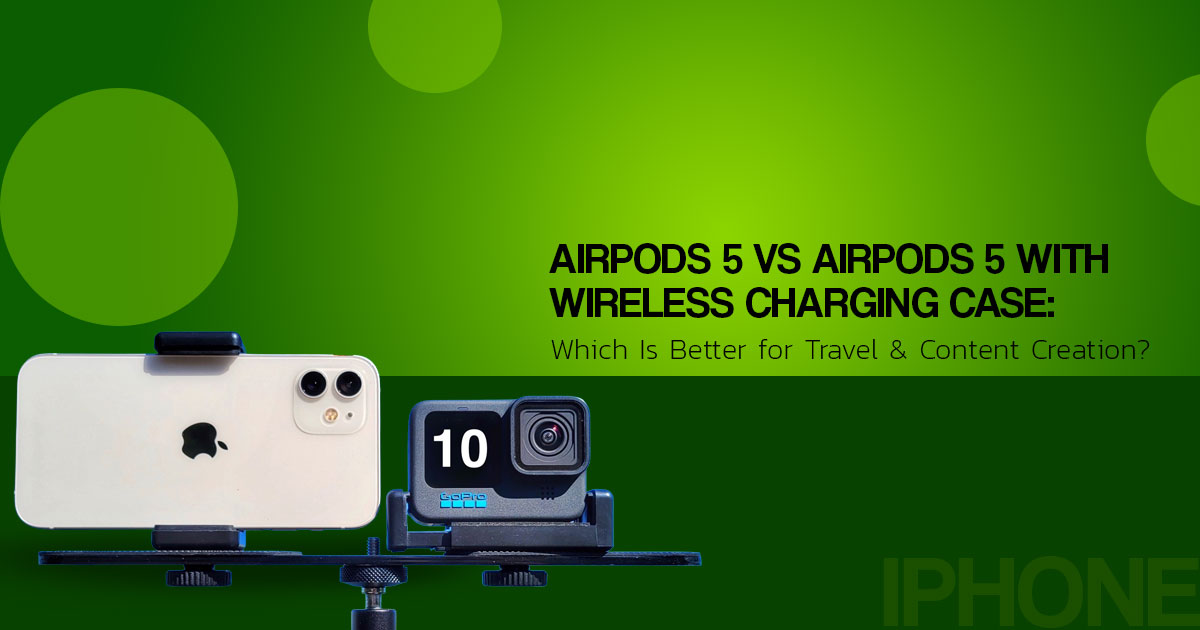
iPhone vs GoPro for Travel: Which Camera Makes More Sense?
Choosing between an iPhone and GoPro for travel depends on the kind of content you plan to shoot. A travel vlogger may need good photos, talking-head videos, low-light performance, clear audio, quick editing, and easy sharing. An adventure traveler may care more about stabilization, ruggedness, water resistance, mounting options, and hands-free shooting.
The best travel camera depends on the trip. A camera that works well for a city break may not be the right choice for a trek, beach holiday, road trip, or water activity.
This guide is for travel vloggers, YouTubers, content creators, photographers, solo travelers, and adventure travelers who are deciding whether to buy a GoPro or use an iPhone for travel photos and videos.
As technology experts with over 20 years of experience in hardware and application research and development, we assess products based on real-world performance, durability, and value for money. Our goal is to help readers choose the right product for their budget, performance needs, reliability, and long-term use. Our recommendations are based on product research, component analysis, real-world usability, and industry experience.
In this iPhone vs GoPro comparison, we look at the areas that matter on a real trip: image quality, video recording, stabilization, battery life, audio, durability, water resistance, portability, storage, editing, and overall value.
The differences become clearer when you look at how each camera handles common travel situations.
Let’s start with the features that matter most before you decide what to pack.
Quick verdict: The iPhone is the better single device for most travel creators. The GoPro is the better specialist camera for POV footage, mounting, water, and high-motion activities.
Scope note: This comparison focuses on GoPro’s action-camera models, such as the HERO line. GoPro’s current lineup also includes other camera types, so check the exact model before buying.
This article is for buyers comparing camera options. Prices, availability, water-resistance limits, and supported features vary by model and region. Check the current product page for the exact model before purchasing.
iPhone vs GoPro for travel: the main difference
An Apple iPhone is a multipurpose device with cameras, a screen, image-processing features, editing apps, cellular connectivity, and fast sharing. It is useful before, during, and after recording. That matters when a creator needs to capture a clip, edit it, add captions, and publish it from the same location.
A GoPro HERO action camera is built for movement and outdoor use. Its design prioritizes quick recording, wide views, stabilization, compact mounting, and protection from the elements. It does not replace a phone, but it can capture angles and activities that are awkward or risky with one.
The useful question is not simply “Which camera has better video?” It is: Which camera creates fewer problems during the type of trip you are planning?
iPhone vs GoPro travel comparison
| Decision factor | iPhone | GoPro | Better fit |
| City walks and sightseeing | Multiple lenses, photos, video, maps, editing, and sharing | Wide action-camera perspective | iPhone |
| Talking-head travel vlogs | Easy to frame and edit; front camera is convenient | Requires more deliberate framing and accessories | iPhone |
| Hiking and cycling | Good for handheld clips, but harder to mount safely | Compact body, dedicated stabilization, and many mounts | GoPro |
| Beaches and water activities | Requires more care and model-specific protection | Designed for outdoor use within stated water limits | GoPro |
| Hotels, restaurants, and night markets | Usually more suitable for low-light scenes | The smaller sensors used in many action cameras can be less forgiving in darkness | iPhone |
| POV travel footage | Possible with a cage or mount, but adds risk and bulk | One of its strongest use cases | GoPro |
| Photos and zoom | Multiple lenses and computational processing | Wide field of view is useful, but less flexible | iPhone |
| Editing and publishing | Simplest all-in-one workflow | Footage can be imported into Quik or another editor | iPhone |
| Storage and batteries | Uses the phone’s internal storage and battery | Removable media and spare batteries can separate filming from phone use | Depends on workflow |
| Purchase decision | May already be owned and need only accessories | Adds a separate camera and accessory ecosystem | Depends on existing gear |
Is an iPhone or GoPro better for travel videos?
For a creator who wants one device, an iPhone for travel videos is often the more practical option. It covers more types of content without requiring a second device. A travel day can include a street interview, a landscape, a meal, a hotel walkthrough, a family photo, and a short vertical video. An iPhone can handle all of those with little setup.
Selected iPhone models offer features such as high-resolution recording, stabilization modes, Cinematic mode, and audio-processing tools. Availability depends on the exact model and software version, so buyers should check the specifications of the iPhone they are considering rather than assuming that every feature is available across the lineup.
A GoPro becomes more useful when the footage involves movement or a difficult environment. A chest-mounted hiking shot, a bicycle ride, a kayak trip, or a rain-soaked trail is easier to record with a GoPro than with a phone that also needs to handle navigation, communication, and other travel tasks.
Video quality and image quality
iPhone video quality
The iPhone generally has an advantage when image processing and lens flexibility matter. Multiple cameras can provide different fields of view, while image processing can help manage exposure, color, and detail without requiring much manual setup.
This makes the iPhone useful for:
- Low-light video in restaurants, hotels, and evening streets.
- Portrait-style clips and interviews.
- Photos and video from the same trip.
- Vertical videos for social platforms.
- Creators who want to edit and publish immediately.
The limitation is that the phone is still a multipurpose device. A good case can reduce everyday risk, but it does not turn an iPhone into a dedicated outdoor camera. Stabilization modes can also crop the image or limit some recording settings on certain models.
GoPro video quality
GoPro HERO cameras are designed around a wide field of view, high frame rates, stabilization, and action shooting. That combination is useful when the camera is moving with the subject or mounted to equipment.
A GoPro for vlogging can be especially effective for:
- Wide walking footage.
- Mountain biking and cycling.
- Hiking and climbing.
- Water sports and beach activities.
- Hands-free POV travel footage.
- Time-lapse and motion-heavy sequences.
The main limitation is low light. Many action cameras perform best outdoors in good lighting. In a dark room or at night, footage can show more noise, softer detail, or motion blur than expected. A GoPro can still record in those conditions, but its outdoor strengths do not automatically carry over to every indoor scene.
Higher resolution does not automatically mean better travel footage. Framing, light, audio, stability, and the ability to capture the moment often matter more than the largest number on a specification sheet.
Stabilization: iPhone Action mode vs GoPro HyperSmooth
Stabilization is one of the main differences in an iPhone vs GoPro video quality comparison.
The iPhone can produce smooth handheld footage, particularly on models with advanced stabilization features. Action mode can help when walking or running, but it may crop the image and is not available with every resolution or frame-rate combination.
GoPro’s HyperSmooth stabilization is designed for more aggressive movement. It is useful when the camera is attached to a helmet, chest mount, handlebar, vehicle, or backpack. The camera can stay pointed at the action while the user focuses on the activity.
For a calm walk through a city, an iPhone may be enough. For a rocky bike trail or a mount that shakes throughout the ride, GoPro stabilization is generally the better fit.
Which is better for low light?
The iPhone is usually the stronger choice in iPhone vs GoPro low-light comparisons. Phones benefit from image processing and, on some models, more capable camera systems. They are often more forgiving in hotels, museums, restaurants, and nighttime streets.
GoPro HERO cameras are strongest when there is enough light for their wide lens and fast-moving capture. Newer models may improve low-light performance, but results vary by model. Anyone who expects to film night markets or indoor travel stories should review sample footage from the exact GoPro model before buying.
For many travel creators, that means using the iPhone for evening and indoor scenes and the GoPro when the day involves movement or outdoor action.
Audio matters more than many buyers expect
A camera can produce sharp footage and still make a video hard to watch if the voice is difficult to understand. Wind, traffic, crowds, engines, and water can overwhelm built-in microphones.
The iPhone is convenient for quiet environments and short clips. A compatible wireless microphone can improve interviews, walk-and-talks, and outdoor narration. The advantage is that the same device can be used for recording, editing, and publishing.
GoPro audio can work well when the camera is close to the subject and conditions are controlled. For travel narration, creators may need a suitable audio accessory, compatible microphone, or separate recording setup. Accessories add cost and setup time.
If the video includes spoken narration, budget for audio before buying another lens or mount. Prioritize clear audio before adding camera accessories that do not improve sound quality.
Durability, water resistance, and mounting
This is an area where GoPro HERO action cameras generally have an advantage.
A phone can be used near water, but its protection depends on the model, seals, case, and condition of the device. Water resistance is not the same as unlimited underwater use, and liquid damage may not be covered in every situation.
A GoPro HERO action camera is built for outdoor use and supports a broad range of accessories. Depending on the model and setup, it can be attached to a chest harness, helmet, handlebar, backpack, grip, or tripod. That makes GoPro mounting useful for footage that would be difficult to capture by hand.
An iPhone can also be mounted with a cage, clamp, tripod, or gimbal. However, the setup can become larger and more expensive, and the risk of damaging or losing the phone is higher. A mounted iPhone may also be less convenient to access for calls, navigation, or quick edits.
Check the manufacturer’s stated water depth, door configuration, temperature range, and accessory requirements for the exact model.
Battery life and storage for travel videos
Battery life depends on resolution, frame rate, stabilization, screen brightness, temperature, network activity, and how often the camera is started and stopped. There is no general rule that an iPhone or GoPro will last longer in every travel setup.
The iPhone has one major workflow advantage: it is already part of the traveler’s daily kit. The downside is that recording can reduce the battery available for navigation, communication, payments, and emergency use. A power bank is often useful for a full day of mobile vlogging.
GoPro HERO cameras separate filming from phone use. Supported models can use spare batteries and removable storage, which can make longer shoots easier to manage. The trade-off is carrying and organizing more equipment.
Before a trip, plan for:
- Extra power for the longest filming day.
- Enough storage for high-resolution clips.
- A way to back up important footage.
- A charging method that works in the destination.
- A method for labeling clips from different cameras.
Editing and publishing on the road
The iPhone generally offers the most convenient workflow for iPhone video editing. Clips can be trimmed, captioned, resized for vertical viewing, and shared from the same device without moving files to another device. That is useful for creators who publish travel updates on the road.
GoPro footage can be edited in the Quik app or another desktop editor. Quik supports importing footage from a GoPro, phone, or other camera, while desktop editing can be useful for longer projects. High-resolution clips can also use a lot of phone storage when copied for editing.
Creators who plan to make longer YouTube videos should consider a laptop, portable solid-state drive, or reliable cloud backup. Creators focused on short-form clips may find that an iPhone-only workflow is faster, while a GoPro adds better source footage for action sequences.
Which camera is better for different travel scenarios?
City travel and sightseeing
Choose the iPhone. It is better suited to changing between photos, video, navigation, translation, communication, and publishing. Its lenses are more useful for varied subjects than a fixed wide action-camera view.
Hiking and trekking
Choose the GoPro if the trip includes walking footage, uneven terrain, rain, or hands-free recording. Choose the iPhone if the priority is landscape photography, detailed close-ups, or a narrated travel diary.
Cycling and motorbike travel
Choose the GoPro for handlebar, helmet, chest, or vehicle mounting. It keeps the phone available for navigation and reduces the risk of damaging a primary communication device.
Beaches, snorkeling, and water activities
Choose the GoPro after checking the exact model’s water-resistance limits and required accessories. The iPhone can be useful on dry land, but it should not be treated as a replacement for an action camera when water use is central to the trip.
Night markets and indoor travel
Choose the iPhone. It is generally the more flexible option for low-light scenes, people, food, and indoor storytelling.
Family vacations
Choose the iPhone for simplicity. It is more likely to be available for photos, video calls, maps, messages, and quick sharing. Add a small tripod or phone gimbal for vlogging if smoother shots are important.
Adventure-heavy travel
Using both can be reasonable when the budget allows and the trip includes different filming conditions. The iPhone can cover the story, while the GoPro captures movement and environmental detail.
Do you need a GoPro if you already have an iPhone?
Not necessarily. If the existing iPhone produces footage that meets the creator’s needs, buying a GoPro may not improve the most important parts of the workflow. A microphone, compact tripod, phone grip, small light, or storage solution may offer better value.
A GoPro becomes easier to justify when one or more of these conditions apply:
- The trip includes water, mud, snow, or frequent rain.
- POV or hands-free footage is central to the content.
- The creator wants to mount a camera to a bike, helmet, chest, or vehicle.
- The phone must remain available for navigation and communication.
- The creator wants separate batteries and removable storage.
- The risk of damaging an expensive phone is a serious concern.
Total cost: camera price is only the beginning
A realistic total cost of a travel-vlogging setup includes more than the camera body.
| Cost category | iPhone setup | GoPro setup |
| Main device | Existing phone may already be owned; a new high-end model can be expensive | Dedicated camera purchase |
| Protection | Case, screen protection, and possibly a cage | Protective case or lens protection depending on use |
| Power | Power bank and charging cable | Spare batteries, charger, or charging grip, depending on model |
| Storage | Internal storage and backup drive/cloud plan | microSD card, phone storage, and backup drive/cloud plan |
| Audio | Compatible wired or wireless microphone | Compatible microphone accessory or wireless setup |
| Support | Tripod, grip, cage, or gimbal | Grip, tripod, extension pole, and action mounts |
| Water use | Model-specific case or careful handling | Verify model-specific depth and accessory limits |
Value depends on what is already in the traveler’s bag. An existing iPhone plus a microphone may cost less than a new GoPro kit. A creator who already owns a suitable phone may still benefit from a GoPro if action footage is the main reason for the purchase.
Pros and cons
iPhone pros
- Strong all-purpose device for travel content creation.
- Multiple cameras and useful fields of view.
- Convenient for photos, video, editing, and publishing.
- Usually more practical for low-light and indoor scenes.
- Useful for navigation and communication beyond filming.
- Large selection of editing and microphone accessories.
iPhone cons
- More fragile and expensive to risk during action activities.
- Recording uses battery needed for travel essentials.
- Mounting requires extra accessories.
- Internal storage cannot be swapped like a memory card.
- Stabilization modes may crop footage or limit settings.
GoPro pros
- Compact and designed for outdoor movement.
- Strong choice for GoPro POV camera footage.
- Easier to mount on equipment and wearables.
- More suitable for water and rough conditions within model limits.
- Separate batteries and removable storage can simplify long shoots.
- Quick capture reduces setup time during activities.
GoPro cons
- Wide action-camera footage is not ideal for every subject.
- Low-light performance can be less consistent than an iPhone.
- Additional audio, batteries, mounts, and storage raise the total cost.
- Editing may involve importing footage into the Quik app or another editor, depending on the workflow.
- A separate camera adds another device to carry and maintain.
Official product and store links
Apple iPhone
- Official Apple iPhone US page
- Official Apple iPhone US buying page
- Official Apple iPhone India page
- Official Apple iPhone India buying page
GoPro
Amazon US
- Check current iPhone prices on the Apple Amazon US store
- Check current GoPro prices on the GoPro Amazon US store
Amazon India
- Check current iPhone prices on the Apple Amazon India store
- Check current GoPro prices on the GoPro Amazon India store
Amazon prices, sellers, warranties, and available models can change. Before ordering, check the listing’s Sold by, Ships from, warranty coverage, storage configuration, and regional compatibility.
Final verdict: iPhone or GoPro for travel content creation?
Choose the iPhone if the goal is to carry one device that handles travel photos, video, low-light scenes, voice clips, editing, navigation, and publishing. It is the stronger choice for beginners, city travelers, family trips, and creators who already own a capable model.
Choose the GoPro if the content depends on movement, water, mounting, or rugged conditions. It is the more appropriate tool for action sports, cycling, hiking POV footage, and situations where a phone is difficult or risky to use.
Choose both when the trip needs a complete range of shots. The iPhone can provide the main narrative and finished social posts. The GoPro can add stable, wide, hands-free footage that makes the travel story more varied.
The best camera for travel vlogging is therefore not the same for every traveler. The right purchase is the one that matches the trip, the existing gear, and the way the finished content will be edited and shared.
The Apple iPhone generally serves as the broader all-rounder, while a GoPro HERO action camera serves a more specialized action role. Consider a second device only when it solves a specific filming problem.
Frequently asked questions
Is an iPhone or GoPro better for travel videos?
An iPhone is generally better for travel videos, photos, low-light scenes, editing, and publishing. A GoPro is generally better for action, water, mounting, and hands-free POV footage.
Is GoPro better than iPhone for vlogging?
It depends on the vlog. The iPhone is usually better for talking-head content, indoor scenes, photos, and fast publishing. A GoPro is usually better for outdoor, high-motion, and mountable footage.
Can an iPhone replace a GoPro for travel?
Yes, for many travelers. An iPhone can replace a GoPro when the trip mainly involves handheld footage, photos, city exploration, family content, and social publishing. It is not a complete replacement when water resistance, mounting, or extreme movement is central to the trip.
Which is better for travel: iPhone or GoPro in low light?
The iPhone is generally the safer choice for low-light travel content. Action-camera results vary by model, so buyers should review footage from the exact GoPro they plan to purchase.
Is an iPhone or GoPro better for underwater and beach footage?
A GoPro is usually the better option for water-focused footage, provided the exact model’s water-resistance limits and accessories are followed. Do not assume that a device’s splash resistance means unlimited underwater use.
Which has better stabilization, iPhone Action mode or GoPro HyperSmooth?
The iPhone can produce smooth handheld footage, while GoPro stabilization is designed for more aggressive movement and mounted action shots. GoPro is usually the better fit for cycling, running, and POV use; the iPhone is often sufficient for ordinary walking clips.
Which has better audio for travel vlogging, an iPhone or GoPro?
Neither should be judged only by its built-in microphones. Both can benefit from an appropriate external microphone, especially in wind, crowds, and moving vehicles.
Do you need a GoPro if you already have an iPhone?
No, not automatically. Buy a GoPro when you need action mounting, water use, hands-free POV footage, separate batteries, or a camera that can be exposed to conditions where a phone is inconvenient or risky.
What accessories should be bought for iPhone travel vlogging?
Start with a compact tripod or grip, a reliable power bank, storage or backup plan, and an external microphone. Add a gimbal only if consistently smooth walking footage is important.
How do battery life and storage compare for iPhone and GoPro travel videos?
The iPhone avoids carrying a second device but shares its battery and storage with travel tasks. A GoPro can use spare batteries and removable storage, but the complete kit requires more planning and accessories.
Should you buy a GoPro or DJI Osmo Pocket for travel vlogging?
A GoPro is usually the better fit for rugged action, mounting, and water. A gimbal camera is often better for stabilized walk-and-talk footage and smoother everyday movement. The choice depends on whether the trip is action-led or story-led.
Still not sure whether an iPhone or GoPro is right for your next trip? Tell us what you’re planning.
Where are you traveling, what kind of videos or photos do you want to shoot, and which camera are you considering? Drop your questions or doubts in the comments. We’ll help you work through the options based on your actual travel needs.
And if you’ve already used an iPhone or GoPro while traveling, share your experience in the comments. Your experience could help another traveler make a better buying decision.
Follow us for more honest product comparisons, practical buying guides, and technology reviews.
Disclaimer

This article is based on our research, analysis, available product information, user feedback, and industry knowledge. It is not an official statement from any brand or manufacturer mentioned in the article. Product specifications, prices, software features, and availability can change. We do our best to keep the information up to date, but please check the latest details with the manufacturer or retailer before making a purchase.

Some links in this article may be affiliate links. If you buy something through one of these links, we may earn a small commission at no extra cost to you. These commissions help support the site and our work. They do not affect how we assess or discuss products. Comments and opinions shared by readers belong to the people who post them and do not necessarily represent our views. Information on this site is provided for general purposes, and we cannot guarantee a particular result from using it. Where professional advice is needed, consult a qualified professional.

All product names, logos, and trademarks belong to their respective owners. We use them only to identify the products and companies discussed and do not imply endorsement or affiliation.