
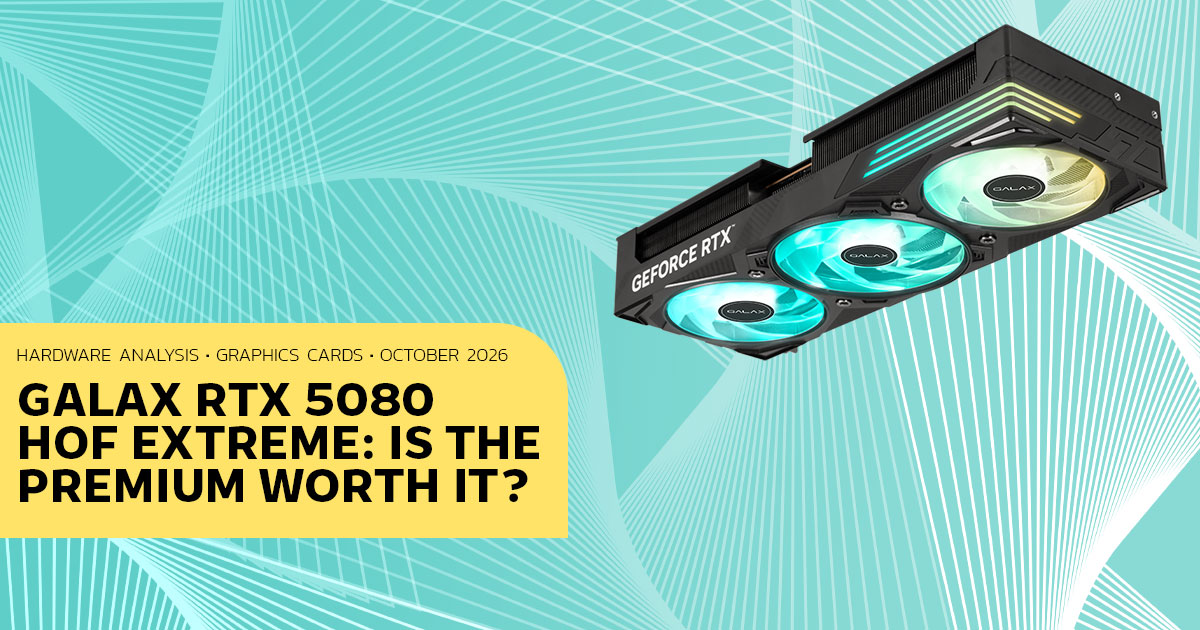
Two 16-pin power sockets sit on the GALAX GeForce RTX 5080 HOF Extreme. Only one is live at a time.
The GALAX GeForce RTX 5080 HOF Extreme takes a different approach to premium graphics card design. It features two 16-pin power connectors, though only one operates at a time, along with a custom white PCB, 20+4-phase power delivery design, a 400 W OC-mode power target and Swarovski crystal inlays. These features put it in a category aimed at extreme overclockers, PC enthusiasts and collectors rather than mainstream gamers.
Its price raises a harder question. Listed in China at ¥19,999, the card was reported at around US$2,995 at launch. That is a steep premium over the standard NVIDIA GeForce RTX 5080, which launched at US$999 with 16 GB of GDDR7 memory. But launch prices do not tell the whole story. With RTX 5080 and RTX 5090 graphics card prices shaping the high-end market in October 2026, the HOF Extreme deserves a closer look before buyers decide whether its features justify the cost.
As technology experts with over 20 years of experience in hardware and application research and development, we assess products based on performance, durability, reliability and value for money. This analysis is intended for PC builders, gaming enthusiasts, extreme overclockers and buyers considering a premium graphics card for gaming, content creation or a custom PC build.
We compare the GALAX RTX 5080 HOF Extreme with four other RTX 5080 models, examine its specifications against manufacturer documentation, and assess its position in the current market. This is a research-based analysis, not a hands-on review. We have not tested the card in our own lab; our findings draw on published specifications, manufacturer information, launch coverage and independent test data.
01. The card in one breath
GALAX’s Hall of Fame line sits at the top of its range, positioned in GALAX’s own words as the record-breaking flagship series built for enthusiasts who overclock. The company and the HOF brand are managed from Palit Group headquarters.
This generation, the line leans less on record-chasing and more on the display case. The HOF Extreme is a GB203 board with a 20+4 phase VRM on a custom white PCB, a four-fan cooler, a physical dual-BIOS switch, and crystal inlays on the front and back of the shroud.
Launch coverage reports 13 Swarovski crystals across the card’s front and back. GALAX confirms genuine Swarovski crystals on both faces.
None of the hardware is unusual for a flagship. What is unusual is the connector arrangement, and it is worth understanding properly, because it is the card’s main reason for existing.
02. Two sockets, one cable
A 12V-2×6 cable is thick, stiff, and about as photogenic as a garden hose. In a glass-panel case it tends to press against the side glass or cut across the middle of the card you paid a premium to look at. Builders have spent years working around it with right-angle adapters of varying quality. Solving that at the factory is a reasonable thing to charge for.
GALAX’s answer is a second socket. One input sits where you would expect, on the top edge. The other is recessed on the opposite face, tucked behind the shroud. You choose the one that gives the cleaner run from your power supply, plug in, and cover the unused port with the bundled magnetic cap.
The two inputs are alternatives, not a pair. GALAX’s launch materials and the coverage that followed describe one connector in use at a time, and the arithmetic explains why a second cable would add nothing: maximum draw in OC mode is 400 W, and a single 12V-2×6 connection is rated to 600 W. That leaves 200 W of headroom before the connector is doing anything interesting.
| THE RUMOR | Two 16-pin ports meant 1,200 W of delivery, or parallel load-sharing to stop connectors melting. |
|---|---|
| OFFICIAL POSITION | The ports are alternative routing inputs. Neither GALAX’s release nor the launch coverage describes using them together. |
| THE SAFETY BIT | An onboard eFuse detects abnormal current, voltage and surges along the power path to help protect the card’s core components. |
The eFuse is another part of the protection design. GALAX says it detects abnormal current, voltage and surges along the power path to help protect the GPU, memory and power-delivery circuitry. It is a safeguard, not a guarantee against damage.
03. Where the premium actually goes
GALAX specifies a 20+4-phase power design but does not detail phase allocation in its launch announcement. The 400 W figure is total card power, not the load on the GPU-core phases alone. A higher phase count can help distribute current and manage heat, but without electrical testing it does not prove greater stability or longer service life.
The same logic explains the white PCB. Plenty of “white edition” cards are a white shroud bolted over a black board, which looks convincing until you view the card from underneath or through a side panel at an angle.
GALAX uses a white substrate and white-finished heat pipes, so the finish holds from every angle. Whether that is worth money is a question about your case, not about your GPU.
To be blunt: none of this shows up as extra frames. It makes the card easier to route and more consistently finished. Those are legitimate things to pay for. They are simply not performance.
PTM7950 and Long-Term Thermal Maintenance
Thermal paste degrades. Under constant heating and cooling it gets squeezed out from between the die and the cold plate, a process called pump-out, and hotspot temperatures creep upward. Two or three years in, a heavily used card starts running hotter and louder than it did when it was new. The fix is a teardown and a repaste.
GALAX lists Honeywell PTM7950 between the GPU and cold plate. This phase-change material softens at operating temperature to help maintain contact and transfer heat. Honeywell publishes reliability testing for the material, but we have no long-term data for this card. PTM7950 may reduce pump-out risk compared with some pastes; it does not rule out future maintenance.
One correction to the marketing framing: this is no longer a Hall of Fame exclusive. ASUS lists a phase-change thermal pad on its ProArt GeForce RTX 5080 16GB GDDR7 OC Edition as well, and the material is spreading across the generation. PTM7950 is a good decision here. It is not, on its own, a reason to pay this card’s premium.
05. Clock Speed vs Real-World Performance
The OC profile runs 2,805 MHz against NVIDIA’s 2,617 MHz reference. That is 188 MHz, or about 7% on paper. Real gains are smaller.
Independent tests of factory-overclocked RTX 5080 cards show small, game-dependent gains. GamersNexus measured about 2.6% to 4.5% in two 4K comparisons of the Zotac RTX 5080 Solid against the Founders Edition. That is a different card, not the HOF Extreme. GALAX has published no benchmarks for this model, so its uplift remains unverified.
The extra 40 W gives the HOF Extreme a higher OC-mode power target. Whether that improves sustained clocks or performance depends on workload, temperature and power limits. Without tests of this card, we cannot quantify the benefit. It is not the same as moving up a GPU tier.
A 7% clock advantage does not reach across a doubled core count.
The gap to an RTX 5090, meanwhile, is not one that overclocking closes. The 5090 carries 21,760 CUDA cores and 32 GB of memory on a 512-bit bus. The 5080 carries 10,752 cores and 16 GB on 256 bits. A 7% clock advantage does not reach across that.
06. Four fans, eight heat pipes, one loud button
Three 102 mm fans sit above a vapor chamber and eight heat pipes: three measuring 8 mm and five measuring 6 mm. A fourth 92 mm fan is integrated into the backplate. The design is intended to move heat from both sides of the card, but its effect on nearby motherboard temperatures has not been independently measured.
There is also a Hyper Boost button on the I/O bracket. Press it and the fans go to maximum for immediate headroom. It ships disabled, with an LED to show which state it is in, and GALAX has made the button smaller this generation so it stops snagging on tight case frames during installation. It is a benchmarking tool, not a daily setting.
We have no independent noise measurements, so we cannot say how quiet this card runs. Gaming mode has a lower 360 W target than OC mode’s 400 W, but actual noise depends on fan settings, case airflow and workload.
07. Will it fit? Read the width, not the length
The card measures 347.5 × 158 × 79.1 mm with the bracket fitted, and 335.9 mm long without it. Its 79.1 mm thickness is roughly four expansion slots, though actual case compatibility depends on the case layout and clearance.
Length is only one part of GPU clearance. GIGABYTE’s GeForce RTX 5080 GAMING OC 16G is 340 mm long, while ASUS’s ProArt card is 304 mm. The HOF Extreme is longer than both, but its 158 mm width and 79.1 mm thickness may be the tighter constraints. Check length, width, thickness and room for the power cable against your case specifications before buying.
Power is the easy part. GALAX recommends an 850 W supply. An ATX 3.1 unit with a native 12V-2×6 cable is the cleanest route; otherwise the box includes a 3× 8-pin to 12V-2×6 adapter and a 15 cm extension cable.
Before installation: decide which socket you are using while the card is still on the bench. Swapping the magnetic cover is far easier there than reaching through a cable-routing grommet once everything is mounted.
08. How it stacks up against four alternatives
| Model | Boost Clock | Cooling | Power | Size | Who It Suits |
|---|---|---|---|---|---|
| GALAX GeForce RTX 5080 HOF Extreme | 2,805 MHz OC 2,655 MHz Gaming |
4 fans (3 × 102 mm + 1 × 92 mm), vapor chamber, PTM7950 | 2 × 12V-2×6 (one in use); 400 W OC target | 347.5 × 158 × 79.1 mm About 4 slots |
White showcase builds, cable concealment |
| GALAX GeForce RTX 5080 1-Click OC White | 2,625 MHz stock 2,640 MHz 1-Click OC |
3 × 92 mm WINGS 3.0, fan stop at idle | 1 × 16-pin; power not listed | 315 × 140.5 × 50.7 mm 2.5 slots |
White build, mainstream budget |
| ASUS ProArt GeForce RTX 5080 16GB GDDR7 OC Edition | 2,730 MHz OC 2,700 MHz default |
Triple Axial-Tech fans, vapor chamber, phase-change pad | 1 × 16-pin; power not listed | 304 × 126 × 50 mm 2.5 slots |
Creators, USB-C output, compact |
| GIGABYTE GeForce RTX 5080 GAMING OC 16G | 2,730 MHz | WINDFORCE triple-fan, vapor chamber, thermal gel | 1 × 16-pin; power not listed | 340 × 140 × 70 mm About 3.5 slots |
High-airflow builds |
| NVIDIA GeForce RTX 5080 Founders Edition | 2,617 MHz (reference) | Dual-slot, dual flow-through, 3D vapor chamber | 1 × 16-pin; 360 W reference | 304 × 137 mm 2 slots |
Compact and SFF builds |
Specifications are compiled from manufacturer pages and launch coverage. Where a manufacturer does not publish a model-specific board-power figure, we do not treat the reference figure as a confirmed model limit.
Three things stand out from that table, and none of them flatter the flagship.
The HOF Extreme has the highest listed boost clock in the table at 2,805 MHz, 75 MHz above the 2,730 MHz figures listed for GIGABYTE and ASUS. Clock speed alone does not establish real-world performance; comparable benchmarks are needed to measure the difference.
- The ProArt does something the HOF cannot: a USB-C display output alongside two DisplayPort 2.1b and one HDMI 2.1b. If you drive a color-critical panel or a portable display over USB-C, one card here supports that workflow and the other does not. The HOF counters with three DisplayPort 2.1b outputs and one HDMI 2.1b.
- Every alternative here fits in 3.5 slots or fewer, and the Founders Edition manages it in two. The HOF needs about four. In a large showcase tower that is irrelevant. In anything smaller, it decides the purchase.
09. The price argument has quietly changed
Launch prices alone do not describe what buyers pay today.
The RTX 5080 launched at US$999. The RTX 5090 launched at US$1,999. On those numbers, a card at roughly US$3,000 looks indefensible, and that is the argument the HOF Extreme has been judged by since it appeared.
In October 2026, launch prices do not capture every market’s current prices. Chinese wholesale reports put mainstream 16 GB RTX 5080 cards at ¥14,500–15,000, with reported increases for some ASUS and GIGABYTE models. These are wholesale figures, not retail prices. US RTX 5080 listings vary by model, seller and stock.
Third-party RTX 5090 listings have been reported at much higher asking prices, but these are not completed sales and should not be treated as a typical market price.
| Card | Launch Price (US Market) | Observed Pricing, October 2026 |
|---|---|---|
| GeForce RTX 5080, 16 GB | US$999 | China wholesale: ¥14,500–15,000, up from ¥12,700–13,500; US listings often above US$999 |
| GeForce RTX 5080 HOF Extreme | No global price announced | ¥19,999 listed in China, VAT included; about US$2,995 at the conversion used in launch reports |
| GeForce RTX 5090, 32 GB | US$1,999 | Third-party asking prices reached US$6,500–9,500 in September; scarcity continued in October |
Two conclusions follow.
The “three times the price of a 5080” comparison uses the US launch MSRP rather than current prices in the same market. The HOF Extreme is listed in China at ¥19,999 including VAT, while reported mainstream RTX 5080 prices of ¥14,500–15,000 are wholesale quotes. These figures are not directly comparable. The actual retail premium can only be established by comparing in-stock retail offers in the same market.
The RTX 5090 is not a simple alternative. Its US$1,999 launch price is difficult to compare with current third-party asking prices, which vary by seller and region. For buyers in China, compare the HOF Extreme’s ¥19,999 listing with current retail offers for mainstream RTX 5080 cards—or wait. Wholesale quotes and third-party asking prices do not establish a like-for-like retail comparison.
One variable remains unconfirmed: reports suggest NVIDIA may introduce an RTX 5080 with 24 GB of memory in 2027. No official price or release date has been announced. Treat this as an unconfirmed report, not a reason to delay or make a purchase decision on its own.
10. Buy or skip
| BUY IT IF | SKIP IT IF |
|---|---|
| ✓ You are building a glass-panel rig in white, and the recessed rear connector removes a cable you would otherwise stare at for years. | ✕ You want frames per dollar at 4K. A standard RTX 5080 has the same 10,752 cores and 16 GB. The HOF’s uplift is unmeasured, and wholesale quotes are not comparable with its VAT-inclusive retail listing. |
| ✓ You collect HOF cards and want the white PCB, the 20+4-phase board and the crystal detailing while they are available. | ✕ Your case is compact or your side panel sits close to the motherboard. At 158 mm wide and 79.1 mm thick, this card needs room most mid-towers do not have. |
| ✓ You value PTM7950 and eFuse protection as part of the card’s thermal and electrical design. | ✕ You expected the second connector to unlock extra overclocking headroom. GALAX documents one input in use at a time. |
| ✕ You are outside China and buying soon. There is no confirmed global price or date. |
11. Quick answers
Do you need an ATX 3.1 power supply?
No. An 850 W unit is the stated requirement, and the bundled 3× 8-pin adapter covers supplies without a native 12V-2×6 cable. A native cable is tidier, not mandatory.
Should you leave OC mode on?
OC mode adds 40 W and 150 MHz over Gaming mode. Gaming mode has the lower power target; use OC mode when you want to test the higher target, but do not assume it will improve every workload without comparable performance and temperature data.
Which connector should you use?
Whichever gives the shorter, straighter run to your power supply. In a glass case with a rear cable channel, the recessed socket usually wins. Decide before installation.
When can you buy one outside China?
GALAX says the card will launch across its global markets. Pricing, retail partners and availability dates have not yet been announced.
12. The verdict
Judged purely as a graphics card, the HOF Extreme is hard to justify. It uses the same GB203 GPU and 16 GB memory as RTX 5080 cards launched at US$999, while its OC-mode boost clock is 188 MHz (about 7%) above NVIDIA’s reference figure. GALAX has not published model-specific benchmarks, so the real-world uplift and frames-per-dollar value remain unverified.

As part of a specific build, the case improves. The dual-position connector solves a real cable-routing problem, and the white PCB gives the card a consistent look. PTM7950 and the 20+4-phase design are worth noting, but neither proves a longer service life without long-term testing. Much of the value is practical and aesthetic, not measurable in frame rates.

Our recommendation is conditional. For an all-white showcase system where clean cable routing matters, the HOF Extreme may earn its premium. Its ¥19,999 Chinese listing is above reported wholesale quotes for mainstream RTX 5080 cards, but those are not comparable retail prices. The exact premium requires like-for-like offers.

For everyone else, including 4K gamers, compact builds and anyone counting performance per rupee or per dollar, the GALAX GeForce RTX 5080 1-Click OC White is the more sensible purchase. The HOF Extreme is a showcase component, best suited to buyers who value its design and cable-routing options over value per frame.

Buy the HOF Extreme for the build. Buy a mainstream RTX 5080 for the frames.
13. What we could not verify
- GALAX has published no benchmark data for this model. Independent tests of another factory-overclocked RTX 5080 found roughly 2.6% to 4.5% gains in two 4K comparisons; those results do not measure the HOF Extreme.

- No independent noise measurements for the HOF Extreme were available at the time of writing.

- Connector One technical write-up suggests both connectors can be populated, but GALAX presents them as alternative cable-routing positions and launch coverage says to use one at a time. We found no official support for simultaneous use; follow GALAX's instructions and do not connect both unless its manual explicitly permits it.

- GIGABYTE power Its official specification page does not state a model-specific board-power target. Reviews report different adjustable limits, so the comparison table leaves the figure unspecified.

- Global pricing and Confirmed for a global launch; unconfirmed for price, partners and dates.

- The 24 GB RTX A reported rumor, not an announced product.

- RTX 5090 street Third-party listing data that moves daily and varies widely by region.
Where to buy
O F F I C I A L M A N U F A C T U R E R L I N K S
Official press release and overview → GALAX Global
Official technical specifications → GALAX specification portal
Official brand website → GALAX.com
S H O P O N A M A Z O N U S
Looking for GALAX GeForce RTX 50 Series cards, white-edition 1-Click OC models or ATX 3.1 power supplies in the United States? Check current stock, buyer ratings and promotional offers.
Check GALAX graphics card prices and latest offers on Amazon US
SHOP ON AMAZON INDIA
Building a high-airflow PC in India? Browse GALAX GeForce RTX 5080, GeForce RTX 5070 EX Gamer 1-Click OC and GeForce RTX 5060 Ti 1-Click OC listings, compare seller pricing and view EMI or bank card offers. At the time of writing, listed prices for mainstream GALAX RTX 5080 variants at Indian retailers ranged from roughly ₹1,20,000 to ₹2,10,000 depending on model, seller and stock, with frequent discounts off MRP. Treat those as listed prices on the day, not fixed prices.
Check GALAX graphics card prices and latest offers on Amazon India
What do you think of the GALAX RTX 5080 HOF Extreme? Would you pay a premium for its design and overclocking features, or would you choose a more affordable RTX 5080? Share your thoughts in the comments.
If you have questions about its specifications, power requirements, performance claims or how it compares with other graphics cards, leave them below. We’ll help you make sense of the details.
Follow us for more technology analysis, hardware comparisons and buying advice to help you choose the right products for your needs and budget.
***Disclaimer***

This article is based on our research, analysis, available product information, user feedback, and industry knowledge. It is not an official statement from any brand or manufacturer mentioned in the article. Product specifications, prices, software features, and availability can change. We do our best to keep the information up to date, but please check the latest details with the manufacturer or retailer before making a purchase.

Some links in this article may be affiliate links. If you buy something through one of these links, we may earn a small commission at no extra cost to you. These commissions help support the site and our work. They do not affect how we assess or discuss products. Comments and opinions shared by readers belong to the people who post them and do not necessarily represent our views. Information on this site is provided for general purposes, and we cannot guarantee a particular result from using it. Where professional advice is needed, consult a qualified professional.

All product names, logos, and trademarks belong to their respective owners. We use them only to identify the products and companies discussed and do not imply endorsement or affiliation.