
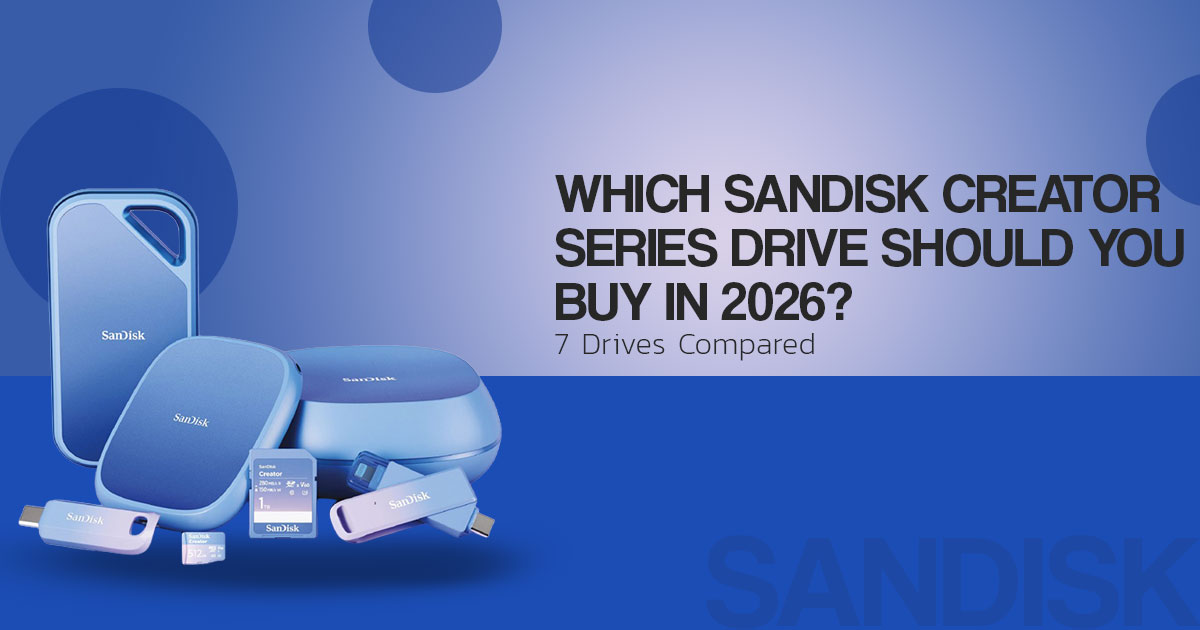
The SanDisk Creator portable storage series has seven drives, a similar blue design, and specifications that can look confusingly close on paper. That makes choosing the right one less straightforward than it should be. The real differences come down to speed, connectivity, capacity, portability, durability, and how you plan to use the drive.
In this guide, we compare the SanDisk Creator series 2026 lineup using manufacturer specifications and published independent testing. We did not test these drives ourselves, so the performance figures in this article come from the publications that conducted those tests.
With more than 20 years of experience in hardware and application research and development, we look at products from a practical point of view. We consider performance, durability, ease of use, and value for money to help readers find the right option for their needs. For this comparison, that includes content creators, photographers, videographers, editors, gamers, professionals, students, and anyone who needs fast portable storage.
Our recommendations are based on product research, component analysis, real-world usability, and industry experience. The question is not simply which drive has the highest number on the spec sheet. It is about which one fits the way you work, create, store, and move your files.
Read on to see how the seven SanDisk Creator drives differ, what matters in 2026, and which features are worth paying attention to before you buy.
THE SHORT VERSION

The SanDisk Creator Series is a seven-product storage line announced at CES 2025 for capture, transfer, editing and backup. SanDisk introduced the Creator Phone SSD as a new MagSafe-compatible design in 2025; the other products have close counterparts in its earlier range. Prices across the range have risen noticeably through 2026 during a global memory shortage, so the live listing matters more than any figure printed here
What Is the SanDisk Creator Series?
The SanDisk Creator Series is a family of storage products aimed at people who shoot, move and edit their own footage. SanDisk announced it at CES 2025 and describes it as covering each stage of a creative workflow.
Seven products make up the range: two portable SSDs, a desktop SSD, two USB flash drives, and two types of memory cards. India received the line on 29 September 2025 through Amazon India and Flipkart.
The detail that press coverage tends to skip is that most of this range is not new hardware. Publications that compared the drives directly found the Creator models reuse the performance and connectivity of drives SanDisk already sold. Digital Camera World described the SanDisk Creator Pro Portable SSD as appearing functionally similar to the earlier 2,000MB/s Extreme PRO Portable SSD, with a different finish. Dong Knows Tech made a broader version of the same point.
The model numbers support that reading. SanDisk’s earlier Extreme PRO Portable SSD carries the SKU SDSSDE81, and the Creator Pro Portable SSD carries SDSSDE81C. A single letter separates them.
That is not proof of identical hardware, but it is consistent with a refresh rather than a new design.
None of this makes the range a bad buy. It tells you where the real differences sit, and where you may be paying for a finish and a software bundle rather than for speed.
What Is Actually New in the SanDisk Creator Series?
SanDisk introduced the Creator Phone SSD as a new MagSafe-compatible design in 2025. The other six products have close counterparts in SanDisk’s earlier range.
The new product: SanDisk Creator Phone SSD
The SanDisk Creator Phone SSD is a compact external SSD that attaches to the back of a MagSafe-compatible phone and connects over a short USB-C cable. SanDisk designed it for people who record video on a phone and run out of internal storage.
MOUNTING, NOT WIRELESS TRANSFER

The magnet holds the drive against the phone so nothing dangles while you shoot. Data still travels over the bundled USB-C cable, and there is no wireless link between the drive and the phone. SanDisk's own product page describes MagSafe as an attachment method, not a connection method.
The six other products
These carry new finishes and updated Adobe bundle terms, and their interfaces match drives already in SanDisk’s range:
- SanDisk Creator Pro Portable SSD — the fastest drive in the series, rated for up to 2,000MB/s, using USB 3.2 Gen 2×2.
- SanDisk Creator Desk Drive — a desktop SSD for larger working
- SanDisk Creator USB-C Flash Drive — a single-connector flash drive that also serves as external storage for smartphones, tablets and laptops.
- SanDisk Creator Phone Drive — a dual Lightning and USB-C flash drive, and the closest product in the range to a general iPhone external storage solution.
- SanDisk Creator SD UHS-II Card — for cameras shooting 6K video and RAW files.
- SanDisk Creator microSD Card — for phones, drones and action cameras.
If you already own the equivalent SanDisk drive from before 2025, the Creator version is unlikely to be a meaningful upgrade. If you are buying your first fast portable drive, the range is a reasonable shortlist.
SanDisk Creator Series Specifications
All figures below come from SanDisk’s product pages and data sheets. They are manufacturer ratings, not measured results. Measured figures appear further down.
| Product | Model numbers | Interface | Capacities | Rated speed | Durability | Warranty |
| Creator Phone SSD | SDSSDE62C-1T00-G25 SDSSDE62C-2T00-G25 |
USB 3.2 Gen 2 (10Gbps), USB-C | 1TB, 2TB | 1,000MB/s read 950MB/s write |
Silicone shell, 3 m drop, IP65 | 5-year limited |
| Creator Pro Portable SSD | SDSSDE81C-1T00-G25 SDSSDE81C-2T00-G25 SDSSDE81C-4T00-G25 |
USB 3.2 Gen 2×2 (20Gbps) | 1TB, 2TB, 4TB | 2,000MB/s read 2,000MB/s write |
Aluminium, 3 m drop, IP65, carabiner loop | 5-year limited |
| Creator Desk Drive | SDSSDT40C series (4TB, 8TB) | USB 3.2 Gen 2 (10Gbps) | 4TB, 8TB | Up to 1,000MB/s read | Desktop form factor | 3-year limited |
| Creator USB-C Flash Drive | SDCZ75C-256G-G46 SDCZ75C-512G-G46 SDCZ75C-1T00-G46 |
USB 3.2 Gen 1 (5Gbps) | 256GB, 512GB, 1TB | 400MB/s read | Metal body | 5-year limited |
| Creator Phone Drive | SDIXD0N-128G-GN6TP SDIXD0N-256G-GN6TP |
USB 3.2 Gen 1 (5Gbps), Lightning and USB-C | 128GB, 256GB | Read speed not stated by SanDisk; B&H lists up to 90MB/s | Metal body | 2-year limited |
| Creator SD UHS-II Card | SDSDXEP-128G-GNCIS SDSDXEP-256G-GNCIS SDSDXEP-512G-GNCIS SDSDXEP-1T00-GNCIS |
UHS-II, V60, U3, Class 10 | 128GB, 256GB, 512GB, 1TB | 280MB/s read; write 100MB/s (128GB), 150MB/s (256GB–1TB) | — | Lifetime limited |
| Creator microSD Card | SDSQXAA-128G-GN6MS SDSQXAA-256G-ZN6MS SDSQXAA-512G-ZN6MS SDSQXAA-1T00-GN6MS |
UHS-I, V30, U3, Class 10, A2 | 128GB, 256GB, 512GB, 1TB | 190MB/s read; write 90MB/s (128GB), 130MB/s (256GB–1TB) | — | Lifetime limited |
Two capacity-specific differences are easy to miss: write speeds on both card lines are lower on the 128GB models than on the larger capacities. SanDisk states these figures per capacity on its product pages.
Bundled Adobe offers. SanDisk promotional materials have listed one month of Adobe Creative Cloud Pro with the Creator Phone SSD, Creator Pro Portable SSD, Creator Desk Drive and Creator SD UHS-II Card, and three months of Adobe Lightroom with the Creator microSD Card, Creator USB-C Flash Drive and Creator Phone Drive. The Creative Cloud Pro offer is a promotional entitlement redeemed by code, limited to one per qualifying product purchase. These offers are time-limited.
SanDisk’s Phone SSD terms list an April 30, 2026 redemption deadline; confirm any current offer before buying.
Key Features and What They Change for a Buyer
Specifications only help if you know what they change in daily use. Five features affect the buying decision.
MagSafe mounting on a portable SSD
A MagSafe SSD removes the awkward part of phone filmmaking. For anyone looking for a portable SSD for iPhone that needs no bracket or clamp, the drive sits flat against the phone instead of hanging off a cable.
TechRadar tested the mount and rated it well, noting the rubberised edges make the attached drive comfortable to hold. Smartprix, testing a separate unit, found the magnets workable but weaker than Apple’s own MagSafe accessories. Both observations are compatible: the mount suits handheld work, while a tripod or gimbal benefits from the magnetic ring SanDisk includes in the box for phones and cases without MagSafe.
Apple ProRes 4K capture at 60fps
With ProRes enabled in the camera settings and the drive connected over USB-C, ProRes video at 4K and 60fps can be written directly to the drive. This is the feature that justifies the drive’s existence for iPhone shooters, because ProRes files are large and internal storage fills quickly.
DIRECT-TO-DRIVE ProRes

SanDisk's product page lists ProRes capture support for the iPhone 15 Pro and Pro Max and the iPhone 16 Pro and Pro Max, using the drive as the recording destination. Apple also documents external ProRes recording on the iPhone 17 Pro models. Check Apple’s current compatibility guidance for newer phones.
Two qualifications matter here. First, non-Pro iPhones cannot record ProRes in the stock camera app. Second, third-party camera apps can behave differently: Smartprix recorded ProRes, ProRes HQ and OpenGate from a base iPhone 17 using Blackmagic Camera. That is a useful capability but an app-dependent one, not a guarantee from SanDisk, and it should not be the reason you choose this drive.
USB 3.2 Gen 2×2 compared with USB 3.2 Gen 2
The Creator Pro Portable SSD reaches 2,000MB/s because it uses USB 3.2 Gen 2×2, a 20Gbps link. The Creator Phone SSD uses USB 3.2 Gen 2 at 10Gbps and is rated at 1,000MB/s.
What this means for buyers: the Pro drive can reach roughly twice the throughput of a 10Gbps drive on a computer with a 20Gbps USB-C port. PCMag has noted that relatively few computers offer Gen 2×2. Many laptops and phones run at 10Gbps, where both drives can be limited by the host interface and the Pro’s extra bandwidth goes unused.
SanDisk Extreme PRO with USB4 is a separate drive. It is easy to confuse with the Creator Pro because both sit near the top of SanDisk’s portable range. They are different products with different interfaces. The SanDisk Extreme PRO with USB4 carries model numbers SDSSDE82-2T00-G25 and SDSSDE82-4T00-G25 and is rated up to 3,800MB/s read. No Creator-branded drive uses a USB4 interface.
IP65 durability
SanDisk rates the Creator Phone SSD and Creator Pro Portable SSD to IP65. Under the IEC 60529 system, this means a dust-tight enclosure and protection against low-pressure water jets; SanDisk’s own data sheet describes testing against water flow at 30 kPa for three minutes. It does not cover immersion, and SanDisk advises that the drive be clean and dry before use.
Reviewers at 91mobiles and the Times of India both flagged IP65 as the main compromise, given that the phones these drives attach to are commonly rated IP68. Anyone shooting in heavy rain or near water should treat the rating as a limitation rather than a feature.
Capacity and speed grading on the memory cards
The Creator SD UHS-II Card carries a V60 rating, part of the SD Association’s Video Speed Class system, which specifies a minimum sustained write speed of 60MB/s. That minimum sustained write speed helps make the card suitable for many 6K video and RAW workflows, although actual support depends on the camera or other host device.
The Creator microSD Card is a UHS-I card rated V30 and A2. SanDisk rates it at 190MB/s read, a figure the company notes is achieved through proprietary technology and requires a compatible host device to reach. In practice, a UHS-I card will not deliver that speed in every reader or camera.
Independent Performance Measurements
We did not run these tests. Each figure below comes from the outlet named in the row.
| Tester | Test method | Result |
| TechRadar | CrystalDiskMark, sequential | 1,049.70MB/s read, 1,010.38MB/s write |
| TechRadar | AJA System Test Lite | 938MB/s read, 946MB/s write |
| Lon.TV | Blackmagic Disk Speed Test (MacBook Air) | ~881MB/s read, ~917MB/s write, with dips to 400–500MB/s |
| Smartprix | Capture and file transfer | ~1,000MB/s read, ~900MB/s write |
| India Today | Blackmagic Disk Speed Test (MacBook) | ~850MB/s read, ~570MB/s write |
| PCQuest | Sustained write after cache | 360–400MB/s |
| exhibit.tech | 50GB folder transfer, Mac to SSD | 52 seconds |
Interpreting peak and sustained speeds
This is the distinction that matters most when comparing these drives, and the one that disappears in marketing copy.
In short bursts, the Creator Phone SSD reaches or slightly exceeds its rated 1,000MB/s read and 950MB/s write. TechRadar’s CrystalDiskMark run landed above the headline figure on both counts.
Sustained writes settle lower once the drive’s cache fills. PCQuest measured 360–400MB/s during longer writes, and India Today recorded around 570MB/s write on a MacBook. Both sit well below the headline number. Apple’s guidance for ProRes 4K120 calls for at least 440MB/s sustained, which is where sustained performance begins to matter more than peak.
The practical rule: for video capture, compare sustained writes rather than peak benchmarks.
Heat and power draw on a phone-powered drive
Two behaviours matter when a phone supplies the power.
On power, Apple’s external-storage guidance sets a maximum power draw of 4.5 watts. Lon.TV reported the Creator Phone SSD stayed within that limit during extended recording, with no dropped frames at ProRes 4K60. The same review recorded occasional dropped frames at the more demanding ProRes 4K120 setting.
On heat, exhibit.tech measured a surface temperature of about 45°C after 30 minutes of continuous ProRes capture and reported no throttling severe enough to interrupt recording. Outlook Business reported a two-hour continuous session with no overheating warnings and no dropped frames.
How Much Footage Fits? Storage Maths for ProRes and HEVC
Working from TechRadar’s measurement — 12 minutes 44 seconds of ProRes at 4K 60fps produced 158.28GB — the rate is roughly 12.5GB per minute.
| Codec and setting | Approximate storage per hour | Approximate capacity on 1TB |
| ProRes 4K at 60fps | ~750GB | ~70 minutes |
| HEVC 4K at 60fps | ~28GB | ~36 hours |
| HEVC 4K at 120fps | ~56GB | ~18 hours |
HEVC figures are from Lon.TV’s capacity testing. ProRes figures are derived from TechRadar’s measured file sizes. Actual rates vary with scene complexity and camera settings.
BUYING ADVICE — CHOOSE CAPACITY BY SHOOT LENGTH

At the cited ProRes rate, a 20-minute recording uses roughly 250GB. A collection of shorter clips may fit on 1TB, depending on the recording format and total duration. Long-form or multi-camera days in ProRes can exhaust 1TB, making the 2TB model more suitable. Capacity is the specification where spending more removes a practical problem rather than adding a feature.
Check the current price of the SanDisk Creator Phone SSD at Amazon India
Design and Build Quality
The Creator Phone SSD measures 82.5 × 68.4 × 11 mm and weighs 54 g, according to SanDisk’s data sheet. Reviewers describe it as light enough to leave attached to a phone during handheld shooting, with curved silicone edges that improve grip. The silicone shell also attracts dust more readily than an aluminium body.
Cable handling is the most frequently raised criticism. The bundled flat USB-C ribbon cable is longer than the task requires, and reviewers at TechRadar, Moneycontrol and the Times of India each noted it. SanDisk includes a small Velcro strap, according to those reviews, which reduces the excess without removing the issue.
The finish divides opinion rather than presenting a clear defect. TechRadar and the Times of India both questioned whether the bright blue gradient suits professional work. Buyers who want a drive that disappears into a bag should weigh that against the price.
One difference worth flagging for buyers comparing SanDisk drives: B&H’s specification table for the Creator Pro Portable SSD lists encryption support as “No”. The earlier SanDisk Extreme PRO Portable SSD (model SDSSDE81) is documented with 256-bit AES hardware encryption. Buyers who need hardware encryption should confirm this on the current model page before ordering, because the Creator line does not advertise it.
Compatibility
| Device type | Works with | Notes |
| MagSafe iPhones | Creator Phone SSD magnetic mount | Requires a MagSafe-compatible phone or case; a magnetic ring is included for others |
| Pro-tier iPhones | Creator Phone SSD, ProRes capture | SanDisk lists iPhone 15 Pro/Pro Max and iPhone 16 Pro/Pro Max; Apple also lists iPhone 17 Pro models |
| Android phones | Creator Phone SSD | Drive connects over USB-C and reads exFAT; ProRes capture is an iPhone feature |
| Windows and macOS | All SSDs, exFAT formatted | SanDisk lists Windows 10+ and macOS 14+ for the Phone SSD |
| Cameras shooting 6K and RAW | Creator SD UHS-II Card | V60 specifies minimum sustained write of 60MB/s |
| Phones, drones, action cams | Creator microSD Card | UHS-I; SanDisk lists 4K and 5.3K recording |
| Apple and PC mixed workflows | Creator Phone Drive | Lightning and USB-C connectors on one drive |
One limitation to plan around: the Creator Phone SSD provides no charging pass-through. While the drive occupies the phone’s USB-C port, the phone cannot charge. The Times of India and PCQuest both identified this as the constraint that limits long filming days. Workarounds include a powered USB-C hub or planning battery use around short sessions.
Software: SanDisk Memory Zone and Camera Apps
The SanDisk Memory Zone app is optional. The drive mounts in the iOS Files app and behaves like any other external drive. App features and recording workflows depend on the phone and camera app.
Reviewers differ on its value. Smartprix found it useful for browsing files, monitoring capacity and ejecting safely. The Times of India advised readers to skip it. Either way, no essential function depends on it, and the phone’s own file manager works as an alternative.
Camera apps matter more to the workflow. Blackmagic Camera and Final Cut Camera both detect the drive and can record to it, and reviewers verified direct recording without dropped frames at 60fps.
Pros and Cons
| Strengths | Limitations |
| Direct ProRes 4K60 capture straight to the drive | No charging pass-through while the drive is connected |
| Magnetic mount holds securely in handheld use | Magnets found weaker than Apple’s own accessories by one reviewer |
| Sequential speeds measured at or above SanDisk’s rating | Sustained writes fall to roughly 360–400MB/s after cache |
| 5-year limited warranty on the Phone SSD and Pro Portable SSD | IP65 only; not rated for immersion |
| Works across iPhone, Android, Windows and macOS | Bundled ribbon cable is longer than convenient |
| Limited-time Adobe software promotion offered with most products | Prices have risen sharply since launch |
| Two capacities for the Phone SSD | Finish divides opinion |
How the SanDisk Creator Series Compares
The Creator Phone SSD does not compete on cost per terabyte. It competes on workflow, which is why buyers searching for a MagSafe SSD for creators often end up comparing it against drives built for laptops and desktops. Knowing where rivals are stronger is part of deciding whether it suits you.
All specifications in this table come from manufacturer product pages or the publication named in the row.
| Drive | Interface and rated speed | Published positioning | Suits |
| SanDisk Creator Phone SSD | USB 3.2 Gen 2; up to 1,000MB/s read, 950MB/s write | Part of the Creator Series, sold on phone capture | Shooting video on a phone with the drive mounted on the back |
| Corsair EX400U USB4 External SSD | USB4; rated up to 4,000MB/s sequential read; MagSafe-compatible | Wirecutter’s top pick for portable SSDs in its 2026 guide | Laptop editing on a USB4 machine, with optional phone mounting |
| Samsung Portable SSD T9 | USB 3.2 Gen 2×2 | Wirecutter describes it as worth considering; it notes the T9 has neither a built-in MagSafe ring nor a Samsung case with one | Value-focused laptop and desktop use |
| Lexar SL500 Portable SSD | USB 3.2 Gen 2×2; up to 2,000MB/s read, 1,800MB/s write; 256-bit AES encryption | Wirecutter lists it as a budget pick; PCMag notes it claims no ruggedness rating | Laptop work where encryption matters more than durability |
| SanDisk Extreme PRO with USB4 | USB4; rated up to 3,800MB/s read | Wirecutter measured much slower small-file random writes than on the Corsair EX400U | Large sequential transfers on USB4 hardware |
| SanDisk Creator Pro Portable SSD | USB 3.2 Gen 2×2; up to 2,000MB/s | Vendor describes it for demanding workflows on the move | Laptop editing where phone mounting is not required |
HOW TO READ THIS TABLE

If you edit mainly on a laptop and rarely shoot from a phone, drives such as the Samsung Portable SSD T9 or the Lexar SL500 serve the same purpose and generally cost less per terabyte. The Creator Phone SSD's justification is narrower: it is built around capturing to the drive while it is physically attached to a phone. Wireless performance is not part of the comparison, because no drive here transfers wirelessly.
Check the current price of the SanDisk Creator Pro Portable SSD at Amazon US
What the SanDisk Creator Series Costs in 2026
Price context matters more for this range than for most storage, because the numbers have moved a long way from launch.
NAND Flash prices rose sharply through 2026, driven in part by strong AI and enterprise demand and constrained supply. SanDisk has publicly stated that undersupply would extend beyond 2026, and has raised prices across its channels. Forecasts from storage-industry analysts point to meaningful consumer relief in 2027 rather than late 2026.
The table below separates three different kinds of price. They are not interchangeable.
| Product and configuration | Price | Currency and market | Price type | Date recorded |
| Creator Phone SSD 1TB | ₹10,999 | India | Launch price | September 2025 |
| Creator Phone SSD 1TB | ₹15,899 | India | Listed price | November 2025 |
| Creator Phone SSD 1TB | ₹16,999 | India | Listed price | January 2026 |
| Creator Phone SSD 2TB | ₹35,799 against an MRP of ₹47,100 | India | Discounted listing | September 2026 |
| Creator Pro Portable SSD 1TB | $229.99 | United States | Listed price on SanDisk.com | September 2026 |
| Creator Pro Portable SSD 4TB | $266, then $589 one month later | United States | Retail listings, reported by PetaPixel | January and February 2026 |
| Creator Desk Drive 4TB | $299.99 | United States | Launch MSRP | January 2025 |
| Creator Desk Drive 4TB | $799.99 against a stated $1,037.99 | United States | Discounted listing on SanDisk.com | September 2026 |
| Creator Desk Drive 8TB | $999.99 | United States | Listed price on SanDisk.com | September 2026 |
WHY THE LAUNCH PRICE IS NO LONGER A USEFUL REFERENCE

The launch figures describe a market that has changed. Treat any "from $109.99" or "from ₹10,999" figure — including those still showing on older retailer pages — as historical, and check the live listing before buying. The figures above were recorded on 28 September 2026 and will age.
Should you buy now or wait?
Two answers, depending on what you need the drive for.
If you need capture capacity this quarter — a shoot booked, a project starting — buying now is the practical choice. Analysts currently forecast continued price increases before any relief, and higher capacities have been the first to sell out.
If you are adding archive capacity with no deadline, waiting until supply loosens has a rationale. The products themselves are not time-limited in that scenario, so waiting is mainly a question of when you need the additional capacity.
Which SanDisk Creator Drive Should You Buy?
Choosing the best SSD for content creators comes down to workflow rather than specifications. Match your main use to the drive.
| If you mainly… | Consider | Why | Think twice if |
| Shoot ProRes or 4K on an iPhone Pro | Creator Phone SSD 1TB | Magnetic mounting plus direct ProRes capture | You film all day on battery alone |
| Shoot long interviews or multi-camera days | Creator Phone SSD 2TB | ProRes fills 1TB in about 70 minutes | You mostly edit on a laptop instead |
| Edit multi-cam footage on a laptop | Creator Pro Portable SSD 2TB | 2,000MB/s over USB 3.2 Gen 2×2, up to 4TB | Your computer’s port runs at 10Gbps, which caps the speed |
| Archive large projects at a desk | Creator Desk Drive 4TB | High capacity, stationary, up to 1,000MB/s read | You need portability |
| Move files between phone, laptop and camera | Creator USB-C Flash Drive 1TB | 400MB/s read in a pocket-sized metal body | You need sustained write performance |
| Back up an iPhone and a PC from one stick | Creator Phone Drive 256GB | Lightning and USB-C on one drive | You need more than 256GB |
| Shoot 6K or RAW stills on a camera | Creator SD UHS-II Card | V60 minimum write guarantee, RescuePRO Deluxe included | Your camera uses UHS-I only |
| Shoot 4K or 5.3K on a phone, drone or action cam | Creator microSD Card | 190MB/s read, up to 1TB | Your device requires a higher video speed class than V30 |
ONE BUYING NOTE ON CAPACITY

The step from 1TB to 2TB on the Creator Phone SSD affects cost more than any other choice in the range. ProRes fills storage faster than most buyers expect, and adding capacity later means buying a second drive.
Where to Buy
The Creator Series sells through Amazon in both markets, and through Flipkart in India. Prices differ between listings, so comparing before checkout is worthwhile.
Buy in the United States
The SanDisk Creator Pro Portable SSD suits laptop-first editing, with 2,000MB/s over USB 3.2 Gen 2×2 and capacities up to 4TB. For iPhone capture, the Creator Phone SSD is available in 1TB and 2TB.
Check the current price at Amazon US — listings update frequently, and the figure today may differ from the last one recorded above.
Buy in India
In India, the Creator Phone SSD starts with the 1TB model, with 2TB available for longer shoots. For anyone tracking the SanDisk Creator Phone SSD price in India, both capacities are listed on Amazon India and Flipkart, and the two marketplaces have not always matched.
Check the current price at Amazon India — compare the 1TB and 2TB listings, because the gap between them has widened and narrowed repeatedly through 2026.
BEFORE YOU CHECK OUT

Confirm three things. If you are buying for ProRes capture, check that your iPhone is a Pro model. If you are buying the Creator Pro for its 2,000MB/s rating, check that your computer has a 20Gbps USB-C port. And check the return window, because storage prices in 2026 have moved quickly enough that a price change within a few weeks is plausible.
Frequently Asked Questions
Is the SanDisk Creator Phone SSD waterproof?
No. It carries an IP65 rating, which under IEC 60529 means a dust-tight enclosure and protection against low-pressure water jets. It is not rated for immersion, and SanDisk advises that the drive be clean and dry before use.
Which iPhones support ProRes recording to the Creator Phone SSD?
SanDisk lists the iPhone 15 Pro and Pro Max and the iPhone 16 Pro and Pro Max. Apple lists external ProRes support for iPhone 15 Pro, 16 Pro and 17 Pro models; check its current support page for newer devices. The drive must be connected over USB-C with ProRes enabled in the camera settings.
Does the Creator Phone SSD work with Android?
Yes. It connects over USB-C and uses exFAT formatting, and SanDisk includes a magnetic ring for phones and cases without MagSafe. ProRes capture is an iPhone feature, so Android use covers storage and transfer.
How many minutes of ProRes at 4K 60fps fit on 1TB?
Roughly 70 minutes, based on a measured rate of about 12.5GB per minute. In HEVC at the same resolution and frame rate, 1TB holds approximately 36 hours.
Can the phone charge while recording to the Creator Phone SSD?
Not directly. There is no charging pass-through, so the phone cannot charge while the drive occupies its USB-C port. A hub with pass-through charging is the usual workaround.
Is the SanDisk Creator Series worth buying in 2026?
It depends on the product. The Creator Phone SSD combines magnetic mounting with supported ProRes capture, a combination few rivals offer, which makes it relevant for iPhone shooters despite the price increases. The other drives serve more conventional storage needs, while rivals such as the Samsung Portable SSD T9 or the Corsair EX400U can offer lower cost per terabyte for laptop editing.
Is the Creator Phone SSD fast enough for 4K video?
For 4K at 60fps, yes. Sustained writes of roughly 360–400MB/s measured by PCQuest exceed what ProRes at 4K60 requires. At ProRes 4K120, Apple’s guidance calls for at least 440MB/s sustained, and one reviewer recorded occasional dropped frames at that setting.
What happened to SanDisk Creator Series prices?
They rose. The increase coincided with strong AI and enterprise demand and constrained supply. The Creator Desk Drive 4TB moved from a launch MSRP of $299.99 in January 2025 to a discounted listing of $799.99 against a stated $1,037.99 on SanDisk.com in September 2026.
Is encryption available on the Creator Series?
Not according to the specifications we reviewed. B&H’s specification table for the Creator Pro Portable SSD lists encryption support as “No”, and SanDisk’s product pages for the Creator line do not advertise hardware encryption. The earlier SanDisk Extreme PRO Portable SSD (SDSSDE81) is documented with 256-bit AES hardware encryption, so buyers who need it should confirm the current model’s specifications directly.
Final Verdict
The SanDisk Creator Series is a seven-product range built around different storage needs, with the Creator Phone SSD focused specifically on direct phone video capture.
Its compromises are equally specific. It cannot charge the phone while connected, sustained writes fall well below the headline figure, and prices have risen steeply since launch.
Buy it if you shoot video on an iPhone Pro and want to stop managing internal storage during a shoot. Consider alternatives if you edit mainly on a laptop, where a Samsung Portable SSD T9, Lexar SL500 or Corsair EX400U often costs less per terabyte for the same purpose.
For the rest of the range, buy on the specification you need rather than the finish. The Creator Pro Portable SSD justifies its price when your computer supports 20Gbps USB; otherwise its advantage over a 10Gbps drive is reduced. The cards make sense for 6K and RAW work, provided you match the capacity to the write speed you need. The two flash drives are conveniences rather than performance tools.
CAPACITY CHOICE FOR PHONE VIDEO

Choose the Creator Phone SSD in 1TB for short sessions or 2TB for long-form ProRes work. Compare both listings before ordering, because the price gap between them has moved repeatedly through 2026.
Have a question about the SanDisk Creator series or not sure which drive fits your setup? Leave a comment below and tell us what you’re looking for—we’ll be happy to help.
If you find our straightforward, research-based tech guides useful, follow us for more product comparisons, buying guides, and hardware reviews. We’ll keep breaking down the specifications and real-world differences so you can make a more informed choice before you spend your money.
Disclaimer

This article is based on our research, analysis, available product information, user feedback, and industry knowledge. It is not an official statement from any brand or manufacturer mentioned in the article. Product specifications, prices, software features, and availability can change. We do our best to keep the information up to date, but please check the latest details with the manufacturer or retailer before making a purchase.

Some links in this article may be affiliate links. If you buy something through one of these links, we may earn a small commission at no extra cost to you. These commissions help support the site and our work. They do not affect how we assess or discuss products. Comments and opinions shared by readers belong to the people who post them and do not necessarily represent our views. Information on this site is provided for general purposes, and we cannot guarantee a particular result from using it. Where professional advice is needed, consult a qualified professional.

All product names, logos, and trademarks belong to their respective owners. We use them only to identify the products and companies discussed and do not imply endorsement or affiliation.