
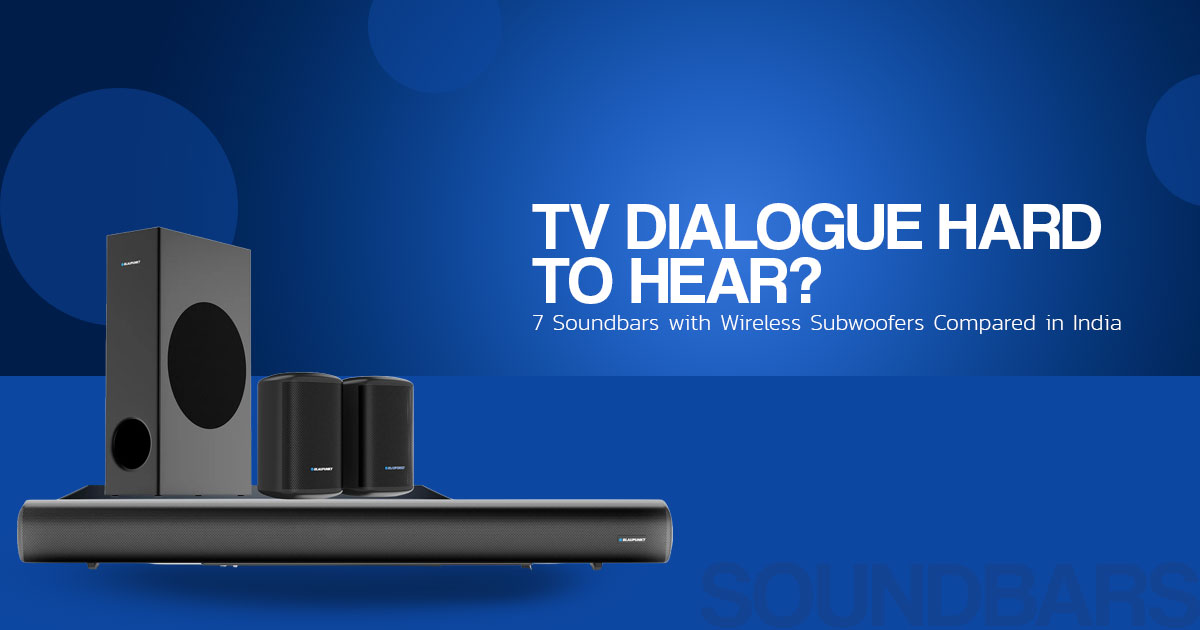
Watch a quiet dialogue scene, then an explosion, and you will probably reach for the volume control twice. Your television is not necessarily the problem. Most flat panels are too thin to house drivers that can move enough air for deep bass, so the low end is thin and dialogue competes with music and effects inside the same small speakers.
A soundbar with a wireless subwoofer fixes both complaints at once. The bar handles the mid-range and treble; a separate box takes the bass. That subwoofer still needs a power socket, but it does not need an audio cable running across the room. That single change is why these systems are popular in flats where drilling through walls is not an option.
This guide compares seven widely sold models from Sony, Samsung and JBL, from about ₹11,000 to ₹50,000. It explains which specifications change what you actually hear, where the marketing oversells, and which bar suits a bedroom, a family living room or a dedicated movie room.
Recommendations come from manufacturer specifications, published reviews where available and retail prices checked on 19 October 2026. We have not measured these units in a lab, so claims about sound quality are either attributed to reviewers who heard them or framed as expectations from the design.
We look beyond the specifications to understand what matters in everyday use. Our focus is on real-world performance, durability and value for money. Whether you are upgrading your bedroom television, improving the sound for family movie nights or building a more immersive home entertainment setup, we aim to help you make an informed decision. Our recommendations draw on extensive research, component analysis, practical usability and industry expertise, with attention to how each product may serve you over time.
By the end of this guide, you will understand which specifications matter, which marketing claims deserve a second look, and what to expect from each price range. Whether you want clearer dialogue, deeper bass for films or a more immersive viewing experience, our goal is to help you find a soundbar that fits your room, viewing habits and budget—without paying for features you may never use.
What the specifications actually mean
A centre channel is the best dialogue upgrade
A 3.1-channel bar has left, centre and right speakers in the bar, plus the subwoofer. A 2.1-channel bar folds the centre information into the left and right speakers. In most film and TV mixes, dialogue is anchored to the centre channel, which is why a dedicated centre driver keeps voices separate from the music and effects playing on either side.
That is why a 3.1 bar with a dedicated centre channel can make dialogue clearer than a higher-wattage 2.1 bar, even when the headline wattage looks worse on paper. The centre channel reproduces much of the dialogue, while the left and right channels handle much of the music and effects.
The advantage is not automatic. A poorly tuned centre channel can sound boxy or detached from the screen, and a good 2.1 bar with well-matched drivers can beat a cheap 3.1 design. Audition both if you can, or buy from a retailer with a return policy.
Subwoofer size tells you more than wattage
Cone area scales with diameter squared. A 10-inch driver has roughly 3.6 times the surface area of a 5.25-inch driver, assuming similar cone geometry. More area usually means more displaced air and deeper bass, but the cabinet, tuning, amplifier and placement matter just as much.
JBL rates the Bar 500 MK2’s system to 40Hz at -6dB. The Cinema SB560 is rated to 45Hz at -10dB. Those figures look close, but they use different -dB thresholds, so they cannot be compared directly. What matters more is the room. A 10-inch sub in a 150 sq ft bedroom will rarely be asked to work hard, and its lowest notes may excite room modes that make bass uneven. A 5.25-inch sub in a 400 sq ft hall will run out of headroom before it fills the space.
Format support is not the same as height effects
Only the Sony HT-B500 in this group supports both Dolby Atmos and DTS:X decoding. The JBL Bar 500 MK2 supports Dolby Atmos and DTS Virtual:X, while the other models do not decode both object-based formats. Format support is not the same as convincing height effects: the Sony and JBL rely on virtual processing rather than up-firing drivers or physical rear speakers.
Sony’s own FAQ for the HT-B500 confirms that it has no rear or up-firing speakers; it creates surround sound with its Vertical Surround Engine and S-Force PRO processing. Engadget’s review found clear sound and ample bass for the bar’s size, but “almost no simulated overhead noise”. Height effects are the reason many people upgrade, and a virtual bar may not deliver them, whatever the logo on the box says.
DTS Virtual:X is virtual-surround processing, not DTS:X decoding. HDMI eARC is useful for lossless Atmos from Blu-ray, while some TVs can pass compressed Atmos over standard ARC. Check your TV’s capabilities before paying extra for a format the bar cannot receive.
Why the wattage number is the least useful specification
Manufacturers quote power differently. JBL’s Bar 2.1 Essential is sold as 440W, but JBL’s own spec sheet gives a rated output of 220W (2 x 50W for the bar, 120W for the subwoofer); 440W is the maximum at 1% THD. The Bar 500 MK2 is quoted at 750W maximum and 375W RMS. Samsung quotes 370W for the B650F without the same qualifier, and Sony quotes 250W total for the HT-B500.
None of those numbers is dishonest. They are simply not comparable. Use wattage as a rough guide to headroom, not as a ranking.
The seven models at a glance
| Model | Layout | Power (as Quoted) | Centre Speaker | Subwoofer | HDMI | Formats | Price (India, 19 Oct 2026) |
| JBL Cinema SB560 | 3.1 | 250W | Yes | 5.25-inch wireless | ARC | Dolby Audio | ₹11,000–15,000 |
| Samsung HW-B45EF | 2.1 | 300W | No | Wireless | ARC out | Dolby 2ch, DTS Virtual:X | ₹11,500–13,000 |
| Samsung HW-B650F | 3.1 | 370W | Yes | Wireless | 1 in, 1 ARC out | Dolby Audio 5.1, DTS Virtual:X | ₹16,500–20,500 |
| Sony HT-S400 | 2.1 | 330W | No | 160mm wireless | ARC out | Dolby Digital | ₹16,000–19,000 |
| JBL Bar 2.1 Essential | 2.1 | 440W max (220W rated) | No | 6.5-inch wireless | ARC | Dolby Digital | ₹18,000–25,000 |
| Sony HT-B500 | 3.1 | 250W | Yes | Wireless | eARC out | Dolby Atmos, DTS:X | ₹28,000–30,000 (MRP ₹37,990) |
| JBL Bar 500 MK2 | 5.1 virtual | 750W max (375W RMS) | Yes | 10-inch wireless | 1 in, 1 eARC out | Dolby Atmos, DTS Virtual:X | ₹47,000–50,000 |
Layout note: “5.1 virtual” means the bar processes five channels but ships without rear speakers. The Bar 500 MK2 is the only model here in that category.
The models, from cheapest to most expensive
JBL Cinema SB560: the cheapest route to a real centre channel
JBL’s Cinema SB560 is the most affordable 3.1 bar in this group, with recent India listings ranging
from about ₹11,000 to ₹15,000. It costs less than the Sony and JBL 2.1 models further down this list at many sale prices and still gives you three channels in the bar plus a 5.25-inch subwoofer. The centre driver is the point: it keeps voices in their own speaker while the left and right channels handle music and effects. In a bedroom or small living room, that is a more useful upgrade than another 100W of quoted power.
The compromises are predictable. JBL rates the system at 250W maximum output, and the subwoofer has a 5.25-inch driver. The published specifications for several other models here do not disclose their subwoofer driver size, so we cannot reliably call this the smallest. JBL does not include DTS Virtual:X or Atmos processing. The 5.25-inch sub will not pressurise a large hall; it is tuned for a modest room. Connectivity covers HDMI ARC, optical and Bluetooth, so it will work with any TV that has ARC.
At a similar sale price, the main alternative is Samsung’s HW-B45EF, a 2.1 design. The JBL is the better pick for dialogue.
VERDICT: The default choice under ₹15,000, provided you are using it in a small or medium-sized room and you do not need Atmos.
Samsung HW-B45EF: compact, but caught between two better options
The B45EF is a 2.1 bar with a 300W rating and DTS Virtual:X, and it is small enough to sit under a 43- to 55-inch TV without blocking the screen. With a Samsung TV, One Remote control is a genuine convenience: the TV remote handles the bar, and there is one fewer controller on the table.
The problem is what the price buys. JBL’s SB560 adds a centre channel for a similar price, and Samsung’s B650F adds a centre channel, an HDMI input and more quoted power for a few thousand
rupees more at typical sale prices. Unless you find the B45EF below ₹11,500 or you specifically want Samsung’s remote integration, it is hard to justify.
VERDICT: Buy only on a deep discount, or for a Samsung-TV household that values One Remote over a centre channel.
Samsung HW-B650F: the best balance for most living rooms
This is the model most people should consider in roughly the ₹16,500–₹20,500 range. Samsung’s 2025 B-series bar is a 3.1 design with a dedicated centre speaker, a quoted 370W, a wireless subwoofer, one HDMI input, an ARC output, optical and USB. Samsung’s Adaptive Sound, Voice Enhance and Night Mode are all present, and Q-Symphony lets a compatible Samsung TV’s speakers run alongside the bar instead of being muted.
Street prices around ₹16,500–20,500 put it near Sony’s 2.1 bar while adding a centre channel and an HDMI input. Samsung’s own store listed it at ₹20,490 before any cart discounts when checked, so compare the final checkout price with retailer offers.
What it does not do: Dolby Atmos, eARC or Wi-Fi. The HDMI input lets you connect a console or streamer directly to the bar, which then sends video to the TV, but Samsung’s specifications do not list 4K video passthrough or HDR passthrough for this model. Check both before routing a PS5 or Xbox through it. The ARC output is standard ARC, and the bar supports Dolby Digital 5.1 and DTS Virtual:X. Cable, DTH, YouTube and most streaming are covered. Lossless Atmos is a different matter.
VERDICT: The safest buy for a mixed household. Add a Samsung TV and Q-Symphony lets compatible TV speakers play alongside the soundbar; with another brand, you still get a straightforward 3.1 bar.
Sony HT-S400: a 2022 design that still does one thing well
The HT-S400 is a 2.1 bar with a 160mm subwoofer, 330W, an OLED text display and Sony’s X-Balanced drivers. The display is a practical advantage. It shows the input, volume and sound mode in words, which matters in a house where more than one person uses the TV and nobody wants to guess what the blinking lights mean.
But this is a 2022 model with Dolby Digital only, HDMI ARC (no HDMI input, no eARC), Bluetooth and no centre channel. At roughly ₹16,000–19,000 it competes with the B650F, which is newer, has a centre channel and an HDMI input. The Sony’s advantage is simplicity and that display; its disadvantage is most of the spec sheet.
VERDICT: A good bedroom bar around ₹16,000 or below. At higher prices, compare it carefully with the Samsung B650F, which adds a centre channel and HDMI input.
JBL Bar 2.1 Essential: loud, bass-forward, and not built for dialogue
440W is the headline, but JBL’s own spec sheet rates the system at 220W (2 x 50W for the bar, 120W for the sub); 440W is the maximum at 1% THD. That does not make it quiet. The 6.5-inch sub and twin racetrack drivers point to a bass-forward sound, but the number is not directly comparable with Samsung’s 370W or Sony’s 330W.
There is no centre channel, no Wi-Fi, no app and no Atmos. Music, cricket and parties make that a reasonable trade: it plays loud and the bass is the point. Late-night drama is not its job. Depending on the retailer and offer, it can cost roughly ₹18,000–25,000—often more than the B650F, which is better suited to television-first use.
VERDICT: Buy for music and sport in a forgiving room; skip it if dialogue clarity is the reason you are shopping.
Sony HT-B500: format support in a compact bar, with one big caveat
Sony’s 2026 3.1 bar is the only model here that decodes both Dolby Atmos and DTS:X, and it does so in a relatively compact 90cm body. It also has a centre channel, eARC, Bluetooth 5.3 and Sony’s BRAVIA Connect app. Street prices of roughly ₹28,000–30,000, below its ₹37,990 MRP, put it between the Samsung and the JBL.
The caveat is in Sony’s own FAQ: there are no rear or up-firing speakers. Atmos and DTS:X are rendered virtually by the Vertical Surround Engine and S-Force PRO. Engadget’s review found the bar produced clear sound and ample bass for its size, but almost no simulated overhead noise. Buy it for height effects and you may be disappointed. It is a reasonable choice if you want a compact 3.1 bar with broad format support.
It also lacks an HDMI input, Wi-Fi and room calibration. Its 250W quoted output is lower than Samsung’s 370W headline figure, though manufacturers do not always rate power on the same basis. The case for it is format support, size and Sony integration (Voice Zoom 3 with a compatible BRAVIA TV), not raw output.
VERDICT: Worth it near ₹28,000 for a small room with an eARC TV and Atmos or DTS:X sources. Poor value at MRP.
JBL Bar 500 MK2: the large-room option
JBL’s Bar 500 MK2 is listed around ₹47,000–50,000, roughly two and a half to three times the Samsung B650F. What that buys: a 10-inch sub rated to 40Hz at -6dB, 750W maximum output (375W RMS), Wi-Fi with AirPlay and Chromecast, one HDMI input with Dolby Vision and HDR10+ passthrough, eARC, and JBL’s Easy Sound Calibration. In a large room, with a taste for bass, it is the most capable system here.
It is still a virtual 5.1 system. The bar has five racetrack drivers and four tweeters, but no rear speakers. MultiBeam 3.0 uses side-firing drivers and processing to create the surround effect, which works best in a symmetrical room with side walls. In an open-plan room, the effect is weaker. The 10-inch sub is also physically large and can overpower a small flat.
The MK2 supports AirPlay, Chromecast, Spotify Connect and TIDAL Connect. At this price, it is also worth auditioning a cheaper bar with physical rear speakers if surround effects matter more to you than deep bass.
VERDICT: The pick for a large, dedicated room where bass and streaming convenience matter. Overkill for a typical flat, and not a substitute for real rear speakers.
The comparisons that actually matter
JBL Cinema SB560 vs Samsung HW-B45EF
Both sit around ₹11,000–15,000 depending on the retailer and offer. The JBL is 3.1 with a centre channel; the Samsung is 2.1 with DTS Virtual:X and Samsung’s One Remote. For dialogue, the JBL has the edge. With a Samsung TV and a dislike of extra remotes, the Samsung has a real convenience advantage. Prices overlap enough that the decision should turn on those two features, not on a small price difference.
Samsung HW-B650F vs Sony HT-B500
The gap is roughly ₹8,000–14,000, depending on current offers. The Sony adds Atmos and DTS:X decoding, eARC, Sony’s app and Voice Zoom 3 with a BRAVIA TV. The Samsung adds an HDMI input, more quoted power and a lower price. Neither has rear speakers or Wi-Fi. With an eARC TV and a diet of 4K Blu-rays or Atmos-heavy streaming, Sony’s format support is meaningful. Cable, DTH and regular streaming are handled just as well by the Samsung for less.
Sony HT-S400 vs JBL Bar 2.1 Essential
Both are 2.1 bars, with the Sony typically around ₹16,000–19,000 and the JBL ranging from about ₹18,000 to ₹25,000. Neither has a centre channel. The Sony has a readable display, HDMI ARC, a 160mm sub and X-Balanced drivers. The JBL has a 6.5-inch sub and a 440W maximum rating.
Television-first use in a shared house favors the Sony. Music and sport favor the JBL. For mixed use, the Samsung B650F is the better buy when prices are close.
Is the JBL Bar 500 MK2 worth roughly ₹30,000 more?
Only if you have the room and the bass appetite. The B650F gives you a centre channel and enough output for a normal living room at roughly a third to two-fifths of the JBL’s price. The JBL’s advantages are a 10-inch sub, Wi-Fi streaming, an HDMI input with Dolby Vision passthrough and room calibration. With none of those on your list, spend the difference elsewhere. Surround effects are better served by a cheaper bar plus physical rear speakers than by virtual 5.1.
Placement: where the sub goes matters more than its size
Start with the subwoofer on the same wall as the television, roughly under or beside it. Bass is less directional than treble, but a sub placed 20 feet away can still be localised, and many soundbar subs offer no delay adjustment to align it with the bar.
Avoid wedging a rear-ported sub into a corner or a closed cabinet. Corners reinforce bass, which can be useful, but a tight corner often makes the low end boom. Follow the manufacturer’s clearance guidance around the port, then try two or three positions before deciding.
Dropouts or popping can sometimes point to wireless interference or a pairing issue. The subwoofer’s wireless link is not necessarily the same as your home Wi-Fi, so changing the router’s channel may not help. Try moving the subwoofer or router apart, then follow the manufacturer’s troubleshooting steps. There is no universal “keep it three feet away” rule.
Set the sub level from your seating position, not by the dial on the back. Run room calibration after you have settled on a position, if the bar offers it; the Bar 500 MK2 does. In a flat with shared walls, a decoupling pad under the sub is cheaper than a complaint.
Questions buyers ask
Do wireless subwoofers still need a power cable?
Yes. Every model here needs a mains socket for the subwoofer’s amplifier. “Wireless” refers to the audio signal between the bar and the sub, not to the power supply.
Can I pair any of these bars with any TV?
Generally yes, if the TV has HDMI ARC/eARC or an optical output. Brand-specific features such as Samsung’s Q-Symphony and Sony’s Voice Zoom 3 require a matching TV. Basic connection works across brands, and HDMI CEC usually lets the TV remote control volume.
Is 3.1 always better than 2.1 for dialogue?
For most television, yes, because the centre channel gives speech its own driver. But tuning matters, and a good 2.1 bar can beat a cheap 3.1 bar. The centre channel is an advantage, not a guarantee.
Do I need eARC for Dolby Atmos?
Not always. Some TVs pass compressed Atmos over standard ARC; eARC is more reliable and is required for lossless Atmos from Blu-ray. With only ARC on the TV, confirm that it passes Atmos before paying for a bar that decodes it.
Will a 10-inch subwoofer be too much for a flat?
It can be turned down, but a large sub in a small room can still excite room modes and produce uneven bass. A 5.25- or 6.5-inch sub may be easier to accommodate in a bedroom, though placement and tuning matter as much as driver size.
The verdict
- Best under ₹15,000: JBL Cinema It is the only 3.1 bar in this guide commonly available near that price, and the centre channel is the upgrade most television viewers notice first.
- Best for most people: Samsung HW-B650F. At roughly ₹16,500–20,500, it adds a centre channel and an HDMI input, and has enough power for a normal living Skip it if you need Atmos or eARC.
- Best for Atmos and DTS:X under ₹30,000: Sony HT-B500 at its street Buy it for format support and size, not for overhead effects.
- Best for a large room: JBL Bar 500 The 10-inch sub and Wi-Fi streaming justify its roughly ₹47,000–50,000 price only if you have the space.
- Buy with caution: Samsung HW-B45EF above ₹13,000, Sony HT-S400 above ₹16,000 unless you value its display, and the JBL Bar 2.1 Essential at ₹18,000–25,000 for television-first use. Each is outclassed by the B650F or the SB560 at a similar price.
A soundbar is a compromise between a television’s built-in speakers and a full AV receiver system. Better news: the compromise has improved. A ₹12,000 3.1 bar now does the one thing that matters most for television, which is keeping dialogue out of the effects. When in doubt, buy the cheapest bar with a centre channel that fits your room, live with it for a week, and upgrade only if bass or connectivity turns out to be the limitation. That is a better use of money than paying for a format badge you cannot use.
Prices, sources and what we could not verify
Prices were checked on 19 October 2026 at the retailers and brand stores linked below. Indian retail prices swing with festival sales, bank offers and stock. Listings for the same model can vary by several thousand rupees, so the table uses ranges where the spread is wide. Treat them as a snapshot, not a guaranteed checkout price.
Specifications come from the manufacturers’ product pages and support documents. Where a claim depends on listening rather than a specification, the source is named in the text. Independent listening reviews cited here include Engadget’s review of the Sony BRAVIA Theatre Bar 5 and WIRED’s review of the JBL Bar 500 MK2. Other judgments about sound quality are inferences from driver size, power ratings and layout, not measurements conducted for this guide.
- Sony HT-B500 product page (India) and specifications; Sony’s FAQ on virtual surround.
- Samsung HW-B650F Amazon product page (US | India); Samsung user guide.
- Samsung HW-B45EF Amazon product page (India).
- JBL Bar 500 MK2 Amazon product page (US); JBL spec sheet; B&H listing for wireless protocols; JBL support answer on Alexa integration.
- JBL Bar 1 Essential Amazon product page (US | India).
- JBL Cinema SB560 Amazon product page (India).
- Sony specifications: Sony HT-S400 Amazon product page (US).
Three things remain uncertain. The published specifications for the B650F, B45EF and HT-B500 do not include the subwoofer driver size, so this guide does not compare them on that basis. We have not assessed long-term reliability or warranty service. And room acoustics vary enough that a bar which sounds right in one living room can sound ordinary in another; the placement advice above matters as much as the model you choose.
Have a question or a different experience with any of these soundbars? Share it in the comments. If you are unsure which model would work best with your television, room size or budget, ask away—we would be happy to help. And if you enjoy practical, research-backed technology guides that make buying decisions easier, follow us for more honest product comparisons and useful advice.
***Disclaimer***

This article is based on our research, analysis, available product information, user feedback, and industry knowledge. It is not an official statement from any brand or manufacturer mentioned in the article. Product specifications, prices, software features, and availability can change. We do our best to keep the information up to date, but please check the latest details with the manufacturer or retailer before making a purchase.

Some links in this article may be affiliate links. If you buy something through one of these links, we may earn a small commission at no extra cost to you. These commissions help support the site and our work. They do not affect how we assess or discuss products. Comments and opinions shared by readers belong to the people who post them and do not necessarily represent our views. Information on this site is provided for general purposes, and we cannot guarantee a particular result from using it. Where professional advice is needed, consult a qualified professional.

All product names, logos, and trademarks belong to their respective owners. We use them only to identify the products and companies discussed and do not imply endorsement or affiliation.