
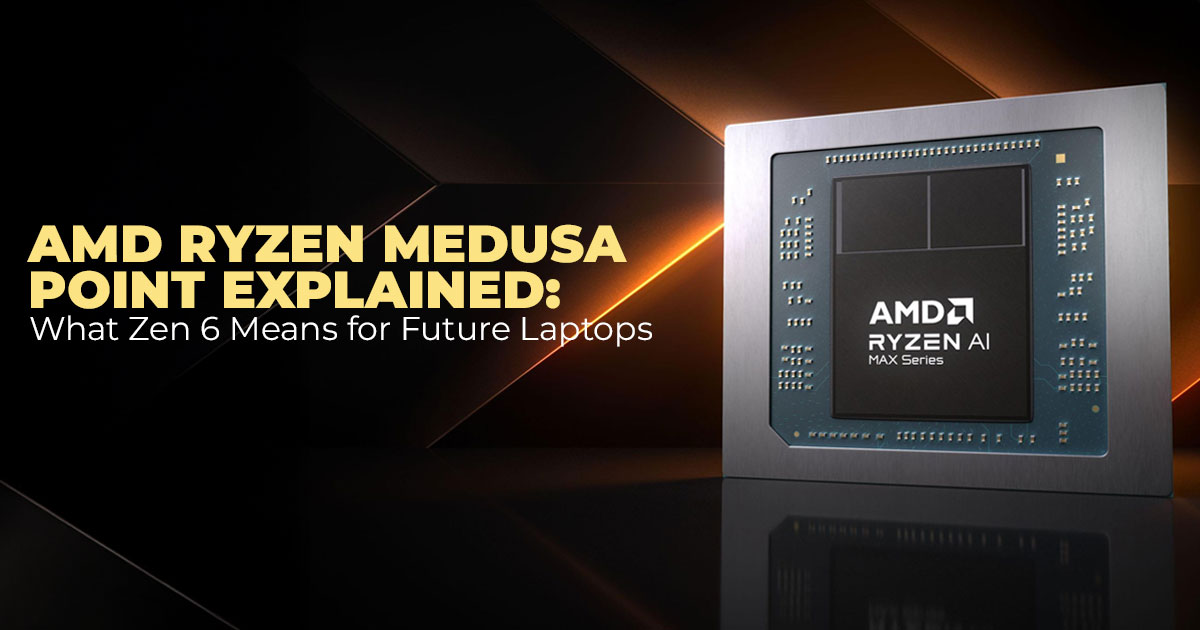
1. Introduction: Spotting Early Signs in AMD’s Next Laptop Chips
Buying a laptop often feels like bad timing. You pick something solid, and weeks later, you hear about the next model coming soon. With current AMD Ryzen laptops already offering strong performance and battery life, many buyers are asking the same question again: Should you buy now, or wait for what’s next?
Here’s why that question matters right now. Late last year, HWMonitor, a widely used hardware monitoring tool, quietly added early support for an unreleased AMD mobile processor family known as AMD Ryzen Medusa Point. That kind of update doesn’t happen by accident. It usually shows up when a chip has moved beyond early design and into real validation work. In simple terms, it’s a sign that next-generation AMD Ryzen processors built on the AMD Ryzen Zen 6 architecture are progressing steadily.
This guide looks at what that signal actually means in day-to-day terms. We explain how AMD mobile processor roadmap updates like this fit into AMD’s normal development cycle, what the Zen 6 CPU architecture is expected to improve based on past patterns, and whether this information should influence your next laptop purchase. The goal is clarity, not speculation.
We’re approaching this with experience, not guesswork. As technology experts with over 20 years of experience in hardware and application research and development, we analyze products based on real-world performance, durability, and value for money. Our focus is on helping laptop buyers, professionals, creators, and enthusiasts choose systems that hold up over time. Every recommendation is grounded in component analysis, practical usability, and long- term reliability, not launch hype.
The takeaway is simple. Early software support often reveals real progress long before official announcements do. Understanding these signs helps you decide when waiting makes sense— and when buying now is the smarter move.
If you’re considering a laptop purchase today, it helps to see what’s already available. You can explore current AMD Ryzen AI laptops on Amazon Worldwide to compare prices, reviews, and configurations, or check Amazon India for locally available models with delivery and warranty details. This gives you a clear baseline before deciding whether waiting makes sense for you.
2. What You Will Learn From This Guide
- Exactly what the codename AMD Ryzen Medusa Point means in AMD’s mobile lineup
- Realistic expectations for Zen 6 architecture upgrades in everyday laptop use
- Why tools like HWMonitor spotting unreleased chips is a trustworthy progress marker
- The latest leak details on upcoming AMD Ryzen mobile CPUs
- Clear advice on whether to buy now or wait for Zen 6
- Boundaries between solid facts and reasonable guesses
3. Why This Breakdown Matters Right Now
Deciding on a laptop means thinking about today’s tasks versus tomorrow’s possibilities. Many people search for terms like best upcoming AMD Ryzen laptops or should you wait for the next AMD Ryzen because current models already handle most jobs well, but future ones promise refinements. These early signs of next-generation AMD laptop CPUs give context without overpromising. We focus on workloads that matter—productivity, content creation, casual gaming, or local AI processing—so you can match upgrades to your routine.
4. Latest AMD Ryzen Medusa Point Leak Details: What We Know So Far
4.1 Clear Signs of Progress in AMD Ryzen Medusa Point Development
Recent leaks around AMD Ryzen Medusa Point suggest more than early chatter. These updates point to a processor family that already exists in test form and is moving through normal development steps. For anyone tracking next-generation AMD Ryzen processors, this kind of signal matters because it shows real work happening behind the scenes.
4.2 Why HWMonitor Support Matters for Upcoming AMD Mobile Processors
In late December 2025, HWMonitor version 1.61 added preliminary support for AMD Ryzen Medusa Point. This allows the software to detect early engineering samples and read basic data such as temperatures and voltages. AMD hardware monitoring support like this usually appears only when physical silicon is already in testing with partners, making it a strong indicator of progress.
4.3 Power Classes Revealed: 28W and 45W Medusa Point Variants
Shipping records from the same period show AMD Ryzen Medusa Point mobile processors split into two main power ranges. The 28W models are aimed at thin-and-light laptops, where battery life and efficiency are the priority. The 45W versions target systems that need higher sustained performance, such as creator laptops and performance-focused notebooks.
4.4 Hybrid Core Design Based on Zen 6 CPU Architecture
Reports also suggest that AMD Ryzen Medusa Point could scale up to 22 hybrid cores, using a mix of standard performance cores, dense cores, and low-power cores built on the AMD Ryzen Zen 6 architecture. This layout reflects AMD’s recent direction in mobile design. Instead of chasing high core counts for headlines, the focus appears to be on mobile CPU performance improvements that balance speed, efficiency, and sustained workloads. In real use, that usually translates to smoother multitasking, steadier performance under load, and better power management across mixed tasks.
Based on the timing of software support, shipping data, and AMD’s usual development cadence, AMD Ryzen Medusa Point laptops are widely expected to arrive in consumer systems around 2027. That places it firmly in the next major upgrade cycle rather than an incremental refresh. For buyers, this helps set expectations: Medusa Point looks like a long-term platform shift, not something launching in the immediate next few months.
4.5 What This Means for Future AMD Ryzen Laptops
Together, these details suggest that AMD Ryzen Medusa Point is designed to cover a wide range of real-world laptop use cases. The 28W processors fit everyday ultrabooks and work machines, while 45W parts suit heavier workloads like content creation and sustained multitasking. This aligns closely with how users actually choose laptops today.
Summary:
Leaks confirm AMD Ryzen Medusa Point is already in testing, with 28W and 45W power options and a hybrid Zen 6 CPU architecture. The design points to broad support across thin-and-light and performance laptops, rather than a limited or niche release.
5. Where AMD Ryzen Medusa Point Fits in the AMD Mobile Processor Roadmap and AMD Ryzen Laptop Roadmap
AMD follows a consistent naming pattern for its mobile processors, often using myth-inspired codenames to mark clear generational shifts. Current laptops built around the Ryzen AI 300 series carry the Strix Point name. AMD Ryzen Medusa Point appears positioned as the next mainstream step forward, focused on laptops people actually buy and use every day.
Based on early indicators, Medusa Point is expected to target thin-and-light laptops and mid- range performance systems, operating in the 28W to 45W power range. This places it squarely between ultra-efficient ultrabooks and heavier performance machines, covering the broadest part of the laptop market.
What makes this more than a simple refresh is the underlying shift to the AMD Ryzen Zen 6 architecture. Previous AMD mobile families that introduced a new “Point” name also brought meaningful architectural changes rather than minor tuning. Medusa Point follows that pattern, signaling updates designed specifically around mobile constraints like battery life, heat output, and sustained performance.
This direction shows AMD doubling down on premium ultraportables and flexible laptops where quiet operation, efficiency, and balanced speed matter more than peak benchmarks.
Key takeaway:
AMD Ryzen Medusa Point is built for practical laptops—thin, efficient, and capable—rather than niche, high-power designs.
6. Zen 6 CPU Architecture Explained: What Laptop Users Can Expect
Each Zen generation refines different aspects of performance. Zen 4 focused on scaling multi- core workloads. Zen 5 improved single-thread speed and strengthened on-chip AI capabilities. Zen 6 CPU architecture continues that pattern, with a sharper focus on efficiency and real-world laptop use, shaping overall Zen 6 laptop performance.
Early expectations around Zen 6 architecture point to wider processing units, better thread scheduling, and further power efficiency improvements in AMD processors. For laptops, those changes usually translate into benefits you can feel rather than numbers on a chart.
In daily use, that can mean:
- Longer battery life during mixed tasks like web browsing, streaming, and light creative work
- Lower heat output, which helps laptops stay quieter under load
- Stronger integrated graphics, useful for casual gaming and creative acceleration
- A more capable NPU, improving on-device AI tasks such as video effects and image processing
Different users see these gains in different ways:
- Students and office workers spend more time unplugged
- Content creators get smoother previews and faster exports
- Casual gamers enjoy playable frame rates without a dedicated GPU
- Windows AI users benefit from faster local processing
Final results will depend on laptop cooling and design choices, but AMD’s recent history shows steady mobile CPU performance improvements alongside better thermal management in AMD laptops.
Key takeaway:
Upcoming AMD Ryzen mobile CPUs with Zen 6 focus on refinements that make AMD Zen 6 laptops feel faster, cooler, and more reliable in everyday use.
7. Why HWMonitor Support Signals Real Progress in Next-Gen AMD Ryzen CPUs
Tools like HWMonitor track key processor data such as temperatures, voltages, and clock speeds. Adding support for an unreleased chip is not a guess—it requires technical information shared during the validation phase.
The appearance of AMD CPU sensor support for Ryzen Medusa Point suggests that engineering samples are already in testing. This stage is where laptop makers tune firmware, reviewers prepare performance tools, and platform stability work ramps up.
For the ecosystem, this matters because:
- Laptop manufacturers use the data to fine-tune power and thermals
- Reviewers prepare benchmarks ahead of launch
- Advanced users gain insight into early hardware behavior
Historically, this kind of Ryzen hardware monitoring tools integration tends to show up 12 to 18 months before retail laptops ship. That timing lines up with broader expectations pointing toward a 2027 release window for AMD Ryzen Medusa Point laptops.
Key takeaway:
Early HWMonitor CPU support is one of the clearest signs that next-generation AMD Ryzen processors are moving through real development stages—not just rumor cycles.
8. AMD CPU Development Timeline: Where Medusa Point Stands Today
Understanding where a chip sits in development helps cut through noise. AMD follows a fairly consistent path from early planning to store shelves. Here’s a simple way to place the current signals in context.
8.1 Typical AMD CPU development stages
| Stage | Usual Timing Before Launch | What This Means |
| Architecture planning | 3–4 years | Core design goals set |
| Design finalization | 18–24 months | Designs sent to
manufacturing |
| Engineering samples | 12–18 months | Early silicon tested by partners |
| Tooling and driver
support |
Around samples | Monitoring tools and
firmware added |
| Official reveal | 6–12 months | Specs shared publicly |
| Laptops available | Launch window | Systems reach stores |
The appearance of HWMonitor CPU support places AMD Ryzen Medusa Point firmly in the processor validation stage, where real chips are being tested. When combined with known 28W and 45W power classes, the timeline points toward 2027 consumer laptops.
The timeline points toward 2027 consumer laptops, aligning with the expected Zen 6 release timeline.
What we can say with conffdence: development looks steady. What we avoid: guessing final clock speeds or exact configurations, which typically settle much later.
Key takeaway:
Current signals fit a normal, healthy path toward next-generation AMD Ryzen processors arriving in 2027.
9. Real-World Impact of AMD Ryzen Medusa Point on Future Laptops
Specs matter only when they improve daily use. Based on the direction of Zen 6 CPU architecture and AMD’s recent mobile focus, Medusa Point is likely to shape several laptop categories in practical ways.
- Ultrabooks: longer battery life for travel, classes, and remote work
- Creator laptops: smoother timelines, faster exports, better on-device AI help
- Gaming laptops: steadier performance with improved integrated graphics
- AI-focused devices: stronger local processing for privacy and responsiveness
Today’s Ryzen AI laptops already perform well. The move to Zen 6 is expected to feel evolutionary, with the biggest gains showing up in efficiency, sustained workloads, and multitasking.
Key takeaway:
Users who value battery life, quiet operation, and integrated graphics benefit most from AMD mobile CPU performance improvements.
10. Buy Now or Wait for Zen 6? A Practical AMD Laptop Buying Guide
Waiting only makes sense when it matches your needs. Here’s a clear way to decide.
| Your situation | Buy a current Ryzen AI laptop | Wait for Medusa Point / Zen 6 |
| You need a replacement
now |
Yes | No |
| Web, office, streaming | Yes | Small real-world change |
| Heavy photo or video
work |
Consider if timing allows | Possible efficiency gains |
| Gaming with a discrete
GPU |
Yes | Smaller CPU impact |
| Battery life is the top priority | Already strong options | Worth considering |
| Planning around future
AI features |
No | Yes, for a stronger NPU |
For most people, 2026 AMD Ryzen laptops remain a smart buy. Waiting makes sense only if your workflow lines up with the expected 2027 Zen 6 improvements and the arrival of next AMD Ryzen laptop CPUs.
If you fall into the “buy now” category, comparing real options can make the decision easier. On Amazon Worldwide, you can filter AMD Ryzen AI laptops by budget, screen size, and performance needs. Readers in India can do the same on Amazon India, where local pricing, delivery timelines, and warranty support are clearly listed.
Key takeaway:
Buy based on needs, not timelines. Waiting helps only when a specific feature matters to you.
11. What to Watch Next Without Chasing Every Rumor
Staying informed doesn’t require constant checking. Focus on signals that usually lead to real announcements:
- AMD official roadmap updates
- Major events like CES and Computex
- Laptop brand previews for 2027 product lines
- Trusted benchmarks once engineering samples circulate
This approach keeps you informed while avoiding rumor
Key takeaway:
Follow confirmed milestones, not speculation cycles.
12. The Bigger Picture: AMD’s Momentum in Mobile Processors
Early tooling support and coordinated leaks point to strong partnerships with laptop makers. AMD has been consistent in hitting processor development milestones, which builds confidence across the ecosystem. This steady AMD Zen architecture evolution continues to push the laptop market toward better efficiency, stronger features, and broader choice.
Key takeaway:
AMD’s mobile strategy shows maturity, not rush, benefiting both manufacturers and buyers.
13. Final Takeaway: Reading AMD Ryzen Medusa Point Signals the Right Way
Seeing AMD Ryzen Medusa Point appear in monitoring tools and shipping records confirms that next-generation AMD Ryzen processors are moving forward on schedule. The signs point to meaningful, realistic upgrades arriving with Zen 6 in future laptops.
The smart move is simple: match your purchase to what you actually do each day. That keeps you productive now while staying ready for what comes next—without waiting longer than you need to.
14. Clearing Common Doubts About AMD Ryzen Medusa Point and Zen 6 Architecture
Before diving into detailed specs or timelines, it helps to clear up the most common questions people search for when researching next-generation AMD Ryzen mobile processors. This short section answers those questions directly, using clear language and practical context so readers know exactly what to expect from AMD Medusa Point and Zen 6 CPU architecture.
Q. What is AMD Medusa Point?
- AMD Ryzen Medusa Point is the codename for AMD’s upcoming mainstream mobile processors built on the Zen 6 CPU architecture. It is designed for a wide range of laptops, from thin-and-light ultrabooks to mid-range performance laptops, with expected power levels between 28W and 45W.
Q. What is Zen 6 architecture?
- Zen 6 architecture is AMD’s next CPU generation after Zen 5, focused on better power efficiency, wider processing capability, and improved on-chip AI hardware. In laptops, this is expected to improve battery life, thermal behavior, and overall responsiveness during everyday tasks.
Q. When will Zen 6 launch?
- Based on current information, Zen 6 desktop and server processors are expected to appear around 2026, while AMD Ryzen Medusa Point laptops using Zen 6 are likely to reach consumers in 2027, following AMD’s usual mobile release cycle.
Q. How does Zen 6 improve mobile performance?
- Zen 6 improves mobile performance by using power more efficiently, managing heat better, and strengthening integrated graphics and NPU performance. For users, this often means longer battery life, cooler and quieter laptops, and faster results in multitasking, creative apps, and on- device AI features.
15. Frequently Asked Questions About AMD Ryzen Medusa Point and Zen 6 CPUs
This FAQ section answers the most common questions people search for when deciding between current AMD Ryzen laptops and upcoming Zen 6 mobile processors. Each answer focuses on real-world use, timing, and buying decisions—so you can act with confidence, not guesswork.
Q. Should you wait for the next AMD Ryzen or buy now?
- It depends on how soon you need a laptop. Current AMD Ryzen AI laptops already handle work, study, and creative tasks very well. Waiting for AMD Ryzen Medusa Point makes sense only if battery life improvements or next-generation AI features are important to you and your upgrade timeline stretches into 2027.
Q. What are the differences between Zen 5 and Zen 6 architecture?
- Zen 6 CPU architecture builds on Zen 5 with a stronger focus on power efficiency, thread management, and mobile tuning. While Zen 5 brought solid performance and AI gains, Zen 6 is expected to refine how laptops balance speed, heat, and battery life during everyday use.
Q. What are the best future Ryzen CPUs for laptops?
- For most users, AMD Ryzen Medusa Point looks well-suited to thin-and-light and balanced performance laptops, thanks to its expected 28W to 45W power range. Higher-tier Zen 6 variants, once announced, may appeal more to creators and power users who need sustained performance.
Q. What are the upcoming Ryzen laptop launch expectations?
- 2026 is expected to bring refreshed versions of the current Ryzen laptop platforms. A broader shift to Zen 6-based AMD Ryzen laptops, including Medusa Point, is more likely in 2027, with clearer gains in efficiency, thermals, and platform features.
Q. How can you tell if a new AMD Ryzen processor is coming?
- Reliable signs include early hardware monitoring tool support, shipping records for test units, and updates to AMD’s official processor roadmap. When these signals appear together, they usually indicate that a new AMD Ryzen processor is moving through active development.
16. Conclusion: Choosing the Right AMD Ryzen Laptop for You
Buying a laptop usually comes down to timing and need. If your current system is slowing you down, waiting rarely helps. Today’s AMD Ryzen AI laptops already offer strong performance, dependable battery life, and stable thermals for everyday work, study, and creative use. For many people, these machines do the job well right now.
At the same time, it’s useful to know what’s coming. AMD Ryzen Medusa Point, built on the Zen 6 mobile architecture, points to future gains in efficiency and on-device AI features. That matters if battery life or AI workloads are central to how you plan to use your next laptop. If your upgrade window reaches into 2027, keeping an eye on that platform makes sense.
The practical choice is simple. Buy based on what you need today, not what might arrive years later. When your workload matches what current laptops already handle comfortably, moving forward now saves time and frustration.
If you want to see what’s available, these searches make comparison easy:
- Amazon Worldwide: Find current AMD Ryzen AI laptops, compare prices, reviews, and configurations
- Amazon India: Browse available AMD Ryzen AI laptops with local pricing, delivery, and warranty options
These links help you narrow options quickly by budget, size, and performance, without bouncing between multiple sites.
Still deciding? Share your current setup or how you use your laptop—office work, study, editing, gaming, or travel. We’ll help you weigh your options and decide whether buying now or waiting fits you better.
***Disclaimer***
This blog post contains unique insights and personal opinions. As such, it should not be interpreted as the official stance of any companies, manufacturers, or other entities we mention or with whom we are affiliated. While we strive for accuracy, information is subject to change. Always verify details independently before making decisions based on our content.
Comments reflect the opinions of their respective authors and not those of our team. We are not liable for any consequences resulting from the use of the information provided. Please seek professional advice where necessary.
Note: All product names, logos, and brands mentioned are the property of their respective owners. Any company, product, or service names used in our articles are for identification and educational purposes only. The use of these names, logos, and brands does not imply endorsement.