
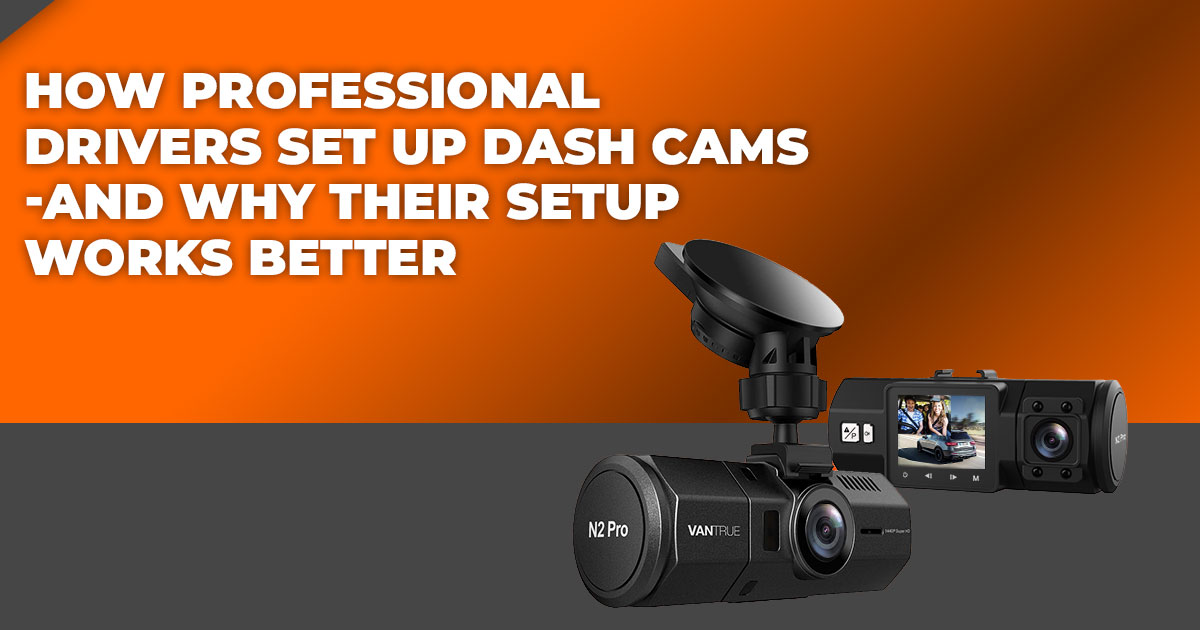
Real-world setups used by fieet, taxi, and delivery drivers—and what everyday drivers can learn from them
Most disputes on the road don’t come down to what happened—they come down to what can be proven. That’s the pain point professional drivers are trying to eliminate. Fleet operators, taxi drivers, and delivery workers rely on a professional dash cam setup that captures reliable footage every single time. No missing clips. No unclear angles. No excuses.
They mount the camera high behind the rearview mirror, use a hardwired dash cam installation for uninterrupted power, and choose a multi-channel dash cam system to cover every angle of the vehicle. Features like parking mode, GPS, and smart alerts aren’t extras—they’re safeguards. Together, they produce clear accident video evidence, speed up insurance claim footage reviews, and reduce disputes. And these same choices work just as well for everyday drivers who want dependable protection.
Quick Summary
Professional drivers don’t treat dash cams as accessories. They hardwire them for constant power, mount them high for a clear view, use dual or triple cameras to remove blind spots, and rely on GPS-backed footage when claims arise. Following the same setup gives everyday drivers stronger evidence and less stress.
1. Introduction: How Professional Drivers Approach Dash Cam Setups
Spend time around taxis, delivery vans, or fleet vehicles, and the difference becomes obvious. Their cameras are always on, properly positioned, and built into the vehicle setup. For professional drivers, a dash cam isn’t a gadget—it’s essential equipment.
They choose a commercial dash cam system designed to record around the clock, capture multiple angles, and deliver dependable driving incident evidence when it’s needed most. The priority isn’t flashy features. It’s consistency, coverage, and footage that stands up during insurance reviews or internal investigations.
This approach explains why professional setups work better. They’re designed for real conditions—night shifts, heavy traffic, tight parking, and long hours on the road.
As technology experts with over 20 years of experience in hardware and application research and development, we analyze each product based on real-world performance, durability, and value for money. Our goal is to help you find the best product in every category—budget, performance, reliability, and long-term usage.
For fleet managers, taxi and rideshare drivers, delivery professionals, and everyday drivers looking for serious protection, our recommendations are based on extensive research, component analysis, real-world usability, and industry expertise. This guide focuses on what actually works in daily driving, not just what looks good on a spec sheet.
1.1 What You’ll Learn From This Guide
- The precise dash cam mounting behind the rearview mirror position that delivers the clearest, least obstructed footage
- Why a hardwired dash cam installation is more dependable than using a cigarette lighter
- How a multi-channel dash cam system—dual or triple channel—eliminates blind spots
- Simple steps to set the correct camera angle for usable footage in daylight and low light
- Why dash cam, GPS, and AI features strengthen evidence during insurance claims
- Which setup details best match the needs of taxi drivers, delivery drivers, rideshare workers, and fleet managers
1.2 Why Learning From Professional Drivers Makes Sense
Drivers who depend on their vehicles for income can’t afford uncertainty. Taxi drivers, Uber and Lyft drivers, delivery workers, and fleet managers need driving incident evidence that holds up in real situations—from late-night passenger complaints to unexplained damage in parking lots.
A well-planned professional dash cam setup reduces stress during claims, shortens resolution times for false accusations, and often encourages safer driving habits over time. These dash cam setup best practices are shaped by experience, not assumptions.
Everyday drivers face the same risks, just less frequently. By following the same setup methods used by professionals, they can achieve the same level of confidence and protection—without added complexity. And that’s why this approach matters.
Once drivers understand why professionals hardwire their dash cams, the next question is usually about reliability. Using the correct power source matters just as much as camera placement or coverage. That’s why many drivers choose official hardwire kits designed specifically for long-term parking mode and battery protection.
For those looking to start with a dependable setup, Vantrue’s offfcial hardwire kits are available directly from their stores:
- US Official Store: Click here to explore
- India Official Store: Click here to explore
1.3 Recommended Specifications at a Glance
| Feature | Recommended Specification | Why It Matters for Professional Use |
|
Front Resolution |
4K or minimum 2K |
Reads license plates clearly from a distance—key for accident video evidence |
| Rear/Interior Resolution | 1080p or better | Sharp footage in low light for rear impacts or passenger areas |
| Channels | Dual or triple | Full coverage with no gaps—standard
in commercial vehicle dash cams |
| Power | Hardwired kit with low-
voltage cutoff |
Enables true parking mode dash cam
without draining the battery |
| Night Performance | Strong sensor + infrared for
interior |
Clear recording at night—vital for
taxis and late deliveries |
| GPS | Built-in | Logs speed and location for stronger
insurance claim footage |
| Storage | 128GB–512GB high-
endurance card |
Handles constant recording without failing |
| Impact Detection | G-sensor with auto-lock | Saves critical clips automatically |
2. Dash Cam Mounting Position: Why Professional Drivers Mount High and Centered
Professional drivers don’t guess where to place a camera. They follow a proven dash cam mounting position used across fleet vehicles, taxis, and delivery vans. The goal is clear: capture the road accurately, avoid driver distraction, and maintain vehicle safety.
2.1 Dash Cam Mounting Behind Rearview Mirror: The Professional Standard
The preferred location is dash cam mounting behind the rearview mirror, positioned high and centered on the windshield. This placement aligns with the driver’s forward view while staying out of direct sight.
From a coverage perspective, this position captures lanes, intersections, and traffic signals consistently. From a safety perspective, it avoids blocking visibility and reduces the risk of interfering with airbags—a common issue with lower mounts.
2.2 Benefits of High Windshield Dash Cam Placement
- Widest possible road view without blocking the driver’s line of sight
- Inside the windshield wiper sweep, keeping the footage clear in rain or snow
- Discreet placement, reducing passenger attention and theft risk
Fleet installers often replace suction mounts with electrostatic adhesive pads. These reduce vibration, withstand heat, and leave no residue when vehicles are reassigned.
For a dash cam for taxi drivers and a dash cam for Uber drivers, hidden placement limits passenger questions and disputes. For delivery drivers, the higher angle ensures an unobstructed view when navigating tight streets and loading zones.
- Common mistake: mounting the dash cam too low. This narrows the field of view, increases glare, and may interfere with airbag deployment during a collision.
3. Hardwired Dash Cam Installation: Why Professionals Avoid the Cigarette Lighter
Consistent footage requires consistent power. That’s why professionals skip temporary power options.
3.1 How Professional Drivers Power Dash Cams
Professional drivers rely on a hardwired dash cam installation connected directly to the vehicle’s fuse box. This setup provides stable power whether the engine is on or off and removes dependence on fragile plugs.
Hardwiring also results in a clean dashboard, with no loose cables and no accidental disconnections.
3.2 Benefits of Hardwiring for Parking Mode and Battery Protection
- Keeps parking mode dash cam active when the vehicle is off
- Records hit-and-runs, vandalism, and parking lot incidents
- Includes low-voltage protection to prevent battery drain
- Creates a professional, cable-free interior
For delivery drivers and fleet operators, a dash cam setup for 24/7 parking surveillance is critical. Many incidents happen when vehicles are unattended in depots, streets, or customer locations.
Drivers who prefer not to work with fuses often choose professional dash cam installation. The cost is reasonable, and the long-term reliability makes it worthwhile.
Hardwiring only works well when the kit includes proper low-voltage protection and stable power delivery. Many issues blamed on dash cams—battery drain or missed recordings—come from poor-quality wiring solutions.
To avoid these problems, professional drivers often rely on offfcial hardwire kits made for continuous use and parking mode reliability. Vantrue offers dedicated options through its regional stores:
- US Official Store: Click here to explore
- India Official Store: Click here to explore
4. Multi-Channel Dash Cam System: Why Single-Lens Recording Is Not Enough
Professional drivers don’t rely on a single angle. Context matters, and context requires coverage.
4.1 Dual and Triple Channel Dash Cam Systems Explained
A multi-channel dash cam system usually means a dual-channel dash cam (front and rear) or triple-channel dash cam (front, rear, and interior). This setup records incidents from multiple perspectives at the same time.
4.2 What Each Dash Cam Channel Records
- Front camera: road incidents, traffic lights, license plates
- Rear camera: tailgaters, rear-end collisions, reversing damage
- Interior camera with infrared: passenger behavior, driver protection
An interior dash cam for taxis and rideshare vehicles helps resolve disputes and protects drivers from false complaints. A rear dash cam for delivery vehicles captures incidents in alleys, loading docks, and tight parking spaces.
A multi-camera dash cam setup for commercial vehicles removes blind spots and provides complete context for insurance claims and internal reviews.
5. Dash Cam GPS, Impact Detection, and Driver Alerts: Evidence That Holds Up
Video alone is often not enough. Professional drivers depend on supporting data to strengthen every recording.
5.1 Smart Dash Cam Features Used by Professional Drivers
Modern commercial vehicle dash cams include dash cam GPS, impact detection sensors, and driver alert systems. These features operate in the background without distracting the driver.
5.2 How GPS and Sensors Strengthen Dash Cam Evidence
- GPS data records speed, location, and route, reinforcing dash cam evidence for false insurance claims
- Impact detection automatically locks critical footage, preventing overwrite
- Driver alerts highlight harsh braking or lane drifting, encouraging safer habits
Insurance providers often process claims faster when footage includes GPS data and impact logs. For fleet managers, this added context reduces investigation time and limits liability.
Each of these choices—mounting position, hardwired power, multi-channel coverage, and data- backed recording—reflects how professional drivers set up dash cams for reliability, coverage, and trust. The result is footage that stands up when it matters most.
6. Dash Cam Camera Angle Calibration: The Step Most Drivers Skip
Most dash cams fail for one simple reason: the angle is wrong. Professional drivers don’t leave this to chance because poor framing can make footage useless during a claim.
6.1 How Professional Drivers Calibrate Dash Cam Angles
Instead of mounting and moving on, professionals calibrate the dash cam angle before driving. They use the live screen or app to confirm exactly what the camera sees from the driver’s seat. This step matters because lighting changes throughout the day, and footage needs to stay clear during daytime driving, evening traffic, and high-glare conditions.
A properly set angle keeps critical details visible without distortion or washout.
6.2 Ideal Dash Cam View Split for Clear Evidence
The most reliable balance is 60–70% road and 30–40% sky.
Too much sky leads to glare and blown highlights. Too much road cuts off traffic lights and overhead signs. Both weaken accident video evidence.
The practical approach is simple. Park in a familiar location, open the live view, and adjust until lanes, signals, and surrounding vehicles are all visible. This small step ensures usable footage when it actually matters.
7. Professional vs Amateur Dash Cam Setup Comparison
The difference between casual and professional setups shows up the moment something goes wrong. One delivers uncertainty. The other delivers clarity.
| Area | Casual Setup | Professional Setup | Why the Professional Approach Wins |
|
Power |
Cigarette lighter plug | Hardwired dash
cam installation with protection |
True parking mode dash
cam without battery concerns |
| Coverage | Front-only recording | Multi-channel dash cam system | Complete context with no blind spots |
| Evidence Access | Manual SD card removal | GPS logging with auto-locked files | Faster insurance claim footage review |
|
Mounting |
Low or visible placement | High dash cam mounting behind
the rearview mirror |
Clear view and discreet positioning |
| Daily Reliability | Frequent checks needed | Set-and-forget operation | Consistent recording every shift |
Professional drivers don’t upgrade for features. They upgrade to remove uncertainty.
8. Matching Dash Cam Setups to Specific Driving Jobs
Different driving roles face different risks. Professional setups reflect those realities.
8.1 Dash Cam Setup for Taxi and Rideshare Drivers
Taxi and rideshare drivers prioritize interior infrared recording paired with front-facing coverage. This combination protects drivers during passenger disputes and ensures clear footage during night shifts.
Clear interior video often resolves issues before they escalate.
8.2 Dash Cam Setup for Delivery and Logistics Drivers
Delivery drivers focus on front and rear camera coverage supported by a reliable parking mode dash cam. Buffered recording captures events before and after motion, which matters in loading zones, alleys, and overnight parking areas.
These environments cause more damage than open roads.
8.3 Dash Cam Setup for Fleet and Commercial Operations
Fleet operators favor triple-channel dash cam systems with GPS logging and minimal driver interaction. These setups support route verification, simplify incident reviews, and reduce downtime caused by disputes.
Less friction keeps vehicles working.
9. How Professional Dash Cam Setups Reduce Risk Over Time
A well-planned professional dash cam setup does more than record incidents. It changes behavior and outcomes.
Drivers stay more focused knowing events are documented. Insurance claims move faster with clear, contextual footage. Conversations with insurers stay factual instead of emotional. Over long-term use, a reliable commercial dash cam system often offsets its cost through avoided disputes and reduced claim delays.
Each decision—camera angle calibration, hardwired power, multi-channel coverage, and GPS- backed data—works together to create evidence that holds up when it counts.
10. Clearing Common Doubts About Professional Dash Cam Setup
Before choosing or installing a dash cam, most drivers ask the same practical questions. This section clears up those doubts using real-world setups followed by professional drivers, fleet operators, and delivery drivers. Each answer focuses on clarity, usability, and how these choices improve dash cam reliability, evidence quality, and insurance outcomes.
Q. Where to mount the dash cam on the windshield for best results?
- The most effective position is high and centered behind the rearview mirror. This dash cam mounting behind the rearview mirror setup delivers the widest road view, stays within the windshield wiper sweep, and keeps the camera discreet so it doesn’t distract drivers or passengers.
Q. Why hardwire a dash cam instead of using the lighter socket?
- A hardwired dash cam installation provides constant power, even when the engine is off. This allows parking mode dash cam recording, keeps cables hidden, and avoids accidental disconnections common with lighter sockets.
Q. What is parking mode on a dash cam, and why do professionals use it?
- Parking mode records incidents while the vehicle is parked. Professional drivers use it to capture hit-and-runs, vandalism, and parking lot damage, especially for delivery vehicles and fleet vehicles that are left unattended.
Q. How do professional drivers install dash cams differently?
- Professionals focus on hardwired power, multi-channel dash cam systems, discreet mounting, and careful camera angle calibration. This approach ensures consistent recording and usable footage in real driving conditions.
Q. Why do taxis use interior dash cams?
- An interior dash cam with infrared records passenger behavior clearly, even at night. This protects taxi drivers and rideshare drivers from disputes and provides reliable evidence if complaints arise.
Q. How do dash cams help insurance claims?
- Dash cams provide time-stamped, GPS-logged, and auto-locked footage. This strengthensinsurance claim footage, reduces disagreements, and often speeds up claim resolution.
11. Frequently Asked Questions About Professional Dash Cam Setup
These are the most common questions drivers ask before choosing or installing a dash cam. The answers below reflect real-world use by taxi drivers, delivery drivers, rideshare operators, and fleet managers, focusing on clarity, legality, and long-term reliability.
Q. Is a multi-channel dash cam worth it for rideshare or delivery work?
- Yes. A multi-channel dash cam system is worth it because single-channel dash cams leave gaps. Missing rear or interior footage can weaken insurance claims, especially for rideshare drivers and delivery drivers who face disputes off the road.
Q. Will a dash cam block safety sensors if mounted behind the mirror?
- In most vehicles, no. Dash cam mounting behind the rearview mirror is safe when placed below the tinted top strip, where factory safety sensors are usually located. This keeps both systems working as intended.
Q. How often should the dash cam memory card be formatted?
- Formatting the dash cam memory card every one to two months helps prevent file corruption and recording errors, especially in commercial vehicle dash cams that record daily.
Q. Can a professional-style dash cam setup be done without an installer?
- Mounting the camera and basic setup are manageable for most drivers. A hardwired dash cam installation may require an auto electrician if working with fuse boxes is unfamiliar. Many drivers choose professional help for long-term reliability.
Q. Do hardwired dash cams drain the car battery in parking mode?
- Quality hardwire kits include low-voltage protection. These systems shut off recording before the battery drops too low, making the parking mode dash cam safe for daily use.
Q. What dash cam resolution is best for reading license plates?
- 4K front dash cams work best in daylight for plate clarity. 2K resolution is often sufficient when paired with a good image sensor and proper camera angle calibration.
Q. Are interior dash cams allowed for Uber or taxi drivers?
- In many regions, interior dash cams are allowed if passengers are notified. Taxi drivers and
rideshare drivers should check local regulations and display visible notices inside the vehicle.
Q. How do professionals hide dash cam cables for a clean setup?
- Cables are routed along the headliner, tucked behind pillar trim, and guided using plastic trim tools. This method creates a clean, professional dash cam setup with no loose wiring.
12. Conclusion
If you want footage you can rely on when it matters, it makes sense to follow the drivers who depend on it every day. Professional drivers don’t leave things to chance. They mount the dash cam high and discreet, choose a hardwired dash cam installation for steady power, and rely on a multi-channel dash cam system to capture the full picture. GPS logging and parking mode aren’t extras—they’re part of making sure the footage holds up when questions come up.
The real gap between an everyday setup and a professional dash cam setup isn’t price. It’s attention to detail. Where the camera sits. How it’s powered. What angles does it cover? Those choices decide whether footage helps you—or leaves you guessing.
If you’re ready to build a setup that works the way professionals expect it to, start with the right power solution. You can find official hardwire kits directly from Vantrue here:
- US Official Store: Click here to explore
- India Official Store: Click here to explore
Have questions about your vehicle, or want to share what’s worked for you? Drop a comment below. We’re happy to help you get the setup right. Drive safe.
***Disclaimer***
This blog post reflects our own research, testing, and personal opinions. It should not be taken as the official position of any brand, manufacturer, or company mentioned here. While we aim to keep information accurate and up to date, product details, pricing, and availability can change. We recommend double-checking important details before making a purchase.
Some links in this article may be affiliate links. If you choose to buy through these links, we may earn a small commission at no extra cost to you. This helps support our work and allows us to keep publishing in-depth, unbiased reviews. Our recommendations are never influenced by affiliate partnerships.
Comments shared by readers reflect their own views and not ours. We are not responsible for outcomes resulting from the use of information on this site. Please seek professional advice where appropriate.
All product names, logos, and brands mentioned are the property of their respective owners. These names are used for identification and informational purposes only and do not imply endorsement.