
Quick Glance
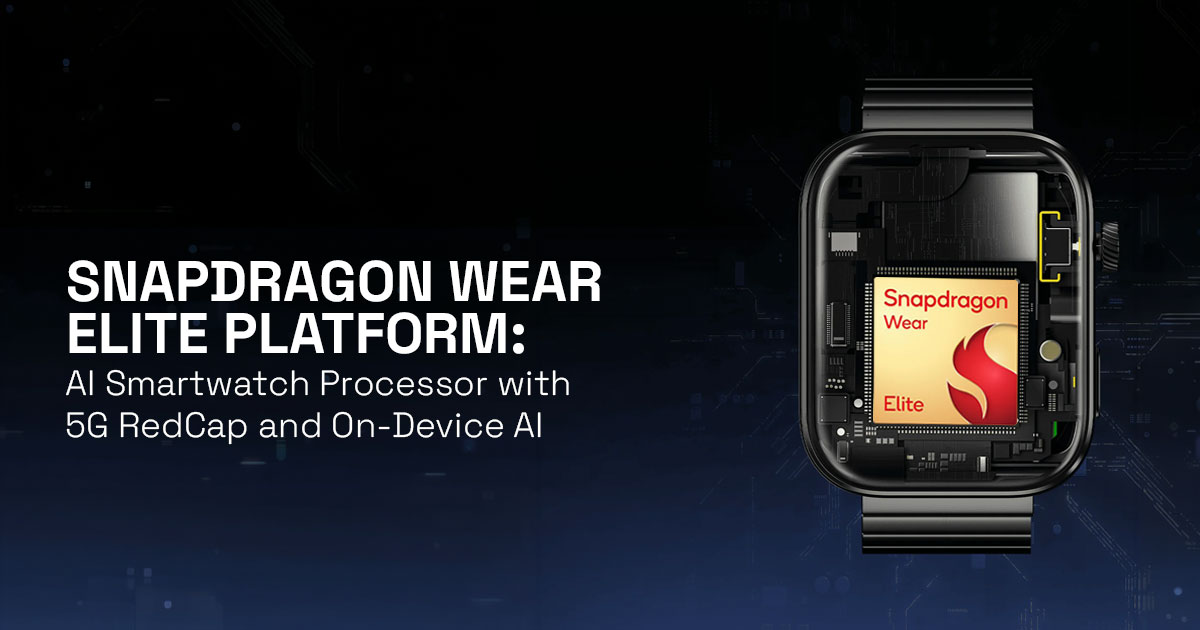
The Snapdragon Wear Elite is Qualcomm’s newest AI wearable processor designed for next- generation smartwatches. It supports on-device AI processing, 5G RedCap connectivity, Wi-Fi 6, Bluetooth 6.0, and up to 12 TOPS of AI performance, enabling faster health analysis and longer battery life in wearable devices.
- Qualcomm’s Snapdragon Wear Elite introduces powerful on-device AI processing for modern wearables with an NPU capable of up to 12 TOPS.
- It supports 5G RedCap, Wi-Fi 6, and Bluetooth 0, allowing standalone wearable connectivity without constant phone pairing.
- Performance improvements include up to 5× faster CPU performance, 7× GPU gains, and
30% longer battery life.
- The 3nm process node improves efficiency while supporting AI models up to 2 billion parameters.
- Devices using the Snapdragon Wear Elite wearable platform could move wearables beyond simple trackers toward independent AI-powered companions.
Introduction
Many smartwatch users face the same problem: advanced features sound great, but the moment AI tracking or health analytics starts running, battery life drops quickly. And when a wearable depends on a phone or cloud server just to analyze personal data, it stops feeling very smart.
That’s the problem the Snapdragon Wear Elite aims to solve.
This Qualcomm wearable platform is designed for devices that run AI models directly on the wearable processor, analyze health signals locally, and connect independently through 5G RedCap, Wi-Fi 6, and Bluetooth 6.0. Instead of acting as a simple extension of your phone, devices powered by the Snapdragon Wear Elite wearable chipset can operate more like personal assistants on your wrist.
And that shift matters. Users want faster responses, stronger privacy, and longer battery life from their devices. When a watch processes heart rhythm, sleep data, or activity patterns locally, the results arrive instantly without relying on cloud processing.
The AI wearable processor inside this platform can also handle AI models up to 2 billion parameters, run real-time analytics, and maintain power efficiency thanks to its 3nm architecture.
But specifications alone don’t explain the full impact. The real question is how this platform changes everyday wearables—from smartwatches and health bands to emerging AI pins and wearable assistants.
Click here to buy from Amazon
Product / Category Overview
The Snapdragon Wear Elite is Qualcomm’s latest wearable system-on-chip (SoC) designed for AI-powered wearables.
Instead of focusing only on notifications or basic fitness tracking, this platform supports advanced AI workloads directly on wearable devices.
Key capabilities include:
- On-device AI processing with an NPU delivering up to 12 TOPS
- 5G RedCap connectivity optimized for low-power connected devices
- Wi-Fi 6 and Bluetooth 0 for faster wireless communication
- Up to 5× CPU performance improvement
- 7× GPU performance gains
- 30% longer battery life
- 3nm semiconductor process for efficient wearable designs
These improvements make the Snapdragon Wear Elite wearable platform suitable for:
- Smartwatches
- Health monitoring wearables
- AI-powered wearable assistants
- Compact edge AI devices
Instead of relying heavily on cloud computing, this chipset supports edge AI processing in wearables, enabling faster responses and improved privacy.
Why User Reviews Matter for Wearable Technology
Specifications can look impressive on paper. But real value shows up only when devices are used daily—during workouts, workdays, and travel.
That’s why user reviews and expert analysis matter.
They reveal what speciffcations alone cannot show:
- How long do devices last during continuous health monitoring
- Whether AI features run smoothly without lag
- How reliable standalone connectivity works without a phone
- Whether performance improvements translate into better daily usability
In this review, we examine how the Snapdragon Wear Elite wearable processor performs in areas that matter most: real-world performance, efficiency, and long-term practicality.
As technology experts with over 20 years of experience in hardware and application research and development, we analyze each product based on real-world performance, durability, and value for money. Our goal is to help you identify the best products across budget, performance, reliability, and long-term use.
Our recommendations come from extensive research, component analysis, real-world usability testing, and industry experience.
This review will help:
- smartwatch buyers exploring next-generation devices
- fitness enthusiasts who rely on accurate wearable tracking
- developers interested in wearable AI platforms
- technology enthusiasts following wearable processor innovation
- and professionals seeking standalone wearable devices that work independently of smartphones
Snapdragon Wear Elite Key Specifications
Before exploring real-world implications, here’s a simplified overview of the Snapdragon Wear Elite wearable platform.
| Feature | Capability |
| AI Processing | On-device NPU up to 12 TOPS, supports 2-billion-parameter AI
models |
| CPU / GPU Boost | Up to 5× single-core CPU performance, 7× GPU performance |
| Connectivity | 5G RedCap, Wi-Fi 6, Bluetooth 6.0 |
| Efficiency | 30% longer battery life, 50% charge in 10 minutes |
| Process Node | 3nm architecture for efficient wearable designs |
| Target Devices | Smartwatches, health wearables, AI pins and pendants |
These specifications highlight Qualcomm’s focus on balancing high performance with energy efficiency, which is essential for devices powered by small batteries.
Why This Review Is Essential
The wearable market has seen many upgrades over the years—slightly faster processors, improved displays, and better sensors.
But the Snapdragon Wear Elite platform introduces a more important shift: AI processing built directly into wearable hardware.
This change addresses several common problems:
- dependence on cloud processing for AI features
- latency during health analysis
- privacy concerns around biometric data
- and battery drain during continuous tracking
For people running outdoors or managing busy workdays, reliability matters more than extra features. A wearable that processes data locally responds faster and remains usable longer.
Industry projections also show strong growth for AI-enabled wearable devices, driven by demand for on-device intelligence and privacy-focused processing.
Understanding the Snapdragon Wear Elite wearable chipset helps readers decide whether to upgrade now or wait for the next generation of AI-powered smartwatches.
What You Will Learn from This Review
By the end of this review, you will understand:
- How on-device AI processing improves wearable health analysis
- Why 5G RedCap connectivity enables standalone smartwatch operation
- How the Snapdragon Wear Elite AI accelerator compares with earlier wearable chips
- The trade-offs of running large AI models on compact wearable batteries
- How this platform may shape future smartwatch and AI wearable designs
You will also see practical scenarios where these improvements matter:
- continuous heart rhythm monitoring without delays
- AI-guided workout recommendations during activity
- smart notifications based on daily patterns
- and wearables that function more like intelligent personal companions
The Snapdragon Wear Elite wearable processor represents more than a routine hardware upgrade. It signals a move toward AI-driven wearable devices that operate independently, respond instantly, and protect personal data through local processing.
1. AI Wearables and the Rise of Edge AI in Smartwatches
Wearables are changing quickly. What started as simple step counters has grown into a new category of AI wearables that can analyze data directly on the device.
1.1 How Wearables Have Evolved
The journey of wearable technology has happened in stages:
- Early wearables: Basic step counters and pedometers
- Next-generation devices: Fitness bands with GPS and heart-rate sensors
- Today’s devices: AI-powered smartwatches that process data locally
This latest stage introduces edge AI in wearables, where the device handles data analysis itself instead of sending everything to the cloud.
1.2 Why Edge AI Matters in Smartwatches
Demand for faster and more reliable insights is driving this change.
Industry forecasts estimate the global smartwatch market could reach $100 billion by 2028, with strong growth in AI-powered wearable devices.
Users want wearables that respond instantly. Examples include:
- Detecting irregular heart rhythms during daily activities
- Adjusting sleep targets based on stress levels
- Delivering health insights in real time
With on-device AI processing, the smartwatch can study patterns and respond immediately without waiting for remote analysis.
1.3 Health Monitoring Is the Main Driver
Health tracking is one of the biggest reasons people buy smartwatches.
Surveys show that continuous health monitoring is among the most important features for wearable users. At the same time, many users remain unsatisfied with the accuracy of current devices.
This is where AI smartwatch processors play a major role. By analyzing sensor data directly on the device, on-device AI processing improves both speed and reliability.
- Key Takeaway
If your wearable currently feels reactive—sending alerts after events happen—the rise of AI smartwatch processors and edge AI in wearables points to devices that learn from daily behavior and provide more useful guidance.
2. Snapdragon Wear Elite Wearable Platform: AI Performance and Architecture
The Snapdragon Wear Elite wearable platform focuses on three areas users notice most: speed, efficiency, and real-time AI processing.
At the center of the chip is a dedicated AI accelerator capable of running AI models locally. Tasks like voice recognition, gesture detection, and biometric analysis can run directly on the device instead of relying on remote servers.
Compared with earlier wearable processors, the platform brings several improvements:
- Up to 5× CPU performance for faster app response
- Up to 7× GPU performance for graphics and interface smoothness
- Advanced biometric sensor support, including multi-lead ECG and advanced health tracking
- 30% longer battery life through power-efficient processing
These upgrades allow smoother multitasking. A smartwatch can track a workout, display navigation, and analyze health data at the same time without slowing down.
Energy efficiency is equally important. Battery life remains one of the biggest concerns for smartwatch buyers. The Snapdragon Wear Elite chipset improves efficiency while running on- device AI workloads, which helps reduce the battery drain that often accompanies advanced features.
3. On-Device AI Processing in Wearables: Faster Insights and Better Privacy
On-device AI in wearables means the smartwatch processes data locally instead of sending everything to the cloud.
For example, during a workout, the wearable can analyze stride patterns and heart-rate signals instantly. There is no delay caused by uploading data for remote analysis.
This approach provides several beneffts:
- Low-latency alerts: Events such as fall detection or abnormal heart rhythms can trigger alerts immediately.
- Stronger privacy protection: Sensitive health data stays on the device rather than being stored on external servers.
- Better battery efficiency: Cloud processing requires constant wireless transmission, which increases power use.
Modern AI wearable processors run optimized neural networks designed for low-power environments. Even models with billions of parameters can run efficiently on wearable hardware.
3.1 Everyday Use Cases for On-Device AI Wearables
- Voice assistants: Commands like “remind me to hydrate” run offline.
- Gesture recognition: Hand motions silence calls or control music.
- Health signal analysis: Real-time estimates of metrics like VO2 max during exercise.
- Context-aware notifications: Alerts pause automatically when driving or during meetings.
Some complex workloads may still rely on cloud processing, but most daily wearable tasks run faster and more securely on-device.
- Key takeaway: Local AI processing in smartwatches delivers quicker results while keeping personal data private.
Click here to buy from Amazon
4. 5G RedCap Connectivity in Wearables: Enabling Standalone Smartwatches
Traditional 5G connectivity consumes too much power for wearable devices. 5G RedCap (Reduced Capability) addresses that issue by offering lower bandwidth while reducing energy consumption.
For wearables, this balance is ideal. 5G RedCap connectivity provides enough speed for health data synchronization, calls, and music streaming while using far less power than standard 5G.
Key beneffts include:
- Standalone smartwatch connectivity without a phone
- Reliable connections during outdoor activities
- Lower energy consumption compared with traditional 5G
RedCap complements other wireless technologies used in modern wearables:
- Bluetooth 0 for device pairing and accessories
- Wi-Fi 6 for fast data transfer at home or in offices
Together, these technologies create a connectivity stack designed for mobility.
User problem solved: Many wearable owners report interrupted tracking when phone connections drop. 5G RedCap smartwatches can remain connected independently, improving reliability during travel, workouts, or daily errands.
5. AI Health Monitoring in Smartwatches: Predictive Wearable Healthcare
Most current wearables generate reports after activities end. AI health monitoring changes that by analyzing biometric data continuously.
Sensors collect signals such as heart rate, motion, and sleep patterns. The AI wearable processor then evaluates these signals in real time.
This allows wearables to move from basic tracking toward predictive health insights.
5.1 Examples of AI-Driven Health Monitoring
- Cardiac monitoring: Continuous rhythm analysis can identify irregular heart patterns.
- Stress detection: Changes in heart-rate variability may indicate stress, prompting breathing guidance.
- Sleep analysis: Sleep cycles are evaluated to suggest improved recovery routines.
- Metabolic tracking: Wearables can analyze energy patterns and glucose trends.
Healthcare researchers suggest that AI-powered wearable monitoring could improve adherence to health tracking programs because alerts feel more relevant to users.
- Key takeaway: AI wearables transform health data into practical guidance, helping users understand signals before problems escalate.
6. Snapdragon Wear Elite vs Apple Watch Chip vs Samsung Exynos W
Choosing a wearable chipset often depends on ecosystem compatibility and performance capabilities. The following comparison highlights the main differences between leading smartwatch processor platforms.
| Feature | Snapdragon Wear Elite | Apple Watch Chip (S10) | Samsung Exynos W1000 |
| AI
Capabilities |
On-device NPU (12 TOPS, supports large AI models) | Neural engine optimized for health analysis | Basic machine- learning acceleration |
| Connectivity | 5G RedCap, Wi-Fi 6, Bluetooth 6.0 | LTE eSIM, Ultra Wideband | LTE, Wi-Fi 5, Bluetooth 5.3 |
| Power Efficiency | 3nm process, 30% battery improvement | Optimized battery performance within the Apple ecosystem | Moderate efficiency |
| Platform Ecosystem | Wear OS, Android, Linux devices | Exclusive to WatchOS | Wear OS / Samsung ecosystem |
The Snapdragon Wear Elite wearable processor stands out for its cross-platform flexibility and AI capability. Apple’s chip delivers strong integration within the Apple ecosystem, while Samsung’s solution focuses on Galaxy devices.
- Choosing a platform: Users seeking open compatibility across Android devices may benefit from Snapdragon Wear Elite smartwatches, while users invested in specific ecosystems may prefer chips designed for those platforms.
7. Real-World Applications of AI Wearables
The impact of AI wearables becomes clearer when looking at everyday use.
A wearable powered by on-device AI processing can analyze personal patterns and adapt throughout the day.
7.1 Examples of Practical AI Wearable Features
- AI fitness coaching: Stride analysis and pace recommendations during running sessions.
- Intelligent sleep tracking: Sleep disruptions linked to habits such as caffeine intake.
- Real-time translation: Local speech processing enables language translation without internet access.
- Gesture-based device control: Hand movements control music, calls, or navigation.
- Context-aware notifications: The device prioritizes alerts based on focus or activity.
Many users notice the difference when switching from basic trackers. Instead of simply collecting data, AI smartwatches interpret behavior and provide useful suggestions.
- Key takeaway: The real strength of AI wearable platforms like Snapdragon Wear Elite lies in personalization—turning raw sensor data into insights that support everyday
8. On-Device AI Privacy in Wearables: Protecting Health Data on Smartwatch Processors
Many smartwatches and AI wearables rely on cloud processing to analyze health data. This means biometric information—such as heart rate, sleep patterns, and activity records—travels to remote servers, which raises concerns about health data privacy and security.
On-device AI processing changes this model. With platforms like the Snapdragon Wear Elite wearable chipset, health data can be analyzed directly on the device instead of being sent to external servers.
8.1 Key Privacy Advantages of On-Device AI
- Local data processing: Health metrics such as heart rhythm and sleep patterns remain on the wearable.
- Reduced cloud dependence: Features like health monitoring alerts continue working without internet access.
- Faster health alerts: Critical notifications—such as abnormal heart rhythm—can trigger instantly.
- Improved data protection: Running AI models locally reduces exposure to external databases and potential breaches.
8.2 Local Processing vs Cloud Processing
Both approaches have roles:
- Cloud AI processing supports large-scale analysis and long-term data trends.
- On-device AI processing focuses on privacy, speed, and continuous monitoring.
For most wearable tasks such as activity tracking and health signal analysis, local processing provides faster results.
- Key takeaway: AI smartwatch processors allow personal health data to stay closer to the device while delivering real-time insights.
9. Snapdragon Wear Elite Developer Platform: Building AI Wearable Applications
The Snapdragon Wear Elite wearable platform creates opportunities for developers building AI wearable applications.
A key capability is sensor fusion, which combines data from sensors such as accelerometers, heart-rate monitors, and GPS to produce deeper insights.
9.1 AI Wearable Development Opportunities
- Health monitoring apps: Applications that track vital signs and provide insights for athletes or patients.
- AI wearable assistants: Voice-based systems that manage reminders, navigation, or daily
- Senior care wearables: Pendant-style devices that monitor activity and provide medication reminders.
- Industrial wearable safety systems: Wearables that detect environmental hazards or worker fatigue.
9.2 Why Snapdragon Wear Elite Supports Innovation
The Snapdragon Wear Elite chipset supports development across Wear OS, Android-based systems, and Linux platforms, enabling faster experimentation.
Developers still need to optimize low-power AI models to maintain battery life in wearable devices.
- Key takeaway: The Snapdragon Wear Elite developer ecosystem supports new categories of AI-powered wearable devices.
10. Challenges Facing AI Wearables and Smartwatch Processors
Despite progress, AI wearable platforms still face technical limitations.
- Battery Life Constraints: Running advanced AI models on smartwatch processors increases power Even with improved efficiency, heavy workloads can reduce battery endurance.
- AI Model Size Limits: Wearable hardware requires compact neural networks. Developers must balance model accuracy and processing efficiency.
- Thermal Management: Continuous AI workloads can generate heat in small wearable devices, which requires careful hardware design.
10.1 Sensor Accuracy Factors
Biometric readings can be influenced by:
- skin tone variations
- sweat and movement
- environmental conditions
Manufacturers continue improving sensors and signal processing.
10.2 Supply Chain Challenges
Advanced technologies such as 3nm wearable processors depend on complex semiconductor manufacturing, which can affect production timelines.
Balanced view: These challenges encourage innovation in power-efficient AI algorithms and improved wearable hardware design.
11. The Future of AI Smartwatches and Next-Generation Wearable Devices
The next generation of AI-powered smartwatches will move beyond apps toward continuous intelligent assistance.
- Ambient AI Assistants: Future wearables may deliver useful information automatically, such as route suggestions based on weather or schedule changes.
- Predictive Health Monitoring: Advanced AI health monitoring systems could detect early signs of conditions like fatigue or metabolic changes.
- Standalone Smartwatch Connectivity: With 5G RedCap connectivity, future wearables may operate independently without relying on smartphones.
- Personalized AI Companions: Wearables may adapt to user routines and preferences, acting as personal digital assistants.
11.1 New Wearable Hardware Designs
Future devices may introduce:
- flexible smartwatch displays
- low-power always-on screens
- modular wearable sensors
These changes may allow users to upgrade sensors without replacing the entire device.
Future outlook: The next generation of AI wearables and smartwatch processors will focus on faster responses, stronger privacy, and personalized insights.
Click here to buy from Amazon
12. Frequently Asked Questions (FAQ) about Snapdragon Wear Elite and AI Wearables
Readers researching the Snapdragon Wear Elite wearable platform, AI smartwatch processors, and on-device AI wearables often want quick answers about performance, connectivity, and real- world use. The short answers below address the most common questions related to Snapdragon Wear Elite, 5G RedCap smartwatches, and AI-powered wearable devices.
Q. What is Snapdragon Wear Elite?
- Snapdragon Wear Elite is a Qualcomm wearable chipset designed for AI-powered smartwatches and wearable devices. It includes an AI accelerator (NPU) for on-device AI processing, along with 5G RedCap, Wi-Fi 6, and Bluetooth 6.0 connectivity.
Q. How does 5G RedCap benefft wearable devices?
- 5G RedCap is a low-power version of 5G designed for wearables and IoT devices. It enables standalone smartwatch connectivity, allowing calls and data syncing without heavy battery use.
Q. Can smartwatches run AI models locally?
- Yes. Modern AI smartwatch processors, including Snapdragon Wear Elite, can run AI models directly on the device, enabling features like voice commands, gesture recognition, and health signal analysis without cloud processing.
- Which devices may use Snapdragon Wear Elite?
- The Snapdragon Wear Elite wearable platform is expected in next-generation Android smartwatches, fitness wearables, AI pins, and wearable assistants built by Wear OS device manufacturers.
Q. How powerful are wearable AI processors today?
- Current wearable AI processors like Snapdragon Wear Elite deliver up to 12 TOPS of AI performance, enabling real-time health monitoring, intelligent notifications, and faster smartwatch performance while maintaining battery efficiency.
13. Conclusion
The Snapdragon Wear Elite wearable platform signals where AI wearables and smartwatches are heading next. Instead of relying heavily on cloud processing, this platform focuses on on- device AI processing, faster response times, and stronger privacy. That shift makes wearables more practical for everyday use—from real-time health insights to reliable standalone connectivity.
Features like 5G RedCap connectivity, AI smartwatch processors, and improved power efficiency address common frustrations such as battery drain, delayed cloud responses, and constant phone dependence. As wearable technology evolves, platforms like Snapdragon Wear Elite are likely to power the next generation of AI-powered smartwatches and wearable devices.
It’s also important to note that the Snapdragon Wear Elite chipset was only announced recently at MWC Barcelona on March 1, 2026. Because it is a processor platform used by manufacturers, the chip itself is not available for direct purchase. Instead, it will appear inside upcoming wearable devices.
The first smartwatches expected to use the Snapdragon Wear Elite wearable processor— including devices such as the Samsung Galaxy Watch 9—are rumored to launch in the coming months, with many reports pointing toward a July 2026 release window.
Key Takeaways
- On-device AI processing improves speed, privacy, and real-time health insights.
- 5G RedCap connectivity enables standalone smartwatch connectivity with better power efficiency.
- The Snapdragon Wear Elite platform will appear in upcoming AI-powered smartwatches and wearable devices expected later in 2026.
- Choosing a smartwatch still depends on ecosystem compatibility and daily use needs.
Looking for a smartwatch you can buy now?
While Snapdragon Wear Elite smartwatches are still on the way, you can explore current flagship devices that represent the latest generation of AI-enabled smartwatches.
Samsung Galaxy Watch 8
- Amazon Worldwide: Click here to explore more
- Amazon India: Click here to explore more
Samsung Galaxy Watch 8 Classic
- Amazon Worldwide: Click here to explore more
- Amazon India: Click here to explore more
Google Pixel Watch 4
- Amazon Worldwide: Click here to explore more
- Amazon India: Click here to explore more
If you already use a smartwatch, it’s worth asking: does your current device process health data locally, or does it depend on cloud analysis?
Feel free to share your experience with AI wearables, smartwatch battery life, or health tracking accuracy in the comments. Real-world feedback helps others choose devices that actually perform well in everyday use.
This analysis reflects chipset announcements, wearable device trends, and industry insights available as of March 2026.
***Disclaimer***
This blog post reflects our own research, testing, and personal opinions. It should not be taken as the official position of any brand, manufacturer, or company mentioned here. While we aim to keep information accurate and up to date, product details, pricing, and availability can change. We recommend double-checking important details before making a purchase.
Some links in this article may be affiliate links. If you choose to buy through these links, we may earn a small commission at no extra cost to you. This helps support our work and allows us to keep publishing in-depth, unbiased reviews. Our recommendations are never influenced by affiliate partnerships.
Comments shared by readers reflect their own views and not ours. We are not responsible for outcomes resulting from the use of information on this site. Please seek professional advice where appropriate.
All product names, logos, and brands mentioned are the property of their respective owners. These names are used for identification and informational purposes only and do not imply endorsement.