
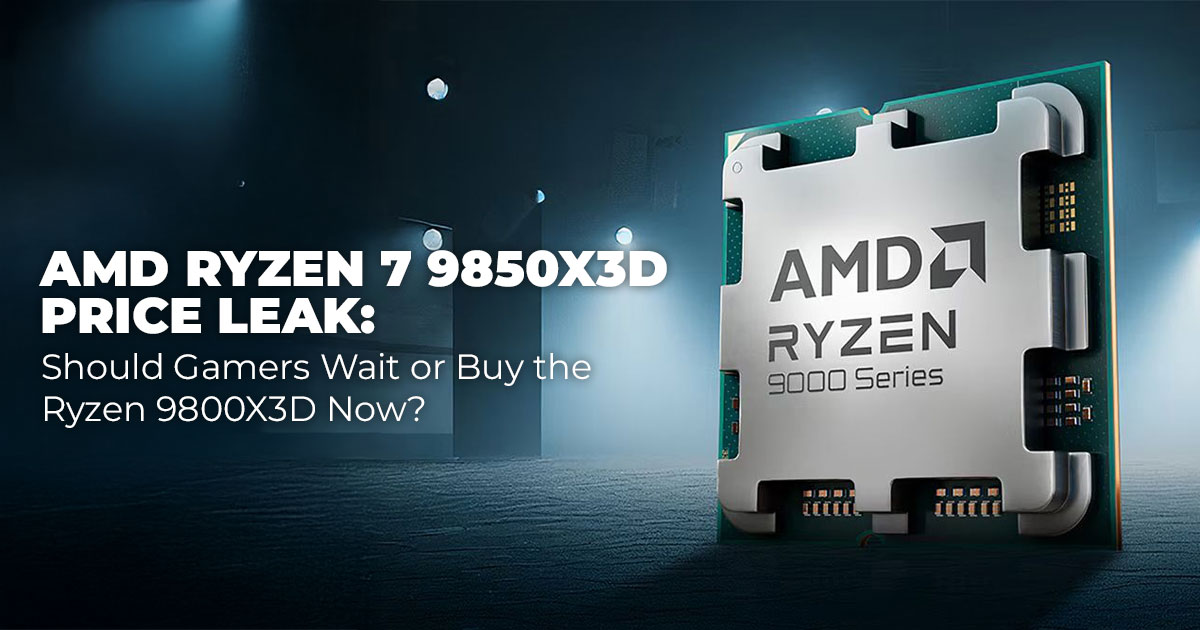
The AMD Ryzen 7 9850X3D is expected to deliver around 5% better gaming performance than the Ryzen 7 9800X3D, mainly from higher clock speeds, at a similar price.
If you play CPU-bound games at 1080p and want every extra frame, waiting could make sense. For everyone else, the Ryzen 7 9800X3D already offers excellent real-world gaming performance and is the smarter buy if you’re building now.
Buy on Amazon worldwide | Buy on Amazon India
1. Introduction
If you’re building a gaming PC today, timing feels like a gamble. You spot a solid deal, hesitate for a moment, and suddenly there’s news of a newer chip coming in at almost the same price. That’s the situation unfolding now, with retailer sightings and partner slips suggesting the AMD Ryzen 7 9850X3D could land around $500. That’s very close to the $479 launch price of the AMD Ryzen 7 9800X3D. For gamers planning an AMD Ryzen gaming CPU build or considering a CPU upgrade for the AM5 platform, this creates real hesitation—not curiosity, but uncertainty.
So, the question isn’t about hype. It’s practical: Does waiting for this next-generation Ryzen X3D actually improve your gaming experience, or does the current pricing in the Ryzen 9800X3D vs 9850X3D debate make buying now the smarter move? This guide breaks down AMD X3D pricing trends and shows how 3D V-Cache actually affects real gameplay—not marketing slides.
1.1 Product & Category Overview
The Ryzen X3D gaming processor lineup exists for gamers who care about consistent frame rates, not just peak benchmark numbers. By adding extra cache directly to the CPU, AMD targets smoother gameplay in CPU-limited scenarios—especially common at 1080p and 1440p. The Ryzen 7 9850X3D, based on current leaks, keeps the same core idea, with a reported 5.6 GHz boost clock and familiar positioning within AMD’s gaming-focused stack.
1.2 Why User Reviews and Real-World Data Matter
Specs and early listings give direction, but they don’t answer the questions buyers actually ask after clicking a search result. Does the performance gain feel noticeable? Are thermals manageable over long sessions? Does the upgrade justify the cost when discounts on the older model exist? User reviews and real-world testing answer these questions in ways launch slides never do, and they’re critical for anyone spending this much on a CPU.
This article is written for PC gamers, competitive players, streamers, and system builders already on or moving to AM5—people who want clarity, not hype. Behind this guide is over 20 years of hands-on experience in hardware research, testing, and real-world system builds. Every recommendation here is grounded in practical performance, long-term reliability, and value— not just spec sheets.
Summary:
Early signals point to the AMD Ryzen 7 9850X3D offering roughly 5% higher gaming performance than the Ryzen 7 9800X3D, mainly from higher clocks, at a similar price. It’s appealing for anyone chasing the best processor for competitive gaming at 1080p or 1440p. But if you need a Ryzen X3D gaming processor now, the real-world gains may not justify waiting.
2. Technical Specifications at a Glance
Details from those database entries and early retailer pages give a solid outline for this next- gen AMD gaming CPU. The numbers line up in a way that shows evolution from past models without big shifts in core design.
Here’s the breakdown in a table to compare key points side by side.
| Specification | AMD Ryzen 7
9850X3D (Leaked) |
Ryzen 7
9800X3D |
Ryzen 7
7800X3D |
| Cores / Threads | 8/16 | 8/16 | 8/16 |
| Base Clock | ~4.7 GHz | 4.7 GHz | 4.2 GHz |
| Boost Clock | 5.6 GHz | 5.2 GHz | 5.0 GHz |
| L3 Cache (3D V-Cache) | 96 MB | 96 MB | 96 MB |
| TDP | 120W | 120W | 120W |
| Socket | AM5 | AM5 | AM5 |
| Ryzen 9850X3D Expected Price / MSRP | ~$500-$511 | $479 | $449 |
These specs suggest the focus stays on gaming tweaks, with the higher boost clock standing out as the main upgrade.
- Key Takeaway: The extra clock speed aims at small gains in CPU-bound gaming performance, around 4 to 5 percent in games like esports titles where the processor handles the heavy lifting.
Final specifications and pricing will only be confirmed at launch; all figures are based on current retailer and partner data.
3. Why This Review Is Essential
Sales have pushed Ryzen 7 9800X3D prices down to about $440 in spots, so the talk around the AMD Ryzen 7 9850X3D has some builders holding back. A lot of write-ups stick to repeating the leak figure of $500, but they skip over Ryzen X3D pricing history or how an AMD 3D V-Cache processor changes things for different users.
What sets this apart is the look at gaming performance per dollar and ways to break gaming CPU bottleneck issues. It also covers when to make a move, based on patterns from earlier releases. Without that, decisions feel like guesses, and this aims to clear that up.
4. What You Will Learn from This Review
- Readers get a handle on what AMD X3D technology is and how 3D V-Cache improves gaming.
- The piece compares Ryzen 9800X3D vs 9850X3D in terms of what the differences mean on the ground.
- It points out who stands to gain most from the best AMD CPU for gaming.
- A framework helps answer should I buy now or wait for Ryzen 9850X3D.
- Signals from the AMD Ryzen CPU roadmap show what might come next.
- Each part builds on the last to make the whole picture easier to see.
5. Why the AMD Ryzen 7 9850X3D Price Rumor Matters for Buyers
Pricing leaks don’t just satisfy curiosity—they actively change how people buy. A good example is the AMD Ryzen 7 7800X3D, which launched at $449 and sold quickly because it undercut rivals while delivering strong gaming results. When a price lands right, buyers move fast.
That’s why the rumored AMD Ryzen 7 9850X3D price hovering around $500 matters. If AMD X3D CPU pricing stays flat from one generation to the next, it signals a strategy to protect AMD’s position as the go-to option for gaming-focused builds. For shoppers searching for the best gaming CPU 2026, this also hints at something else: retailers may start adjusting prices on the current generation.
In real terms, this means potential discounts on existing X3D chips as stores make room ahead of major announcements. For buyers comparing value today versus waiting, the timing becomes just as important as the specs.
- Key point: Stable pricing often leads to better short-term deals, not just newer hardware.
6. AMD X3D vs Non-X3D CPUs: Where Gaming Performance Actually Improves
When people compare AMD X3D vs non-X3D CPUs, the difference usually comes down to one thing: how CPU cache affects FPS. X3D chips are designed to reduce delays when a game engine repeatedly asks for the same data.
Here’s where that shows up clearly:
- Games with large worlds, complex simulations, or heavy AI routines benefit the most.
- Competitive titles often see steadier frame delivery, not just higher peaks.
- In everyday tasks or lightly threaded workloads, the advantage shrinks.
This is why some users see big gains while others see very little change. X3D is not a universal upgrade. It’s a targeted one, built for situations where memory access limits performance more than raw clock speed.
The next section explains why AMD X3D technology delivers these gains and where its limits come from.
7. AMD X3D Technology Explained: How 3D V-Cache Improves Gaming Performance
To understand what AMD X3D technology is, think of CPU cores as workers who constantly need information. That information sits in cache. The closer it is, the faster the work gets done. When data has to come from system memory, delays add up.
A standard processor might carry around 32MB of L3 cache. An AMD 3D V-Cache processor stacks additional cache directly on top of the cores, expanding that pool to 96MB. This keeps frequently used game data close, reducing wait times.
7.1 How 3D V-Cache Improves Gaming
In open-world games, simulators, and competitive shooters, data requests repeat constantly. Extra cache cuts down on memory trips and helps maintain smooth delivery. In the right titles, 3D V-Cache can deliver noticeably smoother gameplay, especially by improving 1 percent lows that players actually feel.
When comparing CPU cache vs clock speed, cache often matters more for consistency. Higher clocks can raise peak numbers, but cache reduces stutters and drops that players actually notice.
Key Features and Practical Benefits
- 96MB of L3 cache, built for AMD CPUs for high FPS gaming
- Faster data access, improving the best CPU for FPS games scenarios
- 120W power draw, keeping cooling needs reasonable
- AM5 socket compatibility, allowing easy upgrades on existing boards
7.2 Who Benefits Most
- Players focused on the Ryzen processor for 1080p gaming, especially competitive setups pushing very high frame rates
- Users running gaming CPU for esports titles like Counter-Strike 2 or Valorant, whereRyzen X3D is good for gaming due to consistent frame delivery
- Gamers who also stream lightly or multitask while playing
7.3 Where X3D Falls Short
For productivity-heavy work, is the X3D CPU good for content creation? Often not. In tasks like video editing or 3D rendering, X3D chips can trail standard CPUs by 10–20 percent because the design favors cache over sustained clocks.
Does X3D help in all games? No. Titles that don’t stress memory see smaller gains. Does X3D matter at 1440p or 4K? It matters at 1440p, where the CPU still influences performance. At 4K, the GPU becomes the main limiter.
Is Ryzen X3D overkill for casual gaming? For players targeting stable 60 FPS, a non-X3D CPU often delivers similar results at lower cost.
- Key takeaway: The AMD gaming architecture behind X3D prioritizes stable frame delivery over raw numbers, making it ideal for players searching for the best Ryzen X3D processor based on real gameplay feel, not benchmarks alone.
8. AMD Ryzen 7 9850X3D MSRP Explained: How to Read the Price Without Guesswork
Rumored prices only make sense when you view them against past launches. On its own, a ~$500 tag can sound steep. In context, it looks more like continuity. Ryzen gaming CPU cost has stayed fairly stable across X3D generations, even as memory prices, platform maturity, and demand shifted.
Here’s how recent launches have played out:
| Model | Launch MSRP | Current Street Price (Jan 2026) |
| Ryzen 7 5800X3D | $449 | ~$400 |
| Ryzen 7 7800X3D | $449 | $380–$420 |
| Ryzen 7 9800X3D | $479 | $440–$470 |
| AMD Ryzen 7 9850X3D | ~$500 | Launch TBA |
What this shows is a pattern. Launch prices hold firm, then ease after supply stabilizes. If the rumored MSRP sticks, buy Ryzen X3D processor options remain within reach rather than jumping into a new price tier. For buyers, that means patience can pay off, but only if waiting doesn’t block current needs.
- Takeaway: MSRP matters less than how fast street prices soften after launch.
Buy on Amazon worldwide | Buy on Amazon India
9. Buyer Scenarios If Ryzen X3D Pricing Holds Steady
Not every buyer gains the same value from a flat price jump between generations. Here’s how it breaks down.
9.1 Best CPU for FPS Games Seekers
- For high-FPS gaming, small clock bumps can still add a few extra frames when the CPU is the limiting factor—especially on high-refresh setups.
9.2 Creators and Productivity-Focused Users
- Is the X3D CPU good for content creation? In most cases,
- Rendering, encoding, and modeling favor higher sustained clocks over Standard CPUs often finish jobs faster.
9.3 CPU Upgrade for AM5 Platform Owners
- X3D chips drop straight into existing boards.
- The AM5 platform still has runway, which protects long-term value without forcing a full rebuild.
Key takeaway: In Ryzen X3D vs Intel gaming performance, X3D often leads on frame consistency in the right games, not across every workload.
10. Should You Wait or Buy Now? A Practical Ryzen X3D Decision Guide
When choosing between the current X3D option and waiting for the next release, the real deciding factors are urgency, gaming resolution, and how much your system is already holding you back. The matrix below turns common situations into clear choices, so you can act without second-guessing.
| Situation | Buy Ryzen 7 9800X3D Now | Wait for Ryzen 7 9850X3D | Skip X3D CPUs |
| Gaming CPU bottleneck today | Strong deals
available |
Lost gaming time while
waiting |
❌ |
| Ryzen processor for 1080p gaming | Very close call | Small FPS edge in CPU- bound games | ❌ |
| Productivity-heavy workloads | ❌ | ❌ | Non-X3D CPUs perform better |
| Casual AM5 platform
upgrade |
Easy drop-in
upgrade |
Only if timing is flexible | ❌ |
How to read this table:
- Choose Buy Now if your current setup is already limiting your gaming experience.
- Choose Wait only if you are chasing the last few frames at 1080p and can afford the delay.
- Choose Skip X3D if your priority is content creation or mixed workloads rather than gaming.
Bottom line: If your system needs relief today, the current X3D option delivers proven performance. Waiting only makes sense when marginal gains matter more than time spent playing.
11. How Reliable Are Ryzen Pricing Leaks? What History Suggests
Retailer listings have a solid track record. Across past AMD launches, early prices usually land within $20 of the final figure. Partner signals, including OEM preparation, often confirm shipment windows before public announcements.
Prices still vary by region or bundle, but the core MSRP tends to hold about 90 percent of the time. Leaks aren’t promises, but they’re not random guesses either.
- Takeaway: Treat leaks as direction, not guarantees.
12. Competitive Pressure and AMD’s Gaming CPU Strategy
Keeping prices steady helps AMD defend its position in the best gaming CPU 2026 discussion. Rather than chasing headline increases, AMD leans on value and consistency, which resonates with gamers who upgrade often but budget carefully.
This approach keeps attention on real performance rather than sticker shock.
13. Hidden Costs Buyers Overlook With X3D CPUs
The CPU price is only part of the spend:
- Cooling: A 120W chip needs capable air cooling or a 240mm liquid cooler to sustain boosts.
- Memory: DDR5-6000 or faster helps unlock smoother results.
- Opportunity cost: In many systems, a GPU upgrade adds more visible gains than a CPU swap.
Key point: Balance the build. One strong part doesn’t fix a weak setup.
14. What to Watch Before Deciding on a Ryzen X3D Purchase
Before committing, watch for:
- Official confirmation during the CES keynote in early January
- Game-based benchmarks, not synthetic scores
- Signals around supply, thermals, or power behavior
Timeline Snapshot
- Reveal: Jan 5, 2026
- Launch: Feb 2026
- Early price movement: Late Q1
15. Bottom Line: Choosing the Right Ryzen X3D Without Overthinking
The AMD Ryzen CPU roadmap keeps X3D positioned as a strong gaming choice, but the current generation already covers most needs with less uncertainty. Waiting only really helps if marginal gains matter more than time spent gaming.
Key takeaways:
- Is AMD X3D better than Intel for gaming? In cache-heavy titles, yes—especially for smooth frame delivery.
- Track CES updates and current
- Which Ryzen CPU is best for gaming? Today’s top X3D remains a safe pick until new benchmarks prove a clear shift.
16. Clearing Common Doubts About Ryzen X3D CPUs
If you’re comparing X3D processors, you’re probably deciding on timing—not just reading specs. The questions below reflect what gamers and PC builders actually search for when deciding whether to buy now, wait, or skip an upgrade. This section clears up pricing, performance, and release timing so you can move forward with confidence instead of guesswork.
Q. Is the AMD Ryzen 7 9850X3D better than the AMD Ryzen 7 9800X3D for gaming?
- Early performance data suggest a small 5 percent uplift in some games, mostly tied to higher boost clocks rather than a major architectural change. In real terms, that means slightly higher frame rates in CPU-bound gaming scenarios, especially at 1080p. For most players, the difference will feel incremental, not dramatic.
Q. When is the Ryzen 9850X3D release date expected?
- Current industry signals point to a CES reveal in early January, followed by retail availability in February. This lines up with AMD’s recent launch patterns, though exact dates can still shift.
Q. What is the expected Ryzen 9850X3D price?
- Leaks and retailer data place the Ryzen 9850X3D price around $500, which keeps it in the same bracket as previous X3D launches. If accurate, this suggests AMD is holding pricing steady rather than pushing into a higher tier.
Q. What is the best AMD CPU for gaming in 2026 right now?
- As of today, the Ryzen 7 9800X3D remains the safest pick for gaming. It offers proven 3D V- Cache gaming performance, stable pricing, and wide availability. That could change once real- world benchmarks for the newer model land, but until then, the current flagship still sets the standard.
Buy on Amazon worldwide | Buy on Amazon India
17. Frequently Asked Questions (FAQ) About Ryzen X3D Gaming CPUs
These are the questions people usually ask right before buying—or waiting. The answers focus on real use cases, not just specs, so you can decide without second-guessing.
- Q. Should I wait for the AMD Ryzen 7 9850X3D or buy the AMD Ryzen 7 9800X3D now?
A. Buying now makes sense if your current PC is already holding back your games or if you’re building a system soon. The performance jump with the newer model looks modest. Waiting only makes sense if you play very CPU-bound games at 1080p and care about squeezing out a few extra frames. - Q. How does Ryzen X3D compare to Intel for gaming performance?
A. In many modern games that rely heavily on memory access, Ryzen X3D vs Intel gaming performance favors X3D chips. They tend to deliver steadier frame rates and better 1 percent lows, which translates to smoother gameplay. In titles that lean more on raw clock speed, the gap narrows. - Q. How does CPU cache affect FPS in real games?
A. More cache keeps game data closer to the CPU cores. That means fewer trips to system memory, less waiting, and higher average FPS with fewer drops. This is why X3D CPUs shine in open-world games, simulators, and competitive titles where consistency matters more than peak numbers.
18. Conclusion: Making the Right Ryzen X3D Choice Without Regret
If your goal is smooth, high-FPS gaming, the takeaway is clear: Ryzen X3D processors still sit at the top for real-world gaming performance. The rumored arrival of the AMD Ryzen 7 9850X3D adds an interesting option, but it doesn’t suddenly make the current lineup obsolete.
For most gamers today, the AMD Ryzen 7 9800X3D already delivers what matters—strong averages, steady 1 percent lows, and consistent frame delivery in CPU-bound games. If you’re building now or your system is holding you back, waiting months for a small performance bump rarely feels worth it once you factor in lost gaming time.
On the other hand, if you enjoy being on the cutting edge and your setup isn’t urgent, keeping an eye on launch benchmarks makes sense. Just don’t let rumors stall a build that could already be running great today.
Buy Now: AMD Ryzen 7 9800X3D — Offfcial Amazon Links
- AMD CPU Ryzen 7 9800X3D (without cooler, AM5)
- AMD Ryzen 7 9800X3D + TUF Gaming X870-PLUS WiFi Combo
- AMD Ryzen 7 9800X3D + ROG Strix B850-F Gaming WiFi Combo
These listings cover both standalone CPU purchases and convenient bundle options for builders who want motherboard + processor value.
The 7800X3D remains a smart buy if you find a good deal, especially for 1080p and 1440p gaming, where X3D benefits still show clearly.
Final thought: The best upgrade is the one that fits your timing, your games, and your budget. Whether you buy now or wait, choosing an X3D CPU means you’re prioritizing how games actually feel—not just how benchmarks look.
If you have questions about builds, compatibility, or choosing between these options, drop them below. Real setups and real use cases always make the decision clearer.
***Disclaimer***
This blog post contains unique insights and personal opinions. As such, it should not be interpreted as the official stance of any companies, manufacturers, or other entities we mention or with whom we are affiliated. While we strive for accuracy, information is subject to change. Always verify details independently before making decisions based on our content.
Comments reflect the opinions of their respective authors and not those of our team. We are not liable for any consequences resulting from the use of the information provided. Please seek professional advice where necessary.
Note: All product names, logos, and brands mentioned are the property of their respective owners. Any company, product, or service names used in our articles are for identification and educational purposes only. The use of these names, logos, and brands does not imply endorsement.