
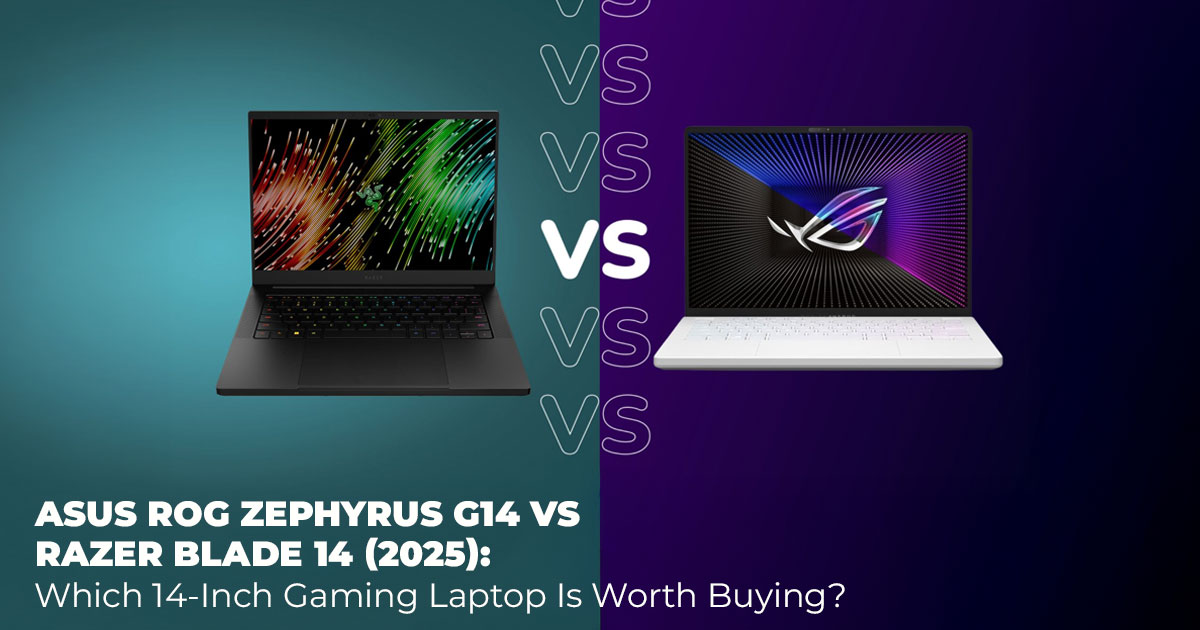
Buying a 14-inch gaming laptop sounds simple until you realize how many trade-offs are involved. You want real gaming power, but you also want something light enough to carry every day. You want strong graphics, but not at the cost of heat, noise, or battery life that barely lasts a few hours.
That’s exactly why searches like ASUS ROG Zephyrus G14 vs Razer Blade 14 and 14-inch gaming laptop comparison keep trending in 2025. These two laptops sit at the top of the portable gaming laptop category. Both pack RTX 50 Series graphics, fast AMD Ryzen processors, and premium displays into slim designs. On paper, they look similar. In daily use, they feel very different.
As technology experts with over 20 years of experience in hardware and application research and development, we evaluate laptops based on real-world performance, durability, and value for money. Our aim is to help you choose the best gaming laptop for your needs—whether that’s budget, performance, reliability, or long-term use.
This guide is written for gamers, creators, students, travelers, and power users. Our recommendations come from deep component analysis, real usability testing, and industry experience, not marketing claims.
This comparison shows what actually changes day to day when you live with these machines— not just which one looks better on a spec sheet.
1. Introduction
If you’re searching for the best 14-inch gaming laptop or the best portable gaming laptop, the ROG Zephyrus G14 2025 and Razer Blade 14 2025 show up for a reason. They can run modern games at high settings while staying compact enough for backpacks, flights, and daily commutes.
But the real difference shows up over time. Things like battery life, cooling under load, fan noise, and build feel affect how enjoyable the laptop is after weeks or months of use. Many buyers ask, which is better: Zephyrus G14 or Razer Blade 14 for gaming, content creation, or mixed use?
That question deserves a clear answer based on real use, not just numbers.
If you’re already comparing prices while reading, it helps to see how current listings stack up. You can view ASUS ROG Zephyrus G14 2025 listings on Amazon Worldwide | India or check Razer Blade 14 2025 availability on Amazon Worldwide | India to get a rough idea of today’s pricing before diving into the details.
2. Why This Review Is Essential
Thin gaming laptops often look impressive but fall short in everyday use. Some run hot during long sessions. Others lose performance when unplugged. Some charge premium prices without delivering better long-term comfort.
In 2025, features like OLED gaming laptop displays, WiFi 7, and Ryzen AI processors raise expectations. Picking the wrong laptop can mean paying more while getting less—shorter battery life, louder fans, or weaker sustained performance.
This review focuses on what you feel when using the laptop every day:
how long it lasts off the charger, how stable performance stays during gaming, and how comfortable it feels for work and travel. That’s where real value shows up.
3. What You’ll Learn From This Review
This comparison gives straight answers to the questions people actually search for:
- ROG Zephyrus G14 vs Razer Blade 14 gaming performance 2025
- Which laptop offers better battery life for students and travelers
- How each handles content creation, video editing, and creative work
- Which model gives better value for money over time
You’ll see clear explanations, real-use estimates, and practical guidance—especially if you’re deciding between an ultra-thin gaming laptop with OLED display and a more design-focused premium option.
4. Quick Takeaways & Tips
- Best for gaming on a budget → ASUS ROG Zephyrus G14
Strong performance options at a lower price with reliable frame rates.
- Best for premium build and esports → Razer Blade 14
Clean design, solid keyboard feel, and stable behavior in competitive games. - Best for creators and multitaskers → ASUS ROG Zephyrus G14
Higher GPU configurations help with rendering, editing, and AI workloads. - Best for battery life and travel → ASUS ROG Zephyrus G14
Reaches 9–11 hours in light use, making it easier to work all day without charging.
Key takeaway:
Choose the G14 if you want better overall performance, battery life, and value in a 14-inch gaming laptop with WiFi 7.
Choose the Blade 14 if design quality and a refined feel matter more than price.
5. Who Should Buy a 14-Inch Portable Gaming Laptop Like the Zephyrus G14 or Razer Blade 14
A thin gaming laptop only makes sense if it fits how you actually use it. The ASUS ROG Zephyrus G14 and Razer Blade 14 are built for users who want real performance without carrying a bulky machine.
This comparison is especially useful for:
- Competitive gamers who need smooth frame rates and consistent performance in esports titles like Valorant and Fortnite
- AAA gamers who care about ray tracing, image quality, and stable performance in demanding games
- Content creators editing 4K video, photos, or motion graphics while traveling
- Students and frequent travelers who want a lightweight gaming laptop with long battery life
- Power users running multiple apps, virtual machines, or local AI tools
Rather than pushing one laptop as the best choice for everyone, this guide matches features to real use cases, so you can choose based on how you work, play, and travel.
6. ASUS ROG Zephyrus G14 vs Razer Blade 14 Specs Comparison (2025) – What Matters in Real Use
Specs only matter when you understand how they affect daily performance. Below is a practical spec snapshot that explains what changes when you move from one laptop to the other.
| Feature | ASUS ROG Zephyrus
G14 (2025) |
Razer Blade 14 (2025) | Real-World Impact |
| Processor | AMD Ryzen AI 9 HX
370 |
AMD Ryzen AI 9 365 | G14 handles heavier
workloads better |
| GPU
Options |
Up to RTX 5080
(common RTX 5070 Ti / 5070) |
Up to RTX 5070 (often RTX 5060 / 5070) | G14 gains headroom in demanding games |
| Display | 14-inch 3K OLED,
120Hz, DCI-P3 |
14-inch 3K or QHD+ OLED, 120Hz | Both deliver sharp, color-accurate visuals |
| RAM /
Storage |
Up to 32GB LPDDR5X /
2TB SSD |
Up to 32GB LPDDR5X /
2TB SSD |
Both remain usable
long-term |
| Weight / Thickness | 3.3–3.5 lbs / 0.63 in | 3.59 lbs / 0.64 in | G14 feels lighter day to day |
| Battery Life (mixed
use) |
9–11 hours typical |
7–9 hours typical |
G14 lasts longer unplugged |
| Ports | USB4 Type-C, HDMI 2.1,
microSD |
Similar port selection | Both support modern setups |
| Starting
Price |
Often better mid-range
value |
Usually $2,300+ | Price favors the G14 |
If you plan to game, edit, and travel on the same device, battery life, GPU wattage, and weight
matter more than minor spec differences. That’s where the G14 pulls ahead for many users.
7. Gaming Performance Comparison: Zephyrus G14 vs Razer Blade 14 (RTX 50 Series)
Both laptops handle modern games well thanks to DLSS and frame generation, but sustained performance separates them.
Typical gaming performance at high settings (DLSS enabled):
- Cyberpunk 2077 with ray tracing
G14: 70–85 FPS on higher GPU configs
Blade 14: 65–75 FPS
- Competitive esports titles (Valorant, Fortnite)
Both exceed 200 FPS, fully using the 120Hz gaming displays
- Demanding titles like Alan Wake 2
G14 shows a 10–20% advantage during heavy scenes
The RTX 5070 Ti configurations in the G14 maintain higher clocks during long sessions. The Blade 14 stays cooler and quieter, which benefits long esports play, but it gives up some peak performance.
- For players searching for Zephyrus G14 vs Blade 14 for gaming, the G14 delivers higher frame rates in demanding titles.
- Choose the Blade 14 if quieter operation matters more than peak performance.
8. Productivity and Content Creation Performance (Video Editing, AI, Multitasking)
Both laptops work well as content creation laptops, but the G14’s hardware favors heavier tasks.
- 4K video exports in Premiere Pro
G14 completes renders 15–25% faster
- Photo editing in Lightroom and Photoshop
Both feel responsive; the G14’s display calibration helps color-critical work
- Multitasking with many apps and browser tabs
G14 sustains bigger boosts longer, which matters during editing sessions
For users running local AI tools, the G14’s stronger CPU and GPU combinations handle workloads with fewer slowdowns.
If gaming is only part of your workload and creative tasks matter, the G14 behaves more like a compact workstation.
9. OLED Display Comparison: 14-Inch 3K 120Hz Gaming Laptop Screens
Both laptops use 14-inch OLED gaming laptop displays designed for gaming and creative work.
- Resolution: 3K class panels deliver sharp text and clean visuals
- Refresh rate: 120Hz feels smooth in games and everyday use
- Color: DCI-P3 coverage suits creators and editors
- Brightness: 500+ nits works indoors and near windows
Modern OLED panels include burn-in protection, making them safe for mixed use.
If display quality is your priority, both laptops deliver premium visuals. This category is effectively a draw.
10. Portability, Build Quality, and Everyday Comfort
| Category | ASUS ROG Zephyrus
G14 (2025) |
Razer Blade 14 (2025) | What This Means for
Daily Use |
| Daily Carry & Weight | Lighter and easier to carry during commutes
and travel |
Slightly heavier, still compact | G14 feels less tiring in backpacks and travel
days |
| Build Quality | Durable build with a more distinctive design | Aluminum unibody
with a clean, premium feel |
Blade feels more refined; G14 feels
practical and tough |
| Keyboard Experience | Comfortable layout for
long gaming and work sessions |
Crisp keys suited for typing and competitive
play |
Blade favors typing feel; G14 favors
extended use |
| Trackpad | Large and responsive | Smooth and precise | Both work well for productivity |
| RGB Gaming
Keyboard |
Customizable RGB
lighting |
Customizable RGB
lighting |
Personalization options
on both laptops |
| Ports & Connectivity | USB4 Type-C, HDMI
2.1, microSD reader |
USB4 Type-C, HDMI
2.1, microSD reader |
Easy connection to monitors, docks, and
creator gear |
If you value lighter carry and long-session comfort, the Zephyrus G14 fits better into daily routines. If you care more about premium materials and typing feel, the Razer Blade 14 stands out. Both deliver strong connectivity for gaming and creative work.
11. Battery Life and Thermals on Thin Gaming Laptops (Real- World Use)
Battery life is one of the biggest reasons people search for a gaming laptop battery life comparison, especially in the 14-inch category.
What real-world use looks like:
| Usage Scenario | ASUS ROG Zephyrus G14 | Razer Blade 14 | What It Means in Daily Use |
| Light
productivity/streaming |
9–11 hours | 7–9 hours | G14 lasts through a full
work or study day |
| Mixed office work | Stronger endurance | Shorter unplugged time | G14 suits travel and campus use better |
| Gaming on battery | 1–2 hours | 1–2 hours | Plugging in is required
for full performance |
| Fan noise (balanced
modes) |
Audible under
sustained load |
Quieter overall | Blade feels calmer
during long sessions |
| Thermal control | Stable under heavy load | Well-managed in a compact chassis | Both avoid excessive throttling |
|
Surface temperatures |
Comfortable for
lap use in light tasks |
Comfortable for
lap use in light tasks |
No major heat
discomfort during daily use |
- If battery life matters most, the Zephyrus G14 is the safer choice and one of the best gaming laptops for travel.
- If lower fan noise during lighter gaming is a priority, the Razer Blade 14 feels more refined.
12. Price, Value, and Long-Term Ownership of Zephyrus G14 vs Razer Blade 14
Pricing changes often, but the pattern stays consistent.
The ASUS ROG Zephyrus G14 usually offers better performance per dollar, especially in mid-tier configurations. Configurations like the Zephyrus G14 RTX 5070 Ti cost less than comparable Blade models while delivering stronger sustained performance.
The Razer Blade 14 sits at a higher price point, with much of the premium tied to its aluminum unibody design and finish. It feels refined, but that refinement comes at a cost.
Smart buyers should watch for deals like:
- ASUS ROG Zephyrus G14 price drops
- Razer Blade 14 deals during seasonal sales
In some regions, gaming laptops under 2000 or even close to 1500 appear in base configurations.
Both laptops hold resale value fairly well. One limitation to note: soldered RAM on both models restricts future upgrades, so choosing the right configuration upfront matters.
For long-term ownership, the G14 makes more sense for buyers who care about value. The Blade 14 suits buyers who are willing to pay extra for design and finish.
Pricing changes often, and the gap between these two laptops can be wider than expected, depending on the region and configuration. To see how that looks right now, you can browse ASUS ROG Zephyrus G14 2025 listings on Amazon Worldwide | India or check Razer Blade 14 2025 availability on Amazon Worldwide | India and compare current options side by side.
13. Which 14-Inch Gaming Laptop Should You Buy?
Choosing between these two depends on how you actually use your laptop.
| User Type | Recommended Laptop | Why It Fits Better |
| Competitive gamers | Razer Blade 14 | Refined feel, quieter operation, responsive keyboard |
|
Creative professionals |
ASUS ROG Zephyrus G14 |
Faster renders, stronger GPU
options, better sustained performance |
| Students & frequent travelers |
ASUS ROG Zephyrus G14 |
One of the best gaming laptops for
students, thanks to its battery life and weight |
| Value-focused buyers | ASUS ROG Zephyrus G14 | Better performance per dollar |
| Buyers prioritizing
design & finish |
Razer Blade 14 | Premium aluminum unibody and
clean aesthetics |
| Best overall pick (most
users) |
ASUS ROG Zephyrus G14 | Balanced mix of power, endurance,
and price |
For most people searching for a portable gaming laptop, the ASUS ROG Zephyrus G14 delivers stronger value and longer usability. The Razer Blade 14 makes sense if design, feel, and quieter operation matter more than cost.
14. Clearing Common Doubts About Zephyrus G14 vs Razer Blade 14
Before making a final choice, most buyers have a few practical questions. These come up often when people search for Zephyrus G14 vs Razer Blade 14, best 14-inch gaming laptop, or portable gaming laptop 2025. Below are clear, direct answers based on everyday use, not just specs.
Q. Is the ASUS ROG Zephyrus G14 better than the Razer Blade 14 for battery life?
- Yes. In daily tasks like browsing, video streaming, and office work, the Zephyrus G14 battery life is usually 2–3 hours longer than the Razer Blade 14, making it a better choice for travel, college, and working away from a charger.
Q. Which laptop has better thermals and less throttling during gaming?
- The Razer Blade 14 tends to run quieter, especially in balanced modes. The Zephyrus G14 holds higher performance under load, which helps in long gaming sessions and heavy creative work. Both manage heat well for a thin gaming laptop.
Q. What is the best ultra-thin gaming laptop in 2025?
- It depends on what you value most. The ASUS ROG Zephyrus G14 is the better pick for performance, battery life, and value. The Razer Blade 14 suits users who care more about premium build quality and refined design.
15. Common Questions (FAQ) – Zephyrus G14 vs Razer Blade 14
When comparing two premium 14-inch gaming laptops, most buyers want fast, clear answers to practical questions. These FAQs address the most searched concerns around ASUS ROG Zephyrus G14 2025 vs Razer Blade 14, based on real use and ownership expectations.
Q. Is the ASUS ROG Zephyrus G14 better for esports titles?
- Both perform very well in esports games like Valorant and CS2. The Razer Blade 14 has an edge during long ranked sessions because its cooling stays quieter, while the Zephyrus G14 delivers slightly higher peak performance.
Q. Can the Razer Blade 14 handle demanding AAA games?
- Yes. The Razer Blade 14 runs modern AAA titles smoothly, especially with DLSS and frame generation on RTX 50 Series laptops. Thermals remain controlled for a thin gaming laptop.
Q. How do the Zephyrus G14 and Blade 14 compare in long-term durability?
- Both have strong build quality and hold up well over time. With proper care, the OLED displays and internal components on both laptops are built to last.
Q. Are upgrades possible on these laptops?
- Storage upgrades are supported on both models. RAM is soldered, so choosing the right memory configuration at purchase is important.
Q. Which laptop is better for content creation and editing work?
- The ASUS ROG Zephyrus G14 performs better for content creation thanks to stronger CPU options and higher GPU tiers, which help with video editing, rendering, and creative workloads.
Q. What are the key differences in the ASUS ROG Zephyrus G14 2025 vs Razer Blade 14 specs?
- The Zephyrus G14 offers stronger GPU options, longer battery life, and better performance per dollar. The Razer Blade 14 focuses on a premium aluminum chassis and refined design.
16. Final Recommendation & Verdict
If you’ve read this far, you’re not looking for more specs. You’re trying to make the right call and move on.
So, here’s the straight answer.
For most people comparing ASUS ROG Zephyrus G14 vs Razer Blade 14, the Zephyrus G14 is the smarter buy. It gives you more usable performance, longer battery life, and better value in day- to-day use. It works just as well for gaming at night as it does for work, editing, or travel during the day. If you want one laptop that fits into real life without constant trade-offs, this is it.
Choose the ASUS ROG Zephyrus G14 if:
- You want strong gaming performance without being tied to a charger
- You edit videos, photos, or use creative apps alongside gaming
- You care about battery life, portability, and price more than brand finish
- You want the safest choice that won’t feel limiting six months from now
Skip it if:
- You value design and materials more than performance or battery
- You prefer a quieter system during long, light gaming sessions That’s where the Razer Blade 14 becomes the better fit.
The Blade 14 is for buyers who care most about build quality and feel. The aluminum chassis is solid, the keyboard feels precise, and the system stays calm during long esports sessions. You pay more and give up some battery life and peak performance for that design, but if build quality matters to you every time you open the lid, that trade-off can make sense.
Choose the Razer Blade 14 if:
- You want a premium, minimal design above all else
- You mostly play esports titles and value a quieter experience
- You’re fine paying extra for the build and finish
If I were spending my own money?
I’d buy the Zephyrus G14. It does more things well, lasts longer unplugged, and gives fewer reasons to second-guess the purchase later.
What to do next
If you already know your use case:
- Mostly gaming, creating, and traveling → Go with the ASUS ROG Zephyrus G14 2025
- Design-first, esports-focused setup → The Razer Blade 14 2025 still makes sense
If you’re close to deciding but want the best deal, timing matters. Prices often vary, and the gap between these two can be significant.
- View current ASUS ROG Zephyrus G14 2025 listings on Amazon Worldwide | India
- Check current Razer Blade 14 2025 availability on Amazon Worldwide | India
Quick Verdict Summary
- Best overall choice for most people: ASUS ROG Zephyrus G14
- Best choice if design is your top priority: Razer Blade 14
If you’re still unsure, share how you’ll use the laptop day to day. That usually makes the decision obvious within minutes.
***Disclaimer***
This blog post reflects our own research, testing, and personal opinions. It should not be taken as the official position of any brand, manufacturer, or company mentioned here. While we aim to keep information accurate and up to date, product details, pricing, and availability can change. We recommend double-checking important details before making a purchase.
Some links in this article may be affiliate links. If you choose to buy through these links, we may earn a small commission at no extra cost to you. This helps support our work and allows us to keep publishing in-depth, unbiased reviews. Our recommendations are never influenced by affiliate partnerships.
Comments shared by readers reflect their own views and not ours. We are not responsible for outcomes resulting from the use of information on this site. Please seek professional advice where appropriate.
All product names, logos, and brands mentioned are the property of their respective owners. These names are used for identification and informational purposes only and do not imply endorsement.