
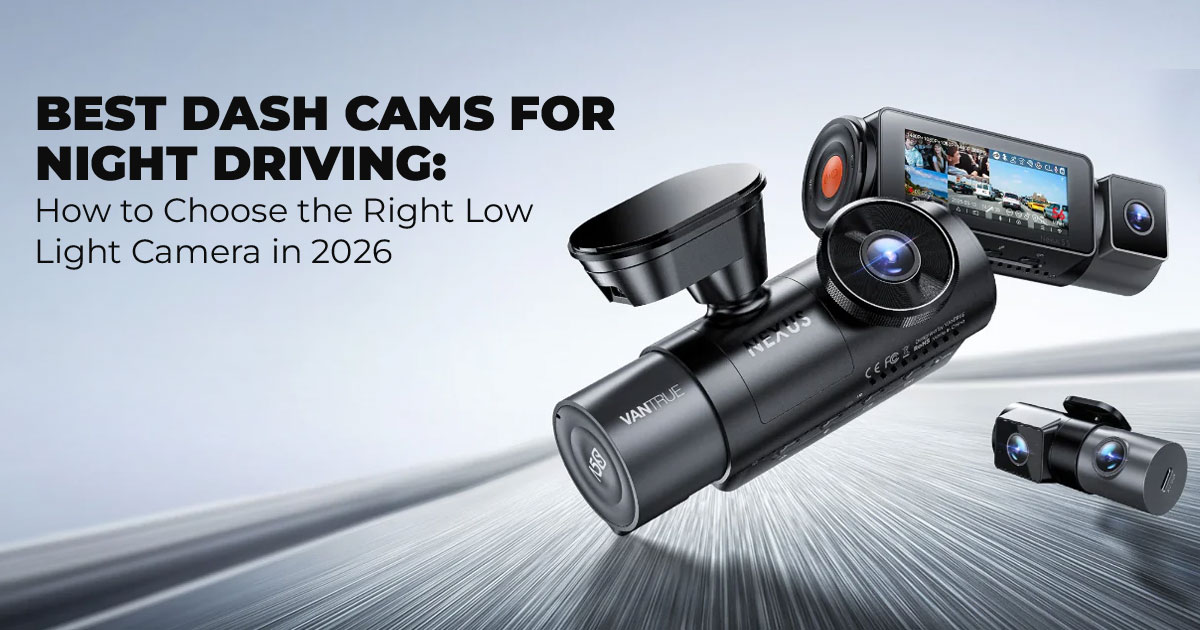
Driving at night is when confidence drops for most people. The road feels calmer, but visibility works against you. Oncoming headlights wash out your view, shadows hide lane markings, and details like license plates or road signs vanish when you need them most. If something happens after dark, unclear footage turns a simple claim into a long argument.
A dash cam for night driving only helps if it is designed for low-light performance. Many cameras look fine during the day and fail the moment the sun goes down. That gap is where frustration starts. This guide focuses on what actually works at night, not what looks good on a spec sheet. We explain the tech behind usable night vision dash camera footage, point out Vantrue dash cam night vision models that handle real roads well, and share setup tips that make a difference from the first drive.
Offfcial Vantrue Dash Cam Store
As technology experts with over 20 years of experience in hardware and application research and development, we judge products by real-world performance, durability, and value for money. The goal is simple: help you pick the right camera for your needs, not the most expensive one.
This guide is for late-night commuters, rideshare drivers, night delivery workers, and anyone who spends serious time on night highway driving. Our conclusions come from component analysis, real driving tests, customer feedback, and industry experience.
Customer reviews matter because they expose the truth. They show how a night vision dash cam behaves on poorly lit streets, how well it handles headlight glare, and whether license plate readability at night holds up outside perfect conditions. We use those insights to cut through marketing claims and help you avoid buying the wrong camera.
1. Introduction
Most people buy a dash cam thinking they are all roughly the same. The first night drive proves otherwise. Grainy footage, blown-out headlights, and unreadable plates make the camera useless when it matters. A proper low-light dash cam fixes that problem.
Cameras built with a Sony STARVIS dash cam sensor, a wide aperture lens, and HDR or WDR support keep footage usable even on unlit roads. That combination matters more than flashy features you will never use. This guide focuses on nighttime video clarity and how cameras perform in real driving conditions, not controlled demos.
Choose this type of camera if you drive after sunset more than a few times a week or rely on video for insurance or work.
Skip basic models if night driving is a regular part of your routine. They save money upfront and cost you later.
2. What You’ll Learn From This Guide
- How sensors and lenses work together to improve dash cam low-light performance
- Which specs matter in daily use, including Sony STARVIS and Sony STARVIS 2 dash cam technology, wide aperture dash cam lenses, and HDR dash cam night driving
- Which Vantrue dash cams perform well on dark roads and during night highway driving
- When infrared lights make sense for interior night recording and when they do not
- Simple mounting and testing steps that lead to clear night dash cam footage without trial and error
If you want a quick answer, you will get one. If you want to understand why, this guide explains it without wasting your time.
3. Why This Guide Matters for Your Safety
Night driving leaves less room for mistakes. A brief glare or a dark stretch of road can hide critical details. A dependable night vision dash camera records what your eyes miss, especially during moments of glare or deep shadow.
For rideshare drivers, clear interior footage adds protection during late pickups. For long- distance drivers, capturing readable license plates at night can be the difference between a resolved claim and a dead end. A reliable Vantrue dash cam for night driving is not about extra features. It is about having proof that holds up when visibility is at its worst.
Choose a night-focused dash cam if you care more about usable evidence than flashy extras.
Skip cameras without STARVIS sensors if night footage matters to you at all.
Summary (Verdict)
Night driving makes it harder to see and harder to prove what happened. A basic camera is not enough. If you want footage that actually helps, choose a dash cam for night driving with a Sony STARVIS or STARVIS 2 sensor, a wide aperture lens, and HDR or WDR.
If night driving is occasional, a mid-range Vantrue model will do the job. If you drive at night for work or long distances, invest in a Vantrue camera built specifically for low light. It costs more, but it removes doubt when you need evidence.
Quick Reference:
If you drive at night often, skip cheap dash cams. Pick a Vantrue night vision dash cam with STARVIS technology. You will get clearer footage, fewer headaches, and proof that actually holds up.
4. Key Technical Specifications at a Glance
Here’s a quick overview of the features that separate decent night recording from excellent.
| Feature | Why It Helps at Night | Ideal Spec |
| Image Sensor | Pulls in more light for cleaner
pictures |
Sony STARVIS or Sony STARVIS 2 |
| Aperture | Let more light reach the sensor | f/1.8 or wider (wide aperture dash cam) |
| Dynamic Range | Controls bright headlights and
dark areas |
HDR or WDR for night driving |
| Resolution | Makes plates and details readable from farther away | 2K or 4K dash cam night recording preferred |
| Field of View | Covers lanes beside you without
missing action |
140°–170° (wide-angle dash cam
lens) |
| Infrared Lights | Lights up the cabin or rear in
total darkness |
Built-in IR for interior/rear |
- Summary: Prioritize Sony STARVIS 2 dash cam sensors, wide apertures, and HDR for the clearest night driving camera for cars.
5. Why Night Footage Breaks and What Actually Fixes It
If your dash cam footage looks fine during the day but falls apart at night, that’s normal. Most cameras struggle when the light drops. The sensor does not get enough data, so the video turns noisy. Headlights blow out the frame. The rest of the road goes dark. Details you need—like license plates or lane markings—disappear.
A dash cam for night driving works only if the hardware is built for darkness. This is where many models fail.
Here’s what actually helps:
- Sony STARVIS sensors collect more light per Less grain. Better detail.
- A wide aperture lens (f/1.8 or lower) lets more light in without forcing the camera to boost noise.
- HDR or WDR helps control headlights while keeping dark areas readable.
Put these together, and you get balanced night footage instead of clips that look bright in one spot and useless everywhere else.
5.1 Sony STARVIS vs Sony STARVIS 2: What the Upgrade Really Means
If you drive on highways or rural roads with few streetlights, Sony STARVIS 2 matters. It uses larger pixels and handles very low light better. Footage stays cleaner. Details hold up longer.
If night driving is occasional, regular STARVIS is enough.
If night driving is routine, STARVIS 2 is the safer bet.
Decision moment:
- Choose STARVIS 2 if night driving is part of your daily routine.
- Stick with STARVIS if night use is occasional and mostly city-based.
6. The Features That Actually Matter for Night Driving (And What You Can Ignore)
Specs can overwhelm fast. For night use, most of them do not matter. These do.
What to prioritize
- Sensor: Sony STARVIS or STARVIS 2
This matters more than brand names or screen size.
- Lens: f/1.8 or wider
Smaller numbers mean more light. Simple as that.
- HDR or WDR: Real support, not marketing claims
Needed to manage headlight glare at night. - Resolution: 2K minimum, 4K preferred
More pixels help with license plate readability at night.
- Field of view: 140°–170°
Wide enough to see nearby lanes without heavy distortion.
Does higher resolution help at night?
Yes, but only if the sensor is good. A 4K dash cam with a weak sensor still fails at night. A strong sensor with 2K or 4K gives you room to zoom without losing clarity. That matters when footage becomes evidence.
Skip cameras that push gimmicks like oversized screens or voice assistants. They do not improve night footage.
Offfcial Vantrue Dash Cam Store
7. Dash Cams That Actually Work at Night (And Who They’re For)
These picks are based on real use, not spec sheets. Each serves a different type of driver. Pick the one that matches how you actually drive.
7.1 Vantrue N5 — Full Coverage for Night Drivers Who Want No Gaps
What it’s good at:
- Four cameras
- Sony STARVIS 2 sensors on every channel
- Infrared night vision inside and out
This is the most complete option. It records front, rear, cabin, and sides at once. Night footage stays clean. Coverage leaves little room for doubt.
Choose this if:
- You drive at night for work
- You carry passengers
- You want maximum protection with no blind spots
Skip this if:
- You only need front recording
- You want a smaller, simpler setup
What I’d do:
If I drove nights daily or handled passengers, this is the one I’d trust.
See details in the US store | India store
7.2 Vantrue E3 — Best Balance of Price and Night Performance
What it’s good at:
- 7K front recording
- Rear and interior cameras
- Sony STARVIS sensors with infrared cabin lighting
This model hits the sweet spot. Strong night footage without the cost or size of a four-camera system.
Choose this if:
- You commute at night
- You want front, rear, and cabin coverage
- You want strong performance without overspending
Skip this if:
- You want side coverage
- You drive long night shifts daily
Fallback option:
If the N5 feels like too much, this is the safe step down.
See details in the US store | India store
7.3 Vantrue N2X — Simple, Reliable, and Focused on What Matters
What it’s good at:
- Front road and interior recording
- Strong night vision dash camera performance
- Infrared cabin coverage
This is for drivers who want clarity without complexity.
Choose this if:
- You drive passengers at night
- You care about interior safety
- You want fewer cables and cameras
Skip this if:
- You want rear recording
- You want full surround coverage
See details in the US store | India store
7.4 Vantrue E360 — Budget Option That Still Gets the Job Done
What it’s good at:
- Wide panoramic view
- Lower cost
- Acceptable low-light results
This is not the sharpest night camera here, but it beats basic models.
Choose this if:
- You want a dash cam for dark roads on a budget
- You are buying your first dash cam
Skip this if:
- You drive long highways at night
- You need a clear plate capture consistently
See details in the US store | India store
7.5 Why Multi-Channel Cameras Matter More at Night
At night, context matters. Multi-channel dash cams show what happened around and inside the car, not just straight ahead. That extra view often answers questions a single camera cannot.
Quick Guide — The Decision Made Simple
- Drive at night often? Get STARVIS 2.
- Want full coverage and peace of mind? Choose Vantrue N5.
- Want strong night performance without overspending? Pick Vantrue E3.
- Need simple front and cabin coverage? Go with Vantrue N2X.
- On a tight budget? E360 works, with limits.
If night driving is part of your routine, do not gamble on cheap cameras. Choose a model built for darkness. That choice saves time, stress, and arguments later.
8. Dash Cam Comparison for Night Driving: Which Model Fits Your Use Case
This section exists for one reason: to remove hesitation. If you already know night footage matters, this side-by-side view shows which Vantrue dash cam for night driving fits how you actually use your car.
8.1 Top Dash Cams for Low Light and Night Performance
| Model | Channels | Front Resolution | Sensor | Aperture | IR Lights | Best For |
|
Vantrue N5 |
4 (360°) |
4K |
Sony
STARVIS 2 |
f/1.4 |
Front, Rear, Interior | Rideshare drivers,
night shifts, full protection |
|
Vantrue E3 |
3 |
2.7K |
Sony STARVIS |
f/1.8 |
Interior, Rear |
Everyday commuters, balanced night
coverage |
| Vantrue N2X |
2 |
2.7K |
Sony STARVIS
2 |
f/1.8 |
Interior |
Front and cabin focus, evening
passengers |
| Vantrue E360 |
Panoramic |
High- resolution
wide |
Upgraded sensor |
f/1.8 |
Optional |
Budget wide coverage, general
night use |
8.2 Quick decision guide
-
- Choose the N5 if you drive at night for work or want proof from every angle.
- Choose the E3 if you want strong low-light dash cam performance without paying for four cameras.
- Choose the N2X if your priority is front road footage plus interior safety.
- Choose the E360 if you want wide night coverage at a lower cost and accept some trade-offs.
9. Extra Dash Cam Features That Improve Night Recording
Good hardware is the foundation, but these features improve how useful your night vision dash camera footage is in daily use.
- Infrared lights
Essential for interior or rear views when there is no ambient light. They make faces and movements visible without distracting the driver. - Built-in GPS
Adds speed and location data to clips, which helps during insurance claims or disputes. - Fast Wi-Fi connectivity
Lets you pull night driving footage to your phone without removing the card. This matters when you need clips quickly. - Parking mode with buffered recording
Captures incidents before and after motion or impact, even in dim parking lots.
What to skip:
Features like oversized screens or voice commands do not improve nighttime video clarity or HDR performance. They look good on paper and add little in real use.
10. How to Improve Dash Cam Night Footage: Setup and Real- World Tips
Even the best dash cam for night driving needs a proper setup. Small mistakes reduce clarity more than most people realize.
- Mounting and positioning
Mount the camera high, behind the rear-view mirror. Angle it to show more road and less This helps with balanced exposure for night recording. - Keep the glass clean
A dirty windshield scatters Headlights turn into glare. Clean glass improves headlight glare control more than most settings. - Test where it matters
Do not test only on well-lit Drive through dark stretches. Check if license plates are readable from 20–30 feet. - Use the right storage
Use a high-endurance microSD card and format it Corrupted files usually start with poor storage. - Adjust the settings
Turn on HDR (or WDR if that’s what your camera supports). Set the highest stable bitrate. These steps reduce noise and preserve detail in real-world night driving footage.
How to improve dash cam night footage?
Start with proper mounting, clean glass, and the right settings. Once those are correct, the hardware can do its job.
Bottom Line
If night driving matters to you, the decision is not about brand names or screen size. It comes down to sensor quality, lens aperture, and real low-light performance. Match the camera to how you drive, set it up properly, and you get footage that helps instead of clips that leave questions unanswered.
11. Clearing Common Doubts About Dash Cams for Night Driving
Before choosing a dash cam for night driving, most people pause at the same questions. This section clears up those doubts in plain terms. It focuses on real-world low-light dash cam performance, not marketing claims, so you can judge what actually works on dark roads, highways, and poorly lit streets.
Q. Do dash cams really work well at night?
- Yes, but only when they are built for it. A proper night vision dash cam uses Sony STARVIS or Sony STARVIS 2 sensors, a wide aperture lens, and HDR or WDR. These features work together to control headlight glare and keep details visible. Cheaper dash cams without this hardware often produce dark, noisy footage that is hard to use.
Q. Is 1080p enough for night driving footage?
- 1080p dash cams can work if the sensor quality is high, but 2K or 4K dash cams for night driving deliver clearer results. Higher resolution improves license plate readability at night, especially when reviewing footage from moving vehicles or highway speeds.
Q. What makes a good dash cam for night highway driving?
- Night highway driving demands a strong sensor, reliable HDR for headlight glare control, and higher resolution. A dash cam for night highway driving should keep fast-moving vehicles sharp and preserve detail even when lighting changes quickly.
Q. Are infrared lights worth it on a dash cam?
- Yes, for interior recording. Infrared dash cam lights make cabin footage usable in complete darkness. This is especially helpful for rideshare drivers, families, or anyone who wants clear interior video at night without using visible light.
Q. Which dash cam records best at night?
- Dash cams with Sony STARVIS 2 sensors and wide aperture lenses deliver the most consistent low-light dash cam performance. These models handle dark roads, glare, and shadows better than standard cameras, making them the safest choice for frequent night driving.
Offfcial Vantrue Dash Cam Store
12. Frequently Asked Questions About Night Vision Dash Cams
This FAQ section answers the questions people usually search right before making a decision. The focus is on how night vision dash cams work in real driving conditions, what to expect day to day, and how to avoid common mistakes when choosing a dash cam for night driving and poor lighting.
Q. How do night vision dash cams work?
- A night vision dash cam relies on three things working together: a high-sensitivity sensor like Sony STARVIS or STARVIS 2, a wide aperture lens that lets in more light, and image processing such as HDR or WDR. This combination helps turn dark scenes into usable video without crushing details or blowing out headlights.
Q. Will parking mode drain my car battery overnight?
- Not if the dash cam is designed properly. Most quality dash cams for night driving include low-power parking modes and voltage cutoffs. Using a hardwire kit adds protection by shutting the camera off before the battery drops too low.
Q. Should I choose HDR or WDR for night driving?
- Both help with night driving footage, but modern HDR usually handles extreme contrast better. HDR does a stronger job controlling headlight glare while keeping dark areas visible, which matters most on highways and poorly lit roads.
Q. Can night vision dash cams handle rain or fog after dark?
- Strong sensors and HDR help improve visibility in rain and light fog. That said, thick fog limits any camera, just like it limits human vision. A good low-light dash cam will still perform better than basic models in these conditions.
Q. What should I look for in a dash cam for night driving and poor lighting?
- Focus on sensor quality, wide aperture (f/1.8 or lower), HDR or WDR, 2K or 4K resolution, and infrared lights if you need interior recording. These features matter far more than screen size or extra apps when it comes to clear night dash cam footage.
13. Conclusion
If night driving is part of your routine, a basic dash cam is not enough. The best dash cam for low light conditions comes down to a few things that actually matter: a strong sensor like Sony STARVIS or Sony STARVIS 2, a wide aperture lens, reliable HDR or WDR support, and enough resolution to capture real detail. Get those right, and the footage stays clear when lighting works against you.
The next step is matching the camera to how you drive. If you want full coverage from every angle, a 4-channel setup makes sense. If your priority is clear road footage and cabin safety, a dual or 3-channel dash cam is often the better fit. There is no single best choice for everyone, only the right choice for your driving habits.
- Vantrue N5 4-Channel Dash Cam – for full, all-around coverage US | India
- Vantrue E3 3-Channel Dash Cam – for balanced front, rear, and interior recording US | India
- Vantrue N2X Dual Dash Cam – for focused front and cabin use US | India
- Vantrue E360 Panoramic Dash Cam – for wide coverage on a tighter budget US | India
If you have already used one of these on night drives, share your experience in the comments. If you are unsure which setup fits your needs or want help with installation, ask. Choosing the right dash cam should feel simple, and we are here to help you get it right.
***Disclaimer***
This blog post contains unique insights and personal opinions. As such, it should not be interpreted as the official stance of any companies, manufacturers, or other entities we mention or with whom we are affiliated. While we strive for accuracy, information is subject to change. Always verify details independently before making decisions based on our content.
Comments reflect the opinions of their respective authors and not those of our team. We are not liable for any consequences resulting from the use of the information provided. Please seek professional advice where necessary.
Note: All product names, logos, and brands mentioned are the property of their respective owners. Any company, product, or service names used in our articles are for identification and educational purposes only. The use of these names, logos, and brands does not imply endorsement.