
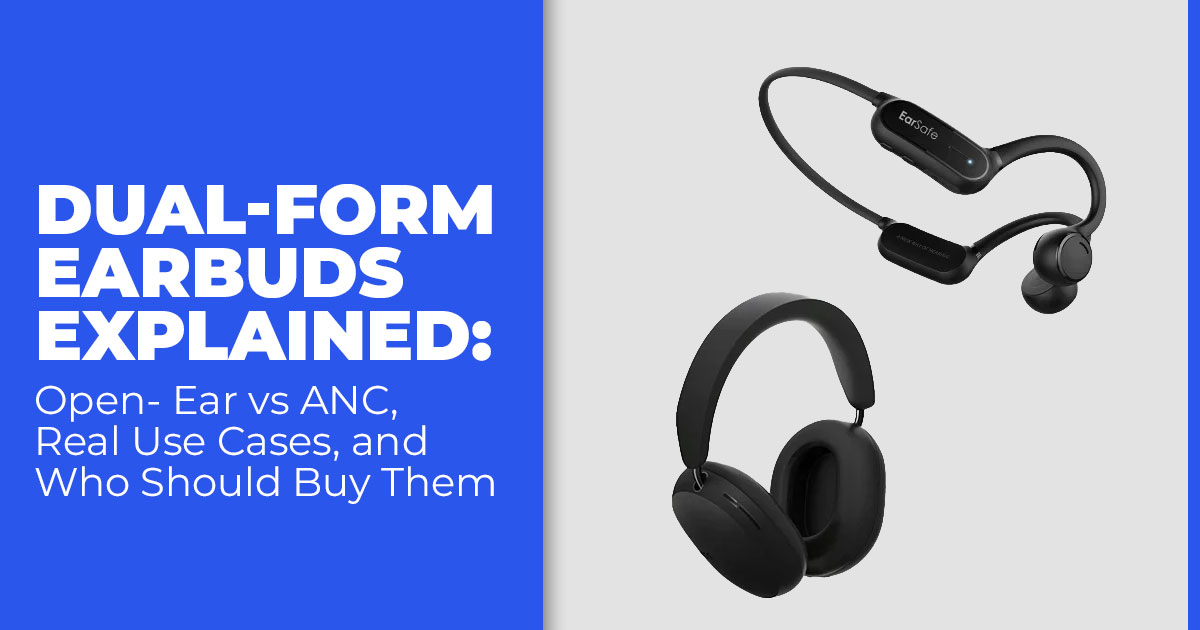
1. Introduction — Why Dual-Form Earbuds Are a Big Deal
Most days don’t follow one pattern. A noisy commute turns quiet. A workout moves outdoors. A work call ends, and someone starts talking to you. Through all of that, your earbuds usually stay the same. And that’s the problem.
With most wireless earbuds, you have to choose upfront. Open-ear earbuds keep you aware but let noise flood in. Active noise cancellation earbuds block sound well, but seal your ears and cut you off. Once you put them on, you’re locked into that choice until you switch devices or take them out.
Buy from Amazon now
Buy on Amazon Worldwide | Buy on Amazon India
Dual-form earbuds were built for this exact tension. They let you adjust how much of the world you hear, without swapping earbuds or carrying backups. And for people whose days change hour by hour, that difference matters.
1.1 Product Category Overview: What Are Dual-Form Earbuds?
SoundCore Dual-form earbuds, often called hybrid open-ear earbuds or open-ear earbuds with ANC, combine two listening styles in one design. With adjustable ear hooks, they sit fully open when you need awareness and shift closer to the ear when you want active noise cancellation.
There’s no deep insertion and no tip changes. You adjust the fit, and the sound behavior changes with it. That simple idea solves a real problem many listeners deal with every day.
1.2 Who This Guide Is For
This guide is written for people whose routines don’t stay still:
- Commuters who need announcements now and quiet later
- Runners and cyclists who rely on situational awareness earbuds for safety
- Office workers moving between focus and conversation
- Travelers who want less noise without missing alerts
If your environment shifts throughout the day, your earbuds should adapt with you.
If you’re already curious about what’s available, you can browse current dual-form earbuds and open-ear earbuds with ANC on Amazon Worldwide, or check Amazon India, where these models often appear under open-ear or hybrid earbud listings. Availability changes, but this gives you a real-world view of the category as you read.
1.3 Why User Reviews Matter More Than Specs
Specs don’t explain how earbuds feel after a long commute. They don’t show whether open-ear ANC earbuds actually reduce noise in traffic. And they won’t tell you if the ear hooks stay comfortable during calls, workouts, or long walks.
User reviews fill those gaps. They reveal how comfort-focused earbuds hold up over time, how battery life in open-ear vs ANC mode really plays out, and whether sound leakage becomes an issue. This guide leans on those real experiences to show what daily use looks like.
1.4 Why This Guide Is Essential
Most reviews treat in-ear ANC earbuds and open-ear earbuds as separate categories. That leaves a blind spot for people considering the hybrid option.
This guide focuses on that middle ground. It explains what dual-form earbuds do well, where they fall short, and whether their flexibility fits real routines or just sounds appealing.
1.5 Our Perspective and Expertise
As technology experts with over 20 years of experience in hardware and application research and development, we examine products based on real use, build quality, and value for money.
Our goal is to help you choose the best option for budget, performance, reliability, and long- term use. For commuters, fitness users, office professionals, and frequent travelers, our recommendations come from deep research, component analysis, hands-on testing, and industry knowledge.
Summary
If you switch between awareness and quiet during the day, dual-form earbuds offer a practical option. This guide explains how they work, who they’re for, and whether they make sense for everyday use.
2. Dual-Form Earbuds: What the Specs Mean for Real Buyers
Here’s what current dual-form earbuds typically offer in each mode:
|
Feature |
Open-Ear Mode (Real
Use) |
ANC Mode (Real Use) |
What This Means for You |
|
Battery Life (Earbuds) |
10–12 hours |
8–10 hours |
Open-ear mode easily lasts a full workday. ANC drains faster, but still covers long commutes, workouts, and calls without
anxiety. |
| Total Playtime with Case |
40–48 hours |
35–42 hours |
You can go several days without charging. A 10-minute quick charge often gets you through a commute or gym session, which
matters more than max numbers. |
| Water & Sweat
Resistance |
IPX5–IPX7 |
Same rating |
Safe for rain, running, and gym use. You
don’t need a “separate workout pair.” |
|
Bluetooth Version |
5.3 or higher |
Same |
Faster pairing, fewer dropouts, and better stability. Many models include Bluetooth multipoint, which is a daily quality-of-life
upgrade. |
|
Supported Codecs |
SBC, AAC, LDAC |
Same |
Works well on both Android and iPhone. LDAC gives cleaner sound if you stream higher-quality audio, without pushing
volume. |
|
Driver Size |
16–17 mm
dynamic |
Same drivers |
Large drivers help open-ear mode sound fuller than expected, reducing the need to crank volume. |
|
Weight per Earbud |
8–10 grams |
Same |
Light enough for long sessions. Less ear pressure than traditional in-ear ANC earbuds, especially noticeable after a few
hours. |
2.1 Quick Buyer Verdict
| Decision Check | Answer |
| Choose this if… | You move between awareness and focus during the day, commute, work out, and take calls with one pair of earbuds. |
| Skip this if… | You want the strongest possible ANC for flights or prefer deep
in-ear seals. |
| Main trade-off | You get flexibility and comfort, but not airplane-level noise blocking. |
| Who benefits most | Commuters, runners, cyclists, office workers, and anyone who wears earbuds for long stretches. |
Bottom Line
If you want one pair of earbuds that adapts to real life instead of forcing a single listening mode, dual-form earbuds make sense. Battery life is strong, durability is reliable, and comfort holds up over time. You give up some peak ANC strength, but you gain flexibility that most people end up using every day.
If that sounds like your routine, this is the category to focus on next.
3. What Dual-Form Earbuds Really Mean in Daily Use
Dual-form earbuds are designed to work in two listening styles using a single pair. By adjusting the ear hooks, the earbuds change how they sit around your ear, which directly affects how sound behaves.
In open-ear mode, the speaker sits just outside the ear canal. Sound is directed toward your ear, but outside noise flows in naturally. This makes them ideal situational awareness earbuds for running, cycling, commuting, or walking in busy areas.
Slide the ear hook forward, and the fit shifts closer to the canal entrance. This creates a light seal that activates active noise cancellation. In this ANC mode, the earbuds provide noticeable noise reduction in daily environments like traffic, office noise, or airplane engines.
Most current open-ear earbuds with ANC use fit sensors. These detect whether you’re in open or ANC mode and adjust sound automatically. Bass gets a lift in ANC mode to balance the seal, while open mode favors clear mids and a wider soundstage.
3.1 Real Benefits You’ll Notice
- Switch between full awareness and moderate isolation in seconds
- Avoid ear fatigue common with deep in-ear ANC earbuds
- Stay safer outdoors while still focusing when needed
3.2 Real Limitations to Know
- Noise cancellation strength is typically in the moderate range, enough to reduce steady background noise like traffic or office hum.
- Some sound leakage can occur in open mode at higher volumes
- Comfort depends on ear shape and proper hook adjustment
This balance is what defines the category. It’s not about maximum isolation. It’s about flexibility.
4. Spatial Audio Earbuds Explained for Open-Ear and ANC Modes
Spatial audio earbuds aim to create a sense of space by placing sound around you instead of directly inside your head. Voices, instruments, and effects feel positioned in front, beside, or behind you.
In dual-form earbuds, spatial audio works especially well in open-ear mode. Because your ears aren’t sealed, natural directional cues from the environment stay intact. This makes the soundstage feel wider and more realistic.
Many models also support head tracking. When you turn your head, the audio stays anchored in place. Dialogue feels centered in front of you, even while walking or moving.
4.1 Why Spatial Audio Matters in Real Life
- Movies and shows feel more engaging
- Music sounds wider and more natural with supported tracks
- Games and videos gain better directional cues
In ANC mode, spatial audio still works, though precision is slightly reduced compared to deep in-ear earbuds. Even so, it remains a noticeable upgrade over standard stereo for commuters, travelers, and podcast listeners.
5. Key Dual-Form Earbuds Features to Check Before Buying
This is the checklist that matters once marketing is stripped away.
5.1 Comfort-Focused Earbuds and Fit
Comfort decides whether you’ll actually use your earbuds all day. In open mode, there’s no canal pressure. In ANC mode, the seal stays shallow. Adjustable ear hooks spread the weight evenly and keep the fit stable during movement.
This matters most for earbuds for running, earbuds for cycling, and earbuds for workouts.
5.2 Noise Control for Mixed Environments
Adaptive noise control earbuds work best when your surroundings change often. ANC focuses on steady background noise without sealing your ears shut. That reduces pressure while keeping commutes and offices quieter.
This balance suits earbuds for commuters and earbuds for office work more than constant heavy isolation.
5.3 Battery Life in Real-World Use
The battery lasts longer in open mode. With mixed use, most people get around 8–9 hours per charge. The case adds multiple recharges, which is more important than single-session numbers.
This reliability matters for earbuds for travel and flights, where charging access isn’t always convenient.
5.4 Sound Quality and Codec Support
Look for LDAC or AAC, plus app-based EQ and spatial audio support. In ANC mode, the bass stays controlled. In open mode, mids remain clear and natural.
This tuning works well for earbuds for mixed daily use, where you switch between music, calls, and podcasts.
5.5 Call Quality and Connectivity
AI noise reduction earbuds use multiple microphones to keep voices clear outdoors. Bluetooth multipoint earbuds let you move between phone and laptop without reconnecting.
Once you rely on multipoint, it becomes hard to live without it.
5.6 Durability and Practical Extras
An IPX5 or higher rating handles sweat and rain without concern. Low sound leakage control
and lightweight hooks improve long-term comfort and everyday confidence.
6. Dual-Form Earbuds vs ANC vs Open-Ear (Side-by-Side Comparison)
| Feature | Dual-Form Earbuds | Traditional ANC Earbuds | Open-Ear Earbuds |
| Situational
Awareness |
Excellent in open / Good in
ANC |
Limited | Excellent |
| Noise
Cancellation |
Moderate | Strong | None |
| All-Day Comfort | Very good, no deep pressure | Pressure can build | Excellent |
| Sound Leakage | Low in ANC / Moderate in
open |
Very low | Higher in volume |
| Best For | Commuting, workouts, mixed
routines |
Focused work,
long flights |
Outdoor runs,
safety-first use |
Summary
If you want one pair that adapts across environments, dual-form earbuds sit between pure open-ear earbuds and full ANC earbuds. They don’t replace either extreme, but they remove the need to choose for mixed daily routines.
That flexibility is the real value—and the reason this category keeps gaining attention.
To see how different brands approach dual-form earbuds, it helps to look at real product listings. On Amazon US, you’ll find current dual-form earbuds and open-ear earbuds with ANC grouped. On Amazon India, true dual-form models may be listed under open-ear or hybrid earbuds, so checking both categories can surface good options.
7. Best Use Cases for Dual-Form Earbuds (Who Should Actually Buy Them)
Dual-form earbuds are not for everyone. They shine when your day keeps changing. If your environment stays the same all day, simpler options may make more sense. This section helps you decide fast.
7.1 Daily Commuters: Awareness First, Quiet When You Need It
If you commute daily, this is where dual-form earbuds earn their place.
In open-ear mode, you hear station announcements, horns, and people around you without pausing audio. That reduces missed stops and awkward moments. When trains or buses get packed, switching to ANC mode cuts engine noise and crowd hum enough to make the ride calmer.
Choose this if:
You commute, work out, and take calls using one pair of earbuds.
Skip this if:
You only want maximum silence and don’t care about announcements or awareness.
What we’d do:
For daily commuting, we’d pick dual-form earbuds over carrying separate open-ear and ANC pairs. The convenience adds up quickly.
–− If commuting is part of your routine, this is where dual-form earbuds make the most sense.
7.2 Gym and Outdoor Activities: Safety Without Sacrificing Focus
For outdoor runs or cycling, situational awareness earbuds matter more than deep noise blocking. Open-ear mode lets you hear traffic, cyclists, or people approaching without pulling earbuds out.
Inside the gym, ANC mode helps reduce background noise during lifting or treadmill sessions. You still don’t get full isolation, but you get enough focus without feeling cut off.
Choose this if:
You train both outdoors and indoors and want one solution.
Skip this if:
You only work out indoors and want heavy bass and isolation.
–− If safety matters during outdoor workouts, dual-form earbuds are a smarter choice than sealed in-ear designs.
Buy from Amazon now
Buy on Amazon Worldwide | Buy on Amazon India
7.3 Work and Focus Sessions: Stay Reachable Without Losing Focus
In office or home work settings, open-ear mode keeps you approachable. You can hear quick questions or your name without stopping the audio.
When it’s time to concentrate, ANC mode lowers steady background noise like fans, chatter, or keyboards. It’s not total silence, but it’s enough to stay focused without the pressure fatigue common with deep in-ear earbuds.
Choose this if:
You switch between collaboration and solo work.
Skip this if:
You work alone all day and want total isolation.
–− If you hate pulling earbuds out every time someone talks to you, this design solves that problem.
7.4 Travel and Flights: A Practical Middle Ground
On planes, ANC mode reduces engine drone enough to make long flights less tiring. It won’t match the strongest in-ear ANC earbuds, and that’s the honest trade-off.
During boarding, layovers, and hotel stays, open-ear mode helps you hear announcements and stay alert.
Choose this if:
You want one pair for the whole travel day.
Skip this if:
You fly often and want the strongest noise cancellation available.
–− For mixed travel use, dual-form earbuds are more convenient than switching between models.
8. Common Questions That Usually Decide the Purchase
Before most people decide, they pause at the same set of questions. Not specs or brand names, but practical doubts: Will this actually work for my routine? What am I giving up? And where does it fall short?
This section answers those questions directly. If you’re still on the fence, these are the details that usually make the decision clear one way or the other.
What are dual-form earbuds, really?
They are hybrid open-ear earbuds that switch between full awareness and active noise cancellation using adjustable ear hooks. One pair, two listening styles.
How do open-ear earbuds with ANC actually work?
The ear hook creates a light seal near the ear canal. That seal activates ANC to reduce low- frequency noise without deep insertion or pressure.
Are open-ear earbuds better than traditional in-ear earbuds?
They’re better if comfort, awareness, and long wear matter. They’re worse if your top priority is maximum noise blocking.
Do they block noise at all?
Yes, in ANC mode, they reduce steady background noise. No, they don’t fully block sound like deep-seal in-ear ANC earbuds. That’s a design choice, not a flaw.
The Clear Verdict
If your day includes commuting, movement, work, and travel, dual-form earbuds make sense. They trade peak noise cancellation for comfort, safety, and flexibility.
- Choose them if you want one pair that adapts to real life.
- Skip them if you only care about maximum isolation.
Still unsure? Use this rule:
If you’ve ever thought, “I wish these earbuds could just adjust instead of me taking them off,” then this is the kind of product you should be looking at.
9. Real User Questions About Dual-Form Earbuds (FAQs)
People usually reach this point when they’re close to deciding. These are the questions that come up after the features sound good, but before money changes hands. Clear answers here remove the last bits of doubt and help you decide whether dual-form earbuds fit your daily use or not.
Q. Do dual-form earbuds leak sound in open-ear mode?
- Some sound leakage can happen at higher volumes, similar to holding a phone on speaker. At normal listening levels, most people around you won’t hear anything. If privacy matters, keeping volume moderate solves the issue.
Q. Are dual-form earbuds worth buying over regular ANC earbuds?
- Yes, if your day involves frequent switching between awareness and focus. Commuters, active users, and hybrid workers benefit most. If you only need silence in one place, traditional ANC earbuds may be enough.
Q. Will open-ear earbuds fit all ear shapes comfortably?
- The adjustable ear hooks fit most ear shapes well. People with very small or unusually large ears may need a short trial period, but comfort is generally better than deep in-ear designs.
Q. How effective is the active noise cancellation in dual-form earbuds?
- The ANC works best against steady background noise like traffic, air conditioning, or airplane engines. You’ll notice clear, everyday noise reduction, but not total silence. That’s the trade-off for comfort and awareness.
Q. Is switching between open-ear mode and ANC mode difficult?
- No. Switching modes is simple. You slide the ear hook, and many models detect the fit change automatically and adjust sound and noise control without extra steps.
Q. Do open-ear earbuds cause ear pressure during long use?
- No. Even in ANC mode, the fit stays shallow and avoids the pressure that often builds up with traditional in-ear earbuds. This makes them easier to wear for long sessions.
10. How to Set Up Dual-Form Earbuds for the Best Daily Experience
Proper setup makes the difference between earbuds that feel fine and earbuds that feel right all day. Dual-form earbuds rely on fit more than most designs, so a few minutes of setup saves hours of adjustment later.
Start in open-ear mode. This lets your ears get used to the shape and keeps natural awareness intact. From there, slowly adjust the ear hook forward until you feel a light seal at the ear canal entrance. This seal is what activates active noise cancellation.
Once the fit feels natural, open the companion app. Use it to fine-tune EQ settings, enable spatial audio, and turn on head tracking if available. These features adapt sound to how the earbuds sit on your ears.
Before settling in, take a short walk. Try both open-ear mode and ANC mode while moving. This helps you find the position that stays comfortable and stable.
If the app allows, save custom sound profiles. One profile for workouts, another for office use, and a third for commuting can remove friction later.
- Key setup reminder: comfort comes before A light seal delivers better long- term results than forcing a tight fit.
11. Dual-Form Earbuds Tips and Common Mistakes to Avoid
These earbuds reward balance. Pushing them too far in either direction often leads to disappointment.
Don’t expect flagship-level ANC. Dual-form earbuds aim for flexibility, not extreme isolation. They reduce steady background noise, not every sound around you.
Keep the ear hooks clean. Sweat and dust can stiffen the mechanism over time. A quick wipe keeps the fit smooth and consistent.
Always store them in the charging case. The case protects the adjustable parts and keeps the hooks aligned between uses.
For calls outdoors, turn on wind noise reduction in the app. This improves voice clarity without affecting awareness.
Avoid forcing the tightest hook position. Many users get better noise cancellation and comfort from a mid-level setting that creates a gentle seal without pressure.
- Most common mistake: chasing maximum ANC instead of the best balance between comfort and awareness.
Buy from Amazon now
Buy on Amazon Worldwide | Buy on Amazon India
12. Wrap-Up: Who Should Buy Dual-Form Earbuds (And Who Shouldn’t)
By this point, the decision should feel simpler, not harder.
Dual-form earbuds make the most sense for people whose days change often. If you commute in the morning, work at a desk, squeeze in a workout, and take calls in between, this design fits that reality. You get awareness when it matters, quieter focus when you need it, and comfort that holds up without ear fatigue.
Choose These If…
- You move between commuting, work, and exercise in the same day
- You want one pair of earbuds instead of juggling multiple styles
- Comfort and long wear matter more than maximum noise blocking
- You like the idea of adjusting sound without taking earbuds off
This is the kind of upgrade that quietly improves your routine rather than trying to impress you with specs.
Skip These If…
- You fly often and want the strongest possible noise cancellation
- You only ever listen in one environment
- You prefer either fully sealed in-ear earbuds or pure open-ear designs
In those cases, a dedicated in-ear ANC earbud or a simple open-ear model will serve you better.
Our Take
If we had to pick one pair for everyday use, we’d choose dual-form earbuds over owning two separate sets. The ability to switch modes without thinking about it is what ends up mattering most in real life.
What to Do Next
If this sounds like your routine, focus on models with adjustable ear hooks, solid battery life, and reliable multipoint Bluetooth. Those details affect daily satisfaction far more than marketing claims.
Still unsure? If you’ve never felt comfortable wearing sealed earbuds for hours, start here. If noise blocking is your top priority, look at traditional ANC earbuds instead.
Summary
Buy dual-form earbuds if your day demands flexibility and comfort. Skip them if you only want total silence. For most people with mixed routines, they’re the more practical choice.
13. Further Reading & Related Gear (Choose What Actually Fits You)
By now, you should have a clear sense of whether dual-form earbuds match your routine. If they do, great. If you’re still weighing options, this section helps you close the gap without second- guessing.
Choose This Instead If…
You want the strongest noise blocking possible
If you spend hours on planes or need near silence to focus, look at flagship active noise cancellation earbuds from brands like Sony, Bose, or Apple. They block more noise than dual- form earbuds. The downside is comfort over long sessions and zero awareness when you need it.
You want maximum awareness, always
If safety and comfort matter more than isolation, bone-conduction or pure open-ear earbuds are a better fit. They’re easy on the ears and great outdoors, but they won’t quiet traffic, engines, or office noise at all.
Dual-form earbuds sit between these two extremes. That’s their strength and also their limit.
13.1 Where I’d Buy Them (When You’re Ready)
If your day includes commuting, work, and movement, this is the category I’d focus on first.
- Amazon US – browse current dual-form earbuds on Amazon US
- Amazon India – check Amazon India open-ear or hybrid earbuds
If you don’t see a direct match right now, follow us for updated India-specific links and solid alternatives that deliver similar comfort and flexibility.
Buying tip: If a product mentions adjustable ear hooks, open-ear design, and ANC together, you’re likely looking at the right category.
Still on the Fence? Here’s a Simple Rule
- Choose dual-form earbuds if you’ve ever wished your earbuds could adjust instead of you taking them off.
- Choose traditional ANC earbuds if silence matters more than comfort or
- Choose open-ear earbuds if you never want isolation at
Summary
If you want one pair of earbuds that works across commuting, workouts, work calls, and travel, dual- form earbuds are the most practical choice. They don’t chase extremes. They solve everyday problems.
If that sounds like your day, this is the direction worth taking next.
***Disclaimer***
This blog post reflects our own research, testing, and personal opinions. It should not be taken as the official position of any brand, manufacturer, or company mentioned here. While we aim to keep information accurate and up to date, product details, pricing, and availability can change. We recommend double-checking important details before making a purchase.
Some links in this article may be affiliate links. If you choose to buy through these links, we may earn a small commission at no extra cost to you. This helps support our work and allows us to keep publishing in-depth, unbiased reviews. Our recommendations are never influenced by affiliate partnerships.
Comments shared by readers reflect their own views and not ours. We are not responsible for outcomes resulting from the use of information on this site. Please seek professional advice where appropriate.
All product names, logos, and brands mentioned are the property of their respective owners. These names are used for identification and informational purposes only and do not imply endorsement.