
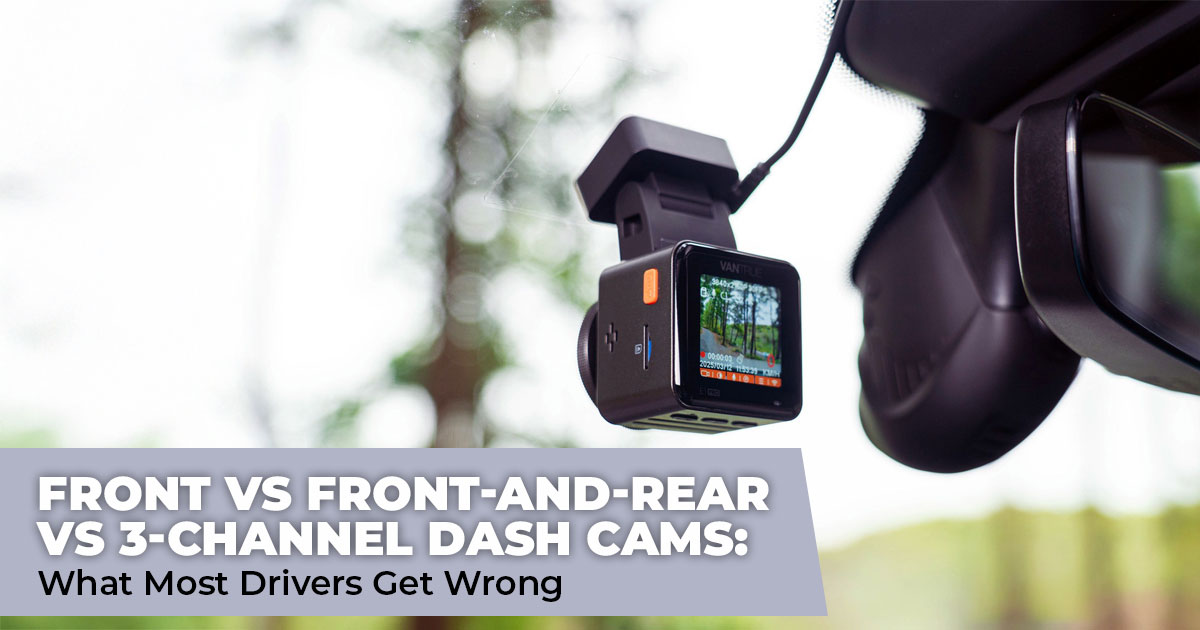
A front dash cam often leaves critical gaps. Adding rear or interior cameras reduces blind spots, speeds up insurance claims, and protects you in real accidents. This guide explains the real differences between front, front-and-rear, and 3-channel dash cams so you can choose what fits your driving life.
Offfcial Vantrue Dash Cam Store
US Store | India Store
1. Introduction
Nearly one in three car crashes involves a rear-end collision, and most drivers never see it coming. That’s where things usually go wrong. Many people install a front dash cam thinking it captures everything that matters until a sudden hit from behind leaves them without clear proof.
That missing angle often turns a straightforward accident into a drawn-out insurance dispute. Dash cam blind spots can slow claims, raise doubts, and sometimes leave drivers paying for damage they didn’t cause. It’s frustrating, and it’s more common than most expect.
This article explains why dash cam channels matter, highlights the blind spots drivers often overlook, and helps you choose a setup that fits how you actually drive. We address real questions people search for like “is a front-only dash cam enough” and “do I need a rear dash cam” using everyday driving situations and real-world road data, not theory.
This guide is written for daily commuters, families, highway drivers, and rideshare drivers who want fewer surprises, faster insurance resolutions, and video evidence that actually holds up.
And here’s the key point many buyers miss: more cameras don’t mean more complexity they mean fewer unanswered questions when it matters most.
1.1 Why Camera Count Matters in Dash Cams
A dash cam channel refers to how many angles your camera records at once. One channel captures the road ahead. Adding a second records what happens behind you. A 3-channel dash cam adds the interior view, which often provides context that outside footage alone can’t.
This isn’t about having extra footage. It’s about having dash cam accident footage that clearly shows what happened. In real claims, multi-channel dash cams often reduce disputes because they remove uncertainty. When insurers see multiple angles, decisions tend to move faster.
That’s why dash cam channel comparison matters more than just resolution or screen size.
As technology experts with over 20 years of experience in hardware and application research and development, we analyze each product based on real-world performance, durability, and value for money. Our goal is to help you find the best dash cam for your needs—whether that’s budget, performance, reliability, or long-term use. Our recommendations are built on extensive research, component analysis, real-world usability, and industry expertise.
1.2 Coverage Gaps People Overlook
Most drivers underestimate what their camera doesn’t see. Rear-end collisions, lane merges, sudden stops, and hit-and-run incidents often happen outside a front camera’s view. These are some of the most common dash cam coverage gaps.
Interior footage is also widely overlooked. For rideshare drivers, family vehicles, or even parked cars, an inside camera can explain movement, behavior, or timing when exterior footage alone leaves questions.
Understanding these gaps helps you avoid relying on footage that feels complete but isn’t.
1.3 Picking the Right Setup
There’s no single option that fits everyone. A front dash cam may be enough for short, low-risk commutes. A front and rear dash cam suits most daily drivers. A 3-channel dash cam makes sense if you want fuller context, stronger insurance support, and fewer disputes.
Whether you’re looking for the best dash cam for daily driving, something dependable for highways, or a dash cam for rideshare drivers, the right choice depends on how you drive not just the price tag.
And that’s exactly what the rest of this guide helps you figure out.
If you’re already considering upgrading beyond a basic front dash cam, it helps to see how different setups are actually sold and supported in your region. You can explore official options directly from trusted sources:
- Official US store: Click here to explore
- Official India store: Click here to explore
1. Introduction
Knowing what configurations are officially available makes it easier to match coverage to how you drive before an incident forces the decision.
2. Technical Specifications at a Glance
Here’s a quick rundown of the main features across front dash cam, front and rear dash cam, and 3-channel dash cam types. Drawn from 2025 model tests, this focuses on resolution, angles, and add-ons like a dash cam with night vision.
| Feature | Front Dash Cam | Front and Rear Dash Cam (Dual Channel) | 3-channel Dash Cam (Front + Rear + Interior) |
| Resolution (Typical) | 1080p to 4K front | 1080p to 4K front, 1080p rear | 4K front, 1080p rear, and interior |
|
Field of View |
140-170° front |
140-170° front, 120-
150° rear |
140-170° front, 120-
150° rear, 120-140° interior |
|
Night Vision |
Often with Sony STARVIS sensors | Dual sensors for low- light performance | Triple sensors,
enhanced for cabin details |
| Storage | 32-256GB microSD | 64-512GB microSD | 128-512GB microSD |
| Extras | GPS, parking mode,
dash cam |
HDR, continuous loop
recording |
Wi-Fi app control,
voice alerts |
| Price Range
(2025) |
$50-150 | $100-300 | $200-500 |
This overview highlights how more channels amp up protection without dropping quality— handy for comparing dash cam prices.
3. Why This Review Is Essential
With better car tech, risks linger from other drivers or parking lot dings. Many overlook multi- channel dash cam benefits, but data shows video from extra angles resolves disputes faster, helping reduce fraud significantly in many truck and passenger vehicle cases. This guide addresses real queries like “how many channels does a dash cam need” or “difference between front and rear dash cam,” aimed at everyday folks wanting a reliable vehicle surveillance camera.
4. What You Will Learn from This Review
You’ll pick up clear info on dash cam channels explained, with accident examples and stats. Get tools for deciding, like a flow for which dash cam should I buy, plus setup advice that digs deeper than basics. We’ll touch on unique points, such as how interior lenses guard against false claims not just in standard lists. End up knowing how to choose for your drives, with sections on people also ask and FAQs covering “front vs dual vs 3-channel dash cam.”
5. Dash Cam Basics: What “Dash Cam Channels” Really Mean
A dash cam channel refers to how many angles your camera records at the same time. Think of channels as extra sets of eyes placed around your car.
A front dash cam records what’s ahead traffic lights, license plates, and sudden braking. A front and rear dash cam adds coverage behind you, capturing tailgaters and rear-end impacts. A 3- channel dash cam records the road ahead, the road behind, and the interior of the vehicle for full context.
This matters during insurance claims. Multi-angle dash cam evidence for insurance often speeds up decisions because it removes guesswork. Real accidents show this clearly single-channel footage leaves gaps, while multiple views tell a complete story.
5.1 Dash Cam Recording Angles Explained (Front, Rear, Interior)
Each camera covers a speciffc range:
- Front dash cam angle: about 140–170 degrees, focused on lanes, signals, and oncoming traffic
- Rear dash cam angle: around 120–150 degrees, useful for rear-end collision footage
- Interior camera angle: roughly 120–140 degrees, answering common questions like “do dash cams record inside the car.”
A dash cam with an interior camera adds context in disputes, passenger claims, or vandalism incidents. These angles work together to reduce blind spots.
6. Front-Only Dash Cams: Strengths, Limits, and Who They Fit
A front dash cam handles direct threats well oncoming crashes, red-light violations, and sudden stops. These units are compact, easy to install, and work well for calm routes and a dash cam for city traffic use.
The limits show up fast. No rear or side coverage means rear-end collisions, which make up a large share of crashes, go unrecorded. Parked scratches, hit-and-runs, and multi-car disputes often lack proof.
This is why many drivers later ask, “Is a front-only dash cam enough?” for low-risk driving, yes; for busy roads, often no.
Front Dash Cam Pros and Cons Pros
- Simple installation
- Lower cost entry
- Sharp forward footage
Cons
- Misses rear-end collision footage
- No interior or side context
- Weak support in shared-fault disputes
Summary: A solid start, but limited once traffic increases.
6.1 Who Should Choose a Front Dash Cam
Best for:
- Solo commuters
- Short daily routes
- Low-traffic areas
Limits appear on highways. This explains why a front dash cam is not enough for fast or dense traffic, where impacts often come from behind.
Offfcial Vantrue Dash Cam Store
US Store | India Store
7. Front-and-Rear Dash Cams (Dual Channel): The Practical Upgrade
A front and rear dash cam closes the most common gap what happens behind you. It captures hit-and-run evidence, tailgating incidents, and parking damage. For many drivers, this setup covers most real-world crashes.
Interior activity is still missing, so disputes involving passengers or vehicle access remain unclear. Still, for most drivers, this is the most balanced choice.
Drivers asking “Do rear dash cams help in insurance claims?” usually find the answer is yes— rear footage often confirms fault quickly.
Dual Channel Dash Cam Pros and Cons
Pros
- Front and rear protection
- Strong dash cam for insurance claims
- Often includes a dash cam with parking mode
Cons
- No interior recording
- Slightly higher cost
- Extra wiring
Key takeaway: Fixes the biggest blind spot with minimal complexity.
7.1 Best Use Cases for Dual-Channel Dash Cams
Ideal for:
- Highway drivers
- Family vehicles
- Regular commuters
You get reliable coverage without dealing with interior wiring or privacy concerns.
For drivers who realize a front-only camera leaves too many unanswered questions, this is usually the point where an upgrade makes sense. Comparing official front-and-rear or 3-channel models along with warranty and support—can save frustration later.
- Official US store: Click here to explore
- Official India store: Click here to explore
This helps narrow choices based on real availability, not just spec sheets.
8. 3 Channel Dash Cams: Full Coverage, Full Context
A 3-channel dash cam records the front, rear, and interior at once. This creates full vehicle coverage, dash cam protection road behavior, traffic impact, and cabin activity.
Interior footage often gets dismissed outside rideshare use, but it matters during disputes, break-ins, and vandalism. Fleets and shared vehicles reduce claim costs with full context.
Trade-offs exist. These systems cost more and require careful installation. Still, many drivers asking “Is a 3-channel dash cam worth it?” decide it is once they face a complex claim.
3 Channel Dash Cam Pros and Cons Pros
- Complete coverage
- Strongest claim support
- Theft and dispute deterrence
Cons
- Higher upfront cost
- More cables
- Power management needed
Key takeaway: Best protection for busy, shared, or high-risk driving.
8.1 Who Benefits Most From 3 Channel Dash Cams
Best for:
- Dash cam for rideshare drivers
- Families with teen drivers
- Commercial and delivery use
For these users, interior proof reduces disputes and stress.
If you’re comparing dual-channel or 3-channel dash cams, it’s worth checking official brand stores to see current configurations and warranty coverage.
9. Common Accident Scenarios and Dash Cam Coverage Gaps
Different crashes need different angles:
- Rear-end crashes: Front-only cameras miss the impact; dual-channel dash cams capture fault
- Intersection side hits: Front and rear help; triple channel dash cam adds passenger context
- Rideshare disputes: Interior footage cuts false claims
This section explains dash cam coverage gaps explained and how dash cams help in accidents using real scenarios.
9.1 Dash Cam Mistakes Buyers Make
Common errors:
- Choosing fewer channels to save money
- Ignoring blind spots in dash cams
- Underestimating parking incidents Most upgrades happen after a missed
10. How Many Cameras Should a Dash Cam Have
Match the setup to your routine:
- Light traffic, short trips → Front dash cam
- Daily driving, highways → Front and rear dash cam
- Family, rideshare, delivery → 3 channel dash cam
Budget Tiers
- Under $100: Basic front camera
- $100–300: Dual channel with GPS
- $300+: Premium 3-channel systems
This answers “how many cameras should a dash cam have” in practical terms.
10.1 Dash Cam for Highway Driving vs City Driving
Highways need rear coverage. Cities benefit from interior views due to stops, passengers, and parking exposure.
11. Dash Cam Installation and Maintenance Tips
Mount high and centered for clear views. Route cables along the trim to avoid noise. Use hardwiring for stable power and a reliable dash cam with parking mode.
Use high-endurance memory cards, format monthly, update firmware, and review footage. Skipping these steps causes most failures after users buy a dash cam online.
12. Clearing Common Dash Cam Doubts (Buyer Questions Answered)
Most drivers researching a dash cam share the same concerns: which model is easy to live with, whether it really helps with insurance, and if paying more for extra cameras is worth it. This section answers those questions clearly and honestly, using real-world use cases and common search queries, so you can make a confident choice without second-guessing later.
Q. What’s the best dash cam for beginners?
- For first-time buyers, a front dash cam that works out of the box is the safest pick. Models like the Garmin Mini 2 keep things simple compact size, reliable recording, and no screen to distract you. It’s a strong choice if you’re asking, “Is a front-only dash cam enough” for short commutes or low-traffic driving. You get clear footage without dealing with complex wiring or settings.
Q. Do dash cams reduce insurance rates?
- In most cases, dash cams don’t lower premiums directly. Some regions report small reductions around 8 percent—but the real benefit is protection. Clear dash cam accident footage helps prevent rate hikes by proving fault. That’s why insurers value dash cam evidence for insurance claims, especially in rear-end or disputed crashes.
Q. Is a 3-channel dash cam worth it?
- A 3-channel dash cam is worth it if you deal with passengers, shared vehicles, or parking risks. The added interior view helps in theft cases and false claims, and data from fleets shows fewer fraud disputes when full vehicle coverage dash cams are used. If you’re comparing the best 3-channel dash cam for peace of mind, the extra coverage often pays for itself after one incident.
Q. How do dash cams handle night driving?
- Night performance depends on sensor quality, not just resolution. Dash cams with HDR or STARVIS sensors reduce glare from headlights and improve plate visibility in low light. This matters when choosing the best front and rear dash cam for highways or late-night driving, where clear footage can make or break an insurance claim.
Offfcial Vantrue Dash Cam Store
US Store | India Store
13. Conclusion What Most Drivers Get Wrong About Dash Cams
Many drivers assume a front dash cam is all they need, only to find out later that limited views leave gaps when it matters most. The real value of a dash cam isn’t just clear video it’s having multiple angles that build strong dash cam accident-proof evidence and clear dash cam legal evidence that stands up in insurance claims.
Adding rear and interior coverage closes the blind spots most people miss. Whether you’re navigating highways, city traffic, or rideshare shifts, the right setup from a solid front and rear dash cam to a full 3-channel dash cam gives you confidence and clarity if something goes wrong.
If you’re ready for better road coverage and real protection, check out trusted options directly from the manufacturers and retailers:
- Official US store: Click here to explore
- Official India store: Click here to explore
- Pick what matches your driving needs, and don’t hesitate to reach out with your picks or setup We’re here to help you get the best dash cam for your car and drive safer with fewer surprises.
***Disclaimer***
This blog post contains unique insights and personal opinions. As such, it should not be interpreted as the official stance of any companies, manufacturers, or other entities we mention or with whom we are affiliated. While we strive for accuracy, information is subject to change. Always verify details independently before making decisions based on our content.
Comments reflect the opinions of their respective authors and not those of our team. We are not liable for any consequences resulting from the use of the information provided. Please seek professional advice where necessary.
Note: All product names, logos, and brands mentioned are the property of their respective owners. Any company, product, or service names used in our articles are for identification and educational purposes only. The use of these names, logos, and brands does not imply endorsement.