
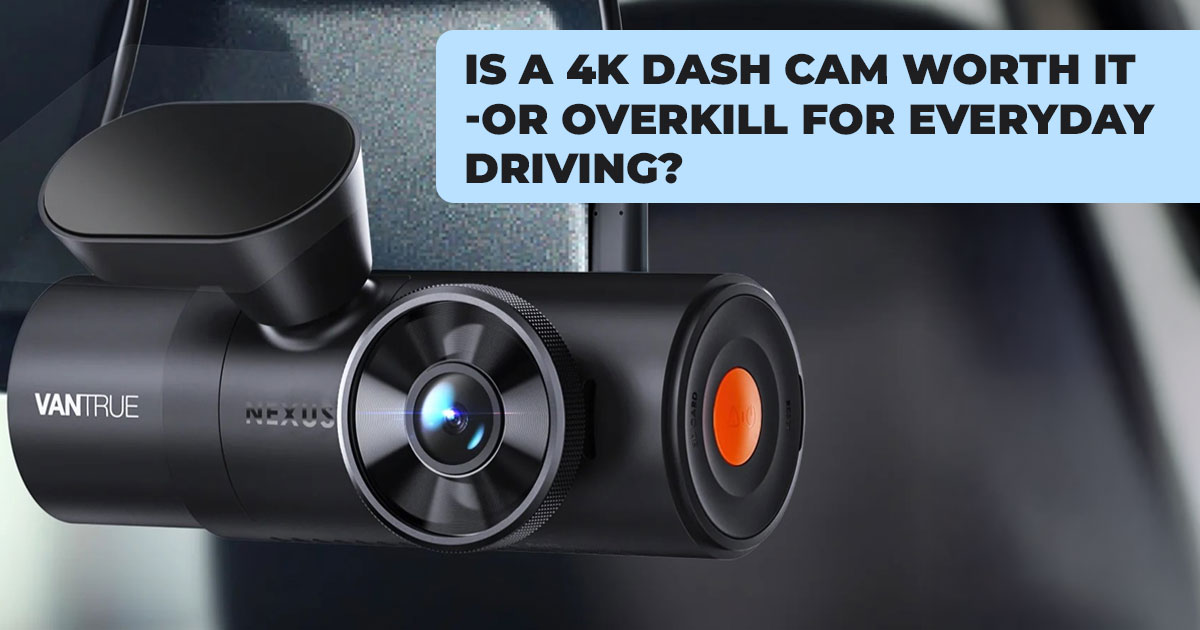
1. Introduction: The Real Question Isn’t 4K — It’s Evidence
Most drivers don’t search what dash cam resolution they should buy because they enjoy comparing specs. They search because they want proof that holds up when something goes wrong. An accident happens fast. A claim follows. And suddenly, the footage you trusted isn’t clear enough. License plates blur. Night footage looks flat. The moment that mattered most slips away.
That’s where the 4K question comes from. Not hype. Not trends. Just a simple concern: will this camera give me evidence I can actually use? A 4K dash cam video setup can solve that problem in the right situations. In others, it adds cost without solving anything new. The difference comes down to how you drive and what you expect your dash cam to do for you.
This guide looks at that gap between promise and reality and helps you close it.
Offfcial Vantrue Dash Cam Store
1.1 When Higher Resolution Actually Matters—and When It Doesn’t
Driving feels more tense than it used to. Traffic moves faster. Mistakes happen closer together. A sudden lane change at a signal. A sideswipe on the highway. A parking lot bump where no one agrees on what happened. When that moment turns into a dispute, your dash cam becomes your backup.
That’s why people keep comparing is 4K dash cam worth it, 4K dash cam vs 2K, and 4K dash cam vs 1080p. They want to know if higher resolution changes the outcome or if it just looks better on paper.
In real use, dash cam video resolution affects how far away a plate stays readable, how much you can zoom before details fall apart, and how well footage holds together at night. It also affects storage use, heat buildup, and how often old clips get overwritten. Some drivers gain real protection from 4K dash cam resolution. Others won’t notice much difference at all. This section breaks down where the line actually sits.
1.2 Why This Guide Matters for Drivers Today
Clear video carries more weight than ever. Insurance companies rely on it. Police officers ask for it. Yet many drivers only find out their dash cam video quality falls short after an incident.
Footage that looks fine at a glance can fail when reviewed frame by frame. And once doubt enters the picture, the burden shifts back to you.
This guide focuses on what makes footage useful in real disputes. Not marketing claims. Not spec-sheet numbers. We look at license plate recognition dash cam performance, night visibility, motion clarity, and storage limits so your setup matches real-world needs.
As technology experts with over 20 years of experience in hardware and application research and development, we analyze each product based on real-world performance, durability, and value for money. Our goal is to help you find the best product in every category—budget, performance, reliability, and long-term usage.
Whether you’re a city driver dealing with heavy traffic, a highway commuter covering long distances, a rideshare driver who needs inside and outside coverage, or a casual or rural driver on quieter roads, our recommendations are built on extensive research, component analysis, real-world usability, and industry expertise.
1.3 What You’ll Learn Here
- How 4K dash cam resolution compares with 1080p and 2K dash cams in everyday driving
- Where higher resolution helps most, such as reading plates from farther away
- When lower resolutions save money without giving up basic protection
- Practical trade-offs, including storage needs, heat concerns, and playback limits
- Clear guidance to match the right dash cam video quality to how and where you drive
Everything here is designed to answer the questions drivers already have and help them choose without regret.
Summary
If your priority is clear evidence that stands up during claims or disputes, a 4K dash cam makes sense for busy roads, highways, and night driving. If your driving is slower or lower risk, 2K or 1080p dash cams often deliver the protection you need without extra cost or storage issues. The right choice depends on your driving habits, not the biggest number on the box.
2. Technical Specifications at a Glance
Here’s a straightforward look at how the main resolutions compare in dash cams:
| Resolution | Pixel Count | Approx. File Size (1 Hour, Front Only) | Typical Frame Rates | Storage Needs | Heat Level | Best For |
| 1080p
(Full HD) |
1920 ×
1080 |
5–9 GB |
Up to 60fps | 64–128 GB
works fine |
Low |
Basic
everyday protection |
| 2K (1440p QHD) | 2560 ×
1440 |
10–16
GB |
Up to 60fps | 128–256 GB
recommended |
Moderate |
Good balance for most
drivers |
|
4K (UHD) |
3840 × 2160 |
20–35 GB |
Usually 30fps |
256–512 GB
high- endurance |
Higher |
Maximum detail in tough
situations |
- Summary: A 4K dash cam packs four times the pixels of 1080p, which means sharper details when you need them—but bigger files and more heat come with
3. What Does 4K Really Mean in a Dash Cam? (4K Dash Cam Resolution Explained)
A 4K dash cam records video at 3840 × 2160 pixels, which works out to roughly eight million pixels per frame. Standard 1080p dash cams capture about two million. That difference matters most when you pause footage and zoom in to check license plates, street signs, or faces after an incident.
But dash cams don’t work like living-room TVs. Distance, vehicle speed, vibration, and lighting all affect results. Extra pixels improve dash cam footage clarity, but only when the lens quality, image sensor, and video bitrate can support that resolution. This is why many drivers search what is a 4K dash cam? and expect perfect footage every time—only to find results vary by situation.
- Key point: usable evidence depends on more than resolution Sensor quality, bitrate, and image processing often matter just as much.
4. When a 4K Dash Cam Is a Smart Investment
Higher resolution pays off in specific situations, but it isn’t always the right choice. For many drivers, 4K dash cam video adds cost, heat, and storage demands without improving everyday protection. This section looks at situations where 2K or 1080p dash cams deliver the same peace of mind with fewer trade-offs, helping you avoid paying more for features you may never actually need.
4.1 License Plate Recognition at Speed (Best Dash Cam for Hit and Run)
Highway commuters and drivers on fast roads face one big challenge: plates disappear fast. If a car cuts across lanes or leaves the scene after contact, you may need to read a plate from 50– 70 feet away.
A 4K dash cam handles this better because higher resolution allows you to zoom in without heavy pixel breakup. Many 1080p dash cams struggle beyond 30–40 feet, especially when vehicles move quickly. That makes the 4K dash cam license plate distance a real advantage for anyone searching for the best dash cam for hit and run or a reliable license plate recognition dash cam.
4.2 Zooming Without Losing Detail (Dash Cam for Evidence)
After an incident, footage review matters as much as recording. Drivers often zoom in to check
lane markings, road signs, or pedestrian positions. Lower resolutions fall apart once enlarged.
4K dash cam video holds detail longer when zoomed, which makes a difference for dash cam for evidence or dash cam for legal evidence. This is where resolution directly supports claims, reports, and disputes—without guessing what the footage shows.
4.3 Urban and High-Traffic Driving (Dash Cam for City Driving)
City roads involve more than just cars. Intersections, cyclists, sudden stops, and pedestrians all compete for attention. A dash cam for city driving or a dash cam for urban traffic needs to capture a wide context with enough clarity to show who moved first or who crossed the line.
Higher resolution helps preserve small but critical details across the frame. It can show side events clearly, not just what’s directly ahead, which often decides fault in dense traffic situations.
4.4 Night Driving and Low-Light Evidence (Best Dash Cam for Night Driving)
Many drivers ask does a 4K dash cam work at night or look for the best dash cam for night driving. Resolution helps, but it isn’t the full story. Low-light performance depends more on sensor technology.
Advanced sensors like Sony STARVIS 2 improve brightness and control noise in dark scenes. When paired with a 4K dash cam recording, they capture clearer license plates and faces after dark. Without a strong sensor, higher resolution alone can increase noise instead of clarity.
4.5 Coverage for Rideshare Drivers (Dash Cam for Rideshare Drivers)
Rideshare drivers need more than front coverage. Interior interactions matter just as much as road events. Multi-channel dash cams with 4K front recording and interior and rear views protect both drivers and passengers.
For a dash cam for rideshare drivers, higher resolution helps document cabin activity clearly and provides stronger evidence if disputes arise later.
4.6 Future-Proofing Your Dash Cam Setup
Video standards keep rising. Insurance companies, law enforcement, and courts expect clearer footage than they did a few years ago. A capable 4K dash cam stays relevant longer and delays the need for an upgrade as expectations increase.
5. When 4K Dash Cam Video Is Overkill
Not every driver needs 4K dash cam video, but in the right situations, it can make a real difference. This section explains where higher resolution provides clear, practical value— especially for drivers who deal with high speeds, dense traffic, night driving, or frequent disputes. If your priority is clear, defensible evidence, these scenarios show when a 4K dash cam becomes a smart investment rather than an unnecessary upgrade.
5.1 Budget Considerations (4K Dash Cam Price vs Value)
A 4K dash cam costs more upfront. You also need high-endurance SD cards, which add to the long-term expense. For many drivers, 2K dash cams or 1080p dash cams already deliver reliable protection at a lower total cost.
5.2 Low-Risk or Rural Driving
On quieter roads with fewer vehicles and lower speeds, extreme detail rarely becomes necessary. A solid 2K dash cam captures enough clarity for most incidents without the added demands of 4K recording.
5.3 Storage and Overwrite Challenges (4K Dash Cam Storage Requirements)
A common question is how much storage a 4K dash cam needs. Realistically, 256 GB is the starting point, and 512 GB works better for longer retention. Larger files fill cards quickly, which means footage gets overwritten sooner if storage isn’t sufficient.
5.4 Heat and Climate Issues (Dash Cam Overheating)
Recording 4K video requires more processing power, which creates more heat. In hot climates or cars parked under direct sunlight, this can stress components. Cameras with supercapacitors handle heat better, but 2K dash cams generally run cooler and tolerate harsh conditions longer.
5.5 Playback and Compatibility Limits
Large 4K video files can be harder to handle on older phones or computers. Transfers take longer, and playback may stutter. For drivers who review footage often or share clips quickly, this can become frustrating.
Key Takeaway
A 4K dash cam delivers clear benefits for high-speed roads, busy cities, night driving, and evidence-heavy use cases. But for lower-risk driving, 2K or 1080p dash cams often provide dependable protection without higher costs, heat, or storage demands. Choosing the right resolution means matching the camera to how you actually drive—not just buying the biggest number on the box.
Once you know where 4K helps, the next step is understanding what you trade away.
Offfcial Vantrue Dash Cam Store
6. Key Trade-Offs Every Buyer Should Understand Before Choosing a 4K Dash Cam
Choosing a 4K dash cam sounds simple until you live with it. Higher resolution brings clear gains, but it also introduces limits that affect daily use. This section lays out the trade-offs so you can decide based on how you actually drive, not how a spec sheet reads.
6.1 4K Dash Cam vs 2K Dash Cam: What You Gain and What You Give Up
| Factor | 4K Dash Cam Benefit | Downside | When Lower Resolution Wins |
| Frame Rate vs Resolution | Sharper detail per frame at 30 fps | Fast movement can blur in darker scenes | 2K dash cam at 60 fps
keeps motion cleaner |
| True 4K vs Upscaled 4K | Native capture preserves real
sharpness |
Some low-cost models stretch lower
resolution |
Check sensor and
processor specs |
| Overall Balance | Best clarity when zooming for evidence | More heat, storage use, and cost | 2K dash cam often fits daily driving better |
For many drivers, weighing a 2K vs 4K dash cam, the decision leans toward 2K. It delivers clear footage without pushing storage limits or stressing hardware during long drives.
7. Quick Buyer Guide: Matching Dash Cam Resolution to How You Drive
Most people land here trying to understand options, not to buy anything yet. That’s fine. The goal now is to remove doubt and help you self-select fast. Resolution should match risk, not hype. If you choose based on how you actually drive, the decision becomes obvious.
7.1 Best Dash Cam Resolution by Driving Profile
| Driving Profile | Recommended Resolution | Why It Fits in Real Life | What Actually Matters |
|
Urban / High- Traffic Driving |
4K dash cam |
Dense traffic, intersections, and close calls demand readable plates and
clear context |
Multi-channel setup, strong low-light sensor |
|
Highway Commuter |
2K or 4K dash cam |
Speed increases plate distance; clarity matters more than
extras |
Wide field of view, high bitrate recording |
|
Rideshare or Family Use |
4K multi-channel dash cam |
Interior and exterior disputes happen; clear footage protects
everyone |
Cabin camera, reliable parking mode |
| Budget / Casual
/ Rural Driving |
1080p–2K dash cam |
Fewer cars, lower
speeds, fewer edge cases |
Simple app, durable build |
| Hot Climate or
Frequent Parking |
2K dash cam preferred |
Lower heat load
improves long-term reliability |
Supercapacitor, solid heat management |
Choose 4K if you deal with traffic, speed, or people every day and want evidence that leaves no room for argument.
Choose 2K if you want strong clarity without storage stress, heat issues, or higher cost.
Stick with 1080p if: you just want basic backup and drive in low-risk conditions. This keeps the focus on usable footage, not chasing the highest number.
8. Final Verdict: Is 4K Dash Cam Video Worth It?
Here’s the honest answer.
If you drive in cities, spend time on highways, drive at night, or carry passengers, a 4K dash cam is worth the money. The ability to zoom in, read plates, and show context clearly can end disputes fast. That clarity matters when insurance or police get involved.
But if your driving is mostly routine—short trips, quieter roads, lower speeds—a 2K dash cam is the smarter buy. It covers real-world needs without higher storage costs, extra heat, or file- handling issues. For many people, it’s the best balance of clarity and reliability.
Our straight recommendation
If we had to choose for ourselves:
- Daily city or highway driving: we’d pick 4K, no hesitation.
- General daily use: we’d pick 2K and keep things simple.
Skip 4K if:
- You’re on a tight budget
- You park in extreme heat often
- You don’t want to manage large files
Still unsure?
Start with 2K. If you ever feel limited by clarity, upgrading to 4K later makes sense. Buying more than you need upfront rarely does.
Quick Verdict
- Buy 4K if evidence quality is critical to you.
- Buy 2K if you want dependable protection without trade-offs.
- Forget the numbers, focus on how it actually Usable proof beats big numbers every time.
9. Clearing Common Doubts About 4K Dash Cam Video
Most readers reach this point because they’re close to a decision but still want clear answers to a few practical questions. This section addresses the most common 4K dash cam concerns in plain terms—focused on daily use, real trade-offs, and what actually matters once the camera is installed.
Q. Is a 4K dash cam better than a 2K dash cam?
- A 4K dash cam captures more detail and allows cleaner zoom, which helps with license plate recognition at longer distances. A 2K dash cam often performs better in daily use because it supports higher frame rates, runs cooler, and uses less storage. That’s why many everyday drivers prefer 2K vs 4K dash cam setups for balance.
Q. How much storage does a 4K dash cam need?
- Most 4K dash cams need at least 256 GB, with 512 GB high-endurance SD cards working better for longer recording loops. Front-only 4K dash cam video can use 20–35 GB per hour, so smaller cards overwrite footage quickly.
Q. Is 4K better than 1080p for a dash cam?
- Yes, 4K dash cam video is better for reading plates at a distance and zooming into details. A good 1080p dash cam still works for basic protection, short trips, and lower-speed driving. The difference shows up most in heavy traffic or highway situations.
Q. Do dash cams overheat more when recording 4K video?
- Recording 4K dash cam video requires more processing power, which creates more heat— especially in parked cars under direct sun. Models with supercapacitors manage heat better, but 2K dash cams usually handle hot conditions with less strain.
Offfcial Vantrue Dash Cam Store
10. Frequently Asked Questions About 4K Dash Cam Video
These questions come up after drivers understand the basics but want to avoid buying the wrong setup. The answers below focus on real use, not specs—so you can decide with fewer doubts and fewer surprises later.
Q. Should I buy a front and rear 4K dash cam?
- A front 4K dash cam delivers the most value because most incidents happen ahead of the vehicle. For rear coverage, 2K or 1080p dash cams usually provide enough clarity for tailgating or rear-end collisions without adding storage or heat load.
Q. Is 60 fps better than 4K resolution for motion clarity?
- In some cases, yes. A 60 fps dash cam at 2K resolution often captures smoother motion and reduces blur in fast action or low-light driving. This is why frame rate vs resolution dash cam comparisons matter—higher resolution alone does not always improve moving footage.
Q. Will my phone play 4K dash cam footage easily?
- Most newer smartphones handle 4K dash cam video without trouble. Older phones may lag or struggle with large files. Many dash cams include lower-resolution playback modes or companion apps to make viewing clips easier.
Q. Is a 4K dash cam overkill for daily driving?
- For calm, low-risk driving, often yes. A 2K dash cam delivers strong clarity for everyday protection while keeping costs, heat, and storage use lower. 4K dash cam video makes more sense for heavy traffic, highways, or frequent disputes.
These answers are meant to help you choose confidently. If your driving demands clear, zoom- ready evidence, 4K dash cams earn their place. If reliability and simplicity matter more, 2K and 1080p dash cams often cover daily needs just as well.
11. Conclusion
By now, the choice should feel clearer than it did at the start.
If your driving involves busy city roads, highway speeds, night travel, or passengers, a 4K dash cam makes sense. The extra detail gives you footage you can zoom into without guessing. When something goes wrong, that clarity saves time and arguments.
If your driving is calmer—short trips, quieter roads, predictable routes—a 2K dash cam is often the better call. You still get sharp video, but with less heat, less storage pressure, and lower cost. For many drivers, that balance works better day to day.
Here’s how the Vantrue lineup ffts real use cases:
Best picks for 4K and heavy-duty protection
- Vantrue N4 Pro – Best for city drivers, highway commuters, and rideshare use. 4K front with rear and cabin coverage gives strong evidence in complex Explore more now, US | India
- Vantrue N5 – Ideal if you want wider coverage with multiple angles and strong front detail for high-risk Explore more now, US | India
Strong choices for balanced, everyday use
- Vantrue E3 – A good fit if you want 4K front clarity without a full multi-channel Explore more now, US | India
- Vantrue E1 Pro – A reliable 2K dash cam for daily driving that keeps heat and storage in Explore more now, US | India
Simple and budget-friendly options
- Vantrue S1 Pro – Best for casual or rural driving where basic protection is enough and simplicity Explore more now, US | India
You can explore all offfcial models here:
If I were buying today, I’d choose 4K only when evidence quality truly matters for my driving. Otherwise, I’d stick with a solid 2K model and keep things simple.
If you’re still unsure, start with 2K. It covers most needs well, and upgrading later is always easier than dealing with footage that falls short when it counts.
If you’ve already installed a dash cam or have questions about your driving setup, share them in the comments. Real experiences help others make better choices—and that’s how we all stay safer on the road.
***Disclaimer***
This blog post reflects our own research, testing, and personal opinions. It should not be taken as the official position of any brand, manufacturer, or company mentioned here. While we aim to keep information accurate and up to date, product details, pricing, and availability can change. We recommend double-checking important details before making a purchase.
Some links in this article may be affiliate links. If you choose to buy through these links, we may earn a small commission at no extra cost to you. This helps support our work and allows us to keep publishing in-depth, unbiased reviews. Our recommendations are never influenced by affiliate partnerships.
Comments shared by readers reflect their own views and not ours. We are not responsible for outcomes resulting from the use of information on this site. Please seek professional advice where appropriate.
All product names, logos, and brands mentioned are the property of their respective owners. These names are used for identification and informational purposes only and do not imply endorsement.