
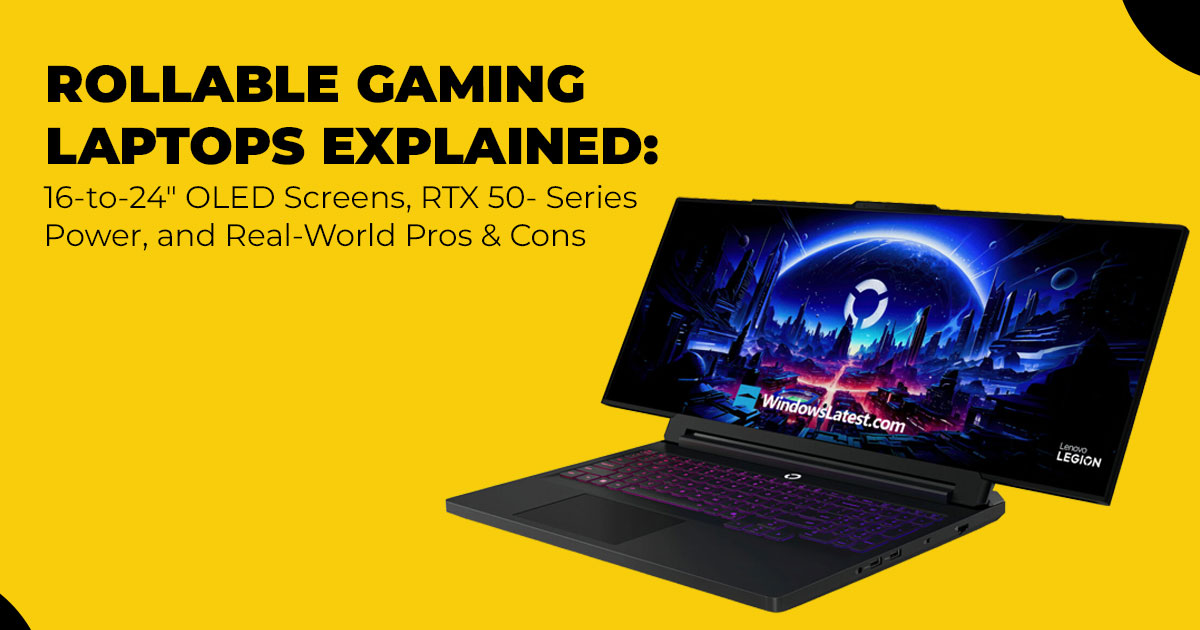
A rollable gaming laptop combines a compact 16-inch design with a 24-inch rollable OLED display and RTX 50-series–class gaming laptop performance. It promises desktop-level screen space without giving up portability—but usability, heat, durability, and long-term value decide whether it’s a smart buy. This guide breaks it down for gamers, creators, and professionals who want clarity before committing.
1. Introduction: Why a Rollable Gaming Laptop Suddenly Makes Sense
If you use a laptop as your main machine, you already know the compromise. At home, the screen feels too small. On the go, carrying an external monitor makes no sense. So you adapt— by stacking windows, squinting at timelines, or constantly switching tabs. That quiet frustration is part of everyday laptop use, and it’s exactly what a rollable gaming laptop is trying to fix.
This new approach starts as a normal 16-inch laptop, then smoothly expands into a 24-inch rollable OLED laptop when you need more space. There’s no fold, no visible crease, and no awkward hinge.
The rollable OLED display extends upward, turning the machine into a true large-screen gaming laptop or desktop replacement gaming laptop—without forcing you to choose between portability and screen size. Add a flagship-class RTX 50-series laptop GPU, and it’s clear this is more than a concept demo.
It’s aimed squarely at high-end gaming laptops in 2025.
What makes this interesting isn’t the spec list—it’s the lifestyle shift. A single expandable screen laptop that works for gaming at night, content creation during the day, and serious multitasking without plugging into a second display. That’s a different way to think about laptops, especially for gamers, streamers, creators, and professionals who want one powerful, premium gaming laptop instead of a desk full of gear.
Our evaluations focus on real-world performance, durability, and long-term usability rather than launch-day specs.
Why focus so much on real-world behavior? Because customer reviews and early user impressions reveal what spec sheets hide—how a rollable OLED laptop holds up over time, how thermals behave with a flagship RTX 50-series laptop, and whether an expandable display laptop becomes something you rely on or something you stop using after the novelty wears off. Those details matter more than launch-day excitement.
If you’re curious how today’s high-end gaming laptops compare—especially large-screen and OLED models—it helps to see what’s already available before diving deeper.
- Amazon (Worldwide) – Explore current RTX 50-series gaming laptops, large screen gaming laptops, and OLED gaming laptops available
- Amazon India – Browse premium gaming laptops, OLED gaming laptops, and upcoming high-performance models available in India.
2. Technical Specifications at a Glance
Here’s the key information we know so far about this rollable OLED gaming laptop concept:
| Feature | Details |
|
Display |
Rollable OLED, 16 inches (closed/Focus Mode) to 24 inches
(Arena Mode), high refresh rate, three expansion stops (21.5″ Tactical Mode) |
| Graphics | RTX 50-series–class laptop GPU (flagship-tier mobile graphics) |
| Processor | Latest high-end Intel Core Ultra series |
| Expansion
Mechanism |
Motorized vertical roll with dual-motor tension system |
| Target Users | Gamers, streamers, video editors, multitaskers |
| Expected Reveal | CES 2026 (concept stage) |
3. Why This Review Matters Right Now
Most early coverage of rollable display technology is either pure excitement or quick news posts that disappear after a week. We wanted to do something different: give you a practical, no- nonsense look at how this gaming laptop with expandable display could actually fit into your life. Whether you’re deciding between a premium gaming laptop and a traditional 18-inch model, or just curious about future laptop display technology, this guide answers the real questions that show up in search results every day.
4. What You’ll Learn From This Guide
- How rollable OLED displays work and the mechanics behind them
- How the rollable OLED laptop changes gaming, streaming, and content creation
- The real engineering challenges, including the mechanical durability of rollable screens and OLED burn-in risk
- Honest battery life expectations and laptop thermal management issues
- Who this workstation-class gaming laptop is built for—and who should skip it
- How it stacks up against current best large screen gaming laptops and best OLED gaming laptops
- Whether rollable laptops are the next big thing or a niche experiment
- Rollable gaming laptop pros and cons
Summary:
By the end of this guide, you’ll know what a rollable laptop actually is, how it compares to today’s large screen gaming laptops, whether a rollable gaming laptop is worth buying, and if buying now makes sense—or if waiting is the smarter move. And once those trade-offs are clear, the decision stops feeling complicated.
5. What Makes a Rollable Gaming Laptop Different From Foldables
A lot of people lump foldable vs rollable laptop displays into the same category. They’re not the same—and the difference matters more than it sounds.
Foldable laptops bend the screen in the middle. That bend almost always leaves a visible crease. You might ignore it while browsing, but during gaming, video editing, or design work, that line sits right where your eyes focus. Once you notice it, it’s hard to unsee.
A rollable gaming laptop works differently. Instead of bending, the display extends smoothly upward, staying perfectly flat as it expands. The panel stays flat and crease-free, which is a big deal for immersive gaming display quality and for anyone who cares about clean visuals. No hinge line, no distortion in the center of your content.
The bigger win, though, is how it fits into daily use. When you’re on the move, it behaves like a compact portable workstation laptop. When you’re back at your desk, it stretches into a wide, cinematic ultrawide OLED gaming display laptop. That ability to shift between modes is what creates a true hybrid desktop laptop experience—something fixed-size large screen gaming laptops simply can’t offer.
Instead of choosing between portability and screen space, a rollable design lets you decide in the moment.
5.1 Foldable vs Rollable Gaming Laptops: Key Differences
| Feature | Foldable Laptop | Rollable Gaming Laptop |
| Screen movement | Bends at a hinge | Extends smoothly |
| Visible crease | Yes, usually noticeable | No crease |
| Display flatness | Slight distortion at the fold | Completely flat |
| Gaming immersion | Can be distracting | Clean, uninterrupted view |
| Portability | Compact but thicker | Compact when retracted |
| Desk usage | Limited screen flexibility | Expands into an ultrawide display |
| Best use case | Reading, light multitasking | Gaming, creation, multitasking |
Why this matters:
For gaming, streaming, and creative work, your eyes stay locked on the center of the screen. A rollable OLED gaming laptop keeps that space clean while still giving you the flexibility of a larger display when you need it. That balance—portable when moving, expansive when stationary—is what separates rollables from foldables and from traditional large-screen laptops.
And that difference becomes more noticeable the longer you use it.
6. How Rollable OLED Displays Work in a Rollable Gaming Laptop (Simple Mechanics Explained)
Before judging whether a rollable gaming laptop is practical, it helps to understand how the rollable OLED display actually works.
Unlike traditional screens made with rigid glass, a rollable OLED laptop uses ultra-thin organic layers built on a flexible plastic base called polyimide. Each pixel lights itself, so there’s no backlight, which keeps the panel thin and flexible without sacrificing contrast or color accuracy.
Inside the laptop lid sits a motorized spool system. When you activate it, dual micro-motors gently unroll the extra screen area upward from inside the lid. Internal rails support the panel as it extends, while tension mechanisms pull the display tight so it stays flat and crease-free. You’re not limited to one size—most designs allow intermediate screen sizes like 16 inches, 21.5 inches, or the full 24-inch rollable OLED laptop mode.
- Key point: This is controlled mechanical movement, not a fragile gimmick. The system is engineered to handle thousands of expansion cycles over years of normal use.
7. Key Benefits of a Rollable Screen Laptop for Gamers, Creators, and Professionals
The value of an expandable screen laptop depends on how you use it. Different users gain different advantages.
For Gamers and Esports Players
Switching to full 24-inch ultrawide OLED gaming display laptop mode gives a wider field of view. In competitive games, that means better peripheral awareness without head movement. You get the feel of a desktop monitor from a portable workstation laptop.
For Streamers and Multitaskers
A gaming laptop for multitasking and streaming benefits from mid-range expansion. Chat windows, streaming software, and gameplay stay visible on one screen. No second monitor needed.
For Content Creators
Editors, designers, and photographers gain workspace. Longer timelines, larger previews, and fewer zoom adjustments turn a gaming laptop for content creators into a serious high- performance mobile computing tool.
For Professionals
Developers, analysts, and researchers see more code, data, or dashboards at once. Less scrolling means less fatigue during long sessions.
8. How an Expandable Screen Laptop Changes Everyday Tasks
This section answers a common question: Does the rollable screen help daily work, or only gaming?
- Gaming: Open-world games, racing titles, and simulators feel larger without an external display. The wider view adds immersion.
- Streaming and Multitasking: Stream controls, chat, and content fit on one screen, making this a true gaming laptop for multitasking and streaming.
- Content Creation: Video timelines stretch Designers work with full-resolution previews.
- Productivity: Coders and spreadsheet users see more data at once, reducing window switching.
Bottom line: With an adaptive screen size laptop, the screen adjusts to the task—not the other way around.
9. Engineering Challenges of Rollable Screens That Buyers Should Know
This is where excitement meets reality.
The biggest concern is mechanical durability. Dust, repeated motion, and long-term wear affect any system with moving parts. While modern designs include protective seals, real-world longevity is still unproven.
There’s also OLED burn-in risk. Static elements like taskbars and HUDs can age pixels unevenly. With a rollable panel, different areas may age at different rates depending on how often they’re extended.
Repairability matters too. A failed rolling mechanism could mean higher service costs than a standard panel. These risks don’t make rollables bad—but they make them a careful purchase.
10. RTX 50-Series Gaming Laptop Performance: Can Cooling Keep Up?
A flagship RTX 50-series gaming laptop GPU brings near-desktop graphics power, but laptops still face GPU power limits and airflow constraints.
In compact mode, the cooling space is tighter. In expanded mode, surface area improves heat dissipation, but fans still work hard under sustained load. Expect strong short-session performance and some throttling during long gaming or rendering sessions.
RTX 50-series laptop performance expectations: It won’t match a desktop tower, but it sits at the top of high-performance mobile computing today.
11. Battery Life on a Rollable OLED Gaming Laptop (The Honest Answer)
Yes, rollable OLED affects battery life.
- Compact mode: Light tasks may reach 4–6 hours
- Expanded mode with gaming: Expect 2–3 hours or less
A rollable gaming laptop is designed as a plugged-in powerhouse, not an all-day travel device. If battery life matters more than screen flexibility, a traditional OLED laptop makes more sense.
12. Who Should Buy a Rollable Gaming Laptop (And Who Shouldn’t)
Best fft for:
- Desk-based gamers wanting an immersive gaming display
- Streamers and creators using complex multitasking layouts
- Enthusiasts drawn to innovative laptop screen technology
Better alternatives for:
- Frequent travelers
- Budget-focused buyers
- Users who prefer proven, low-risk designs
13. Rollable vs Large Screen Gaming Laptops: Practical Comparison
Best High-Performance Laptop Options Compared (Rollable vs Traditional)
Before spending premium money, here’s how the main options stack up in real use.
13.1 Rollable Gaming Laptop (16–24″ Rollable OLED + RTX 50-Series Class Graphics)
Best for:
- Desk-based gamers
- Streamers and creators
- Users who want one device instead of a laptop + monitor
Strengths
- Expandable screen laptop adapts to tasks
- Ultrawide OLED gaming display laptop without an external monitor
- Flagship RTX 50-series gaming laptop performance
Trade-offs
- Very high price
- Higher durability risk (moving parts)
- Short battery life in expanded mode
–− Best choice if screen flexibility matters more than cost.
13.2 Traditional 18-Inch Large Screen Gaming Laptop
Best for:
- Users who want a big screen all the time
- Buyers prioritizing proven designs
Strengths
- Strong performance with fewer mechanical risks
- Easier servicing and resale
- Often cheaper than rollable designs
Trade-offs
- Always bulky
- No flexibility in screen size
- Less immersive than ultrawide formats
–− Best balance of performance and reliability.
13.3 Gaming Laptop + External Ultrawide Monitor
Best for:
- Home setups
- Users who value flexibility over portability
Strengths
- Largest screen experience
- Lowest durability risk
- Easy upgrades over time
Trade-offs
- Extra cables and desk space
- Not portable as a single solution
–− Best overall immersion if portability is secondary.
Comparison Table
| Feature | Rollable Gaming Laptop | 18″ Gaming Laptop | Laptop + Ultrawide
Monitor |
| Screen flexibility | Excellent | None | Excellent |
| Portability | Good when closed | Poor | Laptop only |
| Immersion | Very high | High | Highest |
| Durability risk | Higher | Standard | Low |
| Battery life | Short | Short–moderate | Laptop dependent |
| Price range | Very premium | High | Flexible |
| Upgrade path | Limited | Limited | Strong |
14. Is Rollable Display Technology the Future of Gaming Laptops?
Rollable display technology costs more to build and maintain than standard panels. Early models will sit at the top end of premium gaming laptop cost, similar to early OLED pricing.
If reliability improves and manufacturing scales, prices may fall. For now, rollables remain a luxury niche, not a replacement for every next-generation gaming laptop.
15. Practical Checklist Before You Buy a Rollable Gaming Laptop
Before you buy a rollable gaming laptop, check:
- Warranty coverage for the rolling mechanism
- Independent durability and thermal tests
- Verified rollable gaming laptop reviews
- RTX 50-series gaming laptop price vs current alternatives
- Whether rollable laptops are durable enough for your use
Final advice: Wait for long-term data unless you’re comfortable being an early adopter.
16. Clearing Common Doubts About Rollable Gaming Laptops
Before someone spends serious money on a rollable gaming laptop, they usually pause with a few practical questions. That’s healthy. This section clears up the most common doubts readers search for—how rollable OLED laptops work, whether they last, and how they compare to familiar options like foldables or IPS displays. The goal here is simple: help you decide if this new form factor fits your daily use, not just your curiosity.
What Is a Rollable Laptop?
A rollable laptop uses a flexible OLED display that can extend when you need more screen space and retract when you want portability. In everyday terms, it starts as a normal 16-inch laptop and expands into a large screen gaming laptop—often up to 24 inches—without adding external monitors. This makes it appealing as a desktop replacement gaming laptop for users who work and play at a desk.
Are Rollable Laptops Durable Enough for Daily Use?
This is one of the most searched questions: are rollable laptops durable? Early demonstrations and lab testing suggest the rolling mechanisms are built for thousands of cycles. That said, long-term durability in real homes and offices is still being proven. Dust exposure, repeated motion, and wear over years remain open questions. If reliability is your top priority, waiting for second-generation models is the safer choice.
How Do Rollable OLED Displays Work?
A rollable OLED display is built on a flexible plastic base instead of rigid glass. Inside the laptop lid, a motorized system slowly unrolls the extra screen area from a hidden compartment.
Tension systems keep the panel flat, so you don’t see wrinkles or bends. It’s controlled movement, not a manual pull, which helps protect the screen during everyday use.
Is a Rollable Gaming Laptop Worth Buying Right Now?
Whether a rollable gaming laptop is worth buying depends on how you use your laptop. If you want a large OLED gaming display laptop, value screen flexibility, and are comfortable paying more for early-stage technology, it can make sense. If you care more about long-term reliability, easier repairs, and lower cost, a traditional large screen gaming laptop offers better value today.
Rollable vs Foldable Laptops: Which Is Better?
In the rollable vs foldable laptops debate, the main difference is the screen surface. Foldables bend in the middle and usually show a crease. Rollable laptops avoid creases, giving you a clean, flat image that works better for gaming and creative work. However, foldables are more mature and widely available, while rollables are still early in their lifecycle.
OLED vs IPS Gaming Laptops: What Should You Choose?
When comparing OLED vs IPS gaming laptops, OLED delivers deeper blacks, better contrast, and faster pixel response. That’s why it’s popular in premium gaming laptops. The trade-off is OLED burn-in risk, especially if static elements stay on screen for long periods. IPS panels are less dramatic but often last longer with less concern.
In short:
A rollable OLED gaming laptop makes the most sense for desk-based gamers, creators, and multitaskers who want flexibility and immersion in one machine. If you prefer proven designs and predictable value, waiting—or choosing a traditional setup—remains a smart move.
17. Frequently Asked Questions About Rollable Gaming Laptops
By the time readers reach this point, they usually want quick, clear answers. This FAQ section addresses the most common search queries around rollable gaming laptops, RTX 50-series laptop performance, battery life, pricing, and practical alternatives. These are the questions people ask right before deciding whether to buy, wait, or look elsewhere—so the focus here is clarity, not marketing.
Can a Laptop Really Run a Flagship RTX 50-Series GPU?
Yes, a flagship RTX 50-series gaming laptop can deliver extremely high performance, but it operates under GPU power limits in laptops and stricter cooling constraints than a desktop. That means burst performance can be excellent, while sustained workloads may see some throttling. In real use, it’s one of the closest options to desktop-class gaming in a high-performance mobile computing form factor.
What Games Benefit Most From an Expanded Rollable Screen?
Games that support ultrawide resolutions gain the most. Racing games, flight simulators, strategy titles, and open-world games benefit from the wider field of view. Competitive esports titles may see less advantage, but immersion-focused genres feel noticeably better on a large OLED gaming display laptop.
Does a Rollable OLED Display Affect Battery Life?
Yes, rollable OLED affects battery life in a noticeable way. When the screen is fully expanded, more pixels are active and brightness levels increase power draw. Light tasks in compact mode may last several hours, but gaming or heavy work in expanded mode will drain the battery quickly. A rollable OLED gaming laptop is designed to be used plugged in most of the time.
How Much Will a Rollable Gaming Laptop Cost?
Expect a premium gaming laptop cost. Early models with high-end CPUs, a rollable OLED display, and next-generation RTX 50-series mobile graphics are likely to fall in the $3,000 to $5,000+ range, depending on configuration. Pricing reflects both cutting-edge hardware and the complexity of rollable display technology.
What Is the Best Alternative to Rollable Laptops Right Now?
For most buyers, the best alternative is a current-generation flagship RTX 50-series gaming laptop paired with an external ultrawide monitor. This setup delivers similar immersion with lower risk and often better value, especially if portability is less critical.
Pros and Cons Summary
Pros
- Flexible screen size for gaming, work, and creation
- Clean, crease-free OLED gaming display
- One-device solution instead of a laptop plus a monitor
Cons
- High price
- Shorter battery life
- Long-term durability is still unproven
A rollable gaming laptop is best suited for users who value screen flexibility and immersion and are comfortable paying a premium for new technology. If reliability, battery life, and long-term value matter more, established gaming laptops remain the safer choice.
18. Final Verdict: Exciting, But Not for Everyone Yet
A rollable gaming laptop is one of the most compelling ideas we’ve seen in next-generation gaming laptops. The ability to switch from a compact 16-inch laptop into a 24-inch rollable OLED gaming display solves a real, everyday problem—limited screen space—without forcing you to carry an external monitor. For desk-based gamers, streamers, and content creators, that flexibility alone can change how a laptop fits into daily work and play.
That said, the first wave won’t be perfect. Expect a premium price, higher power draw, shorter battery life, and open questions around long-term durability. This is advanced technology, and early adopters will pay more—both in price and in patience.
If you’re an enthusiast who enjoys cutting-edge hardware and mostly uses your laptop at a desk, a rollable gaming laptop could genuinely improve your setup. If you’re more focused on value, reliability, and proven designs, today’s best RTX 50-series gaming laptops and best large screen gaming laptops already deliver excellent performance with fewer trade-offs.
The smart move for most buyers: watch how the first models perform in real-world use, then decide whether to buy now or wait for a refined second generation.
Where to Check Current High-End Gaming Laptop Deals
If you’re comparing options right now, these are good places to start:
- Amazon Worldwide – Explore current RTX 50-series gaming laptops, large screen gaming laptops, and OLED gaming laptops available globally.
- Amazon India – Browse premium gaming laptops, OLED gaming laptops, and upcoming high-performance models available in India.
Comparing prices, warranty coverage, and user reviews here can help you decide whether a rollable design—or a traditional setup—fits your needs better.
Have you used a large-screen gaming laptop before, or would a rollable OLED laptop make you switch? What price point or reliability milestone would convince you to buy one? Drop your thoughts below—we’re happy to answer questions and help you narrow down the right gaming laptop for your setup.
***Disclaimer***
This blog post contains unique insights and personal opinions. As such, it should not be interpreted as the official stance of any companies, manufacturers, or other entities we mention or with whom we are affiliated. While we strive for accuracy, information is subject to change. Always verify details independently before making decisions based on our content.
Comments reflect the opinions of their respective authors and not those of our team. We are not liable for any consequences resulting from the use of the information provided. Please seek professional advice where necessary.
Note: All product names, logos, and brands mentioned are the property of their respective owners. Any company, product, or service names used in our articles are for identification and educational purposes only. The use of these names, logos, and brands does not imply endorsement.