
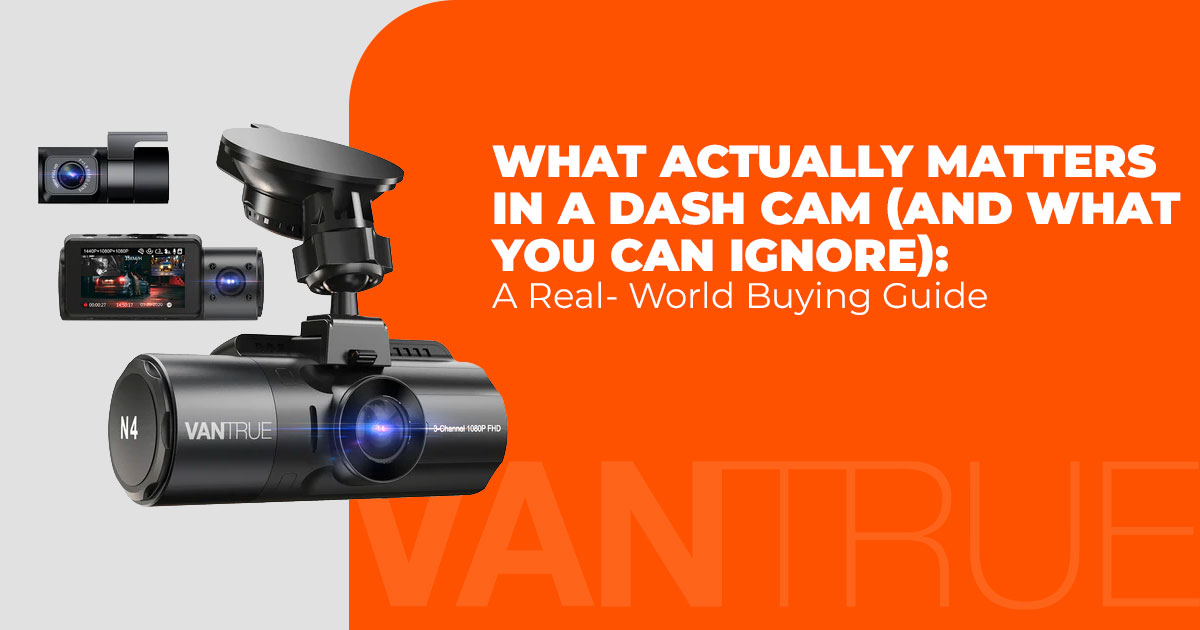
1. Introduction
Most people don’t shop for a dash cam because they’re excited about tech. They shop for one after something stressful happens. A crash at a junction. A car backed into theirs and drove off. An insurance claim where the other driver tells a different story. And in that moment, all the flashy features stop mattering. What matters is whether your camera actually recorded what happened.
If you’ve been browsing dash cams, you’ve probably felt the confusion already. Every model promises 4K video, oversized screens, voice commands, and long feature lists. But when real drivers check their footage after an incident, many find blurry frames, missing clips, or files that won’t open. That’s not a feature problem. That’s a reliability problem.
This guide is about dash cam features that matter in real life. Not what looks impressive on a product page, but what helps when you need clear, reliable footage for an insurance claim or a police report. We focus on dash cam evidence quality, what makes dash cam footage accepted by police, and why many popular specs create more trouble than value.
As technology experts with over 20 years of experience in hardware and application research and development, we examine dash cams the way drivers actually use them—on hot windshields, in traffic, at night, and over long periods of time. Our goal is simple: help you find a dash cam that makes sense for your driving routine, whether that’s daily commuting, highway travel, ride-share work, or keeping your car protected while parked. Our recommendations are based on real-world performance, durability, usability, and value for money, not trends or hype.
User reviews matter here more than anywhere else. They show which cameras overheat, which miss key moments, and which ones drivers trust months later. This guide pulls those real experiences together so you know what to look for in a dash cam, and what you can ignore without regret.
1.1 What You’ll Learn From This Guide
- Which dash cam features actually improve evidence quality in accidents and disputes
- Why specs like 4K resolution and large screens often create problems instead of solving them
- How to choose the right setup for city driving, highways, or ride-share use
- Practical guidance on storage, installation, and accessories, many guides skip
- A clear checklist to compare any dash cam without second-guessing
1.2 Why This Guide Matters
Many dash cam reviews just repeat spec sheets or chase what’s popular. That doesn’t help when you’re trying to choose a reliable dash cam for accidents. Insurance companies and police care about clarity, consistency, and context—not extra buttons or flashy apps.
This guide focuses on accident footage recording that holds up during insurance claims and disputes. The goal is to help you spend money once, avoid gimmicks, and end up with a dash cam that actually protects you when things go wrong.
1.3 Key Specifications at a Glance
| Feature | Minimum Acceptable | Recommended for Most Users | Premium Level |
| Resolution | 1080p | 1440p or higher | True 4K with strong sensor |
| Field of View | 130° | 140°–160° | 170° with controlled
distortion |
| Night Performance |
Basic HDR |
Strong low-light sensor | Advanced HDR with refined night
processing |
| Channels | Front only | Front + rear | Front + rear + interior |
| Parking Mode | Basic motion
detection |
Hardwired impact +
motion |
Buffered recording or
time-lapse |
| Storage Support | 64GB standard | 128–256GB high-
endurance |
Up to 512GB high- endurance |
| G-Sensor | Basic file locking | Adjustable sensitivity | Multi-axis detection +
manual lock |
1.4 Why Most Dash Cam Specs Don’t Matter in Real Life
The dash cam market is crowded with big promises. Many budget models load up on features to look impressive online, but struggle once they’re mounted on a windshield. Heat causes shutdowns. Frames drop during sudden braking. Night footage turns into noise.
When an accident happens, insurance companies and police don’t care about voice control or mobile apps. They care about whether the footage shows the license plate, traffic signal, lane position, and sequence of events. That’s why this guide focuses on dash cam evidence quality, not just feature lists.
And once you understand that, choosing the right dash cam becomes much simpler.
Summary
Ignore feature overload. Focus on clear video, wide coverage, reliable loop recording, G-Sensor protection, strong night performance, and high-endurance storage. Those are the features that matter for insurance claims, police reports, and everyday driving. Everything else is optional.
2. What Actually Matters in a Dash Cam: The Non-Negotiables That Protect You
Most dash cams look impressive until you need them. The difference between useful footage and a useless clip usually comes down to a few core features. These are the dash cam features that matter when you’re dealing with accident footage recording, insurance questions, or a police report. If a camera gets these wrong, the rest doesn’t matter.
2.1 Dash Cam Video Quality: 1080p Is the Floor, Not the Goal
(dash cam video quality, best dash cam for clear license plates)
Dash cam video quality decides everything. If the footage can’t show what happened, nothing else saves it. 1080p is the minimum you should accept. It gives basic license plate readability in good daylight.
But when the lighting is poor, or you need to zoom in, 1440p makes a clear difference. Many drivers ask is 1080p enough for a dash cam. It works, but it leaves little room for error. True 4K dash cams only help when the sensor and cooling are good enough to support them.
What really matters is the image sensor. A strong sensor handles glare, shadows, and sudden lighting changes better than higher resolution alone. That’s what separates watchable video from footage you can actually rely on.
2.2 Wide Angle Dash Cam Field of View: Coverage Beats Zoom
(wide angle dash cam, dash cam ffeld of view)
Accidents rarely stay in front of your bumper. A wide angle dash cam with a dash cam field of view between 140° and 160° captures side lanes, intersections, and nearby traffic without bending the image.
A narrow view misses context. An overly wide view distorts details like plates and road markings. For daily driving, this range gives the best balance of coverage and clarity.
This matters most in city traffic, where side impacts and lane changes cause most disputes.
2.3 Loop Recording Dash Cam Systems: The Feature That Keeps Recording
(loop recording dash cam, continuous loop recording system)
A loop recording dash cam keeps recording by overwriting old files once the card fills up. When it works right, you never have to think about storage limits.
Cheap continuous loop recording systems often fail during overwrites. Files corrupt. Frames drop. The camera freezes without warning. That’s how drivers discover their dash cam stopped recording long before an accident.
Reliable loop recording means the camera stays on, day after day.
2.4 Dash Cam G-Sensor and Impact Detection: Evidence That Stays Protected
(dash cam G-Sensor, impact detection dash cam)
The dash cam G-Sensor protects important footage. When it senses a sudden stop or impact, it locks the file so loop recording can’t overwrite it.
Sensitivity matters. Set it too high and minor bumps lock too many clips. Set it too low and real accidents go unprotected. Many drivers look up how the dash cam G-Sensor works because it decides whether the footage survives.
A properly tuned G-Sensor turns a recording into usable evidence.
2.5 Night Vision Dash Cam Performance and HDR: Where Many Cameras Fall Short
(night vision dash cam, low light dash cam recording)
Many accidents happen after dark. That makes night vision dash cam performance critical. Good
low-light dash cam recording depends on the sensor and HDR tuning, not infrared lights.
Strong HDR balances headlights, streetlights, and shadows so faces and plates remain visible. Infrared LEDs on budget models often reflect off the windshield and reduce clarity.
If you drive early mornings or late nights, this feature matters more than resolution numbers.
2.6 Dash Cam Storage Reliability: The Weakest Link
(dash cam storage reliability, high endurance microSD card for dash cam)
Storage failures ruin more dash cam footage than bad cameras. Regular memory cards wear out under heat and constant rewriting. Most dash cam storage corruption issues trace back to the wrong card.
A high-endurance microSD card for dash cam use is built for nonstop recording. For most drivers,
128GB or 256GB high-endurance cards offer the best balance of lifespan and capacity. Without reliable storage, even a good camera becomes unreliable.
2.7 Parking Mode Dash Cam Protection: Coverage When You’re Not Around
(parking mode dash cam, dash cam that records while parked overnight)
Many drivers discover damage after returning to a parked car. A solid parking mode dash cam records those moments when no one is inside the vehicle.
Once the engine turns off, a properly installed camera switches to parking mode using a dash cam with a hardwire kit or OBD power adapter. Good kits include voltage protection to prevent battery drain.
Common parking mode options include:
- Impact detection using the dash cam G-Sensor
- Motion detection when something moves in front of the camera
- Time-lapse recording to save space
- Buffered recording that saves moments before the trigger
The most useful setups combine impact and motion with buffering. This shows what led up to the incident, not just the result.
Drivers who benefit most from a best dash cam for parking mode setup include city commuters, apartment residents, ride-share drivers between trips, and anyone parking in busy areas.
Hardwiring unlocks a dash cam that records while parked overnight and is worth the one-time setup.
3. What You Can Safely Ignore in a Dash Cam
Not every feature improves safety or evidence. These specs often look helpful but rarely change the outcome.
3.1 4K Dash Cam as a Required Feature
Many people ask whether a 4K dash cam is worth it. Often, the answer is no. Poor 4K implementations overheat, use storage quickly, and can look worse than solid 1440p dash cam footage.
4K only makes sense when the sensor and thermal design support it.
3.2 Large Touchscreens on Dash Cams
Large screens limit mounting options and add distraction. Reviewing footage works better on a phone or computer.
3.3 Wi-Fi, Voice Control, and App Extras
These features add convenience but don’t improve road incident evidence camera quality. They don’t affect clarity or reliability.
Recording comes first.
3.4 Cheap Multi-Channel Dash Cam Systems
Low-cost dual or triple camera systems often use weak rear or interior cameras. Blurry extra angles add little value.
One clear front view beats several poor ones.
Once these points are clear, choosing a dash cam becomes simpler. Focus on evidence quality, reliability, and features that protect footage, and ignore the rest.
4. How to Choose the Right Dash Cam for Your Needs
Most drivers don’t need “the best dash cam.” They need the right dash cam for how they actually drive. Vantrue’s lineup works well here because each model is built around a clear use case, not just stacked features.
Instead of comparing specs line by line, start with your driving routine. Then choose the model that fits it cleanly.
4.1 Best Dash Cam for Daily Commuters and City Drivers
(best Vantrue dash cam for city driving, night vision dash cam)
If you drive in traffic, deal with tight parking, and spend time on city streets, reliability matters more than complexity.
Choose this setup if:
- You drive short to medium distances every day
- You park on the street or in shared parking
- You want something compact that doesn’t block your view
For this use case, a single-channel or basic dual-channel dash cam is enough. What matters is stable loop recording, strong night vision dash cam performance, and heat tolerance.
Good Vantrue fits:
- Vantrue E1 – Simple, compact, Ideal if you want a front camera that just works.(US | India)
- Vantrue E2 – Adds rear coverage without adding Good choice if rear-end bumps or parking issues are common. (US | India)
Skip this if:
- You drive long highways daily
- You need interior or multi-angle coverage
What we’d pick: For city driving, we would choose the Vantrue E2. Front and rear coverage solves most problems without overthinking it.
–− Next step: If city driving is your main use, shortlist Vantrue E1 or E2 and focus on night clarity and reliability, not screen size.
4.2 Best Dash Cam for Highway Drivers and Ride-Share
(best Vantrue dash cam for ride sharing, dash cam with GPS)
Highway driving and ride-share work increase both speed and responsibility. You need coverage and context, not guesswork.
Choose this setup if:
- You drive long distances or highways
- You want speed and location data for disputes
- You carry passengers
Here, a wide angle dash cam, GPS, and a reliable dash cam G-Sensor are essential. Dual-channel recording should be the minimum. In some regions, interior cameras may also be required by ride-share platform rules or local regulations.
Good Vantrue fits:
- Vantrue S1 – Balanced option with front and rear coverage, strong build quality, and dependable performance. (US | India)
- Vantrue M3 – Designed with professional drivers in mind, offering clearer footage and better low-light handling. (Read more)
Skip this if:
- You mostly drive short city routes
- You don’t need rear coverage
What we’d pick: For ride-share or highway use, the Vantrue M3 makes sense. It focuses on footage quality and reliability where it counts.
–− Next step: If you drive highways or passengers, look at Vantrue S1 or M3 and prioritize GPS and rear clarity.
4.3 Best Vantrue Dash Cam for Maximum Evidence and Full Coverage
(best Vantrue dash cam for accident evidence, parking mode dash cam)
If your goal is proof—clear, complete, and defensible—this is where Vantrue’s higher-end models shine.
Choose this setup if:
- You park in busy or high-risk areas
- You want protection while driving and parked
- You want full documentation, not partial clips
This setup should include multi-channel recording, high resolution on all cameras, and a proper parking mode dash cam with buffering. Hardwiring is not optional here.
Good Vantrue fits:
- Vantrue N4 Pro – Triple-channel coverage with strong front detail and solid night performance. (US | India)
- Vantrue N5 – Flagship option with advanced sensors, better processing, and the most complete evidence coverage in the lineup. (US | India)
Skip this if:
- You park in a private garage
- You want the simplest install possible
What we’d pick: If we wanted the strongest evidence possible, we would go for the Vantrue N5 with a hardwire kit. It removes doubt in both driving and parking situations.
–− Next step: If full coverage matters to you, focus on Vantrue N4 Pro or N5, and plan for hardwire installation.
Quick Vantrue Model Match (At a Glance)
- City commuting, simple setup: Vantrue E1
- City driving with rear coverage: Vantrue E2
- Highway driving or ride-share: Vantrue S1, M3
- Maximum evidence and parking protection: Vantrue N4 Pro, N5
Bottom Line
Don’t choose a dash cam by price or resolution alone. Choose it based on where things are most likely to go wrong for you.
If you match your driving habits to the right Vantrue model, the decision stops being confusing—and starts making sense.
5. Dash Cam Comparison Table: Choose Faster, Not Smarter
| Use Case | Who It’s For | What Actually Matters | Channels | Resolution | Parking Mode |
| Daily City Driving | Short trips, traffic, street
parking |
Night clarity, reliability |
1–2 |
1440p+ |
Optional hardwire |
| Highway / Long
Distance |
Long drives, faster speeds | Wide FOV, GPS,
G-Sensor |
2 |
1440p–4K |
Hardwire recommended |
| Ride-Share | Passenger trips, liability | Rear or interior view, audio | 2–3 | 1440p+ | Hardwire essential |
| Maximum Protection | High-risk
parking, full evidence |
Buffered
parking, all angles |
3–4 |
Highest practical |
Full hardwire |
If your use case matches a row, your decision is already half made.
6. Key Takeaways: What Actually Protects You
- Clear accident footage matters more than long feature lists
- A good sensor and lens matter more than resolution numbers
- A high-endurance microSD card for dash cam use prevents silent failures
- A proper parking mode dash cam setup protects your car when you’re not there
If a dash cam doesn’t do these things well, it’s not worth owning.
7. Final Buying Checklist (Use This Before You Buy)
If a dash cam checks these boxes, it’s a safe choice:
- ⬛ 1080p minimum, ideally 1440p or higher, with a quality sensor
- ⬛ 140°–160° field of view
- ⬛ Reliable loop recording dash cam
- ⬛ Adjustable dash cam G-Sensor
- ⬛ Proven night vision dash cam performance
- ⬛ High endurance microSD card (128GB–256GB)
- ⬛ Dash cam with hardwire kit if parking protection matters
The Straight Answer
If you drive daily in the city, buy a simple, reliable dash cam with strong night clarity.
If you drive highways or carry passengers, choose dual-channel with GPS.
If you want real protection when parked, hardwire a multi-channel system with buffered parking mode.
Ignore hype. Choose based on how you actually drive.
If you’re still unsure, pick the option that removes the most doubt—that’s usually the right one.
8. Frequently Asked Questions
Before choosing a dash cam, most drivers have the same set of practical questions. These answers focus on real use, not theory, and address what people usually want to know before they decide. This section also helps clarify common doubts around dash cam evidence quality, insurance claims, and everyday reliability.
Q. Do dash cams really help with insurance claims?
- Yes. Clear insurance claim dash cam footage often speeds up the claims process and reduces disputes. When the video clearly shows lane position, signals, and impact, insurers can determine fault faster and with less back-and-forth.
Q. Does a dash cam record well at night?
- A good night vision dash cam records well in low light, but the quality varies. Models with strong sensors and proper HDR handle headlights and streetlights better. Cheap cameras often struggle with glare and noise, which makes footage less useful.
Q. Do dash cams work when the car is parked?
- Only if the camera has a proper parking mode dash cam setup. Most systems require a hardwire kit or OBD power source to stay active after the engine is off. Without that, the recording usually stops when the car is parked.
Q. Is a 4K dash cam worth it?
- Usually no. Many drivers find that a well-built 1440p dash cam delivers more reliable footage than poorly implemented 4K. Higher resolution only helps when the sensor, cooling, and storage are all strong enough to support it.
Q. What features actually matter in a dash cam?
- Focus on clear dash cam video quality, reliable loop recording, a properly tuned dash cam G- Sensor, strong night performance, a wide but undistorted field of view, and high endurance storage. These features affect evidence quality far more than screens, apps, or extra controls.
9. Conclusion
A dash cam is one of those things you hope you never need—but when you do, it can save you a lot of stress. The right one doesn’t need a long feature list. It just needs to record clearly, work every day, and keep footage safe when something goes wrong.
If you’ve made it this far, you already know what to look for: clear video, reliable recording, strong night performance, and a setup that fits how you actually drive. Once those basics are covered, the decision gets much easier.
And if you’re still unsure, that’s okay. Share your experience in the comments—what setup you’re using now, where you drive, or what worries you most. If a dash cam has helped you before, others will want to hear it. If you’re choosing for the ffrst time, we’re happy to help point you in the right direction.
***Disclaimer***
This blog post reflects our own research, testing, and personal opinions. It should not be taken as the official position of any brand, manufacturer, or company mentioned here. While we aim to keep information accurate and up to date, product details, pricing, and availability can change. We recommend double-checking important details before making a purchase.
Some links in this article may be affiliate links. If you choose to buy through these links, we may earn a small commission at no extra cost to you. This helps support our work and allows us to keep publishing in-depth, unbiased reviews. Our recommendations are never influenced by affiliate partnerships.
Comments shared by readers reflect their own views and not ours. We are not responsible for outcomes resulting from the use of information on this site. Please seek professional advice where appropriate.
All product names, logos, and brands mentioned are the property of their respective owners. These names are used for identification and informational purposes only and do not imply endorsement.