
Accidents don’t end when the cars stop moving. They drag on through phone calls, forms, and arguments about who did what. When stories don’t line up, police dash cam evidence and dash cam footage for insurance claims often decide the outcome. Clear video can close a case fast. Weak footage gets ignored.
And that’s the problem. Officers and insurance adjuster dash cam review teams see blurry clips, missing seconds, and edited files every day. When footage looks unreliable, it’s set aside—even when the fault seems obvious.
This guide explains what police look for in dash cam footage and how insurance companies use dash cam footage when deciding liability. It’s built from real claim outcomes, driver experiences, and cases where video either settled disputes or failed to help. The goal is simple: show what actually holds up and what doesn’t.
As technology experts with over 20 years of experience in hardware and application research and development, we evaluate products and evidence standards based on real-world performance, durability, and value for money. This guide is written for everyday drivers—daily commuters, highway travelers, rideshare drivers, and families—who want dash cam footage legal validity, not just another gadget. Our recommendations come from extensive research, component analysis, real-world usability, and industry expertise.
Here’s the part most guides skip: not all dash cam footage is treated the same, even when it clearly shows the crash.
Quick Summary
Police and insurance adjusters rely on clear, timestamped, continuous dash cam footage that shows the full sequence—what happened before the crash, the impact, and what followed. They look for readable resolution, multiple angles, original unedited files, and accurate metadata.
Poor quality, missing footage, or altered clips rarely help, even when the driver is not at fault.
1. Introduction: Why Dash Cam Footage Matters More Than Ever for Insurance Claims
Most crashes come down to conflicting accounts. Stress clouds memory. Witnesses miss details. Police reports capture only part of the picture. That’s where dash cam evidence standards matter.
Reliable video provides something statements cannot: a neutral record of vehicle position, speed, traffic signals, and the exact moment of impact. When dash cam footage admissibility checks out, doubt fades.
Many drivers see this firsthand. A rear-end collision can be resolved quickly when rear dash cam footage shows the other vehicle never slowed. Claims move faster. Payouts follow. But there are just as many cases where dash cam footage for accident claims is dismissed because the video skips seconds before impact, looks grainy, or appears altered.
For anyone asking what police check in dash cam video evidence or whether dash cam footage helps insurance claims, the answer is simple: they want proof that stands on its own.
2. What You’ll Learn From This Guide
- The four standards used to accept or reject dash cam footage admissibility
- Common mistakes that weaken dash cam footage for insurance adjusters
- Features that strengthen dash cam footage as liability proof
- Camera setups that work best for city traffic, highways, and rear-end disputes
- Clear steps for how to submit dash cam footage to insurance without risking rejection
3. Why This Guide Is Essential
Most articles focus on features. This one focuses on outcomes.
Here, we break down dash cam evidence standards, dash cam footage legal requirements, and chain of custody for video evidence based on what happens after a crash—not before one. You’ll see why raw dash cam footage, continuous dash cam recording, and untouched metadata matter more than brand names or specs.
Because when a claim is on the line, the difference between a smooth payout and a denial often comes down to trust. And trust comes from footage that holds up when it matters.
4. Technical Specifications at a Glance: Features That Matter for Dash Cam Evidence
| Feature | Why It Helps Evidence | Recommended Level | Who Benefits Most |
| Resolution | Clear plates, signs, and vehicle details | 4K front, at least 1080p rear/interior | All drivers, especially highway commuters |
| Channels/Angles | Full context—no blind spots | At least front + rear; 3- or 4-channel ideal | City drivers, rideshare, fleet operators |
| GPS & Timestamp | Proves exact time, speed, and location | Built-in GPS with overlays | Anyone facing disputed fault claims |
| Night Recording | Readable footage in low light | Advanced low-light sensors | Night-shift workers, late commuters |
| G-Sensor & Emergency Lock | Protects files from being overwritten | Auto-lock on impact | Everyone—prevents accidental loss |
| Pre-Event Buffer | Captures seconds before impact | 10–30 second buffer | Drivers in heavy traffic |
| File Protection | Keeps original metadata intact | Locked raw files, no forced compression | Anyone submitting to the police or insurance |
5. Why Dash Cam Footage Carries More Weight Than Eyewitness Testimony
People remember accidents differently under pressure. Details change. Timelines blur. Video does not. That’s why police use of dash cam footage and insurance adjuster dash cam review teams treat video as objective evidence when sorting out fault.
In real claims, this difference decides outcomes. One driver was accused of sudden braking in a rear-end crash. Their dash cam proof for a rear-end collision showed steady speed, normal traffic flow, and a clear impact from behind. The claim closed in days, with zero fault assigned.
The opposite happens just as often. Low-quality or incomplete dash cam footage rarely helps. Adjusters do not clean up or enhance clips. If dash cam footage for insurance claims does not clearly show what happened, it adds no value.
That’s why video matters more than opinions when responsibility is disputed.
6. Evidence Standard #1: Timestamps and Metadata Accuracy in Dash Cam Footage
Before watching the video itself, authorities check the data behind it. Timestamp accuracy in dash cam footage and GPS metadata in dash cam video are treated as the foundation of credibility.
6.1 What Authorities Always Verify
- Exact date and time matching police reports
- GPS speed and location data consistency
- Untouched original file metadata, including creation details
6.2 What Strong Dash Cam Evidence Includes
- Automatic time synchronization after power loss
- Visible GPS and speed overlays
- Locked, unedited raw files
6.3 Dash Cam Models Known for Reliable Metadata
| Model | Key Evidence Strengths |
| N4 Pro | 4K front recording, GPS speed and location overlays, locked raw files |
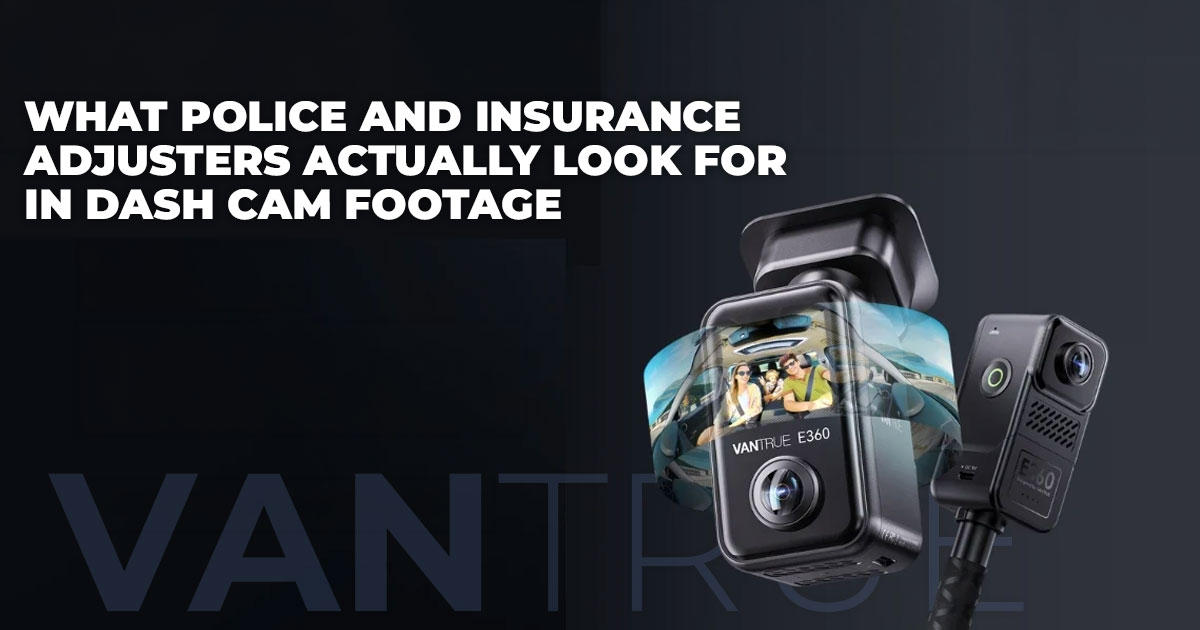
| E360 | Panoramic recording with preserved metadata integrity |
| N5 | Four-channel capture with consistent metadata across files |
Even a small mismatch in time can weaken dash cam footage legal validity and raise doubts during review.
7. Evidence Standard #2: Dash Cam Camera Angles and Coverage for Full Context
Context decides fault. Police and insurers want one continuous view of what happened before the crash, the impact, and what followed.
Most reviewers expect 10–30 seconds of pre-event recording to understand speed, lane position, and driver intent.
7.1 Where Single-Channel Cameras Often Fall Short
- Rear-end collisions without rear footage
- Lane-change accidents missing side views
- Situations where the other vehicle’s position cannot be confirmed
7.2 Multi-Channel Dash Cam Setups That Hold Up
| Driving Situation | Recommended Setup | Why It Helps |
| Daily city driving | Front + rear + interior (N4 Pro) | Covers sudden stops and
sideswipes |
| Full surround coverage | 360° panoramic (E360) | Removes blind-spot disputes |
| Rideshare or taxi use | Interior plus front and rear (N2
Pro) |
Protects against passenger
claims |
| Fleet or commercial use | Four-channel system (N5) | Complete records for business vehicles |
When camera angles and coverage are incomplete, adjusters often split liability due to uncertainty.
8. Evidence Standard #3: Dash Cam Clarity and Resolution for Admissibility
If details cannot be read clearly, dash cam footage admissibility suffers.
8.1 Basic Expectations for Evidence
- 1080p resolution as a baseline
- 4K front recording for license plates and road signs
- Clean night footage without heavy grain
8.2 Common Issues That Reduce Credibility
- Motion blur from low frame rates
- Windshield glare washing out details
- Over-processed video that distorts numbers
8.3 Dash Cam Models Known for Clear Footage
| Condition | Best-Fit Model |
| Daytime plate and sign clarity | N4 Pro (4K front with high dynamic range) |
| Night driving | Models with strong low-light sensors |
| Low-light intersections | N5, consistent clarity across all channels |
Low-quality memory cards often cause dropped frames and gaps, something reviewers notice during dash cam video accident investigations.
9. Evidence Standard #4: Continuity and Chain of Custody for Video Evidence
Even clear footage can fail if continuity breaks. Chain of custody for video evidence protects the recording from capture to submission.
9.1 What Strong Chain of Custody Requires
- One unbroken recording from start to finish
- Automatic file locking during impact
- No edits, trims, or filters
9.2 Common Reasons Footage Gets Rejected
- Missing seconds before impact
- Overwritten loop recordings
- Compressed or re-encoded shared files
9.3 Features That Protect Dash Cam File Integrity
- G-sensor emergency lock
- Protected folders during loop recording
- Buffered pre-event recording that captures the lead-up
Authorities expect continuous dash cam recording. Any gap can raise questions, even when the footage looks clear.
10. What Makes Dash Cam Footage Useless—Even When You’re Not at Fault
Being in the right does not always mean winning a claim. Dash cam footage gets rejected more often than drivers expect, even when it clearly shows the crash.
The most common problems are simple:
- The camera is aimed too high or too low, missing the road or impact
- Interior audio is recorded illegally in two-party consent states
- Footage is manually trimmed or edited to save storage
- Power is lost during impact, cutting the recording
- Only compressed copies are shared instead of the original file
Even a strong video can lose its value if it breaks privacy rules or fails to capture the moments before the crash. Authorities expect context. Without a pre-event recording buffer, the footage often raises more questions than it answers.
11. Matching Dash Cam Setups to Real-World Driving Needs
Not all driving looks the same, and neither do accident claims. Choosing the right setup matters as much as the camera itself.
Different driving situations create different risks. Urban traffic brings sudden stops and sideswipes. Highways bring blind-spot disputes. Rideshare work adds passenger-related claims. Commercial driving demands full documentation.
Here’s how common setups match real claims:
| Driving Scenario | Recommended Model | Why It Fits Real Claims | Target Audience |
| Busy city commuting |
N4 Pro |
Triple-channel coverage captures
urban surprises |
Daily drivers in heavy traffic |
| Highway long- distance driving |
E360 |
Full surround view removes blind-spot
disputes |
Frequent highway travelers |
| Rideshare or taxi work |
N2 Pro |
Interior footage supports passenger
issues |
Rideshare and taxi drivers |
| Fleet or commercial use | N5 | Four channels document every angle | Delivery and business fleets |
When coverage matches the risk, claims move faster and shared fault becomes less likely.
12. How to Submit Dash Cam Footage to Insurance or Police the Right Way
Good footage can still fail if it’s handled poorly. How the file is submitted often matters as much as what it shows.
Authorities expect a clear process:
- Remove the memory card and copy the original file to a computer
- Do not rename or edit the file in any way
- Upload it directly through the insurer’s claim portal or send it through an official police email
- Keep a separate backup for your own records
- Avoid screen recordings, messaging apps, or shared previews unless they are requested
Original files preserve timestamps, location data, and file history. That’s what police and insurers rely on when deciding whether footage can be trusted.
13. Final Verdict: Choosing the Right Dash Cam Setup That Actually Holds Up in a Claim
Dash cams don’t protect drivers on their own. Usable evidence does. The right setup is the one that records the full story, keeps files intact, and removes doubt when police or insurance companies review a claim.
For most drivers, a front-only camera is no longer enough. It may capture the impact, but it often misses what caused it. Claims get delayed or split when angles are missing or the context is unclear.
13.1 Who Should Choose a Front + Rear Setup
If daily driving happens in heavy traffic, intersections, or tight lanes, front and rear coverage makes the difference. It shows the following distance, braking behavior, and impact direction. This setup works best for everyday commuters who want protection without complexity.
13.2 Who Benefits From 360° Coverage
Drivers who spend long hours on highways face blind-spot disputes more than direct collisions. A 360-degree setup removes guesswork by showing vehicle position from every angle. It’s a strong choice for frequent highway travel where lane changes and merges often lead to shared fault decisions.
13.3 Who Needs Interior Recording
Rideshare and taxi drivers deal with more than traffic. Passenger behavior, door openings, and in-car disputes matter. Interior plus front and rear recording provides context that protects both the driver and the claim.
13.4 Who Should Use Multi-Channel Systems
Commercial and fleet drivers carry a higher risk and higher stakes. A four-channel setup documents every side of the vehicle and supports clear reporting for insurance, employers, and regulators. For business use, anything less often leaves gaps.
13.5 What Matters More Than the Model
No matter the setup, evidence holds up only when it meets the basics:
- Accurate timestamps and metadata
- Clear video in daylight and at night
- Continuous recording with pre-event buffer
- Locked, unedited original files
When those pieces are in place, claims move faster, disputes fade, and responsibility becomes clear.
The right dash cam setup isn’t about features. It’s about whether the footage can stand on its own when it matters most.
14. Clearing Common Doubts About Dash Cam Footage for Police and Insurance Claims
Before filing a claim or sharing footage, most drivers have the same questions. This section clears up the most searched doubts about dash cam footage admissibility, insurance claim value, and evidence standards. The answers below reflect how police officers, courts, and insurance adjusters actually review dash cam video—not theory, not marketing.
Q. Is dash cam footage admissible in court?
- Yes. Dash cam footage is admissible in court when it is authentic, relevant to the incident, and follows proper chain of custody for video evidence. Courts and police regularly accept footage that is unedited, clearly dated, and supported by intact metadata.
Q. Does dash cam footage help insurance claims?
- Yes. Dash cam footage helps insurance claims by reducing disputes and speeding up fault decisions. Clear video often leads to faster settlements, especially in rear-end collisions, lane- change accidents, and disputed intersections.
Q. How do insurance adjusters verify dash cam footage?
- During an insurance adjuster dash cam review, adjusters check timestamps, GPS metadata, recording continuity, and visual clarity. They compare the footage against police reports, damage patterns, and statements to confirm consistency.
Q. What makes dash cam footage invalid?
- Dash cam footage becomes invalid when it has gaps, signs of editing, missing pre-event context, or corrupted metadata. Footage shared as compressed clips or screen recordings is also often rejected.
15. Frequently Asked Questions About Dash Cam Footage for Police and Insurance Claims
This FAQ section answers the most common search questions drivers ask after an accident. These responses reflect how police officers and insurance adjusters actually evaluate dash cam footage, helping readers understand what works, what fails, and why.
Q. What do police check in dash cam video evidence?
- Police focus on timestamps, camera angles, video clarity, and whether the footage is original and continuous. They look for a clear sequence showing what happened before, during, and after the crash, without gaps or edits.
Q. How to make dash cam footage legally valid?
- To ensure dash cam footage legal validity, use auto-synced timestamps, GPS overlays, emergency file locking, and submit the untouched original file. Any edits or missing metadata can weaken credibility.
Q. What are the common reasons dash cam footage is rejected?
- The most common reasons include missing pre-impact seconds, poor resolution, edited clips, and overwritten recordings. Lack of context often causes authorities to dismiss otherwise useful footage.
Q. Does edited dash cam footage get rejected by insurance?
- Yes. Edited dash cam footage is almost always rejected because any trimming or alteration breaks the chain of custody for video evidence, making the file unreliable.
Q. Is a 4K dash cam worth it for insurance claims?
- Yes. A 4K dash cam improves the ability to read license plates, road signs, and lane markings, especially at a distance. This clarity often strengthens claim outcomes.
Q. Do police require rear dash cam footage?
- Rear footage is not required, but it strongly helps in rear-end collisions and lane-change disputes. Without it, fault is more likely to be shared.
Q. Why did insurance reject my dash cam footage?
- Insurance companies usually reject footage due to clarity problems, recording gaps, timestamp errors, or signs of editing. Compressed or screen-recorded files are also common issues.
Q. Front vs dual-channel dash cam evidence—which is better?
- Dual or multi-channel dash cam setups almost always provide stronger evidence than front- only cameras. Multiple angles give full context and reduce doubt during claim reviews.
16. Final Verdict: Reliable Evidence Protects You Better Than Any Camera Alone
A dash cam matters only if the footage holds up when it’s reviewed. The strongest protection comes from recordings with accurate time, clear views, continuous capture, and untouched original files. When those basics are in place, arguments fade, and decisions become straightforward.
Cameras don’t settle claims. Usable evidence does.
Before choosing a setup, it helps to think through how and where you actually drive.
16.1 Before You Buy: 5 Practical Questions to Ask Yourself
- Do your daily drives call for rear or interior coverage?
- How often do you drive at night or in low light?
- Would full surround or multi-channel recording remove doubt in a crash?
- Is parking mode or buffered recording useful where you usually park?
- Will this setup produce footage that police and insurance adjusters will accept without hesitation?
If you’re ready to choose a setup that ffts real-world claims, these options are known for consistent, claim-ready footage:
- Explore N4 Pro 3-Channel 4K Dash Cam, US | India
- Explore N5 4-Channel Dash Cam, US | India
- Explore E360 Panoramic Dash Cam, US | India
- Explore N2X Dual Dash Cam, well-suited for rideshare US | India
Have you ever used dash cam footage during a claim? Did it speed things up, or did it get questioned? Share your experience in the comments, ask a question, or let us know what you’re unsure about. We read every response and do our best to help.
Drive safe.
***Disclaimer***
This blog post reflects our own research, testing, and personal opinions. It should not be taken as the official position of any brand, manufacturer, or company mentioned here. While we aim to keep information accurate and up to date, product details, pricing, and availability can change. We recommend double-checking important details before making a purchase.
Some links in this article may be affiliate links. If you choose to buy through these links, we may earn a small commission at no extra cost to you. This helps support our work and allows us to keep publishing in-depth, unbiased reviews. Our recommendations are never influenced by affiliate partnerships.
Comments shared by readers reflect their own views and not ours. We are not responsible for outcomes resulting from the use of information on this site. Please seek professional advice where appropriate.
All product names, logos, and brands mentioned are the property of their respective owners. These names are used for identification and informational purposes only and do not imply endorsement.