
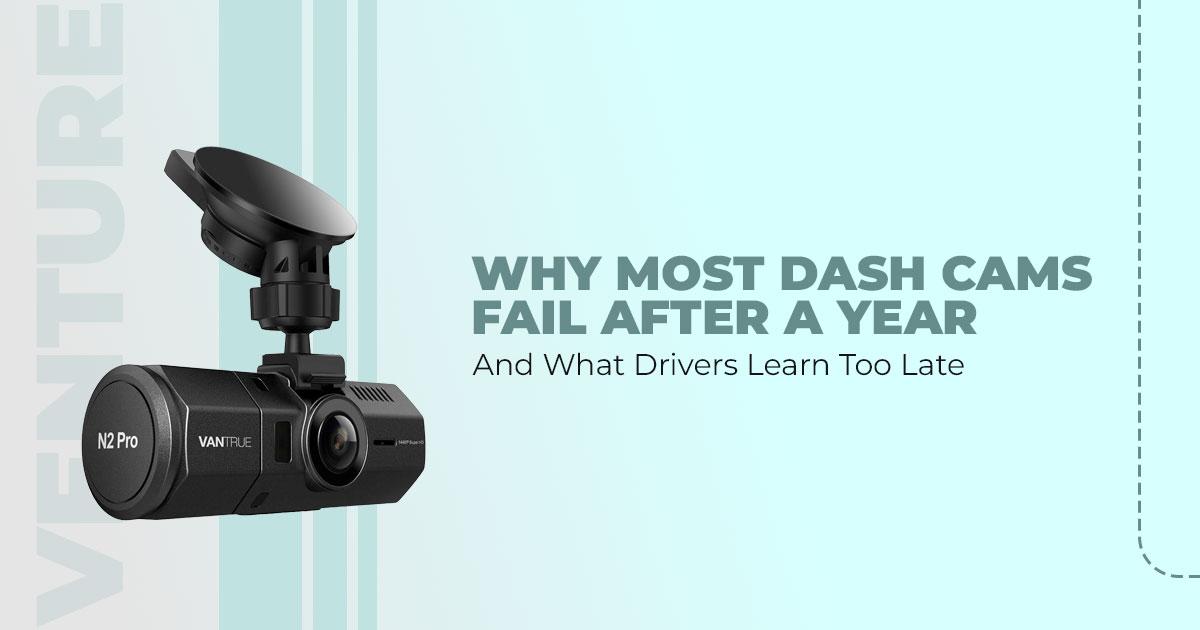
Most dash cam failures don’t show up in the first week. They show up after a year — when the footage you need is missing.
A minor collision. A parking lot scrape. A road rage moment. You go to pull the clip and realize your dash cam stopped recording weeks ago. Or the file is corrupted. Or the camera won’t power on.
That is when dash cam ownership after one year stops feeling like a smart gadget purchase and starts feeling like a hard lesson.
This is not a fresh unboxing take. This is a real dash cam long-term review based on what drivers experience after 12–18 months of daily use.
Click here to buy from Official Vantrue Dash Cam Store
1. The Reality of Long-Term Dash Cam Ownership
A dash cam is sold as a simple safety tool. Mount it, plug it in, and forget about it.
But real life includes:
- Extreme cabin heat
- Continuous loop recording
- Stress on your microSD card
- Voltage fluctuations
- Months of silent overwriting
Over time, small weaknesses turn into real problems. That is where dash cam reliability and dash cam durability matter more than price.
2. What This Guide Covers
Here’s what drivers usually learn the hard way:
- Why do many dash cams stop working after 12–18 months
- How to prevent corrupted dash cam footage
- Whether 1080p is enough for license plates
- Why battery vs supercapacitor dash cam comparison matters in hot climates
- When to follow a proper dash cam upgrade guide
- And when it is perfectly fine to keep your current setup
3. Why Long-Term Reviews Matter More Than First Impressions
Most reviews stop after a few weeks. That does not reveal:
- True dash cam lifespan
- Real dash cam heat resistance
- Long-term parking mode battery drain
- Wear on a high endurance microSD card
- Failure patterns in cheaper battery-powered models
In countries like India, parked cars can reach 60°C inside. That is where many battery-based cameras fail.
Drivers often discover this only after searching for:
- “Why do dash cams stop recording?”
- “Dash cam not recording issue. ”
- “Dash cam overheating issue. ”
By then, the footage is already gone.
As technology experts with over 20 years of experience in hardware and application research and development, we analyze each product based on real-world performance, durability, and value for money. Our goal is to help you find the best product in every category—budget, performance, reliability, and long-term usage.
For daily commuters, city drivers, rideshare operators, highway travelers, and anyone who parks outside overnight, our recommendations are based on extensive research, component analysis, real-world usability, and industry expertise.
This review focuses on long-term performance — not marketing promises.
4. What Changes After One Year of Daily Driving
After 12 months, patterns become clear.
4.1 Storage Becomes a Weak Point
Standard memory cards struggle with constant rewriting.
That leads to:
- Missing clips
- Random recording gaps
- Corrupted dash cam footage
A high-endurance microSD card is no longer optional. It is required for stable overwrite recording cycle performance.
4.2 Resolution Limits Show Up in Real Incidents
Drivers often ask: Is 1080p enough for license plates?
In daylight, it may be. At night, under motion, glare, or distance, it often is not.
This is where the 2K vs 4K dash cam difference matters. Higher resolution allows better cropping and clearer plate detail. That is why many upgrades move toward 4K dash cam footage or at least strong 2K recording.
4.3 Battery-Based Models Struggle in Heat
The battery vs supercapacitor dash cam comparison becomes important after summer.
Lithium batteries can swell or fail under constant heat exposure. A supercapacitor dash cam handles extreme temperature swings far better. For drivers in hot regions, this single factor often determines long-term survival.
5. Parking Mode Isn’t Just a Feature — It’s a Risk
Many plug-and-play setups record only while driving.
That means no protection during:
- Hit-and-run incidents
- Parking scratches
- Overnight damage
Proper dash cam parking mode requires a hardwire kit with voltage cut-off protection. Without it, users risk draining their car battery. With it, they gain true overnight security.
5.1 At-a-Glance: Recommended Setup After One Year
| Feature | Recommended Minimum | Why It Matters Long Term |
| Channels | Dual channel dash cam (front + rear) | Captures rear-end collisions and parking incidents |
| Power Source | Supercapacitor dash cam | Resists heat-related failure |
| Front Resolution | 2K or 4K dash cam footage | Improves license plate clarity |
| Storage Support | 256GB compatible | Reduces recording gaps |
| Memory Card | High endurance microSD card | Prevents footage corruption |
| Parking Mode | Hardwired with voltage cut-
off protection |
Safe overnight recording |
| Connectivity | WiFi app support | Faster footage access for insurance claims |
5.2 Signs It Is Time to Upgrade
Consider upgrading if:
- You frequently experience dash cam startup or shutdown problems
- Footage looks grainy at night
- You cannot read plates clearly
- Your camera overheats
- Your SD card fails repeatedly
- You lack rear coverage
Search trends often reflect this stage:
- When to upgrade the dash cam
- signs you need a new dash cam
- dual vs single channel dash cam comparison
- How long do dash cams last
5.3 When You Can Keep Your Current Dash Cam
An upgrade may not be necessary if your system includes:
- Dual channel dash cam setup
- Stable supercapacitor power
- Clear night recording
- 128GB–256GB storage support
- Proper hardwired parking mode
- Regular dash cam firmware updates
If it records reliably and the footage is clear, there is no need to replace it.
5.4 The Bigger Lesson After One Year
The first week of ownership is about features. The first year is about performance under stress.
After 12 months, drivers stop asking which model looks impressive. They start asking whether it works when needed.
A dependable in-car camera system should quietly handle heat, vibration, storage wear, and night driving without constant attention.
That is what defines true dash cam reliability. Overall Summary
After one year, most dash cam ownership experience changes.
Common long-term issues:
- Dash cam not recording issue
- Corrupted dash cam footage
- Weak night clarity
- Overheated battery models
- Failing standard memory cards
What works long term:
- Dual channel dash cam
- Supercapacitor power
- 2K or 4K dash cam footage
- High endurance microSD card
- Hardwired parking mode with voltage cut-off protection
- WiFi app support
A dash cam proves its value on the day something goes wrong. Everything else is secondary.
6. Dash Cam After One Year: Long-Term Reliability, Heat Damage, and Real Failure Signs
After 12–18 months of daily use, many drivers begin searching “How long do dash cams last” or “Why did my dash cam stop recording?” The first year exposes weaknesses that short reviews never show.
6.1 Does a Dash Cam Still Work After One Year? (Dash Cam Reliability in Hot Climates)
Many budget units struggle beyond the first year. In regions where cabin temperatures cross 60°C, internal components face daily stress. Continuous loop recording, vibration, and heat cycles slowly reduce dash cam durability.
The biggest risk is heat damage.
Lithium battery models often fail ffrst. Swelling batteries cause:
- Random shutdowns
- Boot loops
- Failure to power on
- Screen stays black despite power
A supercapacitor dash cam handles temperature swings far better. Unlike lithium cells, capacitors do not degrade under repeated high-heat exposure. For drivers in tropical climates, this is the single most important factor in long-term survival.
Silent warning signs of failure:
- Random reboots while driving
- Missing or blank video files
- Repeated “overheat shutdown” alerts
- Camera powers on but records nothing
Daily commuters and rideshare drivers notice these signs quickly because they depend on reliable video evidence for insurance claims.
6.2 Dash Cam Maintenance Guide: How to Prevent Corrupted Footage
Many failures trace back to skipped maintenance. The idea that a dash cam is “install and forget” leads to regret.
Basic care protects your footage:
- Format your high endurance microSD card inside the camera every 3–4 weeks
- Check for dash cam firmware updates every few months
- Play back a short clip monthly to confirm proper recording
Without these steps, even quality models may develop corrupted dash cam footage or silent recording gaps.
6.3 Dash Cam Lifespan: Battery vs Supercapacitor Comparison
| Power Type | Typical Lifespan in a Hot Climate | Common Failure Pattern |
| Lithium Battery | 10–20 months | Swelling, boot failure, shutdowns |
| Supercapacitor Dash Cam | 3–6 years or longer | Rare premature failure |
For drivers researching battery vs supercapacitor dash cam comparison, the difference is clear. Capacitor-based models offer superior dash cam heat resistance and longer operating life.
7. Why SD Cards Fail in Dash Cams: Loop Recording and Storage Limits
Search trends show rising questions like “Why does my dash cam SD card keep failing?” Storage wear is one of the most overlooked issues.
7.1 How Long Does a MicroSD Card Last in a Dash Cam?
Standard memory cards often fail within 6–12 months under constant overwrite recording cycle pressure. Every drive rewrites data repeatedly.
A high endurance microSD card is built for surveillance-level workloads and typically lasts 2–5 years with proper formatting.
Corruption signs include:
- “Card error” warnings
- Missing or frozen video segments
- Constant format prompts
Ignoring these warnings risks losing crucial footage.
7.2 Best SD Card Size for 2K and 4K Dash Cam Footage
Storage size directly affects evidence retention.
| Capacity | Ideal Use Case | Approximate Loop Duration (2K Dual Channel) |
| 64GB | Weekend driving | 4–6 hours |
| 128GB | Daily short city commute | 9–12 hours |
| 256GB | Long commute, highway, rideshare | 18–22 hours |
For 4K dash cam footage, 256GB support is strongly recommended. Higher resolution fills storage quickly.
7.3 How to Prevent Dash Cam Footage Loss
To protect accident proof dash cam footage:
- Format the card inside the device
- Use only reputable high-endurance microSD cards
- Confirm compatibility with your model
- Keep a spare formatted card ready
These habits prevent costly evidence gaps during insurance disputes.
Click here to buy from Official Vantrue Dash Cam Store
8. Front-Only vs Dual Channel Dash Cam: Why Drivers Regret Limited Coverage
After one incident, many drivers search “dual vs single channel dash cam comparison”.
8.1 Are Rear-End Collisions Recorded by Front Cameras?
Rarely with clarity. A front-only camera may show vehicle movement, but it seldom proves fault in rear impacts. Rear-end collisions remain the most common urban accident type.
8.2 Is a Dual Channel Dash Cam Worth It?
For most drivers, yes.
A dual channel dash cam provides:
- Clear rear-impact evidence
- Protection against parking lot damage
- Documentation of road rage incidents from behind
A proper front and rear dash cam system reduces insurance disputes and speeds up claims resolution.
9. Is 1080p Enough for License Plates? 2K vs 4K Dash Cam Difference
Many drivers discover resolution limits only after reviewing footage from a real incident.
9.1 Why Basic 1080p Dash Cams Often Fail
Problems include:
- Motion blur
- Low bitrate compression
- Headlight glare at night
- Limited zoom clarity
This is why searches for “is 1080p enough for license plates” remain common.
9.2 Is 2K or 4K Necessary for Clear License Plate Capture?
For reliable plate readability, yes.
The 2K vs 4K dash cam difference becomes obvious when cropping footage. Higher resolution allows zooming without losing clarity. Modern 4K dash cam models capture more image detail and typically use higher bitrates, improving license plate readability during motion.
10. Why Dash Cams Stop Working in Hot Weather
Heat is the silent failure trigger behind many support complaints.
10.1 Battery vs Supercapacitor Dash Cam Comparison in 60°C Conditions
Lithium batteries degrade quickly above 60°C. Swelling and power instability follow.
A supercapacitor dash cam typically operates up to 85°C without internal damage. For drivers in hot regions, this directly impacts dash cam lifespan.
10.2 Best Dash Cam Technology for Indian Summer Heat
Models designed with supercapacitor power systems, strong internal heat management, and quality components offer better long-term stability in tropical climates.
11. Does Dash Cam Parking Mode Drain Your Car Battery?
Parking surveillance is valuable, but setup determines safety.
11.1 Does Parking Mode Kill Car Batteries?
Continuous recording draws heavy power. Without protection, it can drain the battery overnight. Buffered dash cam parking mode activates only during impact or motion, reducing power draw.
11.2 Should You Use a Dash Cam Hardwire Kit?
Yes, for full protection.
A dash cam hardwire kit with voltage cut-off protection stops recording before the battery voltage drops too low. It enables true overnight recording and protects against hit-and-run incidents.
12. Why Drivers Upgrade Their Dash Cam After One Year
Upgrade searches increase after real frustration.
Common triggers include:
- Persistent boot loops
- Poor license plate clarity
- Grainy night footage
- Storage limitations
- No functional dash cam parking mode
- Repeated SD card removal
Modern models with WiFi app support simplify footage sharing with insurers and eliminate frequent card removal.
13. Best Features to Look for in a Second Dash Cam Purchase
After real-world experience, priorities shift.
13.1 Minimum Requirements for Long-Term Dash Cam Reliability
- Dual channel dash cam coverage
- Supercapacitor power system
- Support for high endurance microSD card up to 256GB+
- At least 2K front resolution (4K preferred)
- Built-in WiFi connectivity and mobile app
- Compatibility with hardwire kit and voltage cut-off protection
These features form the foundation of dependable dash cam ownership after one year.
13.2 Advanced Dash Cam Features Worth Considering
- Sony STARVIS 2 sensor for improved dash cam night vision quality
- Cloud connectivity for remote viewing
- GPS logging for trip verification
- Interior infrared recording for rideshare drivers
These additions enhance documentation quality but should come after core reliability requirements are met.
Summary
After one year, the question is no longer “Which dash cam has the most features?”
The question becomes: Will it record clearly, survive heat, and protect my claim when it matters?
That is what defines true dash cam reliability and long-term value.
14. When to Upgrade Your Dash Cam: Clear Signs vs Normal Wear
Many drivers search “when to upgrade dash cam” or “signs you need a new dash cam” after the first year. Not every issue requires replacement. But some problems signal declining dash cam reliability that should not be ignored.
Upgrade Your Dash Cam If:
- Your camera overheats often and shows repeated shutdown warnings
- License plates are unreadable in both daylight and dash cam night vision quality tests
- You drive daily in dense city traffic where accidents are common
- You park outdoors overnight without a reliable dash cam parking mode
- The device reboots randomly or shows frequent dash cam stopped recording issues
- Storage errors persist even after replacing the high-endurance microSD card
In these situations, upgrading improves video evidence for insurance claims and overall driving protection.
Drivers in heavy urban traffic benefit most from a dual channel dash cam because rear-end incidents are common and fault disputes happen quickly.
Keep Your Current Dash Cam If:
- It already uses a supercapacitor dash cam power system
- It supports 128GB or 256GB high endurance microSD cards
- Footage remains sharp with strong license plate clarity in dash cam footage
- The dash cam hardwire kit with voltage cut-off protection works properly
- There are no overheating or recording failures
If your current system records consistently and survives heat without shutdowns, there is no reason to upgrade just for newer features.
The key factor is stable long-term performance, not novelty.
15. Dash Cam Buyer’s Checklist for Year Two: Long-Term Reliability Essentials
After one full year of real-world use, priorities become practical. This checklist reflects what experienced drivers look for in a dependable setup.
✔ Dual channel dash cam (front + rear coverage)
Provides complete accident documentation and stronger claim protection.
✔ Supercapacitor dash cam (no lithium battery swelling)
Improves dash cam lifespan and withstands high cabin temperatures.
✔ 2K or 4K dash cam front resolution
Enhances license plate clarity and allows cropping without losing detail.
✔ High endurance microSD card support (256GB compatible)
Reduces the risk of corrupted dash cam footage and recording gaps.
✔ Hardwired dash cam parking mode with voltage cut-off protection
Enables safe overnight recording without draining the car battery.
✔ Reliable, heat-resistant mounting system
Prevents camera shake and alignment issues during long drives.
✔ Built-in WiFi with mobile app connectivity
Allows fast footage transfer and easy sharing with insurers.
Final Summary
The second purchase decision is different from the first.
Instead of asking which model looks impressive, experienced drivers ask:
- Does it survive heat?
- Does it protect against rear collisions?
- Does it store footage without corruption?
- Does parking mode work without battery drain?
That shift in focus defines smarter dash cam ownership after one year. Reliability now matters more than features.
Click here to buy from Official Vantrue Dash Cam Store
16. Frequently Asked Questions About Dash Cam Lifespan, Storage, and Upgrades
Before buying or upgrading, most drivers search practical questions like “how long do dash cams last”, “why did my dash cam stop recording”, or “is 1080p enough for license plates”. Below are clear, direct answers based on real-world use in hot climates, daily commuting, and long-term ownership.
Q. How long do dash cams last?
- In hot climates, lithium battery models often fail within 1–2 years due to heat stress. A supercapacitor dash cam typically lasts 4–6 years or longer because it handles high cabin temperatures without battery swelling. If you want stronger dash cam durability, choose a capacitor-based model.
Q. Why do dash cams stop recording?
- The most common reasons are SD card corruption, heat damage, or outdated dash cam firmware updates. Regularly formatting a high-endurance microSD card and checking firmware prevents most dash cam not recording issues.
Q. Do dash cams drain car batteries?
- Only if installed incorrectly. A proper dash cam hardwire kit with voltage cut-off protection keeps dash cam parking mode safe and prevents battery drain. Without voltage protection, continuous recording can discharge the battery overnight.
Q. Is 1080p enough for license plates?
- In controlled daylight, sometimes. In real traffic with motion blur and headlight glare, often not. For reliable license plate clarity in dash cam footage, a 2K or 4K dash cam resolution performs much better, especially at night or highway speeds.
Q. How often should you format a dash cam SD card?
- Every 3–4 weeks for daily drivers. Monthly works for lighter use. Regular formatting protects against corrupted dash cam footage and supports stable loop recording.
Q. Why does my dash cam overheat?
- Cheap internal components and lithium batteries struggle in parked-car heat. A heat- resistant dash cam built with supercapacitor technology is far more reliable in temperatures above 60°C.
Q. What size SD card is best for a 4K dash cam?
- A 256GB high-endurance microSD card is recommended for daily driving. Smaller cards fill quickly with 4K dash cam footage, increasing overwrite cycles and the risk of missing important clips.
Q. Do dash cams work at night?
- Quality models do. Look for cameras with Sony STARVIS sensors for stronger dash cam night vision quality and improved low-light plate readability.
Q. Should I upgrade my dash cam after one year?
- Upgrade if you experience overheating, poor plate clarity, storage failures, or lack of rear coverage. If your dual channel dash cam with supercapacitor power still records clearly and supports large storage, you may not need to replace it.
Q. Is a rear dash cam worth it?
- Yes. Rear-end collisions are common, especially in city traffic. A front and rear dash cam system provides stronger evidence in disputes where a front-only camera cannot clearly show fault.
17. Ready to Move to a Dash Cam That Actually Lasts?
If your camera overheats, misses recordings, or fails to capture clear plates, it may be time to upgrade to something built for long-term dash cam reliability.
After one year, most drivers stop chasing features and start looking for stability — a supercapacitor dash cam, strong 4K front resolution, dependable dual channel dash cam coverage, and proper parking mode with voltage protection.
If that sounds like what you need, start with official sources:
◆ Buy from Official Stores
Vantrue US Official Store
Vantrue India Official Store
Both stores list current 4K dash cam models, front and rear dash cam systems, and heat- resistant builds designed for long-term use.
◆ Use the Right Storage from Day One
A camera is only as reliable as the card inside it. Pair your setup with a high-endurance microSD card made for constant loop recording.
Vantrue Memory Cards – US Store
Vantrue Memory Cards – India Store
Using compatible storage reduces the risk of corrupted dash cam footage and recording gaps.
Upgrading is not about buying the most expensive model. It is about choosing a setup that survives heat, records clearly at night, and protects you when an insurance claim depends on it.
If you already own a dash cam, share your experience below. Which model are you using?
What problems have you faced? What helped solve them?
We read and respond to every comment to help drivers choose a setup that truly lasts.
***Disclaimer***
This blog post reflects our own research, testing, and personal opinions. It should not be taken as the official position of any brand, manufacturer, or company mentioned here. While we aim to keep information accurate and up to date, product details, pricing, and availability can change. We recommend double-checking important details before making a purchase.
Some links in this article may be affiliate links. If you choose to buy through these links, we may earn a small commission at no extra cost to you. This helps support our work and allows us to keep publishing in-depth, unbiased reviews. Our recommendations are never influenced by affiliate partnerships.
Comments shared by readers reflect their own views and not ours. We are not responsible for outcomes resulting from the use of information on this site. Please seek professional advice where appropriate.
All product names, logos, and brands mentioned are the property of their respective owners. These names are used for identification and informational purposes only and do not imply endorsement.