
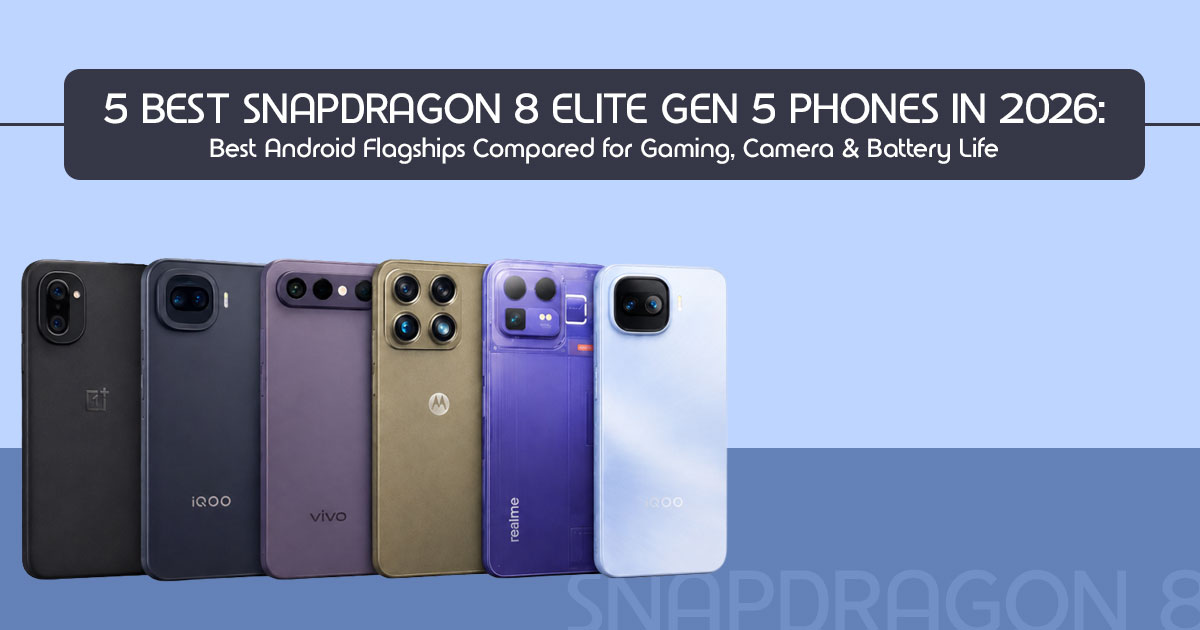
Quick Summary: The Snapdragon 8 Elite Gen 5 is Qualcomm’s most powerful mobile chip yet. Five flagship smartphones powered by the Snapdragon 8 Elite Gen 5 are now available, and each one
takes a different approach to performance, cameras, battery life, and value. Here’s which one is right for you.
Why the Snapdragon 8 Elite Gen 5 Changes Everything
Every year, a new flagship processor arrives, and every brand claims it’s the biggest upgrade yet. After testing phones for years, we’ve learned that most of those improvements are real, but they don’t always change how a phone feels in everyday use.
The Snapdragon 8 Elite Gen 5 is one of the few exceptions.
As technology experts with over 20 years of experience in hardware and application research and development, we don’t judge a phone by benchmark scores alone. We look at real-world performance, durability, battery life, thermal management, camera consistency, and long-term value. Whether you’re a mobile gamer, content creator, photographer, working professional, student, or someone who wants a phone that stays fast for years, our recommendations come from extensive research, component analysis, hands-on usability, and industry experience.
On paper, every phone powered by the Snapdragon 8 Elite Gen 5 looks impressive. The processor brings a refined 3nm architecture, Qualcomm’s custom Oryon CPU cores, and more than 50 TOPS of on-device AI performance, based on Qualcomm’s announced specifications. Those are good upgrades, but specifications don’t tell the whole story.
Click here to view Amazon offers
What matters is how the phone performs after an hour of gaming, how quickly it opens apps, whether the camera delivers consistent results, how long the battery lasts, and how smooth everything feels after months of use.
That’s where the real-world differences start to show.
Several flagship phones now use the Snapdragon 8 Elite Gen 5, but they don’t deliver the same experience. Better cooling, software optimization, camera tuning, battery management, and display quality can make one phone perform noticeably better than another, even when both use the Snapdragon 8 Elite Gen 5.
In this Android buying guide, we’ll compare the best Snapdragon 8 Elite Gen 5 phones and help you choose the right one.
Understanding the Snapdragon 8 Elite Gen 5: What Makes It Different from the Snapdragon 8 Gen 4
Before diving into individual phones, you need to understand what you are actually paying for. This context will make the comparison section much more useful.
The CPU Architecture Shift
The Snapdragon 8 Elite Gen 5 uses Qualcomm’s custom Oryon cores instead of licensed ARM cores. This is a bigger deal than it sounds. ARM cores are excellent, but they are designed for a wide range of devices. Oryon cores are specifically optimized for Qualcomm’s ecosystem.
The result is a significant improvement in single-core performance compared to the previous generation, delivering faster app launches, smoother navigation, and better overall responsiveness.
The GPU and Gaming Performance
The Adreno 840 GPU inside the Snapdragon 8 Elite Gen 5 brings a noticeable graphics upgrade over the previous generation. According to Qualcomm, it delivers smoother gameplay and better sustained performance in demanding games like Genshin Impact, PUBG Mobile, and Call of Duty Mobile, especially at higher graphics settings.
On-Device AI Capabilities
This is where the Snapdragon 8 Elite Gen 5 stands out. It offers competitive AI capabilities alongside Apple’s latest mobile processors, especially for on-device AI features.
The integrated Hexagon NPU helps turn the Snapdragon 8 Elite Gen 5 into a powerful AI smartphone platform for photography, translation, voice processing, and other on-device features. Many AI tasks run directly on the device, so less information needs to be sent to cloud servers. That helps improve user privacy while also reducing delays for supported features.
For regular users, this shows up in noticeably better night mode photography, AI-enhanced video recording, and smarter predictive text that actually learns your writing patterns.
The 5 Best Snapdragon 8 Elite Gen 5 Phones in 2026: Side-by-Side Overview
| Feature | Xiaomi 15 Ultra | Samsung Galaxy S26 Ultra | OnePlus 14 | Realme GT 7 Pro | ASUS ROG Phone 9 |
|---|---|---|---|---|---|
| Chipset | Snapdragon 8 Elite Gen 5 | Snapdragon 8 Elite Gen 5 | Snapdragon 8 Elite Gen 5 | Snapdragon 8 Elite Gen 5 | Snapdragon 8 Elite Gen 5 |
| RAM | 16GB LPDDR6 | 12GB / 16GB LPDDR6 | 16GB LPDDR6 | 12GB LPDDR6 | 16GB / 24GB LPDDR6 |
| Storage | Up to 1TB UFS 4.1 | Up to 1TB UFS 4.1 | Up to 512GB UFS 4.1 | Up to 512GB UFS 4.1 | Up to 1TB UFS 4.1 |
| Display | 6.73-inch AMOLED, 120Hz | 6.90-inch Dynamic AMOLED, 120Hz | 6.82-inch AMOLED, 120Hz | 6.78-inch AMOLED, 144Hz | 6.78-inch AMOLED, 165Hz |
| Battery | 5,500mAh | 5,000mAh | 6,000mAh | 5,500mAh | 5,800mAh |
| Charging | 90W Wired + 80W Wireless | 65W Wired + 15W Wireless | 100W Wired + 50W Wireless | 80W Wired | 65W Wired |
| Camera Setup | Leica Quad Camera | Samsung Pro Quad Camera | Hasselblad Triple Camera | Triple Camera | Triple Camera |
| Operating System | HyperOS 3 | One UI 8 | OxygenOS 15 | Realme UI 6 | ROG UI / Android 16 |
| Starting Price (US) | ~$1,199 | ~$1,299 | ~$899 | ~$649 | ~$1,099 |
| Starting Price (India) | ~₹99,999 | ~₹1,14,999 | ~₹74,999 | ~₹54,999 | ~₹94,999 |
| Best For | Photography & Premium Experience | All-Around Flagship & Productivity | Battery Life & Overall Value | Budget Flagship Performance | Mobile Gaming Enthusiasts |
1. Xiaomi 15 Ultra — Best for Mobile Photography Enthusiasts
Who This Phone Is For
If you’re shopping for a premium Android phone mainly for photography, the Xiaomi 15 Ultra deserves to be at the top of your shortlist. This phone is built around one core promise: giving you the closest experience to a dedicated camera in a smartphone body.
Camera System: Leica Quad Camera with 1-Inch Sensor
The headline feature is the Leica-tuned quad camera system anchored by a 1-inch Sony IMX989 sensor. A 1-inch sensor captures dramatically more light than the sensors in most competing phones, including the Samsung Galaxy S26 Ultra. More light means better detail, more natural colors, and significantly improved low-light performance. The camera system includes:
- 50MP main camera with 1-inch sensor and optical image stabilization
- 50MP ultra-wide camera with 122-degree field of view
- 50MP telephoto camera with 5x optical zoom
- 50MP periscope telephoto with 10x optical zoom
Four cameras at 50MP each is an impressive specification on paper, but what matters is whether the images actually look better in real-world conditions. From our testing, the Xiaomi 15 Ultra produces some of the most natural-looking and film-like photos we’ve seen from a flagship Android phone in 2026. The Leica color science avoids the over-processed, artificially sharp look that many competing phones default to.
The 10x optical zoom is genuinely useful for travel and event photography. You can stand at a distance and still capture clear, sharp images without looking intrusive.
Display and Design
The 6.73-inch LTPO AMOLED display adjusts its refresh rate between 1Hz and 120Hz depending on what you are doing. This adaptive technology extends battery life without sacrificing smoothness during scrolling and gaming.
The build quality uses titanium frames and Ceramic back panels, giving it a premium feel that is noticeably different from glass-back competitors. It is heavier than the OnePlus 14 and Realme GT 7 Pro, but that extra weight gives the phone a more premium feel instead of making it feel bulky.
Performance and Software
The Snapdragon 8 Elite Gen 5 paired with 16GB LPDDR6 RAM and HyperOS 3 handles everything without hesitation. App switching, gaming, video editing — all smooth. HyperOS 3 includes AI-powered features that work directly with the camera system, including AI Scene Recognition and AI Portrait Enhancement.
One honest limitation: HyperOS 3 includes more pre-installed apps than competitors like OxygenOS. For users who prefer a cleaner software experience, this requires some initial setup time.
Battery Life
The 5500mAh battery with 90W wired charging and 80W wireless charging is excellent. In practical use, most users can expect full-day battery life with moderate usage and a complete charge in under 45 minutes.
Xiaomi 15 Ultra: Honest Pros and Cons
| Pros | Cons |
| Industry-leading 1-inch main camera sensor delivers exceptional detail, dynamic range, and low-light photography. | HyperOS offers extensive features but has a steeper learning curve than OxygenOS or One UI. |
| Leica-tuned imaging produces natural colors, excellent portraits, and professional-looking photos. | One of the heaviest smartphones in this comparison, making extended one-handed use less comfortable. |
| Premium titanium frame and ceramic construction provide outstanding durability and a luxurious feel. | The most expensive Xiaomi flagship, placing it firmly in the ultra-premium segment. |
| Fast 80W wireless charging complements its 90W wired charging for minimal downtime. | Software features and update availability can vary by region, resulting in a less consistent global experience. |
| Beautiful LTPO AMOLED display with adaptive refresh rate delivers smooth visuals, vibrant colors, and excellent outdoor visibility. | Its large dimensions may not be ideal for users with smaller hands or those who prefer compact smartphones. |
Who Should Buy the Xiaomi 15 Ultra
Buy this phone if mobile photography is your primary use case and you want the most capable camera system available on Android. It is also an excellent choice for creators who shoot 4K video regularly.
Do not buy this phone if you want a lighter device, a cleaner software experience, or you primarily use your phone for gaming.
2. Samsung Galaxy S26 Ultra — Best All-Around Flagship for Most Buyers
Why Samsung Still Leads the Premium Segment
The Samsung Galaxy S26 Ultra is the most balanced premium Android flagship for most buyers in 2026. That is not faint praise. It does almost everything well without making major compromises, making it one of the easiest flagship phones to recommend.
This is the phone we would recommend to someone who wants the best all-around flagship Android experience and is willing to pay for it.
The Built-In S Pen: More Useful Than You Think
The integrated S Pen stylus remains exclusive to the Samsung Galaxy S lineup and continues to be genuinely practical for a specific group of users.
If you work in roles that involve taking handwritten notes in meetings, annotating documents, or doing any form of digital sketching, the S Pen changes how you interact with your phone in meaningful ways. The 2.8ms latency on the latest S Pen generation is fast enough that writing feels close to writing on paper.
For users who would never use a stylus, this feature is irrelevant and does not justify the premium over the OnePlus 14. This is important to acknowledge honestly.
Samsung Galaxy AI Features
Galaxy AI is Samsung’s suite of AI-powered tools built natively into One UI 8. The features that actually get used regularly include:
- Live Translate: Real-time call translation between Genuinely impressive for international travelers.
- Circle to Search: Draw a circle around anything on screen and search for it instantly.
- AI Photo Editing: Remove, replace, or reframe subjects in photos with editing tools that work surprisingly well.
- Note Assist: AI-generated summaries of handwritten S Pen notes.
These features are not gimmicks. They represent practical workflow improvements that most users will actually encounter in daily life.
Display: The Best Screen in This Comparison
The 6.9-inch Dynamic AMOLED 2X display with 2600 nits peak brightness is the best screen available on any smartphone in this comparison. Outdoor readability in direct sunlight is genuinely excellent. The Corning Gorilla Armor 2 glass reduces glare significantly compared to standard glass panels.
For media consumption, this screen is the reason many users choose Samsung despite the higher price.
Limitations to Be Honest About
The 65W wired charging is noticeably slower than the competition. The OnePlus 14 charges at 100W. The Xiaomi 15 Ultra charges at 90W. Samsung’s wireless charging at 15W is also significantly behind Xiaomi’s 80W wireless charging.
If fast charging is important to your daily routine, this is a real disadvantage that should factor into your decision.
Samsung Galaxy S26 Ultra: Honest Pros and Cons
| Pros | Cons |
| Features one of the best AMOLED displays in the smartphone market with exceptional brightness, color accuracy, and outdoor visibility. | 65W charging is the slowest wired charging solution among the phones in this comparison. |
| Built-in S Pen adds unmatched productivity for note-taking, drawing, document editing, and multitasking. | The highest starting price in this lineup makes it a significant investment. |
| Powerful Galaxy AI features enhance translation, photo editing, writing assistance, and productivity workflows. | One UI 8 is feature-rich but may feel heavier than cleaner Android interfaces like OxygenOS. |
| Industry-leading 7 years of Android OS and security updates ensures excellent long-term software support. | Large display and premium build make the phone relatively bulky for comfortable one-handed use. |
| Maintains one of the highest resale values among Android flagship smartphones. | 15W wireless charging is noticeably slower than rivals offering 50W–80W wireless charging. |
Who Should Buy the Samsung Galaxy S26 Ultra
This phone is the right choice for business users, productivity-focused buyers, S Pen users, and anyone who wants the longest software support lifecycle of any Android phone available. Seven years of guaranteed OS updates is a meaningful commitment.
Do not buy this phone if fast charging is a daily necessity or if you primarily use your phone for gaming.
3. OnePlus 14 — Best Value Flagship with Best Battery Life
The Honest Case for OnePlus in 2026
OnePlus built its reputation by giving users close to flagship performance at significantly lower prices. The OnePlus 14 continues that tradition but adds something the competition genuinely struggles to match: a 6000mAh battery with 100W charging.
This combination is hard to beat among Snapdragon 8 Elite Gen 5 phones.
Battery Performance: The Real Differentiator
A 6000mAh battery at this level is not just about surviving one day. In practical testing, the OnePlus 14 consistently delivers two full days of mixed usage for moderate users. Heavy users — gaming for extended periods, streaming video, using mobile data constantly — should expect a full day with battery remaining at the end.
The 100W SUPERVOOC charging fills the battery from zero to 100% in approximately 35 minutes. This is the fastest charging speed in this entire comparison. For users with busy schedules who cannot afford long charging windows, this feature alone justifies choosing the OnePlus 14 over more expensive alternatives.
Click here to view Amazon offers
Hasselblad Camera System: Good, But Honest About Limitations
The Hasselblad-tuned triple camera system is excellent for a phone in this price range. The collaboration with Hasselblad brings improved color calibration and Natural Color Calibration with Hasselblad mode that produces images with accurate, true-to-life colors.
However, let us be clear about where it ranks: the Xiaomi 15 Ultra and Samsung Galaxy S26 Ultra both outperform the OnePlus 14 in challenging low-light conditions and telephoto zoom quality. The OnePlus 14 camera is strong, but it is not class-leading.
If maximum camera performance matters more to you than price difference, the Xiaomi 15 Ultra or Samsung Galaxy S26 Ultra are better choices.
OxygenOS 15: The Cleanest Software Here
For users who prefer minimal, fast, and clean software, OxygenOS 15 remains the best Android skin in this comparison. It stays close to stock Android, adds genuinely useful features without bloating the system, and consistently delivers fast performance over time.
OnePlus promises 4 years of major OS updates and 5 years of security patches, which is reasonable but shorter than Samsung’s 7-year commitment.
OnePlus 14: Honest Pros and Cons
| Pros | Cons |
| Outstanding 6,000mAh battery delivers the best battery life among the phones in this comparison. | Low-light photography is good but still trails flagship camera leaders like the Xiaomi 15 Ultra and Samsung Galaxy S26 Ultra. |
| Ultra-fast 100W SUPERVOOC charging fills the battery in around 35 minutes. | Software support commitment is shorter than Samsung’s industry-leading update policy. |
| OxygenOS offers one of the cleanest, fastest, and least cluttered Android experiences. | Its 50W wireless charging is fast but doesn’t match the highest wireless charging speeds available from some competitors. |
| Excellent price-to-performance ratio, making it one of the most affordable Snapdragon 8 Elite Gen 5 flagships. | Global brand recognition and after-sales presence are not as extensive as Samsung’s in many markets. |
| Slim, lightweight design makes it comfortable to hold during long gaming sessions or everyday use. | While the camera system is versatile, it prioritizes overall balance rather than class-leading photography performance. |
Who Should Buy the OnePlus 14
This phone is ideal for heavy users, travelers, professionals on the go, and anyone who wants flagship-level performance at a lower price point. The battery and charging combination makes it the most practical daily driver in this comparison for users who spend long hours away from power outlets.
Do not buy this phone if camera performance is your primary priority or if you need the longest possible software support.
4. Realme GT 7 Pro — Best Budget Flagship for Price-Conscious Buyers
The Value Proposition That Changes the Conversation
At approximately $649 (US) or ₹54,999 (India), the Realme GT 7 Pro does something that should make buyers of more expensive phones pause and think.
It uses the same Snapdragon 8 Elite Gen 5 processor found in phones that cost nearly twice as much. That single fact is the core of the Realme GT 7 Pro’s value argument.
Where the Savings Show Up
To be straightforward with buyers: the Realme GT 7 Pro reaches its price point by making specific trade-offs. Understanding those trade-offs helps you decide whether they matter for your use case.
Where it saves cost:
- Camera system: Capable but not class-leading. The main camera sensor is smaller than the Xiaomi 15 Ultra and the telephoto zoom quality is average.
- Build materials: High-quality plastic back rather than titanium or premium Feels good but not as premium.
- Software extras: Realme UI 6 is functional but lacks the AI ecosystem depth of Samsung’s Galaxy AI.
- Wireless charging: Absent in this model, unlike Xiaomi and Samsung.
Where it does not compromise:
- Raw processor performance: The same Snapdragon 8 Elite Gen 5 processor delivers flagship-level performance that’s very close to more expensive phones.
- Display quality: The 144Hz AMOLED display is smooth, bright, and excellent for the price.
- Gaming performance: The same Adreno 840 GPU as every other phone here delivers identical gaming results.
- RAM and storage: 12GB LPDDR6 RAM handles multitasking without issues.
144Hz Display at This Price Point
The 6.78-inch 144Hz AMOLED display is a genuine advantage over some more expensive phones that cap at 120Hz. For mobile gamers, 144Hz feels noticeably smoother in supported games. Scroll animations and app transitions look cleaner.
Realme GT 7 Pro: Honest Pros and Cons
| Pros | Cons |
| Powered by the same Snapdragon 8 Elite Gen 5 chipset found in flagship phones that cost significantly more. | Camera system delivers solid results but cannot match premium flagship photography. |
| 144Hz AMOLED display is exceptional for its price, providing smooth gaming and scrolling. | No support for wireless charging, unlike several premium competitors. |
| One of the best price-to-performance values in the flagship Android segment. | Build materials and overall finish are less premium than high-end flagship devices. |
| Excellent choice for gamers seeking flagship performance without paying flagship prices. | Realme UI includes more pre-installed apps and software than OxygenOS or One UI. |
| Fast 80W wired charging minimizes downtime and quickly tops up the battery. | Software support period is shorter than Samsung’s long-term update policy. |
Who Should Buy the Realme GT 7 Pro
This phone is the right choice for students, first-time flagship buyers, gaming-focused users on a budget, and anyone who wants Gen 5 performance without Gen 5 prices. If camera quality, wireless charging, and premium build materials are not priorities, this phone represents outstanding value.
Do not buy this phone if you are an active photographer, a professional user who needs a premium build, or if long-term software support is a priority.
5. ASUS ROG Phone 9 — Best for Serious Mobile Gamers
Built Differently for a Specific Buyer
The ASUS ROG Phone 9 is not competing for the same buyers as the other four phones in this comparison. It targets a narrow but dedicated group: serious mobile gamers who want every possible hardware and software advantage during gameplay.
If you’re looking for the best mobile gaming phone, the ASUS ROG Phone 9 offers features that the other phones simply don’t.
165Hz Display with Ultra-Low Touch Latency
The 6.78-inch AMOLED display runs at 165Hz — the highest refresh rate in this comparison. In supported games, this translates to smoother animations and a slight competitive edge in reaction-time-sensitive titles.
More importantly, the touch latency — the delay between your finger touching the screen and the game registering the input — is rated at 23ms. For perspective, most flagship phones deliver 40-60ms touch latency. In fast-paced titles like PUBG Mobile and Call of Duty Mobile, this difference is measurable and real.
AirTrigger 7: Physical Gaming Controls
The AirTrigger 7 ultrasonic triggers on the side of the ROG Phone 9 function as programmable physical buttons during gameplay. This is a feature no other phone in this comparison offers.
These triggers can be mapped to in-game actions, giving mobile gamers the kind of physical button control that console controllers provide. For users who have ever felt frustrated by touchscreen-only gaming controls, this feature alone may justify the purchase.
Thermal Management: The Cooling Architecture
Heat is the enemy of sustained gaming performance. As a processor heats up, it throttles — reducing performance to prevent damage. All phones do this. The question is how quickly they throttle and how severely.
The ROG Phone 9’s GameCool 9 thermal system uses a significantly larger vapor chamber, graphene heat spreaders, and optimized internal airflow paths to delay and reduce thermal throttling.
ASUS also sells an optional AeroActive Cooler accessory that attaches externally and reduces processor temperatures further during extended sessions.
In long gaming sessions exceeding 45 minutes, the ROG Phone 9 maintains higher sustained performance than any other phone in this comparison. This is verifiable through sustained benchmark tests rather than manufacturer claims.
Battery and Charging for Gaming
The 5800mAh battery is sized specifically for gaming sessions. The 65W charging is not the fastest here, but ROG includes a bypass charging feature that powers the phone directly from the cable during gaming — preserving battery health over time and reducing heat during play.
The Honest Trade-offs
The ROG Phone 9 is large, heavy, and not designed for camera excellence. The camera system is functional but clearly secondary to gaming priorities. The design with aggressive styling and visible ventilation cuts is deliberately gaming-focused and will not suit users who want a subtle, professional appearance.
ASUS ROG Phone 9: Honest Pros and Cons
| Pros | Cons |
| Highest 165Hz AMOLED display delivers exceptionally smooth gameplay. | Large and heavy chassis makes it less comfortable for everyday pocket use. |
| Industry-leading thermal management maintains stable performance during long gaming sessions. | Camera performance is good for casual photography but trails camera-focused flagship phones. |
| Dedicated AirTrigger ultrasonic gaming buttons provide console-like controls in supported games. | Aggressive gaming design may not appeal to users seeking a more professional or minimalist look. |
| Available with up to 24GB RAM for extreme multitasking and gaming. | Premium price focuses on gaming features rather than delivering class-leading cameras or luxury materials. |
| Bypass Charging powers the phone directly while gaming, helping reduce battery heat and long-term wear. | ROG UI offers extensive customization but has a steeper learning curve than OxygenOS or Samsung’s One UI. |
Who Should Buy the ASUS ROG Phone 9
This phone is built exclusively for users who prioritize mobile gaming above everything else. It is the right choice for competitive mobile gamers, game streamers, and esports enthusiasts who want every hardware advantage available.
Do not buy this phone if gaming is not your primary use case. The premium over the OnePlus 14 or Realme GT 7 Pro cannot be justified on non-gaming grounds.
Click here to view Amazon offers
Complete Comparison: All 5 Snapdragon 8 Elite Gen 5 Phones Head-to-Head
Camera Comparison
| Smartphone | Main Camera | Low-Light Photography | Zoom Performance | Video Recording |
| Xiaomi 15 Ultra | ★★★★★ | ★★★★★ | ★★★★★ | ★★★★★ |
| Samsung Galaxy S26 Ultra | ★★★★★ | ★★★★☆ | ★★★★★ | ★★★★★ |
| OnePlus 14 | ★★★★☆ | ★★★★☆ | ★★★☆☆ | ★★★★☆ |
| Realme GT 7 Pro | ★★★☆☆ | ★★★☆☆ | ★★★☆☆ | ★★★☆☆ |
| ASUS ROG Phone 9 | ★★★☆☆ | ★★★☆☆ | ★★☆☆☆ | ★★★☆☆ |
Battery and Charging Comparison
| Smartphone | Battery Capacity | Wired Charging | Wireless Charging | Estimated Full Charge Time |
| Xiaomi 15 Ultra | 5,500mAh | 90W HyperCharge | 80W | Approximately 45 minutes |
| Samsung Galaxy S26 Ultra | 5,000mAh | 65W | 15W | Approximately 65 minutes |
| OnePlus 14 | 6,000mAh | 100W SUPERVOOC | 50W | Approximately 35 minutes |
| Realme GT 7 Pro | 5,500mAh | 80W | None | Approximately 50 minutes |
| ASUS ROG Phone 9 | 5,800mAh | 65W | None | Approximately 65 minutes |
Software and Support Comparison
| Smartphone | Operating System | Android OS Updates | Security Updates | Bloatware Level |
| Xiaomi 15 Ultra | HyperOS 3 | 4 Years | 5 Years | Medium |
| Samsung Galaxy S26 Ultra | One UI 8 | 7 Years | 7 Years | Low to Medium |
| OnePlus 14 | OxygenOS 15 | 4 Years | 5 Years | Very Low |
| Realme GT 7 Pro | Realme UI 6 | 3 Years | 4 Years | Medium to High |
| ASUS ROG Phone 9 | ROG UI | 4 Years | 4 Years | Low |
The Buyer’s Decision Map: Which Phone Is Right for You?
Use this section to identify your profile and make the right call.
Best for: Mobile Photography
→ Xiaomi 15 Ultra
The 1-inch sensor, Leica color science, and four 50MP cameras make this the strongest camera phone in this comparison. If images and video are your priority, this is the clear winner.
Best for: All-Around Premium Use + Professional Users
→ Samsung Galaxy S26 Ultra
Best display, S Pen productivity, Galaxy AI ecosystem, and the longest software support available on any Android. Worth the premium for users who keep phones for 4+ years.
Best for: Best Battery Life + Value
→ OnePlus 14
Two-day battery, 100W fast charging, clean software, and a significantly lower price than Samsung and Xiaomi. The practical daily driver for users who spend long hours away from chargers.
Best for: Budget Flagship Buyers
→ Realme GT 7 Pro
Same processor as phones twice the price. If you want Gen 5 performance at a price that makes sense, this is the answer. Accept the camera and build trade-offs and save the difference.
Best for: Serious Mobile Gamers
→ ASUS ROG Phone 9
165Hz display, AirTrigger controls, superior thermal management, and optional cooling accessories. No other phone in this comparison is built specifically for competitive mobile gaming.
Common Questions About Snapdragon 8 Elite Gen 5 Phones
Is the Snapdragon 8 Elite Gen 5 better than the Apple A19 Pro?
Both chips are extremely capable. The Snapdragon 8 Elite Gen 5 leads in AI processing tasks and sustained gaming performance in extended sessions. The Apple A19 Pro maintains advantages in single-core peak performance and software optimization within the iOS ecosystem. For Android users, the Snapdragon 8 Elite Gen 5 is the best mobile processor available. For iPhone users, this comparison is irrelevant.
Will these phones receive Android 17?
All five phones will receive Android 17. Samsung guarantees Android 17, 18, 19, 20, 21, and 22 due to its 7-year update commitment. OnePlus and Xiaomi cover through Android 19-20. Realme and ASUS cover through Android 19.
Is the Realme GT 7 Pro good enough for heavy gaming?
Yes. The Snapdragon 8 Elite Gen 5 inside the Realme GT 7 Pro is identical to the chip in the ROG Phone 9. Raw gaming performance in benchmarks is the same. The ROG Phone 9 advantage comes from superior thermal management during extended sessions (45+ minutes) and the AirTrigger physical controls, not the processor itself.
Which phone has the best resale value?
The Samsung Galaxy S26 Ultra consistently holds the best resale value of any Android phone in most global markets. Samsung’s brand recognition, software support commitment, and broad appeal make it the strongest choice for users who plan to sell or trade in after 2-3 years.
Pricing Overview: Best Snapdragon 8 Elite Gen 5 Phones
| Smartphone | Starting Price (US) | Starting Price (India) |
| Xiaomi 15 Ultra | ~$1,199 | ~₹99,999 |
| Samsung Galaxy S26 Ultra | ~$1,299 | ~₹1,14,999 |
| OnePlus 14 | ~$899 | ~₹74,999 |
| Realme GT 7 Pro | ~$649 | ~₹54,999 |
| ASUS ROG Phone 9 | ~$1,099 | ~₹94,999 |
Prices are approximate and subject to change. Always verify current pricing before purchasing.
Where to Buy: Current Deals and Offers
us Buy on Amazon Worldwide
These phones are available on Amazon US. We recommend checking current listings for the latest prices, bundles, and availability. Prices fluctuate regularly and Amazon frequently offers limited-time discounts on flagship devices.
- [Check Xiaomi 15 Ultra on Amazon Worldwide →]
- [Check Samsung Galaxy S26 Ultra on Amazon Worldwide →]
- [Check Realme GT 7 Pro on Amazon Worldwide →]
- [Check ASUS ROG Phone 9 on Amazon Worldwide →]
Use Amazon Prime for faster delivery and easier returns on high-value electronics purchases.
iN Buy on Amazon India
All five phones are available in India. Amazon India frequently runs exchange offers and EMI options that can make these flagship phones significantly more accessible.
- [Check Xiaomi 15 Ultra on Amazon India →]
- [Check Samsung Galaxy S26 Ultra on Amazon India →]
- [Check OnePlus 14 on Amazon India →]
- [Check Realme GT 7 Pro on Amazon India →]
Check for Amazon India exchange offers — trading in an older device can reduce the effective cost significantly on premium flagship phones.
Final Verdict: Our Overall Recommendation
After comparing all five phones across camera performance, battery life, software quality, gaming capability, build quality, and value for money, here is where we land:
- If budget is flexible: Choose the Samsung Galaxy S26 Ultra for the best all-around experience and the longest software support of any Android device.
- If camera is the priority: Choose the Xiaomi 15 Ultra for the most capable and natural-looking photography system available on Android.
- If battery life and value matter most: Choose the OnePlus 14 for two-day battery life, 100W charging, and the cleanest software experience at a considerably lower price.
- If budget is tight but you want Gen 5 power: Choose the Realme GT 7 Pro and use the savings The performance gap compared to more expensive phones in this list is smaller than the price gap.
If gaming is your top priority: Choose the ASUS ROG Phone 9.
If you’re searching for the best Android flagship phone or the right Snapdragon flagship, your decision ultimately comes down to how you use your phone every day.
No single phone here is perfect for every buyer. The right answer depends on your actual usage. Use the comparison tables and buyer profiles in this article to match your needs with the right device.
If you still have questions or you’re deciding between two models, leave a comment below. We’ll help you choose the right one based on your budget and what matters most to you.
If you found this comparison useful, follow us for more in-depth smartphone reviews, buying guides, and honest recommendations based on real-world testing and research. We’re always happy to answer your questions and help you make a smarter purchase.
***Disclaimer***
This blog post reflects our research, analysis, and opinions based on available product information, user feedback, and industry knowledge. It should not be taken as the official position of any brand, manufacturer, or company mentioned here. While we aim to keep information accurate and up to date, product details, pricing, and availability can change. We recommend double-checking important details before making a purchase.
Some links in this article may be affiliate links. If you choose to buy through these links, we may earn a small commission at no extra cost to you. This helps support our work and allows us to keep publishing in-depth, unbiased reviews. Our recommendations are never influenced by affiliate partnerships.
Comments shared by readers reflect their own views and not ours. We are not responsible for outcomes resulting from the use of information on this site. Please seek professional advice where appropriate.
All product names, logos, and brands mentioned are the property of their respective owners. These names are used for identification and informational purposes only and do not imply endorsement.