
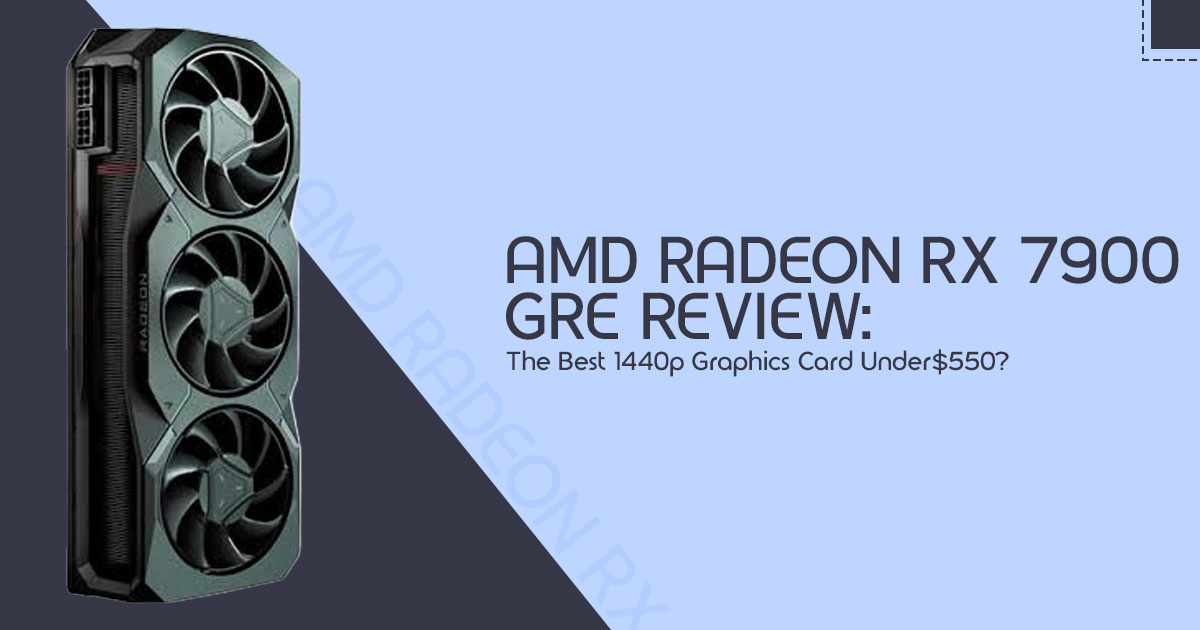
Key Takeaways
- The AMD Radeon RX 7900 GRE is now selling below its $549 MSRP at major retailers
- It comes with 16GB of GDDR6 VRAM, which is more memory than most competing graphics cards at this price.
- Built on AMD’s RDNA 3 architecture for strong 1440p and entry-level 4K gaming
- Competes directly with the Nvidia RTX 4070 Super at a lower price point
- Models from Sapphire, ASRock, and PowerColor are widely available right now
- Strong value for content creators, gamers, and anyone building a long-lasting gaming PC
Why Everyone Is Talking About the RX 7900 GRE Right Now
The AMD Radeon RX 7900 GRE has quietly become one of the most interesting graphics cards you can buy right now—and not because AMD launched a new version.
The reason is simple: the price has dropped.
Originally released with a $549 MSRP, many RX 7900 GRE models are now selling for around $529 to $539 at retailers like Amazon and Newegg. A $20 discount may not sound significant, but in today’s GPU market, seeing a current-generation card sell below its launch price without supply issues is uncommon.
So, is it actually worth buying?
Is the RX 7900 GRE finally the value pick many gamers were waiting for, or are there better options at the same price?
Benchmark numbers tell only part of the story. Factors like gaming performance, power efficiency, cooling, software support, and long-term value matter just as much.
As technology experts with over 20 years of experience in hardware and application research and development, we evaluate every product based on real-world performance, build quality,
reliability, and value for money. Whether you’re building your first gaming PC, upgrading from an older GPU, or looking for the best 1440p graphics card, our recommendations come from extensive research, component analysis, real-world testing insights, and industry experience.
In this review, we’ll examine where the AMD Radeon RX 7900 GRE stands today, how it compares with its closest rivals, and whether it’s the right GPU for your next upgrade.
What Is the AMD Radeon RX 7900 GRE?
The AMD Radeon RX 7900 GRE (the GRE stands for “Great Radeon Edition”) is AMD’s value-focused upper mid-range GPU. It sits between the RX 7800 XT and the RX 7900 XT in AMD’s lineup, and it targets the sweet spot that most PC gamers actually care about — smooth, high-fidelity 1440p gaming at a price that’s still within reach for many gamers.
The card initially launched in select regions before expanding to global availability. With supply now stabilizing, pricing has become more competitive.
This is not a budget card trying to punch above its weight. It is a serious upper mid-range GPU with flagship-level VRAM and architecture — just without the flagship price tag.
Full Specifications at a Glance
| Specification | Details |
|---|---|
| GPU Architecture | AMD RDNA 3 |
| Compute Units | 80 Compute Units (CUs) |
| Stream Processors | 5,120 |
| Video Memory (VRAM) | 16GB GDDR6 |
| Memory Bus | 256-bit |
| Memory Bandwidth | 576 GB/s |
| Total Board Power (TBP) | Approximately 260W |
| Recommended Power Supply | 750W or higher |
| Display Outputs | DisplayPort 2.1, HDMI 2.1 |
| Ray Tracing Support | Yes (2nd-Generation Ray Accelerators) |
| Recommended Gaming Resolution | 1440p Ultra / Entry-Level 4K Gaming |
| Launch MSRP | $549 |
| Current Street Price | Approximately $529–$539 |
Key Features Explained — What They Mean for You
16GB GDDR6 VRAM — This Is a Big Deal
VRAM has become one of the most important GPU specifications over the past few years.
Modern AAA games are increasingly demanding more than 8GB and even 10GB of VRAM. Titles like Alan Wake 2, Cyberpunk 2077 with path tracing, and Starfield can push well past 10GB in certain configurations. Cards that were considered “enough” two years ago are starting to hit walls.
The 16GB frame buffer gives the RX 7900 GRE plenty of room for today’s games and enough memory to handle more demanding titles in the years ahead.
If you plan to keep your GPU for three to four years — which most people do — this VRAM advantage matters.
RDNA 3 Architecture — What RDNA 3 Brings to the Table
AMD’s RDNA 3 architecture brought meaningful improvements over RDNA 2, particularly in:
- Rasterization performance — the traditional rendering method used by almost every game
- Compute efficiency — more work done per watt than the previous generation
- Display output support — including DisplayPort 1, which supports up to 8K at 165Hz or 4K at 240Hz
For the average gamer, what RDNA 3 means in practice is strong 1440p framerates across a wide range of titles with good power efficiency relative to the performance you receive.
It is worth noting that AMD’s ray tracing performance, while improved over RDNA 2, still lags behind Nvidia’s implementation. Ray tracing on the RX 7900 GRE is capable but not class-leading. If ray tracing in every game is your priority, Nvidia has the edge. If you primarily care about rasterization performance and traditional gaming, AMD is competitive.
80 Compute Units — More Than Raw Numbers
The 80 Compute Units in the RX 7900 GRE translate to 5,120 stream processors. To put that in context, the full-fat RX 7900 XTX has 96 CUs, and the RX 7800 XT has 60 CUs.
The RX 7900 GRE sits between the RX 7800 XT and RX 7900 XT, giving you performance that’s surprisingly close to AMD’s higher-end cards while costing much less. In real-world gaming benchmarks, the RX 7900 GRE consistently delivers between 70 and 100 fps at 1440p Ultra settings in demanding titles, depending on the game.
Real-World Gaming Performance: What to Expect
Numbers on a spec sheet only tell part of the story. Here is a practical breakdown of how the RX 7900 GRE performs across different gaming scenarios.
1440p Gaming — Its Natural Home
This is where the RX 7900 GRE shines brightest. At 2560×1440 resolution with high or ultra settings:
| Game (4K Ultra Settings) | Estimated Average FPS |
|---|---|
| Cyberpunk 2077 (Ultra, Ray Tracing Off) | ~75–85 FPS |
| Call of Duty: Warzone | ~110–130 FPS |
| Elden Ring | ~90–100 FPS |
| Hogwarts Legacy | ~80–95 FPS |
| Forza Horizon 5 | ~100–115 FPS |
| Alan Wake 2 (High Preset) | ~65–75 FPS |
These are real-world typical performance ranges, not cherry-picked marketing numbers. Performance varies by system configuration, CPU pairing, and driver version, but the RX 7900 GRE consistently delivers playable, high-quality 1440p gaming across modern titles.
4K Gaming — Possible, With Caveats
The RX 7900 GRE can handle 4K gaming, but you’ll need to lower a few settings in more demanding games to maintain smooth frame rates.
If your primary monitor is 4K and you want a consistent ultra-settings experience, the RX 7900 XT or RX 7900 XTX would be better investments. But if you have a 1440p primary monitor and occasionally want to push to 4K, the RX 7900 GRE still delivers a good gaming experience.
1080p Gaming
At 1080p, the RX 7900 GRE is likely overkill for most people — unless you are chasing high refresh rates above 240Hz for competitive gaming. The card will max out most games at 1080p with headroom to spare, but you would be leaving significant performance potential on the table.
RX 7900 GRE vs RTX 4070 Super: The Real Comparison
This is the comparison most buyers are actually making, so we are going to be direct about it.
| Category | AMD Radeon RX 7900 GRE | NVIDIA GeForce RTX 4070 Super |
|---|---|---|
| Price | ~$529–$539 | ~$599–$619 |
| VRAM | 16GB GDDR6 | 12GB GDDR6X |
| Architecture | AMD RDNA 3 | NVIDIA Ada Lovelace |
| Rasterization Performance | Excellent 1440p performance, often matching or slightly exceeding the RTX 4070 Super. | Excellent 1440p performance with similar rasterization results. |
| Ray Tracing | Good, but behind NVIDIA in demanding ray-traced games. | Superior ray tracing performance with more consistent frame rates. |
| Upscaling Technology | AMD FSR 3 | NVIDIA DLSS 3.5 with Frame Generation |
| Typical Power Draw | ~260W | ~220W |
| Software Ecosystem | AMD Software: Adrenalin Edition | NVIDIA App with CUDA, Reflex, Broadcast, and Studio features |
| Best For | Gamers seeking outstanding value, 16GB VRAM, and long-term 1440p performance. | Gamers who prioritize ray tracing, DLSS 3.5, AI features, and creator workloads. |
Our honest take:
The RTX 4070 Super remains an excellent graphics card. Nvidia’s DLSS 3.5 Frame Generation is technically superior to AMD’s FSR 3 in games that support it. Nvidia’s ray tracing performance is genuinely better. And the Ada Lovelace architecture is power efficient.
But the RX 7900 GRE costs less and gives you 16GB of VRAM. If ray tracing and Nvidia-exclusive features are not at the top of your list, the AMD card delivers similar gaming performance while giving you more memory for today’s games and those coming over the next few years.
If you are building a system focused on traditional gaming performance and want to spend less money while getting more VRAM, the RX 7900 GRE is the smarter buy today.
RX 7900 GRE vs RX 7800 XT: Is the Upgrade Worth It?
Some buyers are considering jumping from the RX 7800 XT rather than coming from an Nvidia card. Here’s how the two cards compare.
| Category | AMD Radeon RX 7900 GRE | AMD Radeon RX 7800 XT |
|---|---|---|
| Price | ~$529–$539 | ~$449–$479 |
| VRAM | 16GB GDDR6 | 16GB GDDR6 |
| Compute Units | 80 Compute Units | 60 Compute Units |
| 1440p Gaming Performance | Approximately 20–25% faster in modern AAA games. | Baseline performance for comparison. |
| 4K Gaming Capability | Well-suited for high-quality 4K gaming with optimized settings. | Capable of 4K gaming but better optimized for 1440p. |
| Typical Power Draw | ~260W | ~185W |
The RX 7800 XT also has 16GB VRAM, so the VRAM advantage disappears here. The main reasons to choose the GRE over the 7800 XT come down to raw performance — approximately 20 to 25% faster in most workloads — and better 4K capability.
If your budget is tight and you are strictly gaming at 1440p on a 60Hz or 144Hz monitor, the RX 7800 XT saves you around $60 to $80 and delivers solid results. But if you have a 165Hz or 240Hz 1440p panel, the extra performance of the RX 7900 GRE helps you use that refresh rate more consistently.
Available Models: Which One Should You Buy?
Several AIB (Add-In Board) partners are producing RX 7900 GRE cards. Here is a quick guide to the main options.
| Model | Key Highlights | Best For |
|---|---|---|
| Sapphire Pulse RX 7900 GRE | Excellent cooling performance, quiet acoustics, and consistently high build quality. | Most buyers looking for the best all-around RX 7900 GRE. |
| Sapphire Pure RX 7900 GRE | Compact cooler, attractive design, and a more affordable price point. | Budget-conscious gamers with good PC case airflow. |
| ASRock Challenger RX 7900 GRE | Competitive pricing, dependable cooling, and reliable overall construction. | Value-focused buyers seeking maximum performance per dollar. |
| PowerColor Hellhound RX 7900 GRE | Premium styling, efficient thermal design, and quiet operation under load. | Gamers who want a stylish GPU without compromising performance. |
Our recommendation: The Sapphire Pulse is consistently regarded as one of the better-built mid-range AMD cards. Sapphire has a strong reputation for thermal management, build quality, and driver stability with AMD GPUs. It is the safe choice for most buyers.
Who Should Buy the RX 7900 GRE?
Use this quick guide to decide if this card is right for your situation.
Buy the RX 7900 GRE if you:
- ⬛ Game primarily at 1440p and want high, consistent framerates
- ⬛ Want 16GB of VRAM to handle today’s games and upcoming titles without paying flagship prices
- ⬛ Are upgrading from an older card like an RX 580, RX 5700, or GTX 1080
- ⬛ Do video editing or 3D rendering and need more VRAM for large projects
- ⬛ Want a strong price-to-performance ratio in the upper-midrange segment
- ⬛ Are building a new gaming PC with a 1440p 144Hz or 165Hz monitor
Skip it and consider alternatives if you:
- + Primarily play games with heavy ray tracing and DLSS support
- + Own a 4K monitor and want maximum ultra-settings performance
- + Have a very tight budget — the RX 7800 XT saves money with similar VRAM
- + Are in the Nvidia ecosystem with G-Sync monitors (though FreeSync works well too)
Pricing Breakdown: What Does It Cost Right Now?
| Region | Estimated Price |
|---|---|
| United States (Amazon / Newegg) | $529 – $549 |
| India (Amazon.in) | ₹44,000 – ₹52,000 (varies by AIB model and retailer) |
| United Kingdom | £449 – £499 |
| Europe | €499 – €549 |
Prices shift frequently based on stock levels and retailer promotions. Cards are already selling below MSRP in the US, which points to healthy supply. Prices could fall a little further, but major discounts are unlikely in the near term.
Pros and Cons: The Honest Summary
| Pros | Cons |
| Excellent 16GB GDDR6 VRAM provides outstanding value for modern AAA games and future-proofing. | Ray tracing performance still trails competing NVIDIA GPUs in the same price range. |
| Delivers outstanding 1440p rasterization performance with high frame rates across demanding titles. | Power consumption of around 260W is higher than the more efficient RTX 4070 Super. |
| DisplayPort 2.1 support makes it ready for next-generation high-refresh-rate 4K and 8K monitors. | FSR 3 has improved significantly but still isn’t as refined or widely adopted as NVIDIA’s DLSS 3.5 ecosystem. |
| Frequently available below its original MSRP, making it one of the best GPU bargains in its class. | AMD’s drivers have matured considerably, but NVIDIA continues to offer broader software support with technologies like CUDA, DLSS, and superior AI acceleration. |
| Wide availability from major AIB partners gives buyers plenty of cooling and factory-overclocked options. | While capable of 4K gaming, it is primarily optimized for high-refresh 1440p rather than uncompromised 4K Ultra settings. |
| Offers one of the strongest price-to-performance ratios in the upper mid-range GPU market. | No dedicated AI upscaling or creator ecosystem equivalent to NVIDIA’s CUDA-based workflow for professional applications. |
Final Verdict: Is the RX 7900 GRE Worth Buying?
After looking at the hardware, pricing, and competition, here’s where the RX 7900 GRE stands today.
The AMD Radeon RX 7900 GRE is one of the most sensible GPU purchases you can make at the $529 to $549 price point right now. Like every graphics card, it comes with a few compromises. The ray tracing performance will not impress Nvidia loyalists. The power draw is on the higher side. And FSR 3 is still catching up to DLSS.
For most PC gamers, the RX 7900 GRE gets the important things right. It delivers strong 1440p gaming performance, comes with 16GB of VRAM, and costs less than many of its closest rivals.
The fact that it is already available below MSRP within weeks of its global launch is a strong signal that supply is healthy and prices may continue to soften. Getting in now means you lock in a competitive price without worrying about the stock shortages that often follow new GPU launches.
Our Rating: 8.5 / 10
Strong value. Great VRAM. Good performance. Minor compromises in ray tracing and power efficiency. Overall, a smart buy for the budget-conscious 1440p gamer.
Where to Buy the AMD Radeon RX 7900 GRE
/¯. Buy on Amazon Worldwide
The Sapphire Pulse RX 7900 GRE and other AIB models are available on Amazon US. Prices are currently sitting at or below the $549 MSRP, making this one of the better GPU deals in the upper-midrange category right now.
–− Check Current Price & Availability on Amazon Worldwide (Prices update frequently — click to see the latest deal)
We recommend checking for:
- Sapphire Pulse RX 7900 GRE 16GB
- ASRock Challenger RX 7900 GRE 16GB
- PowerColor Hellhound RX 7900 GRE 16GB
/¯. Buy on Amazon India
For buyers in India, the RX 7900 GRE represents strong value compared to the alternatives available locally. Given import pricing and local taxes, expect prices in the ₹44,000 to ₹52,000 range depending on the model and current exchange rates.
–− Check Current Price & Availability on Amazon India
(Stock and pricing vary — verify availability before purchasing)
Tip for Indian buyers: The Sapphire Pure model is often the most competitively priced option in India and delivers solid thermal performance for the money.
What Do You Think?
Are you planning to buy the AMD Radeon RX 7900 GRE, or are you considering another graphics card instead?
Share your thoughts or questions in the comments—we’d be happy to help you choose the right GPU for your budget and gaming needs.
If you found this review helpful, follow us for more in-depth GPU reviews, PC hardware buying guides, and the latest tech updates. We regularly test and compare new hardware to help you make informed buying decisions.
***Disclaimer***
This blog post reflects our research, analysis, and opinions based on available product information, user feedback, and industry knowledge. It should not be taken as the official position of any brand, manufacturer, or company mentioned here. While we aim to keep information accurate and up to date, product details, pricing, and availability can change. We recommend double-checking important details before making a purchase.
Some links in this article may be affiliate links. If you choose to buy through these links, we may earn a small commission at no extra cost to you. This helps support our work and allows us to keep publishing in-depth, unbiased reviews. Our recommendations are never influenced by affiliate partnerships.
Comments shared by readers reflect their own views and not ours. We are not responsible for outcomes resulting from the use of information on this site. Please seek professional advice where appropriate.
All product names, logos, and brands mentioned are the property of their respective owners. These names are used for identification and informational purposes only and do not imply endorsement.