
Laptop RAM may finally be getting the upgradeability many users have been asking for.
For years, laptop buyers have had to choose between fast, efficient memory that cannot be upgraded and upgradeable memory that takes up more space and often runs at lower speeds. That trade-off could be starting to change with a new 96GB LPDDR5X memory module designed for laptops.
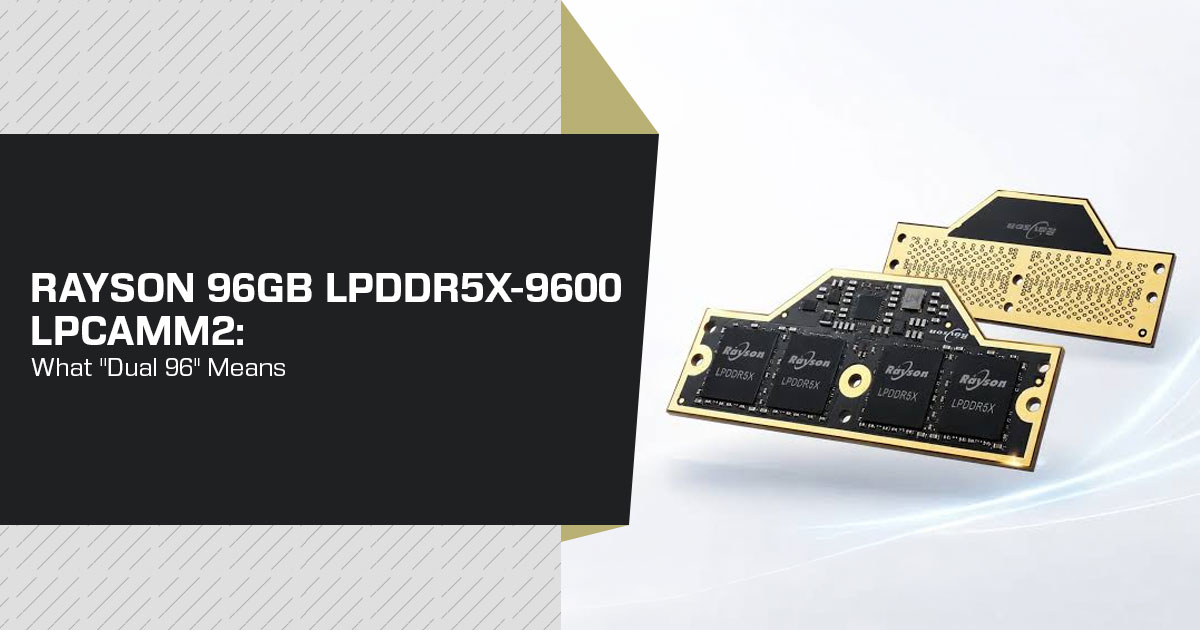
Rayson has announced a 96GB LPDDR5X-9600 LPCAMM2 module rated for speeds of up to 9600 MT/s. Unlike traditional soldered LPDDR5X memory, the module is removable and upgradeable. That means a laptop could potentially offer the speed and efficiency of LPDDR5X while still allowing users to replace or upgrade the memory later.
The idea matters because laptop memory has become an important buying decision. Modern laptops are used for demanding workloads such as 4K video editing, 3D rendering, software development, engineering applications, AI workloads, content creation, and heavy multitasking. For these users, having more memory can make a real difference. But buying a laptop with soldered RAM also means living with that memory capacity for the life of the machine.
Rayson’s new module could offer another path. The company calls the 96GB LPDDR5X-9600 LPCAMM2 configuration “dual 96.” If the technology makes its way into more laptops, buyers could get high-capacity, high-speed memory without giving up future upgrade options.
That does not mean everyone needs 96GB of RAM. Most everyday laptop users will be fine with much less memory. The bigger question is whether this new format can become a practical alternative to DDR5 SO-DIMM and soldered LPDDR5X, rather than remaining a niche option for expensive high-performance laptops.
In this article, we examine Rayson’s 96GB LPDDR5X-9600 LPCAMM2, how the technology works, and how it compares with Samsung‘s 96GB LPCAMM2 preview, conventional DDR5 SO-DIMM memory, and soldered LPDDR5X. We will also look at who could benefit from this technology and whether it is worth waiting for.
As technology experts with over 20 years of experience in hardware and application research and development, we carefully analyze products based on the factors that matter in real-world use, including performance, durability, compatibility, upgradeability, and value for money. Our goal is to help you choose the right product for your needs, whether your priority is budget, performance, reliability, or long-term use.
This analysis is especially relevant for professionals, content creators, developers, engineers, students, PC enthusiasts, and laptop buyers who want their next machine to remain useful for years. Our recommendations are based on extensive research, component analysis, real-world usability, and industry expertise.
There is one important limitation to keep in mind. We have not tested the Rayson module ourselves. The module has been announced, but pricing and retail availability have not been published. Therefore, this article focuses on the announced specifications and what they could mean for future laptops. Actual performance, compatibility, pricing, and long-term reliability will need to be confirmed once the module reaches the market.
At a glance: Rayson 96GB LPCAMM2 specifications
| Specification | Rayson 96GB LPCAMM2 |
|---|---|
| Module Type | LPCAMM2 (removable and upgradeable) |
| Memory Technology | LPDDR5X |
| Capacity | 96GB; 16GB, 32GB, and 64GB capacities are also offered |
| Data Rate | Up to 9,600 MT/s (Rayson also describes the specification as 9,600 Mbps) |
| Dimensions | 78 × 23 × 3 mm |
| Board Space vs DDR5 SO-DIMM | Approximately 60% less board space (Rayson claim) |
| Power Consumption vs DDR5 SO-DIMM | Approximately 50% lower power consumption (Rayson claim) |
| Energy Efficiency | Approximately 70% better energy efficiency (Rayson claim) |
| Upgradeable | Yes |
| Model / Part Number | Not published |
| Announced | September 2026 |
| Pricing | Not announced |
| Availability | Not announced; mass-production status remains unconfirmed |
The figures marked as claims come from Rayson’s announcement. Treat them as manufacturer claims until independent testing is available.
Who is Rayson?
Rayson is the memory brand of Jingcun Technology, a Shenzhen-based company founded in 2016. The company develops and sells memory products including eMMC, DDR3, DDR4, LPDDR4/4X, LPDDR5/5X, SSDs, and memory modules for markets including smartphones, tablets, laptops, automotive systems, and IoT devices.
The 96GB LPCAMM2 module marks the company’s move further into upgradeable PC memory. Some English-language reports have mistranslated the company name, so the names to look for are Rayson and Jingcun Technology.
What is LPCAMM2, and why does it matter?
What is LPCAMM2?
LPCAMM2 is the industry term commonly used for the LPDDR5/LPDDR5X version of JEDEC‘s CAMM2 standard. The underlying JEDEC standard is JESD318, first published in November 2023.
The idea is straightforward: take the LPDDR5X chips that are normally soldered to a laptop motherboard and place them on a flat, screw-down, removable module instead. That gives a laptop three important advantages:
- LPDDR-class power efficiency, which helps with battery life and thermals.
- High-speed signaling and a compact LPCAMM2 is designed to support higher memory speeds than many conventional SO-DIMM implementations while keeping the module footprint small.
- Upgradeability, because the module can be removed and replaced like a standard stick.
A single LPCAMM2 module can provide a 128-bit memory interface in the LPDDR5X implementation, so one module can serve both memory channels rather than requiring two separate SO-DIMMs.
Adoption has been gradual. Micron introduced LPCAMM2 modules in 2024, with Crucial retail modules following in May 2024. Lenovo’s ThinkPad P1 Gen 7 was the first mobile workstation to use LPDDR5X LPCAMM2, followed by the Framework Laptop 13 Pro with Intel Core Ultra Series 3 and select Lenovo ThinkBook 14+ and 16+ models.
Key features and what they mean for buyers
96GB on a single module
A single 96GB module gives compact laptops much more memory headroom for local AI models, virtual machines, large datasets, and heavy creative workloads. It also leaves the door open to starting with a smaller module and upgrading later, which soldered memory does not allow.
9600 MT/s data rate — the other half of “dual 96”
The second “96” in Rayson’s naming refers to the 9600 MT/s data rate. Rayson’s announcement also uses 9600 Mbps. In this article, we use 9600 MT/s, the more familiar way of expressing the effective data-transfer rate of DDR and LPDDR memory. Higher data rates can matter for memory-heavy workloads such as integrated graphics and some AI workloads, while they matter far less for web browsing and office documents.
A 9600 MT/s rating on the memory module does not guarantee 9600 MT/s operation in every laptop. The actual speed depends on the processor, motherboard design, signal integrity, firmware, and the laptop makers‘ validation.
The small footprint is mainly a benefit for laptop makers because it can free board space for a larger battery, cooling, or other components. The buyer benefit is indirect: a smaller modular design makes it easier for OEMs to include upgradeable memory in thin systems.
Around 50% lower power and 70% higher efficiency, according to Rayson
Rayson reports roughly half the module power draw of DDR5 SO-DIMM and claims a 70% efficiency improvement. Those figures could help with heat and battery life at the system level, but they are manufacturer claims and have not been independently measured for this specific module.
Removable and replaceable
This is the core benefit of upgradeable laptop RAM in the LPCAMM2 format. A failed memory module can be replaced without replacing the entire motherboard, and buyers are not locked into the factory memory capacity. The catch is compatibility: the module only fits laptops designed with an LPCAMM2 connector.
Real-world performance expectations
No independent benchmarks exist for this specific module, so any performance picture is an expectation, not a measurement. What can be said with reasonable confidence is based on the platform, memory technology, and workload.
- On-device AI and local large language models are among the workloads most likely to benefit from 96GB of memory and high bandwidth. Keeping more model data, context, and application data in RAM can reduce reliance on slower storage when the workload would otherwise run out of memory.
- Content creation, code compilation, and virtualization can benefit from the extra capacity in a different way: more applications and larger projects can remain in memory at the same time, reducing the need to swap data to storage.
- Intel’s Core Ultra Series 3 (Panther Lake) platform includes LPCAMM support and supports up to 96GB on certain LPDDR5X configurations. That makes the platform relevant to the move toward higher-capacity modular LPDDR memory, but it does not guarantee that every Panther Lake laptop will support a 96GB, 9600 MT/s Rayson module. Laptop makers still have to validate specific memory configurations.
Rayson vs Samsung vs Micron: the 96GB landscape
| Supplier | 96GB Module? | Data Rate | Status | Pricing |
|---|---|---|---|---|
| Rayson | Yes | 9,600 MT/s | Announced, with OEM platform validation claimed by the manufacturer | Not announced |
| Samsung | Yes — demonstrated in February 2026 | 9,600 MT/s | 96GB module demonstrated, but mass-production availability remained unconfirmed as of February 2026 | Not announced |
| Micron (Crucial) | No — retail modules available up to 64GB | 7,500 MT/s for retail modules; capability up to 9,600 MT/s announced | 64GB retail modules launched in 2024; current availability varies by market | US$174.99 for 32GB / US$329.99 for 64GB at launch |
Rayson is not the first company to show a 96GB/9600 configuration. Samsung‘s module was shown earlier in 2026, but mass production was not confirmed at the time. What Rayson adds is its claim that the 96GB module has completed compatibility validation on platforms from leading international PC manufacturers, although those manufacturers have not been named.
LPCAMM2 vs SO-DIMM vs soldered LPDDR5X
| Factor | DDR5 SO-DIMM | Soldered LPDDR5X | LPCAMM2 |
|---|---|---|---|
| Upgradeable? | Yes | No | Yes |
| Speed Ceiling | Around 6400 MT/s is common, although higher speeds are available on some platforms. | Up to 9600 MT/s on supported platforms. | Up to 9600 MT/s announced. |
| Power Draw | Higher | Lowest | Low, depending on the implementation. |
| Motherboard Space | Largest | Smallest | Small |
| Typical Use | Mainstream and gaming laptops | Thin-and-light laptops where efficiency and compactness are priorities | Premium, workstation, and AI laptops requiring high-speed memory with upgradeability |
The table above is a simple way to frame the buying decision. LPCAMM2 is not universally better than SO-DIMM; it changes the trade-off. LPCAMM2 can offer lower power, a smaller footprint, and higher bandwidth potential, while SO-DIMM remains more widely available and easier to find across existing laptops. Compared with soldered LPDDR5X, LPCAMM2 keeps the low-power design while adding upgradeability.
The list is still short but growing. Lenovo’s ThinkPad P1 Gen 7 was the first mobile workstation with LPDDR5X LPCAMM2. The Framework Laptop 13 Pro with Intel Core Ultra Series 3 and select Lenovo ThinkBook 14+ and 16+ models have since adopted LPCAMM2. Dell has also used the broader CAMM2 family in Pro Max workstations, although that does not mean every Dell CAMM2 system uses LPDDR5X LPCAMM2.
For anyone wondering whether this module fits an existing laptop, the answer is almost certainly no unless that laptop has an LPCAMM2 connector and supports the specific module. Check the service manual or the manufacturer’s compatibility list before buying. Intel’s Core Ultra Series 3 (Panther Lake) platform has already brought LPCAMM support to more laptops, but exact memory capacity and speed support still vary by model.
Who should consider it, and who should wait
A reasonable target:
- People planning an AI PC purchase who want up to 96GB without a soldered memory ceiling.
- Mobile workstation users who run local models, large datasets, or several virtual machines.
- Buyers who value repairability and upgrade paths over the lowest possible price.
Reasons to wait:
- There is no price or retail availability yet, so this specific module cannot be bought today.
- Early LPCAMM2 modules have carried a meaningful premium over comparable DDR5 SO-DIMM A 96GB/9600 module may also carry a premium, but its price is unknown.
- For a laptop with standard SO-DIMM slots, none of this applies; a DDR5 SO-DIMM upgrade is the practical move.
Pricing and availability: what is actually known
Rayson has not announced pricing, retail availability, or a confirmed mass-production date. For reference, Crucial launched 32GB and 64GB LPCAMM2 modules at US$174.99 and US$329.99, respectively, in May 2024. Those launch prices show that LPCAMM2 can carry a premium, but they do not provide a reliable forecast for Rayson.
The first Rayson-equipped laptops may arrive before the module becomes widely available as a standalone retail product, but that is not confirmed. Buyers who want LPCAMM2 soon should watch both laptop announcements and module availability.
Pros and cons
| Strengths | Limitations |
|---|---|
| ✔ Offers a substantial 96GB capacity in a single removable memory module, combining high capacity with upgradeability. | ✖ Pricing and retail availability have not yet been announced. |
| ✔ Supports LPDDR5X speeds up to 9,600 MT/s, providing high memory bandwidth for demanding mobile workloads. | ✖ Specific OEM partners and confirmed laptop models have not yet been named. |
| ✔ Compact LPCAMM2 form factor, with claimed space and power-efficiency advantages compared with traditional DDR5 SO-DIMM memory. | ✖ Requires a laptop specifically equipped with a compatible LPCAMM2 slot. |
| ✔ OEM platform validation is claimed, indicating progress toward integration into commercial laptop designs. | ✖ Early systems and modules could carry an early-adopter price premium compared with established memory formats. |
| — | ✖ No independent performance benchmarks are available yet to verify real-world bandwidth, latency, power, or thermal improvements. |
Buying advice: what can be purchased now
Since the Rayson module is not on sale, the practical options for most readers are these:
- Want a laptop with the slot? The Framework Laptop 13 Pro with Intel Core Ultra Series 3 and Lenovo ThinkPad P1 models are established LPCAMM2 options, while select Lenovo ThinkBook 14+ and 16+ models also use the format.
- Set on 96GB? Track Rayson and Samsung announcements, and look for laptop design wins before expecting a broad retail release.
- Have a standard laptop? Stick with the memory format it An LPCAMM2 module will not fit a standard DDR5 SO-DIMM slot, and moving to LPCAMM2 generally means buying a compatible laptop.
Final verdict
On specifications, the Rayson 96GB LPDDR5X-9600 LPCAMM2 module is a meaningful development for upgradeable laptop memory. It combines 96GB capacity, a claimed 9600 MT/s data rate, LPDDR5X technology, and a removable form factor. It also gives the market another supplier alongside Samsung in the 96GB/9600 segment. What remains unknown is the price, production status, laptop support, and real-world performance.
As a product readers can buy, it is not one yet. There is no announced price, no retail availability, and no named laptop partner. The practical recommendation is simple: treat it as a strong signal for where upgradeable laptop memory is heading, buy what is available today if you need an upgrade now, and revisit Rayson once pricing, compatibility, and availability are confirmed.
Frequently asked questions
What is LPCAMM2?
LPCAMM2 is the industry term commonly used for the LPDDR5/LPDDR5X version of JEDEC‘s CAMM2 standard. It aims to combine the efficiency and bandwidth of LPDDR memory with the ability to replace or upgrade the module.
What does “dual 96” mean?
Rayson’s “dual 96” refers to two numbers: 96GB of capacity and a 9600 MT/s data rate on one module. It is a product naming phrase, not a JEDEC technical standard.
Is LPCAMM2 upgradeable, and can it go in any laptop?
Upgradeable, yes, but only on compatible systems. An LPCAMM2 module can be removed and replaced, but it cannot be installed in a standard DDR5 SO-DIMM slot or in a laptop with soldered LPDDR memory.
Which laptops use LPCAMM2?
The Lenovo ThinkPad P1 Gen 7 was the first mobile workstation with LPDDR5X LPCAMM2, followed by newer systems including the Framework Laptop 13 Pro with Intel Core Ultra Series 3 and select Lenovo ThinkBook 14+ and 16+ models. More models are expected, but support remains model-specific.
How much does LPCAMM2 cost?
Retail LPCAMM2 has carried a premium. Crucial launched 32GB at US$174.99 and 64GB at US$329.99 in May 2024. Rayson has not announced pricing for its 96GB module.
Current LPCAMM2 options to check
The Rayson 96GB module is not yet available at retail. For readers who need LPCAMM2 memory now, established 32GB and 64GB modules are the practical alternatives, subject to laptop compatibility.
- Crucial 32GB LPDDR5X-7500 (part CT32G75C2LP5X) — an established LPCAMM2 capacity for compatible laptops.
- Crucial 64GB LPDDR5X-7500 (part CT64G75C2LP5X) — a higher-capacity option for heavy multitasking and other memory-intensive workloads.
- Laptops with LPCAMM2 support, including the Lenovo ThinkPad P1 line and Framework Laptop 13 Pro, are another option if you want an upgradeable LPDDR5X
Check current pricing, stock, and compatibility before buying because LPCAMM2 availability varies by region and laptop model.
Before buying, confirm the exact memory part number and supported capacities against the laptop manufacturer’s service information. LPCAMM2 modules are not interchangeable with standard SO-DIMM memory.
We will add direct links to the Rayson 96GB module if and when it becomes available at retail.
What do you think about upgradeable LPDDR5X memory? Would you choose a laptop with 96GB of fast, removable RAM, or do you think traditional memory options are still good enough?
Share your thoughts in the comments and tell us what you would want to see in your next laptop. If you found this analysis useful, follow us for more hardware news, reviews, comparisons, and practical buying advice.
Have a question about LPCAMM2, LPDDR5X, laptop RAM, or whether you should wait for this technology? Ask us in the comments. We’ll do our best to help.
***Disclaimer***
This blog post reflects our research, analysis, and opinions based on available product information, user feedback, and industry knowledge. It should not be taken as the official position of any brand, manufacturer, or company mentioned here. We make every effort to keep this guide accurate, but product specifications, pricing, and availability may change after publication. We recommend double-checking important details before making a purchase.
Some links in this article may be affiliate links. If you choose to buy through these links, we may earn a small commission at no extra cost to you. This helps support our work and allows us to keep publishing in-depth, unbiased reviews. Affiliate partnerships never influence our recommendations.
Opinions expressed by readers are their own and do not necessarily reflect ours. We are not responsible for outcomes resulting from the use of information on this site. Please seek professional advice where appropriate.
All product names, logos, and brands mentioned are the property of their respective owners. These names are used for identification and informational purposes only and do not imply endorsement.