
In a Nutshell
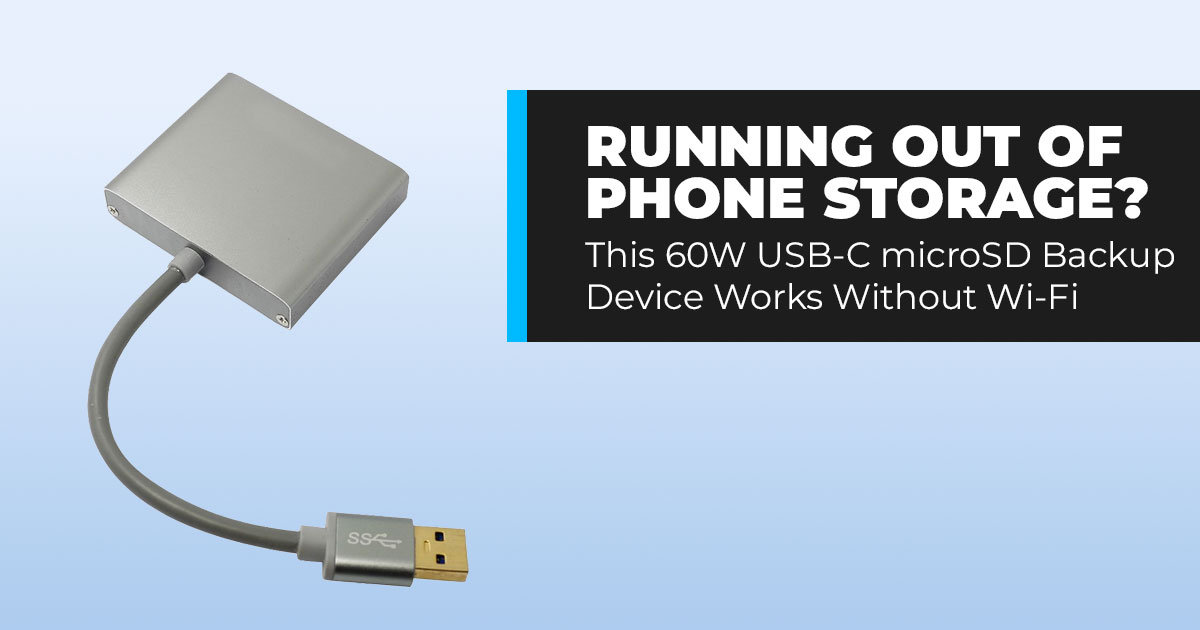
- What it is: A small USB-C microSD card reader with USB PD passthrough that lets you back up phone files directly to a card — no internet needed.
- Who it’s for: People who shoot lots of photos or 4K videos, travel often, or constantly fight phone storage full alerts.
- When it makes sense: During travel, field work, events, or anywhere with a weak signal where you need offline phone backup fast.
- When it doesn’t: If you rely fully on automatic cloud backup and rarely fill your storage.
- Biggest advantage: You keep physical control of your data and can swap cards for more space.
- Biggest limitation: It depends on quality microSD cards and requires manual backups — it’s not fully automatic.
1. Introduction
Running out of storage always happens at the worst time. You’re recording a 4K video, shooting family photos, or capturing content for work — and suddenly your phone says storage is full.
Now you’re deleting old files in a hurry or waiting for slow cloud uploads on weak signal.
That’s where a USB-C microSD card reader with USB PD passthrough comes in. If you already know this is the kind of solution you’re looking for, you can explore available models here:
Buy from Amazon now
Buy on Amazon Worldwide | Buy on Amazon India
If you want to understand how it works, who it’s best for, and what to look for before buying, keep reading.
This small gadget works as a portable external phone storage tool. You plug it into your phone, insert a microSD card, and transfer files directly — while charging your device at the same time, up to 60W fast charging. No Wi-Fi. No cloud subscription. No waiting on uploads.
It belongs to a growing category of offline mobile backup solutions built for people who want simple, local control over their data.
And here’s something most people overlook: product specs rarely tell the whole story. Real value shows up when you’re backing up 40GB of video on a weak network and your battery is at 15%. That’s why user reviews and real-world testing matter. They reveal what works outside the marketing page.
As technology experts with over 20 years of experience in hardware and application research and development, we deeply analyze each product based on real-world performance, durability, and value for money. Our goal is to help you find the best product in every category—budget, performance, reliability, and long-term usage. Our recommendations are based on extensive research, component analysis, real-world usability, and industry expertise.
This guide is written for:
- Photographers and videographers
- Content creators shooting 4K or RAW
- Frequent travelers
- Students managing large projects
- Remote workers
- And anyone searching for how to expand iPhone storage or a reliable Android microSD reader with OTG
We’ll explain how this device works, where it fits, and where it doesn’t — so you can decide if it’s the right mobile file backup solution for you.
2. Technical Specifications at a Glance
Here’s a quick look at what powers this USB-C card reader with charging support:
- Compatibility: Works with most Android phones with OTG support and iOS devices using compatible USB-C or Lightning adapters.
- Storage Support: Supports microSD cards up to 2TB, giving you serious expansion room.
- Transfer Speed: Up to 5Gbps (USB 2 Gen 1) for fast portable data transfer.
- Charging Feature: 60W USB PD passthrough lets you charge your phone while transferring files.
- App Support: Includes a companion app for selecting files, managing folders, and controlling access.
- Size: Compact and pocket-friendly — easy to carry in a small bag or even your wallet pouch.
- Power Source: Powered through your phone or an external power adapter — there is no internal battery.
These specs focus on practicality: fast transfer, expandable storage, and uninterrupted power.
3. Why This Review Is Essential
Phone storage problems aren’t new. But they’ve become more intense.
- 4K video files are
- RAW photos eat space
- Apps like WhatsApp silently fill
- Cloud uploads crawl on weak
- And many users worry about data privacy in cloud storage.
People searching for terms like best external microSD for iPhone, charge phone while using card reader, or USB-C OTG backup device are usually trying to solve a real frustration — not just buy another gadget.
This review answers practical questions:
- Is this better than cloud storage?
- Does USB PD passthrough slow charging?
- Is it fast enough for large video files?
- Is it reliable for travel?
You’ll get straight answers, including limitations. Because knowing what not to expect matters just as much as knowing what it does well.
4. What You Will Learn from This Review
By the end, you’ll understand:
- How to use this as a mobile backup solution without internet
- How it compares to cloud storage vs external microSD
- Which microSD cards work best for performance and durability
- How USB PD passthrough charging actually works
- Basic security considerations for protecting your files
- Whether this fits your workflow — or not
You’ll also see where it makes sense for photographers, travelers, and heavy media users — and where it may feel unnecessary.
5. The Real Problem: Why Phone Storage Fails Heavy Users
Modern phones capture amazing detail. But that quality eats storage fast.
A short 4K video can take up several gigabytes. A few minutes of footage from a trip or event can fill a big chunk of your space. RAW photos are even larger. They look great, but they’re heavy files.
Now add everyday use:
- Social media downloads
- WhatsApp images and videos
- Screenshots
- Offline Netflix or YouTube content
- Work documents and PDFs
Before you notice it, your phone shows the dreaded “Storage Almost Full” alert.
5.1 Cloud Backup Isn’t Always Practical
Cloud storage sounds easy. But it depends on internet speed.
If you’re traveling, working outdoors, or in an area with a weak signal, uploading large files can take hours. Sometimes uploads fail halfway. And large video files drain battery while they upload.
When everything depends on the internet, you lose flexibility.
5.2 Privacy Concerns Matter
Not everyone wants personal photos, business files, or client data stored on remote servers. Even if cloud providers are secure, some users simply prefer local control over their files.
That’s why interest in external phone storage and offline mobile backup solutions keeps growing.
5.3 Why USB PD Passthrough Makes a Difference
Here’s the simple explanation of USB PD passthrough: It lets your phone charge while transferring data.
That means you can:
- Back up large files
- Move videos to a microSD card
- Free up storage
— all without draining your battery.
And when you’re on the move, that’s a big advantage.
The Bottom Line
This kind of device isn’t meant to replace cloud storage for everyone.
But for heavy users who want:
- Offline file access
- Fast space recovery
- Physical control over their data
It offers something cloud services can’t — independence and reliability without needing a signal.
And that’s why it deserves attention.
6. How Does a microSD Card Reader with USB PD Passthrough Work on a Smartphone?
A microSD card reader with USB PD passthrough is a small device that connects directly to your phone’s USB-C port. You insert a microSD card, open the companion file app, and select the files you want to move.
There’s no internet required. No cloud login. No waiting for uploads.
The device transfers files using USB 3.2 Gen 1 (up to 5Gbps theoretical speed), while the USB Power Delivery (PD) passthrough port keeps your phone charging at the same time. That means you can move large files without draining your battery.
What makes this different from cloud backup?
- Files stay on a physical microSD card
- Storage expands by swapping cards
- No subscription fees
- Works completely offline
If you’ve searched for how to use microSD on smartphone, this setup is simple: plug in, select files, transfer.
7. How to Use a microSD Card Reader for Phone Backup (Step-by- Step Workflow)
Understanding real-world usage matters more than specs.
Scenario 1: Photographer Traveling
- Shoot in RAW photos or 4K video
- Connect the USB-C card reader
- Insert a fresh high-capacity microSD card
- Select files in the app
- Transfer and confirm backup
- Swap cards for the next day
This creates a fast offline phone backup without relying on Wi-Fi.
Scenario 2: Content Creator Shooting Video
- Record multiple clips
- Back up selected files only
- Delete originals from phone
- Keep charging with USB PD passthrough This helps free up phone storage instantly. Scenario 3: Remote Work in Low-Signal Areas
- Back up work documents
- Organize files directly on the card
- Access everything later with offline file access
For users searching portable backup device for photos, this is practical and reliable.
8. Key Features That Actually Matter in a microSD Backup Device
Swappable microSD Cards (Expandable Storage Without Limits)
- Lower cost per GB
- Flexible expandable smartphone storage
- No recurring subscription
For those looking for external phone storage without cloud, this provides long-term flexibility.
60W USB PD Passthrough Charging With 60W USB-C charging, your phone stays powered during large transfers.
Important for:
- Travel days
- Event coverage
- Long shooting sessions
This solves the problem of charging phone while using card reader. Read-Only Mode for File Protection
Switching to read-only mode prevents accidental deletion or overwriting. This improves data integrity and file safety.
Offline File Access
- No roaming charges
- No data usage
- No network dependency
For users searching for alternatives to cloud storage for phones, this is the biggest benefit.
9. microSD Card Reader vs Cloud Storage: Which Is Better?
| Feature | microSD Backup Device | Cloud Storage |
| Internet Required | No | Yes |
| Recurring Fees | One-time cost | Often monthly |
| Transfer Speed | 5Gbps local transfer | Depends on the connection |
| Privacy | Physical control of data | Stored on servers |
| Risk | Physical loss | Account breach or downtime |
| Auto Sync | Manual | Automatic |
Cloud services win for automatic backup.
A microSD phone backup solution wins for control, privacy, and offline access.
If you’re leaning toward a portable microSD backup device with USB PD charging, it’s a good time to compare available options. Different models vary in build quality, transfer speed, stability, and app experience. You can browse current alternatives here:
Buy from Amazon now
Buy on Amazon Worldwide | Buy on Amazon India
Look for models that clearly list USB 3.2 support, 60W PD passthrough, and confirmed OTG compatibility with your device.
10. microSD Card Reader vs Portable SSD: Which One Should You Choose?
| Aspect | microSD + Reader | Portable SSD |
| Cost per GB | Lower overall cost | Higher |
| Size | Ultra compact | Larger |
| Swappability | Multiple cards | Fixed capacity |
| Speed | Good for most users | Faster for heavy editing |
| Durability | Suitable for normal
handling |
More rugged options |
For travelers and creators, microSD storage with USB charging offers better portability. For high-volume editors, SSD may provide better sustained speed.
11. Limitations of microSD Phone Backup Devices (Before You Buy)
- Card Speed Varies by Quality – Use UHS-I or UHS-II microSD cards for stable
- microSD Cards Have Write Lifespan Limits – Heavy users should rotate cards regularly.
- No Built-In Encryption (Most Models) – If you handle sensitive data, enable manual encryption.
- Small Size Increases Loss Risk – Store cards in protective labeled cases.
Not a Full Phone System Backup
This supports:
- Photos
- Videos
- Documents
It does not clone your entire phone system.
Before purchase, confirm USB-C OTG compatibility with your device.
12. Who Should Use a microSD Card Reader for Phone Backup?
Ideal for:
- Photographers handling RAW images
- Videographers recording 4K footage
- Drone operators storing aerial clips
- Journalists working offline
- Frequent travelers avoiding roaming data
- Students managing large project files
- Android users with OTG support
Main beneffts:
- Expand smartphone storage instantly
- Offline media playback from microSD
- No recurring cloud fees
- Direct physical data ownership
13. Who Should Avoid a microSD Backup Device?
- Light users with minimal storage needs
- Users fully dependent on iCloud or Google Drive automatic backup
- Enterprise users needing advanced encryption compliance
- Anyone preferring hands-free auto sync
Manual control is powerful, but not automatic.
14. Security & Data Integrity Best Practices for microSD Backup
Follow the 3-2-1 Backup Rule
- 3 copies of important data
- 2 different storage locations
- 1 copy stored separately Use Trusted microSD Brands
Avoid counterfeit cards. Buy only from verified sellers on Amazon Worldwide | Amazon India
Rotate High-Write Cards
Heavy video users should rotate cards based on usage cycles.
Label and Store Properly
Use durable cases and keep backups separate while traveling. Explore more on Amazon Worldwide | Amazon India.
For iPhone users, verify MFi-certified card reader compatibility for safe operation.
15. Realistic Performance Expectations (Transfer Speeds & Heat)
With a quality UHS-I V30 microSD card, expect:
- Real-world speeds can range between 80–200 MB/s depending on card quality and phone hardware.
Approximate transfer times:
- 5GB → 2–3 minutes
- 20GB → 5–10 minutes
- 100GB → 25–35 minutes
Actual speed depends on card quality and phone hardware.
16. Best microSD Cards for Phone Backup Devices
Recommended Speciffcations
- UHS-I minimum
- UHS-II for higher performance
- V30 or V60 rating for 4K video
- High endurance microSD cards for frequent writing
Capacity Recommendations
- 128GB – Light users
- 256GB – Balanced everyday use
- 512GB – Heavy content creators
- Supports microSD cards up to 2TB (device compatibility may vary by phone model).
Higher-quality cards reduce the risk of file corruption and speed throttling.
17. Travel & Emergency Backup Strategy Using a microSD Card Reader
Three-Card Rotation System
- Card A – Day 1
- Card B – Day 2
- Card C – Backup reserve
Daily routine:
- Transfer files
- Verify backup
- Store card separately
Keep cards in a protective, labeled case. Avoid carrying all backups in the same bag.
This transforms a small portable phone backup device into a reliable travel data protection system.
Final Perspective
A microSD card reader with USB PD passthrough is not meant to replace cloud storage entirely.
It is built for users who value:
- Offline access
- Expandable storage
- Physical control over personal data
- No recurring subscription fees
In environments where signal drops or privacy matters, that control makes the difference.
18. FAQ: microSD Card Reader with USB PD Passthrough (Quick Answers for Buyers)
Before buying a microSD card reader with USB PD passthrough, most people have practical questions. Below are clear, direct answers to common searches like “Does OTG work on Android?”, “Can I use a microSD card reader on iPhone?”, and “Does this replace cloud backup?” These responses are written to match real user intent and help you decide quickly.
Q. Can I use this with iPhone?
- Yes, but compatibility matters.
If your iPhone has USB-C (iPhone 15 and newer), it works directly with compatible USB-C card readers. For older Lightning models, you’ll need an MFi-certified microSD card reader or adapter.
MFi certification means Apple has approved the accessory for safe and stable iOS use. Always check this before buying.
Q. Does it work without Wi-Fi?
- Yes. That’s the main advantage.
A USB-C microSD backup device transfers files directly between your phone and the card. No Wi- Fi. No mobile data. No cloud login.
If you’re searching for offline phone backup without internet, this is built exactly for that use case.
Q. Can I back up apps using a microSD card reader?
- No. It backs up files, not full apps.
You can transfer:
- Photos
- Videos
- Documents
- Audio files
It does not clone applications or system settings. For full device backups, you still need iCloud, Google backup, or desktop backup software.
Q. Does it encrypt files automatically?
- Most models do not include built-in encryption.
If you need extra protection, you can:
- Use your phone’s file encryption settings
- Store files inside encrypted folders
- Choose encrypted microSD cards (if supported)
For users concerned about secure offline file backup, adding encryption manually is recommended.
Q. What happens if the device disconnects during file transfer?
- Most file management apps allow you to restart the transfer if it is interrupted. They typically either:
- Resume from where the transfer stopped
- Or require you to restart that specific file
To avoid corruption, always wait for the transfer to complete before unplugging.
Q. How long do microSD cards last?
- With quality cards and normal use, they can last several years.
Lifespan depends on:
- Write frequency
- Card quality (UHS-I, V30, high-endurance models)
- Storage conditions
Heavy 4K video users should rotate cards periodically. For long-term reliability, choose high- endurance microSD cards for video recording.
Q. Can I edit files directly from the microSD card?
- Yes, as long as the reader is connected.
You can open, edit, and save files directly on the card. For large video projects, performance depends on the card’s speed rating.
If you’re searching can I edit video from microSD on phone?, the answer is yes — but use a fast card.
Q. What is the BackupBOT app like?
- It depends on the model. Many devices use a companion backup app (such as BackupBOT) that allows you to:
- Preview photos and videos
- Choose specific files
- Organize folders
- Manage transfers
For users looking for a microSD backup app review, the interface focuses on clarity rather than complex automation.
Q. What is OTG on Android, and why does it matter?
- OTG (On-The-Go) lets your Android phone act like a computer.
With USB OTG support, your phone can connect to:
- Card readers
- Flash drives
- Keyboards
- External storage
If you’re searching for what is OTG for Android, it simply enables external accessories like this USB-C microSD reader to function properly.
Q. What does MFi certification mean?
- MFi stands for “Made for iPhone/iPad.”
It’s Apple’s approval system for accessories that meet performance and safety standards.
If you’re buying a microSD card reader for iPhone, choosing an MFi-certified device reduces connection errors and compatibility issues.
If you’re considering a portable microSD backup solution with USB PD charging, the key questions are simple:
- Do you need offline file backup?
- Do you prefer manual control over cloud automation?
- Do you work with large media files regularly?
If the answer is yes, this device category is built for you.
Buy from Amazon now
Buy on Amazon Worldwide | Buy on Amazon India
19. Final Verdict: Is a microSD Card Reader with 60W USB PD Passthrough a Better Alternative to Cloud Storage?
If you want full control over your files, this makes a lot of sense.
A microSD card reader with 60W USB PD passthrough gives you something cloud storage never fully provides — physical ownership of your data. Your photos and videos stay on a card you hold, not on a server somewhere else. And because it works as an offline phone backup solution, you’re not stuck waiting for uploads on weak networks.
For people who shoot large files — 4K video, RAW photos, drone footage — this is practical. You can back up, free space, and keep moving. And since it supports USB-C fast charging while transferring data, your battery doesn’t become another problem.
But it’s not for everyone.
If you prefer automatic cloud sync, background uploads, and never thinking about backups, then services like iCloud or Google Drive still win for convenience. This device requires manual file selection. You choose what gets backed up. Some people like that control. Others don’t.
The Bottom Line
The Pocket Cloud 60W backup device featured on Kickstarter focuses on a simple idea: backup and charge at the same time, without internet. It fills a gap that cloud services don’t address well — fast, local backup when you’re offline.
It’s not meant to replace cloud storage completely. It’s meant to give you another option. And for media-heavy users, that option can make daily workflow easier.
Where to Buy
If you’re interested in this device or similar microSD phone backup solutions, you can check availability here:
For comparable alternatives on Amazon:
- Amazon US – USB-C microSD Card Readers with USB PD Passthrough
- Amazon India – USB-C microSD Card Readers with Charging Support
(Search for: USB-C microSD card reader with PD passthrough or OTG card reader with charging port
to compare options.)
If you’ve tried a portable phone backup device, share how it worked for you. What setup are you using? Cloud only? Physical cards? A mix of both?
Storage problems aren’t going away. But having the right backup method makes them easier to manage.
***Disclaimer***
This blog post reflects our own research, testing, and personal opinions. It should not be taken as the official position of any brand, manufacturer, or company mentioned here. While we aim to keep information accurate and up to date, product details, pricing, and availability can change. We recommend double-checking important details before making a purchase.
Some links in this article may be affiliate links. If you choose to buy through these links, we may earn a small commission at no extra cost to you. This helps support our work and allows us to keep publishing in-depth, unbiased reviews. Our recommendations are never influenced by affiliate partnerships.
Comments shared by readers reflect their own views and not ours. We are not responsible for outcomes resulting from the use of information on this site. Please seek professional advice where appropriate.
All product names, logos, and brands mentioned are the property of their respective owners. These names are used for identification and informational purposes only and do not imply endorsement.