
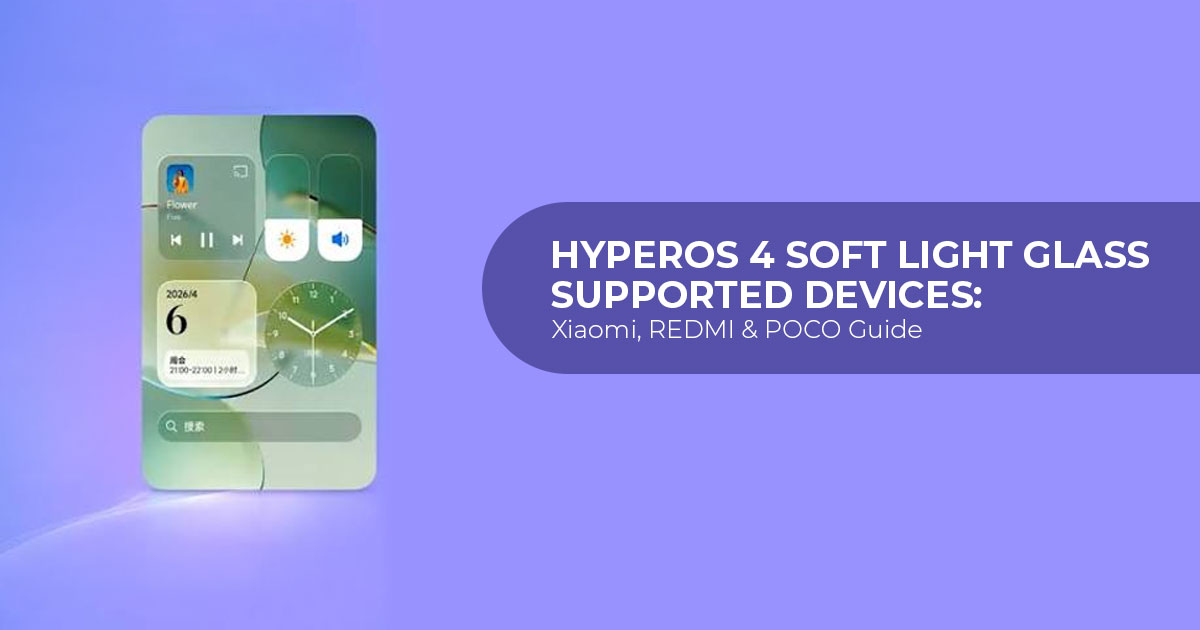
Xiaomi has introduced Soft Light Glass as a new interface material in HyperOS 4, designed to make the software feel more responsive to what is happening on screen. According to Xiaomi, it can respond to surrounding colours, adjust transparency based on the content, and use light effects to react to user interactions. But there is an important detail to keep in mind: the HyperOS 4 Soft Light Glass supported devices list is not the same as the full HyperOS 4 update list. Xiaomi’s launch materials set specific hardware requirements for Soft Light Glass and its interactive lighting features, while a later compatibility chart includes a wider range of devices scheduled to receive HyperOS 4.
As technology experts with over 20 years of experience in hardware and application research and development, we look beyond specifications and marketing claims. We assess products and software based on real-world performance, durability, usability, and value for money. Our goal is to help Xiaomi users, smartphone buyers, tech enthusiasts, and anyone considering a HyperOS 4 upgrade understand what they are actually getting before making a decision. Our recommendations are based on extensive research, component analysis, real-world usability, and industry expertise, so you can choose with confidence whether you care most about performance, reliability, features, or long-term usage.
In this guide, we explain what HyperOS 4 Soft Light Glass actually does, which devices are expected to support it, and why the difference between HyperOS 4 compatibility and full Soft Light Glass support matters.
Quick answer: Xiaomi’s planned list covers selected numbered flagships, MIX foldables, REDMI K and Turbo phones, and specific Xiaomi and REDMI tablets. The first China beta wave began on 14 August 2026, but Xiaomi has not published a dedicated POCO, India, or global Soft Light Glass schedule.
HyperOS 4 Soft Light Glass devices list: what current sources show
- Soft Light Glass is a software interface material, not a physical display coating.
- Xiaomi attributes its model restrictions to hardware-performance limits.
- The Xiaomi 13, Xiaomi 14, Xiaomi 15, and Xiaomi 17 families appear in the wider planned-support chart.
- The REDMI K70 family is listed, but REDMI K70E is excluded.
- The current Xiaomi HyperOS 4 beta schedule explicitly lists Xiaomi MIX Flip 2 in the 17 September Xiaomi MIX Fold 2 is not named in that schedule, so this guide treats its Soft Light Glass support as unconfirmed.
- Xiaomi’s official beta page says model coverage and rollout dates may be adjusted.
What is the HyperOS 4 Soft Light Glass UI?
Xiaomi describes Soft Light Glass as a material that responds to the colour of its surroundings and the properties of on-screen content. It can alter its transparency to preserve readability and use light effects when the user taps or drags interface elements 2.
The official HyperOS 4 page also shows the design alongside flexible lock-screen clocks, stacked notifications, resizable folders, grouped widgets, and updated layouts. Those are related HyperOS 4 interface changes, but they should not all be treated as part of Soft Light Glass itself.
For buyers, Soft Light Glass mainly changes the appearance of the interface and how it responds to touch. Xiaomi has not published stable international test data showing how the effect affects battery life, heat, or performance across every listed model. Those questions should remain open until stable regional builds can be tested.
HyperOS 4 Soft Light Glass eligible devices
The table below follows the wider planned-support chart attributed to Xiaomi and reviewed during fact-checking. Where Xiaomi uses a family name, the chart does not identify every regional SKU or every model within that family.7
| Product Group | Exact Models or Families Shown in the Chart | Status Note |
|---|---|---|
| Xiaomi MIX | Xiaomi MIX Fold 4; Xiaomi MIX Fold 3; Xiaomi MIX Flip 2; Xiaomi MIX Flip | Planned support; current availability may vary depending on the beta rollout wave. |
| Xiaomi Numbered Series | Xiaomi 17 Series; Xiaomi 17T Series; Xiaomi 15 Series; Xiaomi 14 Series; Xiaomi 13 Series | A family-level listing does not confirm that every regional variant will receive the effect at the same time. |
| Xiaomi Civi | Xiaomi Civi 5 Pro | China-market model; no separate global rollout schedule is listed. |
| REDMI K | REDMI K100 Pro Series; REDMI K90 Series; REDMI K80 Series; REDMI K70 Series | REDMI K70E is expressly excluded. |
| REDMI Turbo | REDMI Turbo 5 Max; REDMI Turbo 5; REDMI Turbo 4 Pro | Global equivalents may use different product names; model equivalence does not confirm support. |
| Xiaomi Pad | Xiaomi Pad 8 Pro; Xiaomi Pad 8; Xiaomi Pad 7 Ultra; Xiaomi Pad 7S Pro 12.5 | Only the tablet models explicitly listed in the chart are covered. |
| REDMI K Pad | REDMI K Pad 2; REDMI K Pad | International availability has not been separately confirmed. |
Readers looking for every phone that may receive the operating system should use a separate Xiaomi HyperOS 4 update list. Software-update eligibility does not by itself establish support for this visual material.
Product-name correction: Xiaomi MIX Flip 2 or Xiaomi MIX Fold 2?
Some reports have listed Xiaomi MIX Fold 2 among the devices expected to receive Soft Light Glass. However, Xiaomi’s current HyperOS 4 beta schedule does not name MIX Fold 2, so its support remains unconfirmed.8
Because the two names refer to different devices, this guide does not combine them. It uses Xiaomi MIX Flip 2 where Xiaomi’s current beta schedule provides direct confirmation and treats Xiaomi MIX Fold 2 support as unconfirmed.
HyperOS 4 hardware requirements
Xiaomi’s official HyperOS 4 announcement states that, because of hardware-performance limits, Soft Light Glass and its interactive light effects are intended for:
- phones and tablets using the Snapdragon 8 Elite Mobile Platform or a later qualifying platform;
- phones using the MediaTek Dimensity 9500 or a later qualifying platform; and
- phones using the Xiaomi XRING O1 3nm flagship processor or a later qualifying platform 2. Qualcomm’s official name is Snapdragon 8 Elite Mobile Platform 3. MediaTek uses MediaTek Dimensity 9500 4, while Xiaomi identifies its in-house processor as Xiaomi XRING O1.
Why the hardware note and device chart appear to conflict
The wider chart includes older families such as Xiaomi 13 and REDMI K70, even though those families predate the launch-stage platform thresholds above. Xiaomi has said that HyperOS 4 is still being optimized and that more devices will be added during the beta period.
The sources reviewed do not provide a model-by-model explanation of whether every older device will receive identical Soft Light Glass quality and interactive lighting. In other words, the hardware threshold describes Xiaomi’s launch-stage requirement, while the wider chart reflects planned compatibility as testing and optimization continue. The safest interpretation is therefore:
- the chipset statement describes Xiaomi’s stated hardware condition for the Soft Light Glass material and lighting effects at launch; and
- the wider chart records devices planned for support as optimization expands.
It would be inaccurate to say that every model in the wider chart already has the complete Soft Light Glass effect.
Current HyperOS 4 beta rollout versus planned support
Xiaomi’s official schedule says the first China beta wave began on 14 August 2026. Further waves are scheduled from 27 August 2026 and 17 September 2026. Xiaomi also warns that supported models and timing can be adjusted according to actual conditions.1
| Status | What It Means | Buyer Implication |
|---|---|---|
| China Beta Rollout | Early software is being distributed to eligible devices in scheduled rollout waves. | Beta availability in China does not confirm a stable international release. |
| Wider Planned-Support Chart | Xiaomi intends to expand compatibility across the listed device families. | Rollout timing, availability, and final implementation may vary by individual device. |
| Global or India Availability | No dedicated Soft Light Glass rollout schedule has been published for these regions. | Buyers should verify support for the exact regional model before making a purchase. |
| POCO Compatibility | POCO devices are absent from the support chart reviewed here. | Sharing hardware with a comparable REDMI model should not be treated as official confirmation of POCO support. |
The beta schedule should not be used as an India or global release calendar.
Will POCO phones get HyperOS 4 Soft Light Glass?
Xiaomi has not named POCO models in the current China-market chart. Some POCO phones may share underlying hardware with REDMI devices, but Xiaomi can still vary firmware features by model, memory configuration, or region.
Until Xiaomi publishes a dedicated international compatibility list, Soft Light Glass should not be treated as a confirmed POCO feature. Buyers should make a decision using the software and functions available at purchase.
HyperOS 4 global rollout and India availability
As of 23 August 2026, Xiaomi’s official HyperOS 4 materials provide a China beta schedule, but no exact India or global date for Soft Light Glass. That means the China schedule should not be presented as an international release date.
A general HyperOS 4 release does not necessarily mean every interface feature will arrive on every supported model at the same time. Regional firmware, product naming, and staged deployment can affect availability.
What buyers in India should verify
China-market REDMI phones can use different names internationally. Before ordering, check:
- the complete Indian product name and model number;
- official Xiaomi India warranty coverage;
- the stated operating-system and security-update policy;
- seller authorization; and
- any model-specific HyperOS 4
Soft Light Glass vs Apple Liquid Glass
Apple’s exact name for its interface material is Liquid Glass. Apple says it reflects and refracts what is underneath in real time and changes dynamically to keep attention on the content.5
Xiaomi does not call its material Liquid Glass. Its official name is Soft Light Glass. The two can be compared at a design level, but they belong to different operating systems and compatibility policies.
| Area | Xiaomi Soft Light Glass | Apple Liquid Glass |
|---|---|---|
| Official Name | Soft Light Glass | Liquid Glass |
| Platform Context | Xiaomi HyperOS 4 | Apple operating systems |
| Published Behaviour | Responds dynamically to environmental color, displayed content, and user interaction. | Reflects and refracts surrounding content while dynamically adapting to context. |
| Compatibility Basis | Availability depends on Xiaomi model support and applicable hardware requirements. | Availability depends on Apple’s supported-device and operating-system policies. |
| Buying Relevance | A secondary consideration compared with the phone’s hardware, software-support period, and regional warranty. | A secondary consideration compared with the device’s broader hardware capabilities and ecosystem fit. |
Visual similarity does not establish feature parity or identical performance.
Buying advice for Xiaomi Soft Light Glass supported phones
Existing Xiaomi 13, Xiaomi 14, or Xiaomi 15 owners
A planned interface update alone provides limited reason to replace a working phone. Waiting for the stable regional release avoids buying around an unconfirmed timetable.
An upgrade is easier to justify when it also addresses battery wear, storage limits, camera requirements, network support, or the end of security updates.
Buyers considering a recent Xiaomi flagship
Recent Xiaomi flagship models appear in the earlier HyperOS 4 beta waves, but that does not confirm the timing for every international version. Check the exact model and current regional notice before paying more for a feature that has not reached a stable local build.
REDMI and POCO shoppers
The planned chart includes selected REDMI K and REDMI Turbo products. It does not include POCO. Price, battery, display, camera system, network compatibility, warranty, and the official update policy should carry more weight than this interface effect.
Tablet buyers
The chart covers only Xiaomi Pad 8 Pro, Xiaomi Pad 8, Xiaomi Pad 7 Ultra, Xiaomi Pad 7S Pro 12.5, REDMI K Pad 2, and REDMI K Pad. A tablet purchase should still be based on app support, display size, storage, accessory compatibility, and update coverage.
Price and value
There is no single price for Soft Light Glass because it is a software feature planned across several product families. This guide does not quote device prices because no specific model, storage configuration, market, or retailer has been selected.
When comparing listings, match the price to the exact regional model and configuration. Treat temporary discounts separately from the normal listed price, and do not pay a premium solely on the assumption of a future software feature.
Strengths and limitations of the HyperOS 4 glass effect
| Potential Benefit | Verified Limitation |
|---|---|
| Adds adaptive transparency and interaction-based lighting effects to supported interface elements. | Xiaomi limits availability according to hardware capabilities and individual model compatibility. |
| Extends the visual experience across selected smartphones, foldables, and tablets. | The feature is not available on every HyperOS 4 device. |
| The broader compatibility list includes several older flagship device families. | Xiaomi has not confirmed that every older supported model will deliver identical visual effects or feature parity. |
| Xiaomi provides a staged beta rollout schedule, giving users an indication of when testing should begin. | The published schedule applies to China and remains subject to adjustment. |
| Equivalent hardware may also be sold under global Xiaomi and POCO product lines. | Rollout schedules for POCO, India, and other global markets remain unconfirmed. |
Stable international builds still need independent testing before making conclusions about battery use, thermal behaviour, or sustained smoothness.
Frequently asked questions
Which Xiaomi phones will get HyperOS 4 Soft Light Glass?
The planned chart lists Xiaomi 13, Xiaomi 14, Xiaomi 15, Xiaomi 17, and Xiaomi 17T families; selected Xiaomi MIX products; Xiaomi Civi 5 Pro; REDMI K70 through REDMI K100 Pro families; and selected REDMI Turbo phones. The table above records the exact families and exclusions shown in the reviewed chart.
Will Xiaomi 13 get the HyperOS 4 glass effect?
The Xiaomi 13 Series appears in the wider planned-support chart. Xiaomi has not confirmed an exact international release date or identical effects for every Xiaomi 13 model.
Will REDMI K70 get Soft Light Glass?
The REDMI K70 Series is listed, but REDMI K70E is excluded. Timing and implementation details for the other K70 models have not been published by region.
Is every HyperOS 4 phone getting Soft Light Glass?
No. HyperOS 4 update eligibility and Soft Light Glass compatibility are separate questions.
When will HyperOS 4 Soft Light Glass launch in India?
Xiaomi has not published an exact India date for this specific interface material. The China beta schedule should not be presented as an India schedule.
Is HyperOS 4 based on Android 17?
Xiaomi has a separate official Android 17 Developer Preview program. However, the HyperOS 4 China page reviewed for this article does not state that every HyperOS 4 build for every listed model uses Android 17.
Check the Android version and HyperOS build shown for the exact regional device instead of assuming they are the same.
Final verdict: should Soft Light Glass affect a Xiaomi purchase?
Soft Light Glass provides useful context about Xiaomi’s interface direction, but current regional uncertainty makes it a secondary buying consideration.
Existing owners of a listed device can wait for a stable regional build. New buyers should prioritize the exact model number, update commitment, battery, cameras, network compatibility, warranty, and price. If Soft Light Glass is essential, wait for Xiaomi to confirm it for the exact device and region before purchasing.
Check current Xiaomi prices on Amazon US
Amazon US listings may include imported Xiaomi phones. Confirm the full model number, supported carrier bands, ROM, seller warranty, and return policy before ordering.
Check current Xiaomi phone prices on Amazon US →
View Xiaomi and REDMI offers on Amazon India
Model names in China do not always match Indian product names. Verify the Indian model number, official warranty, update policy, storage configuration, seller, and current listed price.
View current Xiaomi and REDMI offers on Amazon India→
Have questions about HyperOS 4, Soft Light Glass, or whether your Xiaomi device will get the full experience?
Drop your questions in the comments—we’ll be happy to help clear up any doubts.
If you found this guide useful, follow us for more honest tech updates, reviews, and buying advice. If there’s a Xiaomi device or feature you want us to cover next, let us know in the comments.
Disclaimer
This blog post reflects our research, analysis, and opinions based on available product information, user feedback, and industry knowledge. It should not be taken as the official position of any brand, manufacturer, or company mentioned here. We make every effort to keep this guide accurate, but product specifications, pricing, and availability may change after publication. We recommend double-checking important details before making a purchase.
Some links in this article may be affiliate links. If you choose to buy through these links, we may earn a small commission at no extra cost to you. This helps support our work and allows us to keep publishing in-depth, unbiased reviews. Affiliate partnerships never influence our recommendations.
Opinions expressed by readers are their own and do not necessarily reflect ours. We are not responsible for outcomes resulting from the use of information on this site. Please seek professional advice where appropriate.
All product names, logos, and brands mentioned are the property of their respective owners. These names are used for identification and informational purposes only and do not imply endorsement.