
Editorial Disclosure: Retail availability for iPhone Duo is scheduled to begin on October 23, 2026. This guide uses Apple's published specifications, launch announcement, regional pricing pages, and available repair guidance. Delivery estimates and promotional prices are time-sensitive and should be checked again before publication. Claims that require independent testing—such as sustained thermal performance, mixed-use battery life, under-display camera clarity, and long-term crease wear—are identified as unverified or still to be tested.
Introduction
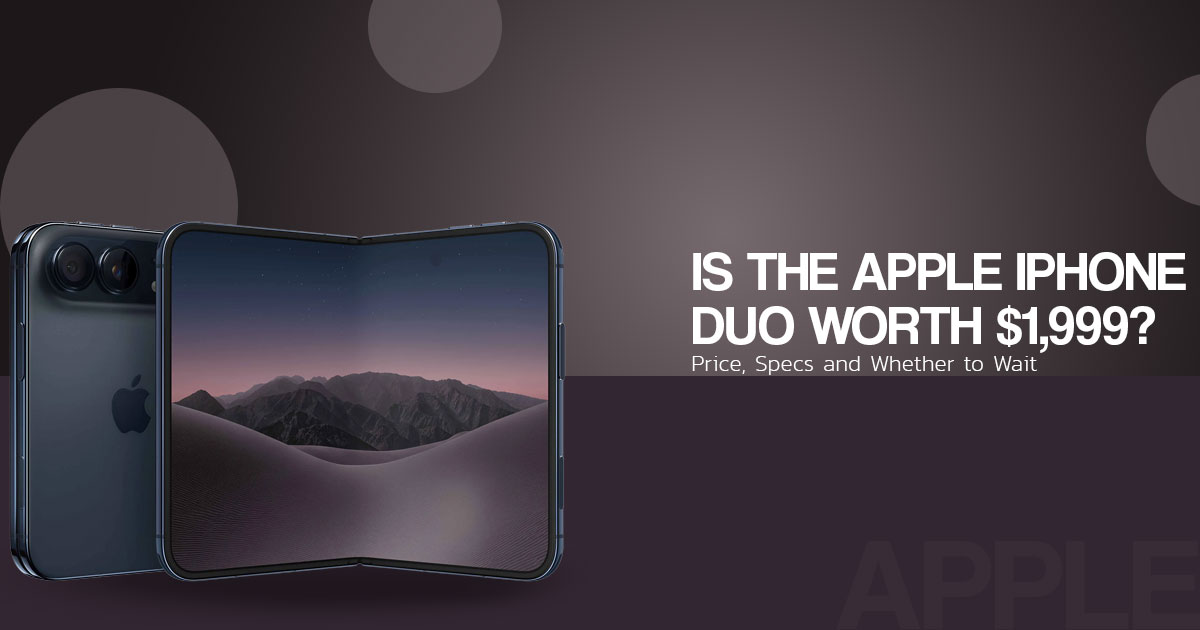
Apple’s first foldable phone arrives with two numbers that complicate any impulse upgrade: a starting iPhone Duo price of $1,999 in the United States (₹2,99,900 in India) and an online delivery estimate stretching into late January 2027. Pre-orders opened on October 16 ahead of the October 23 retail launch. Reports published after pre-orders opened said delivery estimates moved into late January within the first hour, although availability can vary by configuration and location. Apple has not disclosed unit volumes, so the relative contributions of demand and supply constraints remain unclear.
This Apple iPhone Duo buyer’s guide examines what the foldable design could change in daily work, where its thin chassis may involve hardware compromises, and how it compares with the iPhone 18 Pro Max and Samsung Galaxy Z Fold8. It also looks at US financing, Apple’s India EMI options, repair-cost uncertainty, and whether to wait for a later delivery or consider an alternative available sooner.
Our approach
We assess products through research into hardware, software, durability, and value for money. This guide is for iPhone users considering their first foldable, professionals who need a larger screen for work, technology enthusiasts comparing foldable phones, and buyers weighing the cost of a premium device against its long-term usefulness.
We distinguish Apple’s published specifications and prices from third-party reports and our own analysis of design trade-offs and everyday usability. Where a claim needs independent testing—such as sustained performance, repair costs, or long-term crease wear—we say so rather than presenting an estimate as a confirmed result.
Verified Specifications Reference
The figures below are drawn from Apple’s official US and India specification pages and its launch announcement. Where Apple does not publish a figure, or a detail comes from third-party reporting rather than Apple, that distinction is noted.
| Attribute | Verified Specification |
| Model & Finishes | Apple iPhone Duo — Navy Blue, Sand |
| Announcement / Pre-Order / Launch | Announced Sept. 9, 2026; pre-orders Oct. 16, 2026; retail launch Oct. 23, 2026 (70+ countries; 28 more Oct. 30) |
| Current Online Delivery Window | January 25–29, 2027 for new Apple Store orders (check local pickup starting Oct. 24) |
| Inner Folding Display | 7.6-inch diagonal (7.58-inch rectangle) Super Retina XDR OLED, 2670 × 1878 px (430 ppi, ~1.42:1 ratio), 120Hz ProMotion, Always-On, 1,000 nits typical / 1,600 nits HDR / 3,000 nits outdoor peak, nano-texture polymer surface |
| Outer Cover Display | 5.4-inch diagonal (5.36-inch rectangle) Super Retina XDR OLED, 2034 × 1398 px (460 ppi, matched aspect ratio), 120Hz ProMotion, Always-On, up to 3,000 nits outdoor peak |
| Stylus Support | Apple Pencil (USB-C) supported on both displays via a software update rolling out later in 2026 |
| Dimensions & Weight | Open: 164.6 × 117.8 × 5.2 mm / Closed: 84.1 × 117.8 × 11.3 mm / Weight: 254 g (8.96 oz) |
| Materials & Ingress Rating | Mirror-polished Grade 5 titanium frame, 3D-printed micro-blasted titanium hinge cover (100+ component hinge), Ceramic Shield 2 front, Ceramic Shield back, IP68 (up to 6m for 30 mins under IEC 60529) |
| Chip & Memory | Apple A20 Pro (2nm; 6-core CPU, 7-core GPU with hardware ray tracing, dual 16-core Neural Engine), custom vapor chamber; RAM not published by Apple (third-party reports cite 12GB, unconfirmed) |
| Rear Cameras | 48MP Fusion Main (26mm, f/1.6, sensor-shift OIS; enables 12MP 2x optical-quality Telephoto at 52mm) + 48MP Fusion Ultra Wide (13mm, f/2.2, 120° FOV, 48MP macro); 2x optical zoom in, 4x optical-quality range, up to 10x digital zoom |
| Front Cameras | Outer: 12MP Center Stage (f/2.2, 4K60 Dolby Vision) / Inner: Under-display FaceTime camera (f/1.8, 1080p up to 60fps; MP count undisclosed) |
| Battery & Charging | Dual lithium-ion cells; third-party reports citing regulatory filings list 4,883 mAh (not published by Apple); up to 24 hrs typical use, 31 hrs inner-display video playback (26 hrs streamed), 44 hrs outer-display video playback (37 hrs streamed); fast charging up to 50% in around 20 mins wired or 30 mins wirelessly under Apple’s stated adapter conditions |
| Connectivity & Biometrics | Side-button Touch ID (no Face ID), Apple C2 5G modem (sub-6 + US mmWave), Apple N1 wireless chip (Wi-Fi 7, Bluetooth 6, Thread), USB-C (10 Gbps), satellite SOS/Messages, Dual eSIM only worldwide |
| Software at Launch | iOS 27.1; foldable-specific multitasking features. Feature availability may vary by app, software version, and region. |
| Official US Pricing | 256GB: $1,999 / 512GB: $2,199 / 1TB: $2,599 / 2TB: $3,199 |
| Official India Pricing | 256GB: Rs 2,99,900 / 512GB: Rs 3,24,900 / 1TB: Rs 3,74,900 / 2TB: Rs 4,49,900 |
Display Geometry and Daily Ergonomics: Why the Wider Format Matters
Some book-style foldables have used narrow cover screens or nearly square inner displays, which can affect typing comfort and the way widescreen video fits the screen. The iPhone Duo takes a different approach with a wider cover display and a more rectangular inner screen.
Closed, the phone measures 84.1 mm wide—about 6 mm wider than an iPhone 18 Pro Max, yet over 45 mm shorter—giving the 5.4-inch cover screen more than 90% of the viewing area of an iPhone 18 Pro. Replying to messages, triaging email, or checking maps on the outside screen feels like using a wide compact phone rather than peering through a narrow strip. Unfolded, the 7.6-inch inner OLED runs at 2670 × 1878 pixels (430 ppi), which works out to roughly a 1.42:1 landscape aspect ratio. Because both screens share virtually the same proportions, apps scale cleanly from the cover display to a canvas with 50% more screen area than the 6.9-inch iPhone 18 Pro Max. Side-by-side documents, spreadsheets, and 16:9 videos make far better use of that rectangular space than a square foldable display allows.
Apple is placing much of the phone’s appeal on crease reduction. Apple says the inner display’s nano-texture finish reduces glare and reflections and minimizes crease visibility. The company also describes a precision-engineered hinge with more than 100 components and internal support ribs. These are manufacturer descriptions, not proof that the fold line will remain subtle after years of use. Long-term crease wear still needs independent testing over time.
One welcome addition is stylus support. Apple says the USB-C Apple Pencil will work with the iPhone Duo, with support arriving through a software update later in 2026. Do not assume it will be available on day one.
Build, Weight, and Repair Risk: Titanium Meets Folding Physics
At 5.2 mm thick when open, the iPhone Duo is the thinnest device to carry the iPhone name, edging past the 5.64 mm iPhone Air. Folded shut, it measures 11.3 mm thick and weighs 254 grams. While 254 grams makes it the heaviest iPhone on paper, context matters: a bare iPhone 18 Pro Max weighs 249 grams. In a coat or trouser pocket, the Duo weighs just 5 grams more than Apple’s largest slab phone, though it feels noticeably denser than Samsung’s 201-gram Galaxy Z Fold8.
The Duo carries an IP68 dust- and water-resistance rating under IEC standard 60529, tested up to 6 metres of water for 30 minutes. Apple also lists Ceramic Shield 2 on the outer screen, Ceramic Shield on the rear glass, and a Grade 5 titanium frame. Water resistance is not permanent and should not be treated as a guarantee against damage.
Apple lists the iPhone Duo in two finishes:
- Navy Blue: A dark blue finish with matching design details.
- Sand: A light, warm finish with matching design
Apple lists the iPhone Duo Case at $79 in the United States and the iPhone Duo Folio with Kickstand at $129. Check Apple’s India store for current local prices before buying. The accessories use magnetic alignment for MagSafe and Qi2 charging; confirm compatibility and charging speed on the current product page.
A bare foldable can carry a high repair risk. Exact out-of-warranty costs for the inner display, outer display, back glass, and other damage were not confirmed against a stable, model-specific Apple India price list during this review. Apple’s service guidance says final estimates may depend on inspection, taxes, parts availability, and service location. Check Apple’s current service estimate or contact an Apple Authorised Service Provider before budgeting for repairs or AppleCare+.
Performance, Biometrics, and iOS 27.1 Software
Powering both displays is Apple’s 2nm A20 Pro, the same processor used in the iPhone 18 Pro line. Apple says the Duo has an advanced thermal-management system with a custom vapor chamber and claims up to 35% better sustained performance than the iPhone 17 Pro. Apple does not publish the phone’s RAM capacity on its specification page; third-party reports cite 12GB, which should be treated as unconfirmed. Independent sustained-load tests are needed to establish real-world performance and thermal behaviour.
To keep both halves thin without sacrificing battery volume, Apple dropped Face ID entirely and placed a Touch ID fingerprint sensor in the side button (with optional Apple Watch unlock). In everyday use on a folding phone, this is arguably a practical gain rather than a step backward: a single side sensor authenticates unlocks and Apple Pay reliably whether the phone is closed in one hand, fully open in two hands, or resting half-folded on a desk.
Software determines whether a 7.6-inch screen saves time or merely stretches mobile layouts. Apple highlights features such as side-by-side apps and flexible viewing angles for the foldable display; check the current iOS release notes for the exact feature set available on your device and in your region.
- Split View and Dual Windows: Apple’s foldable software experience supports side-by-side app use and multitasking across the larger The precise options can depend on app support and the installed software version.
- Flexible Viewing Angles: Apple highlights flexible viewing angles and hands-free FaceTime as part of the foldable Check app compatibility and the current software version for the features you plan to use.
- Siri and Apple Intelligence: Feature availability can vary by region and Buyers considering the phone for AI workflows should check Apple’s current availability notes for their country and preferred language; do not assume every feature is available in every market.
Camera System: What a 5.2 mm Chassis Gives Up
The camera system involves a clear trade-off. The iPhone Duo has no dedicated telephoto camera and does not include the variable physical aperture introduced on the iPhone 18 Pro series.
Instead, rear photography relies on two 48MP sensors:
- 48MP Fusion Main (26mm, f/1.6, sensor-shift OIS): Captures 24MP defaults or full 48MP stills and crops the center of the sensor for a 12MP optical-quality 2x shot at 52mm.
- 48MP Fusion Ultra Wide (13mm, f/2.2, 120° field of view): Matches the Ultra Wide hardware on the iPhone 18 Pro models, including sharp 48MP macro capture.
Read Apple’s zoom wording carefully before buying: it advertises a ‘4x optical-quality zoom range’, spanning from the 0.5x Ultra Wide camera to the 2x optical-quality crop from the main sensor.
Maximum optical-quality zoom in is 2x; still-photo digital zoom reaches up to 10x, while video digital zoom reaches up to 6x. By comparison, the iPhone 18 Pro Max has a dedicated 48MP telephoto camera with up to 8x optical-quality zoom. Check Apple’s current specification page for the exact zoom and recording limits.
Selfies and video calls split duties across two separate front cameras—another detail worth understanding clearly. On the outer cover display sits a sharp 12MP Center Stage camera (f/2.2) capable of orientation-independent framing and 4K60 Dolby Vision recording. Beneath the inner folding screen hides an under-display FaceTime camera (f/1.8) capped at 1080p video, prioritizing an uninterrupted reading canvas over raw selfie detail.
With Duo Preview, you can open the phone, use the outer screen as a live viewfinder, and take self-portraits with the rear cameras. Apple’s published specifications list 4K Dolby Vision recording at up to 60 fps. Recording options can vary by camera and mode, so check the current specification page for the exact limits.
Battery Life, Charging Adapters, and the eSIM-Only Rule
Apple uses two lithium-ion battery cells, one on each side of the phone. Third-party reports citing regulatory filings put their combined capacity at 4,883 mAh, but Apple does not publish that capacity on its specification page. Apple rates the iPhone Duo for up to 24 hours of typical use when both displays are used equally, up to 31 hours of video playback on the inner screen (26 hours streamed), and up to 44 hours on the outer screen (37 hours streamed). These are Apple’s test figures; real battery life will depend on signal strength, settings, apps, and how often each display is used.
Fast charging requires checking your existing power bricks:
- Wired USB-C: Reaches 50% in roughly 20 minutes, provided you supply a 60W-capable or higher USB-C PD adapter and compatible cable (sold separately).
- Wireless MagSafe / Qi2: Reaches 50% in roughly 30 minutes when using a MagSafe Charger paired with a 35W or higher power adapter.
One important detail for international travellers: the iPhone Duo is eSIM-only worldwide, including in India, Europe, and Asia, with no physical SIM tray. Apple says eSIM is supported by more than 500 carriers globally. Before travelling, check that your home carrier and destination provider support eSIM activation and transfer, and arrange a travel eSIM if you normally buy a physical SIM card at the airport.
Competitor Comparison: US Parity vs. India’s Wide Price Gap
Most prospective buyers are weighing two alternatives: staying with Apple’s flagship slab—the iPhone 18 Pro Max—or considering Samsung’s Galaxy Z Fold8 as an Android foldable. Prices, regional configurations, and availability can differ, so confirm the current official listing before making a purchase.
| Feature | Apple iPhone Duo | Apple iPhone 18 Pro Max | Samsung Galaxy Z Fold8 |
| US Starting Price (256GB) | $1,999 | $1,299 | Check Samsung’s current US price. |
| India Starting Price (256GB) | Rs 2,99,900 | Rs 1,79,900 | ₹1,74,999 displayed selling price; ₹1,84,999 MRP on Samsung India when checked |
| Main Display | 7.6-inch OLED (~1.42:1), 120Hz, nano-texture | 6.9-inch OLED slab, 120Hz | 7.6-inch inner Dynamic AMOLED 2X, 120Hz |
| Cover Display | 5.4-inch wide OLED, 120Hz | Single 6.9-inch screen | 5.5-inch cover display, 120Hz |
| Thickness & Weight | 5.2 mm open / 11.3 mm closed / 254 g | 8.75 mm / 249 g | 4.5 mm open / 9.7 mm closed / 201 g |
| Water & Dust Rating | IP68 (dust-tight + 6m water) | IP68 (dust-tight + 6m water) | IP48 |
| Chipset | 2nm Apple A20 Pro (RAM capacity not published by Apple) | 2nm Apple A20 Pro (RAM capacity not published by Apple) | Snapdragon 8 Elite Gen 5 for Galaxy |
| Rear Cameras | 48MP Main (2x crop) + 48MP Ultra Wide | 48MP variable-aperture Main + 48MP Ultra Wide + 48MP 4x/8x Telephoto | 50MP Wide + 50MP Ultra Wide |
| Stylus Support | Apple Pencil (USB-C) (late-2026 update) | None | No S Pen support |
| Biometrics | Side-button Touch ID | Face ID | Side-button fingerprint sensor |
| Availability (Oct. 2026) | Online orders shown with January 25–29, 2027 estimate; check live availability. | Check current retailer stock. | Check current retailer stock. |
What the Regional Pricing Gap Means
The US price comparison depends on Samsung’s current Galaxy Z Fold8 listing, so confirm both prices before buying. Samsung’s standard Fold8 is lighter on paper at 201 g, while Apple lists the Duo at 254 g. Apple counters with an IP68 rating, a nano-texture inner display, planned USB-C Apple Pencil support, and integration with iOS. Prices and availability can change.
In India, the iPhone Duo starts at ₹2,99,900, compared with ₹1,79,900 for the iPhone 18 Pro Max. Samsung India’s store listed the Galaxy Z Fold8 at ₹1,74,999, against an MRP of ₹1,84,999, when checked for this review. Prices and promotions can change, so confirm the live price before publishing or buying. If you do not need a foldable screen for daily work, the iPhone 18 Pro Max is the less expensive option and offers a dedicated telephoto camera.
Storage Tiers, Financing Traps, and How to Buy
Because storage cannot be upgraded later, match your capacity tier to what stays locally on your phone:
| Storage Tier | US Official Price | India Official Price | Practical Buyer Fit |
| 256GB | $1,999 | Rs 2,99,900 | Best for most buyers: Plenty for Split View apps, documents, streaming media, and iCloud-synced photo libraries. |
| 512GB | $2,199 | Rs 3,24,900 | Sensible travel upgrade (+$200 / +Rs 25,000): Worthwhile if you store downloaded movies for flights, large offline game installs, or years of local photos. |
| 1TB | $2,599 | Rs 3,74,900 | Video & heavy local workflows: Useful if you keep large 4K video files and other media on the phone. Recording modes and frame rates vary by camera and mode. |
| 2TB | $3,199 | Rs 4,49,900 | Specialist archive tier: Crosses laptop and camera-body pricing; unnecessary when USB-C 10 Gbps external SSDs cost a fraction of the $1,200 / Rs 1.5 lakh jump over base storage. |
Financing Fine Print: Check India’s EMI Tenure and Total Repayment
- In the US: Qualified buyers can spread the base model across 24 months at $83.29 per month at 0% APR through Apple Card Monthly Installments, subject to eligibility and checkout terms. Apple also offers Apple Upgrade, a Klarna-backed lease starting at $57.99 per month for a 24-month term. This is a lease rather than a standard purchase-financing plan, so check the return, buyout, and early-termination terms before signing. Carrier trade-in credits are separate promotions and usually depend on eligible devices, plans, and bill-credit conditions.
- In India (Important EMI Check): Apple’s India store offers up to Rs 7,000 instant cashback on eligible ICICI Bank, Axis Bank, and American Express cards (minimum spend Rs 10,001) and up to Rs 81,500 via Apple Trade In. However, read the EMI tenure carefully before clicking buy:
- Apple’s India store may display monthly instalments and eligible-card offers, but the amount, tenure, interest, processing fees, and total repayment depend on the offer available at Use the final checkout summary and lender terms rather than relying on a static figure in an article.
- Apple’s India store has also displayed a ₹26,574-per-month figure for the 256GB That figure alone does not establish the tenure, interest rate, fees, or total repayment. Do not multiply it by an assumed 12-month term or describe the plan as No-Cost EMI without confirming the final checkout summary and lender terms.
Realistic Stock Strategy Ahead of Launch Week
If you missed the October 16 pre-order opening window and do not want to wait until late January 2027, avoid paying inflated secondary-market markups:
- Check Apple Store Pickup Starting October 24: While unreserved walk-in units on launch day (October 23) are expected to be scarce, Apple’s online storefront explicitly prompts shoppers to check back on Saturday, October 24, for local retail pickup allocations.
- Monitor separate retail and carrier batches: authorised retail partners and carriers may receive inventory independently of Apple’s online Delivery estimates can change as inventory is allocated, but reports of earlier shipping windows are not a guarantee. Check the retailer’s current stock and delivery estimate before travelling or paying a resale premium.
- Buy from Apple or an authorised retailer, and confirm the seller’s status, warranty coverage, and AppleCare+ eligibility before paying:
Frequently Asked Questions
Why are new iPhone Duo orders delayed until January 2027?
Online delivery estimates moved to January 25–29, 2027 within the first hour of pre-orders opening on October 16, according to published launch-week reporting. The delay may reflect strong demand, limited early supply, or both. Apple has not published unit volumes, so the precise cause and scale of the delay remain uncertain. Delivery estimates can change by location and configuration.
Is the iPhone Duo display completely crease-free?
Apple says the nano-texture finish reduces glare and minimizes crease visibility. It has not promised a crease-free display, and long-term durability cannot be judged from launch specifications alone. Independent testing over months of repeated folding will be needed to assess how the panel holds up.
Does the iPhone Duo support a stylus or Face ID?
Apple says the USB-C Apple Pencil will work with the iPhone Duo through a software update later in 2026. The phone does not include Face ID; authentication relies on Touch ID integrated into the side button.
Can I use a physical nano-SIM card in the iPhone Duo?
No. Every regional model of the iPhone Duo—including units sold in India and Europe—uses Dual eSIM exclusively and has no physical SIM tray.
Verdict: Should You Buy the Apple iPhone Duo?
On paper, the iPhone Duo addresses several foldable-phone concerns with a 5.4-inch cover screen, a 7.6-inch inner display, an IP68 dust- and water-resistance rating, and side-button Touch ID. These features may suit buyers who want a larger workspace in an iPhone, but real-world comfort and long-term durability still need hands-on assessment.
Even so, paying $1,999 / Rs 2,99,900—plus any protection plan and a potentially long delivery wait—makes sense only if you expect to use the unfolded screen often.
- Buy the iPhone Duo if: You often read long PDFs, annotate documents, review spreadsheets, or use side-by-side apps on the move and want a larger screen in one iOS device. Budget for protection, and be prepared for delivery estimates to change.
- Buy the iPhone 18 Pro Max instead if: You want a conventional flagship, rely on a dedicated telephoto camera or variable-aperture photography, need a physical SIM in your market, or would rather spend less. Although it shares the A20 Pro chip, real-world sustained performance should be judged from testing rather than the processor name alone.
- Consider Samsung’s Galaxy Z Fold8 if: You are comfortable with Android and want a lighter foldable. Samsung India’s store listed it at ₹1,74,999 when checked, against an MRP of ₹1,84,999. Prices and stock change, so confirm the current listing before buying.
Have a question about the iPhone Duo’s price, cameras, battery life, or whether a foldable is right for you? Leave a comment and tell us what you are deciding between. We’ll do our best to answer with useful details. Follow us for more practical technology reviews and buying advice.
***Disclaimer***

This article is based on our research, analysis, available product information, user feedback, and industry knowledge. It is not an official statement from any brand or manufacturer mentioned in the article. Product specifications, prices, software features, and availability can change. We do our best to keep the information up to date, but please check the latest details with the manufacturer or retailer before making a purchase.

Some links in this article may be affiliate links. If you buy something through one of these links, we may earn a small commission at no extra cost to you. These commissions help support the site and our work. They do not affect how we assess or discuss products. Comments and opinions shared by readers belong to the people who post them and do not necessarily represent our views. Information on this site is provided for general purposes, and we cannot guarantee a particular result from using it. Where professional advice is needed, consult a qualified professional.

All product names, logos, and trademarks belong to their respective owners. We use them only to identify the products and companies discussed and do not imply endorsement or affiliation.