
| Thickness | Weight | Wireless | Wired | Price |
| 6.75 mm
Was 6.0 mm |
105 g
Was 98 g |
20 W
Compatible Xiaomi phones |
27 W
Was 22.5 W |
¥299
Unchanged |
01 The simple version of events
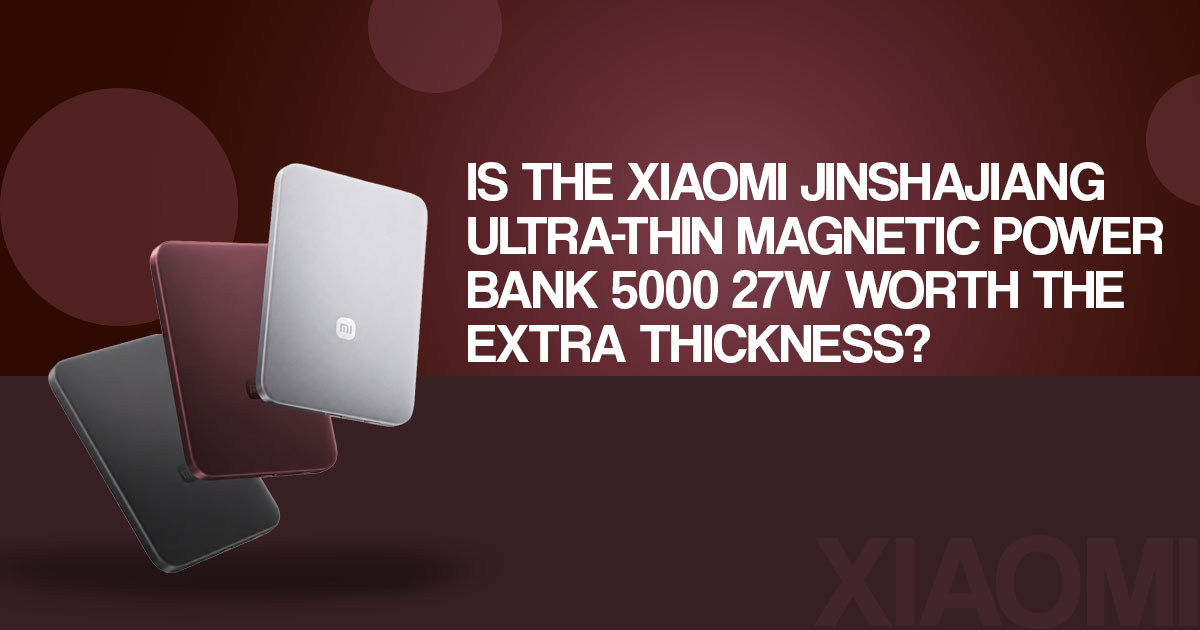
On 16 October, Xiaomi listed a new power bank on its Youpin storefront in China: the Xiaomi Jinshajiang Ultra-Thin Magnetic Power Bank 5000 27W. It costs 299 yuan and looks much like the earlier 6 mm model, though Xiaomi has not explicitly described the new unit as a replacement. The company has said nothing about selling it elsewhere.
That last point shapes everything below. The earlier 6 mm version is available outside China, including in India, where it went on sale in September 2026. The new 6.75 mm version has no announced international launch. For most readers, then, this is not a purchase decision yet; it is a look at a China-market product whose overseas availability and price remain unknown.
What follows is a specification analysis, not a hands-on review. The discussion draws on Xiaomi’s published product information, its rated-capacity figures, public material about GB 47372-2026 and the product’s CCC certification details. We have not tested a review unit, so real-world performance remains unverified.
With over 20 years of experience in hardware and application R&D, we assess products for performance, durability, reliability and value for money. Our analysis helps Xiaomi users, iPhone owners and frequent travellers make informed decisions based on thorough research, practical usability and industry expertise.
But here is the question worth asking: what does an extra 0.75 mm of thickness actually buy you? The answer may matter more than the headline specifications suggest. Read on to see what Xiaomi’s published data reveals—and what it still leaves unanswered.
02 The 0.75 mm tax
The new model is thicker and heavier, while its published rated energy is slightly lower. The clearest gains are output power and the cited safety standard—not battery capacity.
| Specification | 6.0 mm (First Gen) | 6.75 mm (New) | Change |
| Thickness | 6.0 mm | 6.75 mm | +0.75 mm |
| Weight | 98 g | 105 g | +7 g |
| Footprint | 98.5 × 71.5 mm | 101 × 71.5 mm | +2.5 mm tall |
| Magnetic Wireless Output | 15 W (Xiaomi 17 series) | 20 W max (compatible Xiaomi; broader support unconfirmed) | +5 W |
| USB-C Output | 22.5 W | 27 W | +4.5 W |
| Rated Energy | 18.58 Wh | 18.38 Wh | −0.20 Wh |
| Safety Standard | GB 31241 / GB 4943.1 | Adds GB 47372-2026 | New |
| Launch Price | ¥299 | ¥299 | Flat |
| Colours | Black, silver, orange | Black, silver (burgundy reported) | Reworked |
Generational deltas, from Xiaomi’s China listing and the first-generation global specification sheet. Prices are launch prices in China.
The chassis gained 0.75 mm and 7 g, while rated energy fell by 0.20 Wh—about 1%. That small difference may reflect rating or measurement conditions, so it is not worth over-interpreting. The important point is that the extra thickness does not buy more rated energy. It may reflect design choices around power delivery and safety, but Xiaomi has not publicly explained what accounts for the added thickness, so that connection should be treated as an inference rather than a confirmed design rationale.
The 2.5 mm of extra height comes from somewhere too. Xiaomi’s new figure is 101 mm against the old 98.5 mm, which nudges it closer to the height of a large camera island. On a 6.1-inch phone that is still fine. On a compact phone it is starting to be a visible appendage rather than an invisible one.
If you own the 6 mm model, the upgrade offers 5 W more listed wireless output, 4.5 W more wired output and a newer cited safety standard, in exchange for a thicker, heavier device. Whether that trade-off is worthwhile depends on your phone and charging habits. The unchanged launch price does not, by itself, explain Xiaomi’s pricing strategy.
03 Where the watts actually go
Here is the number almost no power-bank article prints, and Xiaomi publishes it in its own listing: rated output capacity by voltage tier.
| Output Tier | Rated Capacity | Implied Energy Delivered | What It Powers |
| 5 V / 3 A | 3,000 mAh | 15.0 Wh | Slow charge, small devices |
| 9 V / 3 A | 1,400 mAh | 12.6 Wh | The 27 W fast-charge mode |
| 11 V / 2.45 A | 1,100 mAh | 12.1 Wh | Xiaomi’s higher-voltage fast charge |
Rated output capacity as listed for the 6.75 mm model. Watt-hours are arithmetic — capacity multiplied by voltage — not a manufacturer figure.
The pattern matters, but the figures need context. The listed output energy falls from 15.0 Wh at 5 V to 12.6 Wh at 9 V and 12.1 Wh at 11 V. Voltage conversion and other losses reduce the energy delivered to the phone. Compared with the 5 V figure, the 11 V tier delivers about 2.9 Wh less—roughly 19% less—while the 9 V tier delivers 2.4 Wh less. Fast charging buys speed, not more usable energy.
Now convert that into something you can feel. A typical 5,000 mAh phone battery stores about 19 Wh. A Xiaomi 18 Pro, with its 7,000 mAh cell, stores roughly 26.5 Wh.
|
79% Of a 5,000 mAh phone, charging at 5 V |
64%
Of the same phone, at the 11 V output tier |
46% Of a Xiaomi 18 Pro, at the 11 V output tier |
So the new pack is not a spare battery. For a phone with a 26.5 Wh battery, the 12.1 Wh output figure equals about 46% of the battery’s stored energy. For a typical 19 Wh phone, it works out to roughly 64% before real-world charging losses. Actual charge percentages will vary and may be lower.
A 5,000 mAh label is a tank size. It has never been a range.
WORTH MORE THAN ANY HEADLINE WATTAGE ON THE BOX
Two honest caveats. Rated capacity is measured under conditions the manufacturer chooses, so treat these percentages as arithmetic rather than lab results. And Xiaomi publishes no wireless rated capacity at all — inductively coupled charging loses more to heat than a cable does, which is why 20W magnetic wireless charging will leave you further short than 20 W of cable output.
04 Twenty watts, one large asterisk
Xiaomi’s listing advertises 20 W of magnetic wireless charging and a tier list of 5, 7.5, 10, 15 and 20 W. What it does not publish — at least in the material available in English — is which phones get the top tier.
The previous generation offers a useful clue. Xiaomi’s published specifications list 15 W wireless output and add this footnote: “15 W wireless fast charging is supported on the Xiaomi 17 Series.” Independent testing of that model reported a 7.5 W ceiling on non-Xiaomi phones. Xiaomi has not published a full compatibility table for the new model, so it is safest to treat 20 W support beyond compatible Xiaomi phones as unconfirmed.
If you use an iPhone or Pixel that supports faster wireless charging, do not assume this power bank will deliver the phone’s maximum rate. The new model is not listed as Qi2-certified in the material reviewed, and Xiaomi has not confirmed its wireless output for these phones. The previous model was reported to top out at 7.5 W on non-Xiaomi phones; that figure should not be treated as a confirmed specification for the new model.
In practical terms, the 20 W headline appears most relevant to compatible Xiaomi phones, while the product is currently listed for China only. Until Xiaomi publishes a compatibility list, buyers should not assume that other phones will reach the top wireless tier.
The cable is the equaliser
The USB-C port is where the new model earns its keep for everyone else. It negotiates 5 V/3 A, 9 V/3 A and 11 V/2.45 A, supports PD, QC and BC, and Xiaomi explicitly notes that iPhones work. A short USB-C to USB-C cable paired with the magnetic mount is a practical arrangement: the magnets hold the pack in place, while the cable handles charging at up to 27 W. We have not tested temperatures or throttling, so real-world thermal performance remains unknown.
Just don’t assume the jump from 22.5 W to 27 W will feel dramatic. On a phone that accepts 27 W or more, the higher ceiling may shorten a partial top-up, but the size of the gain depends on the phone, battery level and charging conditions; we have not measured it. On a phone that caps lower, the extra 4.5 W may not be used at all.
05 The nail test: what a 2026 safety certificate actually means
GB 47372-2026 is China’s new national safety standard specifically for power banks. Xiaomi cites the standard alongside CCC certificate number 2026010914894094. The listing does not establish that the standard is the reason for the product refresh, so that link should not be presented as confirmed.
Two dates matter. The standard was published on 31 March 2026 and takes effect on 1 April 2027, after a twelve-month transition. During the transition, certification can proceed under the old or new rules; existing certificates must be updated to meet the new requirements by the effective date. Xiaomi is adopting the new standard ahead of the deadline, according to the product information cited here.
| Test / Attribute | Details / Interpretation |
| Nail Penetration | Published summaries describe a nail-penetration test intended to assess severe internal short-circuit abuse; exact parameters are not independently confirmed here. |
| Thermal Abuse | The standard includes a high-temperature abuse test. Do not interpret a test requirement as proof that every unit is risk-free. |
| Crush Resistance | Published summaries describe mechanical compression testing; the precise test setup can vary by cell construction. |
| Aging | Some summaries describe checks related to lithium plating after repeated cycling. Treat this detail as reported unless verified against the full standard. |
| Traceability | Product information refers to traceability features; confirm the actual unit’s markings and documentation. |
| Energy Rating | 18.38 Wh — below the commonly cited 100 Wh carry-on threshold, but airline and route rules still apply. |
Published summaries describe the test areas below. The precise parameters and wording should be treated as reported details, not as independently verified results for this specific power bank.
Two practical points sit behind the safety discussion. First, nail-penetration testing is designed to assess a severe abuse scenario. The standard’s test requirements should not, by themselves, be taken as proof that a particular unit is risk-free in everyday use.
Second, if you fly domestically within mainland China, CCC marking has a practical consequence. Since 28 June 2025, the aviation regulator has prohibited power banks with missing or unclear CCC marks, as well as recalled models or batches, on domestic flights. Check the mark and any recall notices before travelling; do not assume that a product bought overseas lacks certification without checking its label.
06 The field
Four packs, four different bargains. Anker and Sharge are what a non-Chinese buyer can actually put in a basket today; the two Xiaomi columns show what the cheap end of this category looks like when you can reach it.
| Feature | Xiaomi 27W (New) | Xiaomi 15W (6 mm) | Anker Nano 5K (MagGo Slim) | Sharge CarbonMag 5K |
| Thickness | 6.75 mm | 6.0 mm | 8.6 mm | 8.8 mm |
| Weight | 105 g | 98 g | 122 g | 120 g |
| Wireless | 20 W max on compatible Xiaomi phones; other phones: unconfirmed | 15 W Xiaomi; 7.5 W others | 15 W Qi2 iPhone | 15 W magnetic, vendor-rated |
| Wired | 27 W | 22.5 W | 20 W | 20 W |
| Capacity | 5,000 mAh | 5,000 mAh | 5,000 mAh | 5,000 mAh |
| Price | ¥299 | ₹5,599 | $54.99 | $59.90 |
| Best For | Xiaomi owners in China | Buyers outside China today | iPhone users, wireless only | Buyers who want the look |
Anker and Sharge figures come from each brand’s published specifications. Anker’s Qi2 rating applies to iPhones; Sharge rates its magnetic output at 15 W without a Qi2 claim on the 5K model.
The Anker comparison matters for buyers outside China. It is 1.85 mm thicker and 17 g heavier, but its Qi2 support enables up to 15 W wireless charging on compatible iPhones. Xiaomi’s earlier model was reported to top out at 7.5 W on non-Xiaomi phones; the new model’s iPhone rate has not been confirmed by Xiaomi. For anyone who prefers cable-free charging, Anker’s documented Qi2 support may outweigh Xiaomi’s thinner body. Xiaomi’s 27 W USB-C advantage matters most to people willing to use a cable.
07 Buy, wait, or walk
| Buyer Profile | Verdict | Supporting Reasoning |
| Compatible Xiaomi Phone Owner Buying in China | Consider | The advertised 20 W tier may be useful, but Xiaomi has not published a full compatibility table. Confirm support for your exact phone. |
| iPhone or Pixel Owner Who Already Carries a Short Cable | Buy, with Eyes Open | The magnetic mount helps keep the pack aligned, but cable charging is the dependable way to use its 27 W wired output. Actual speed depends on the phone and charging conditions. |
| iPhone Owner Who Only Charges Wirelessly | Walk | The new model’s wireless rate for iPhones is not confirmed. Choose a Qi2-certified power bank with explicit iPhone support if wireless speed matters. |
| Current Owner of the 6 mm Model | Skip | You would trade a thinner, lighter object for a higher wireless ceiling that may not apply to your phone. Unless compatibility is confirmed and the extra speed matters, keep the older model. |
| Anyone Outside Mainland China | Wait | No international launch date or price has been announced. Importing may add shipping and duties; check seller warranty, returns and local support before ordering. |
08 Price, availability, and the links
The 6.75 mm model is 299 yuan in China — about $42 to $45 depending on the day’s rate, or roughly ₹3,700 to ₹4,000 before shipping and duty. That is the number to hold onto when you see the Indian price of the older model: the 6 mm unit launched in India on 11 September 2026 at ₹5,599 against a ₹5,999 MRP. Import costs and retail margin are not the same thing as engineering cost, but the gap is worth knowing about before you assume the newer model will land at a comparable price.
25 SEPTEMBER 2025 — 6 mm UltraThin 5000 (15 W) launches in China at ¥299, at the Xiaomi 17 event.
EARLY 2026 — The 6 mm model reaches international markets beyond China.
11 SEPTEMBER 2026 — India launch: ₹5,599 against a ₹5,999 MRP, in black, silver and orange.
16 OCTOBER 2026 — 6.75 mm, 27 W model listed on Youpin in China. No global date announced.
Official links
Every link from the original draft is retained below. Two caveats worth stating: Xiaomi’s China product URLs render their content in the browser after the page loads, so a scripted check cannot confirm which product a numeric ID resolves to; and Amazon’s India listing returned a bot-block during verification, so open it in a normal browser.
Xiaomi Mall China — new 6.75 mm / 27 W
model Xiaomi’s own storefront for the new unit.
https://www.mi.com/shop/buy?product_id=21811
Xiaomi Youpin — new 6.75 mm / 27 W model
The listing where the product actually appeared on 16 October.
https://www.xiaomiyoupin.com/detail?gid=185214
Xiaomi Global — 6 mm / 15 W model
The model you can actually buy outside China today.
https://www.mi.com/global/product/xiaomi-ultrathin-magnetic-power-bank-5000-15w/
Xiaomi Global — full specifications
The source of the 15 W-only-on-Xiaomi-17-series footnote. https://www.mi.com/global/product/xiaomi-ultrathin-magnetic-power-bank-5000-15w/specs/
Xiaomi India — 6 mm / 15 W model
Listed at ₹5,599 in India.
https://www.mi.com/in/product/xiaomi-ultrathin-magnetic-power-bank-5000-15w/
Xiaomi India store hub
Entry point for current Indian stock and offers.
https://www.mi.com/in/store/
Xiaomi official store on Amazon US
Brand storefront, not a product page. Stock changes.
Xiaomi power bank listing on Amazon India
Individual listing; confirm the model and seller before ordering.
ON THE COLOUR QUESTION

At least one early hands-on report describes a burgundy finish matched to the Xiaomi 18 Pro, alongside silver and black. The retail listing for the 16 October launch shows only black and silver. Until Xiaomi’s own store page shows a third colour, treat burgundy as reported rather than confirmed — and do not choose this product for its paint.
09 Questions people actually ask
How thick and how heavy is the new model?
The new model is listed at 6.75 mm thick and 105 g, with a 101 × 71.5 mm footprint. The earlier model measures 6.0 mm thick, weighs 98 g and is 98.5 mm tall.
What is actually different between the 6 mm and 6.75 mm versions?
Wireless output rises from 15 W to a listed maximum of 20 W on compatible Xiaomi phones, while USB-C output rises from 22.5 W to 27 W. The product information also cites GB 47372-2026. The nominal capacity remains 5,000 mAh and the China launch price remains ¥299, but rated energy is listed as 18.38 Wh rather than 18.58 Wh. The new model is slightly larger and heavier.
Will it fast-charge an iPhone wirelessly?
Do not count on it. The magnetic ring may hold the phone in place, but the earlier model delivered up to 7.5 W to non-Xiaomi phones. Xiaomi has not published enough compatibility detail to confirm a higher wireless rate for the new model. The listing also does not show Qi2 certification. If charging speed matters on an iPhone, use the USB-C port.
How many full phone charges should I expect?
Fewer than the mAh figure might suggest, especially when charging at higher voltage. The listed output energy is 15 Wh at 5 V and about 12.1 Wh at 11 V. Against a 19 Wh phone battery, those figures work out to about 79% and 64%, respectively. Against a 26.5 Wh Xiaomi 18 Pro battery, 12.1 Wh is about 46%. These are arithmetic estimates, not lab measurements, and actual results will vary.
Can I take it on a plane?
Its listed 18.38 Wh rating is below the 100 Wh threshold commonly used for carry-on lithium batteries, but always check your airline’s current rules. For domestic flights within mainland China, power banks must have a clear CCC mark and must not be from recalled models or batches. Confirm the marking on the actual unit before travelling.
When will it go on sale outside China?
Xiaomi has not said. The 6 mm model launched in China in September 2025, reached international markets in early 2026 and arrived in India in September 2026 — so a similar lag is the reasonable expectation, not a schedule. Any specific date you see quoted elsewhere is speculation until Xiaomi publishes one.
The verdict
A good accessory aimed at a narrow slice of a single market.
On paper, the Xiaomi Jinshajiang Ultra-Thin Magnetic Power Bank 5000 27W is a focused update. It adds 5 W of listed wireless output and 4.5 W of wired output, while the China launch price stays at ¥299. The extra thickness may reflect design and safety considerations, but Xiaomi has not explained that trade-off publicly.
As a purchase, its appeal is narrower. The 20 W wireless tier is advertised for compatible Xiaomi phones, but international availability has not been announced and Xiaomi has not published a full compatibility table. Its rated output energy also means it will not restore a full charge to many phones. If Xiaomi confirms that your phone supports the 20 W tier and you are buying in China, it may be worth considering at ¥299. Do not assume every Xiaomi 17 or 18 series phone qualifies without a compatibility list. Everyone else should compare the available 6 mm model in India or a Qi2 power bank if cable-free charging is a priority.
For current owners of the 6 mm version, the honest advice is to keep it. A thinner object with a lighter weight is the whole reason you bought into this category, and five watts is not worth surrendering that.
Have questions about the Xiaomi Jinshajiang Ultra-Thin Magnetic Power Bank 5000 27W? Leave a comment below. Whether it is about the specifications, charging performance, compatibility or everyday use, feel free to ask. No question is too small, and we’re here to help you make sense of the technology before you spend your money.
If you find our research useful, follow us for more honest, research-backed tech analysis. And if there’s a product you’d like us to examine next, tell us in the comments. We’d love to hear from you.
***Disclaimer***

This article is based on our research, analysis, available product information, user feedback, and industry knowledge. It is not an official statement from any brand or manufacturer mentioned in the article. Product specifications, prices, software features, and availability can change. We do our best to keep the information up to date, but please check the latest details with the manufacturer or retailer before making a purchase.

Some links in this article may be affiliate links. If you buy something through one of these links, we may earn a small commission at no extra cost to you. These commissions help support the site and our work. They do not affect how we assess or discuss products. Comments and opinions shared by readers belong to the people who post them and do not necessarily represent our views. Information on this site is provided for general purposes, and we cannot guarantee a particular result from using it. Where professional advice is needed, consult a qualified professional.

All product names, logos, and trademarks belong to their respective owners. We use them only to identify the products and companies discussed and do not imply endorsement or affiliation.