
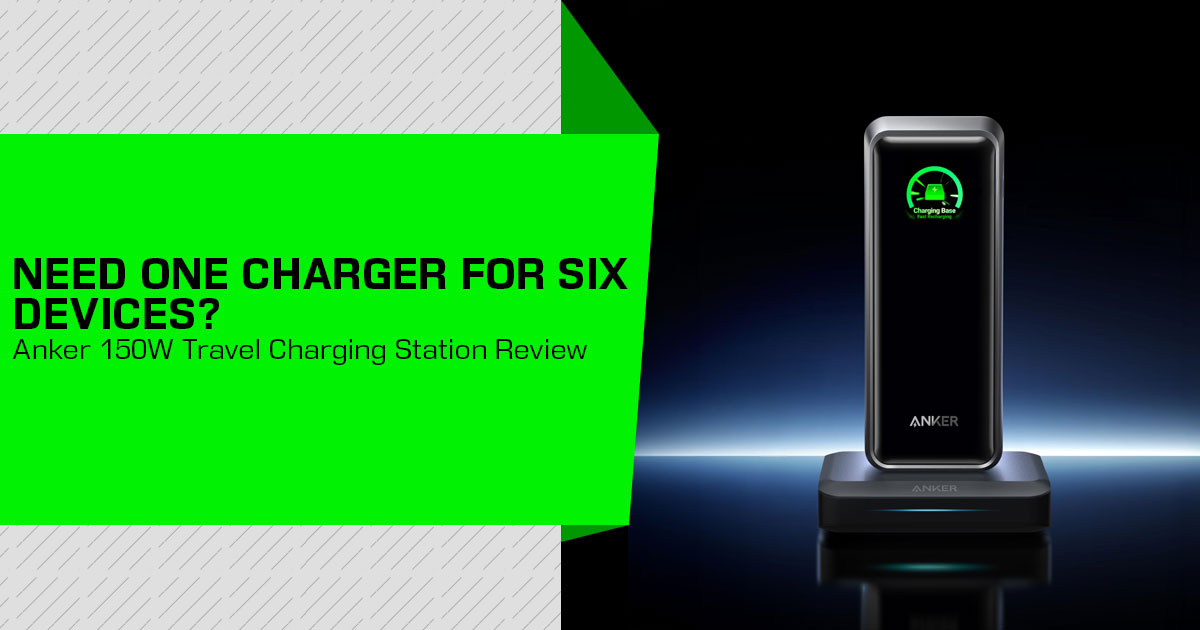
Finding a free wall outlet for a laptop, phone, tablet, earbuds, and smartwatch is not always easy when you are travelling or working in a shared space. The Anker Travel Charging Station, 6-in-1 150W, 100W Laptop Charger is built for this setup, with six USB ports, including two high-output USB-C ports, in a compact travel-friendly design.
Priced at $79.99 in the United States, the Anker Travel Charging Station comes in Iron Gray and Radiant White. It is important to note that this is a USB charging station, not a traditional power strip. There are no AC outlets, it cannot be used as a power bank, and USB charging cables are not included. For travellers carrying several USB-powered devices, these details can make a bigger difference than the 150W maximum output.
The station is aimed at frequent travellers, remote workers, business professionals, students, and people who carry several devices every day. If your travel kit includes a laptop, phone, tablet, earbuds, and smartwatch, having one charging station instead of several individual chargers can make packing and setup easier.
As technology experts with over 20 years of experience in hardware and application research and development, we analyze products for performance, durability, and value for money. We look at what matters in everyday use, from budget and charging capability to reliability and long-term use. Our recommendations are based on product research, component analysis, real-world usability, and industry experience.
This review is based on manufacturer specifications and independent launch coverage. It is not a hands-on test, so information about charging speed, heat, and sustained power output reflects reported specifications rather than measurements from our own testing.
Anker Travel Charging Station, 6-in-1 150W, 100W Laptop Charger: Key specifications
| Specification | Details | What It Means for the Buyer |
|---|---|---|
| Product Model | Anker Travel Charging Station, 6-in-1 150W, 100W Laptop Charger; Model A1A05 | The model number identifies the specific 6-port, 150W configuration discussed in this article. |
| Total Output | 150W maximum | The 150W power budget is shared across connected USB devices rather than being available from every port simultaneously. |
| USB-C Ports | 4 × USB-C | Provides enough modern USB-C connections for laptops, tablets, smartphones, handheld gaming systems, and accessories. |
| USB-C1 & USB-C2 | Up to 100W each when used individually | The two primary USB-C ports can provide high-power laptop charging for compatible devices. |
| USB-C3 & USB-C4 | Up to 45W each | Well suited to smartphones, tablets, handheld consoles, and smaller USB-C laptops. |
| USB-A Ports | 2 × USB-A, up to 12W each | Maintains compatibility with older USB cables and lower-power accessories that do not use USB-C. |
| AC Input | 100–240V, 50–60Hz | Supports different mains-voltage regions, although the appropriate plug or travel adapter may still be required. |
| Dimensions | 5.9 × 2.7 × 0.87 inches (149 × 67.5 × 22 mm) | Its slim form factor can take up considerably less bag and desk space than carrying several separate chargers. |
| Weight | 0.64 lb (290 g), excluding the AC power cord | Portable enough for travel, although heavier than a basic single-port GaN charger. |
| Plug Design | 90-degree foldable plug | Makes the charger easier to pack and helps reduce how far the plug protrudes from a wall outlet. |
| AC Cable | Flat-braided AC cable | Designed to reduce cable bulk and make storage easier inside a travel bag. |
| Safety System | ActiveShield 4.0 with seven-layer protection | Anker reports safeguards against overheating, overcurrent, overvoltage, and short circuits. |
| Included USB Cables | No | Buyers need to provide their own compatible USB-C or USB-A cables for connected devices. |
The official product page is the primary source for these specifications.
What makes this a travel charging station rather than a power strip?
The Anker Travel Charging Station, 6-in-1 150W, 100W Laptop Charger connects to one AC wall outlet and provides USB charging ports. It does not provide pass-through AC sockets for lamps, monitors, hair dryers, shavers, or other household appliances.
That distinction should guide the buying decision. A conventional travel power strip is more flexible when a trip involves both USB devices and AC-powered equipment. Anker’s station is more focused: it consolidates several USB chargers into one unit and keeps the setup relatively flat.
In practical terms, it replaces multiple USB chargers, not a power strip.
This design has one practical advantage. Removing AC sockets allows Anker to keep the unit smaller and concentrate its capacity on USB charging. The trade-off is that every device connected to it must charge through a USB cable.
Four USB-C ports and two USB-A ports
The port selection is central to the product’s intended use. Four USB-C ports can serve many laptops, tablets, phones, and handheld devices, while two USB-A ports remain available for older cables and accessories.
The two main USB-C ports are rated for 100W laptop charging when used individually. That gives the station a useful role for people carrying two compatible laptops, although the actual charging rate will depend on the laptop, cable, charging protocol, and the station’s power distribution.
The other two USB-C ports are rated up to 45W. These ports may suit compatible phones, tablets, gaming handhelds, and smaller computers. The USB-A ports are limited to 12W, so they are better matched to earbuds, watches, older phones, and other low-power devices.
The station’s 150W total output should not be interpreted as 150W available independently from every port. It is the maximum combined budget. When several devices are connected, the available power is divided among them.
Can it charge two laptops at once?
On paper, it is designed to support that use. The two main USB-C ports are each rated up to 100W when used individually, but the station’s total output is 150W, so those two ports cannot both deliver 100W at the same time. Anker presents the station as suitable for two-laptop charging, but actual output depends on the laptops, cables, charging protocols, and other connected devices.
There are several conditions to keep in mind:
- Both laptops must support USB-C Power Delivery at the required wattage.
- The cables must also support the expected power level.
- The combined demand cannot exceed the station’s 150W maximum.
- Actual charging speed changes as a device reaches a higher battery level.
- Other connected devices can affect how the station distributes power.
For a laptop-and-phone setup, the port arrangement provides enough capacity for common travel needs. For two demanding laptops plus several other devices, the product should be viewed as a high-capacity shared charger rather than a source of maximum output on every port at all times.
PowerIQ 4.0: What automatic power sharing means
Anker’s PowerIQ 4.0 system is designed to identify the needs of connected devices and distribute available power automatically. This reduces the need to remember which port should be used for a laptop or phone.
The feature is useful in a mixed-device setup, but it does not remove the limits of the shared power budget. Automatic distribution cannot create additional power beyond the station’s rated 150W. Users who connect multiple high-demand devices should still check the device requirements and observe whether charging speeds change after other devices are plugged in.
This is also why a port-by-port specification table is more informative than the 150W headline alone. The two 100W ports matter for laptops. The 45W ports are more appropriate for phones and tablets. The 12W USB-A ports are intended for lower-power accessories.
Compact design, foldable plug, and travel practicality
The station measures 149 × 67.5 × 22 mm and weighs about 290 g without the AC cord. Anker uses phone and earbud-case comparisons to describe its compact form, while launch coverage describes it as roughly the size of a deck of cards.
The comparison is useful only as a quick size reference. The important travel details are the flat profile, foldable plug, and braided cable. A 90-degree plug can be easier to use behind a bed, next to a nightstand, or in a crowded airport outlet. The flat cable also helps keep the travel setup compact.
At the same time, 290 g is not exceptionally light compared with a basic single-port charger. Its value in a travel bag comes from its port count and output, not from being the lightest charger available.
Safety and heat claims: what can be verified
Anker says the station uses ActiveShield 4.0, monitors internal temperature more than 10 million times per day, and includes seven layers of protection against overtemperature, overcurrent, overvoltage, and short circuits.
These are manufacturer-provided safety claims. The available launch coverage does not provide independent laboratory measurements of temperature, sustained output, or protection behavior. The official product page also notes that the station may reduce output during prolonged full-load operation if its overtemperature protection activates.
That note is important because a compact charger operating near its maximum capacity can produce significant heat. A buyer should leave ventilation around the unit and avoid covering it with clothing, bedding, or other materials during extended charging.
Anker versus other charger types
| Charger Type | Main Advantage | Main Limitation | Best Suited To |
|---|---|---|---|
| Anker Travel Charging Station, 6-in-1 150W, 100W Laptop Charger | Six USB ports, including two USB-C ports capable of delivering up to 100W each when used individually | No AC outlets, and charging cables are not included | Travelers carrying multiple USB devices who need to maximize a single available wall outlet |
| Compact GaN Wall Charger | Lightweight, compact, and easy to pack | Typically offers fewer ports and lower combined power output | Travelers carrying one laptop and one or two smaller devices |
| AC Travel Power Strip | Supports AC-powered appliances alongside USB devices | Usually bulkier and less focused on high-power USB-C charging | Hotel rooms, desks, and setups combining AC and USB equipment |
| Power Bank | Provides portable charging when a wall outlet is unavailable | Limited by battery capacity and output power, and must eventually be recharged | Flights, trains, outdoor use, commuting, and power interruptions |
| Desktop Charging Station | Convenient permanent multi-device charging from a central location | Less portable and generally requires more desk space | Home offices, shared desks, and fixed workstations |
For a direct product comparison, use a specific model with a verified port layout, output rating, included accessories, warranty, and regional price. Brand-level comparisons would be incomplete because each manufacturer sells several charger types and generations.
Strengths and limitations
Strengths
- 150W multi-device charging from one wall outlet.
- Two USB-C ports rated up to 100W each when used individually.
- Four USB-C ports can serve many compatible laptops, tablets, and phones.
- Two USB-A ports support older accessories.
- Compact 22 mm profile and a foldable plug suit travel use.
- 100–240V input supports use across different mains-voltage regions with the appropriate plug arrangement.
Limitations
- No AC outlets, so it cannot replace a general-purpose power strip.
- The 150W capacity is shared across all connected devices.
- Charging cables are not included.
- The 290 g weight is higher than that of many simple laptop chargers.
- Available performance and thermal behavior have not been independently tested in the reviewed sources.
- The confirmed price and pre-order information are US-specific; international availability may differ.
Who should buy the Anker Travel Charging Station, 6-in-1 150W, 100W Laptop Charger?
This compact laptop travel charger is aimed at:
- Remote workers carrying a laptop, phone, tablet, and accessories.
- Couples or colleagues who need to charge two USB-C laptops from one outlet.
- Travelers who prefer one six-device charging station over several individual adapters.
- Users who already own suitable USB-C and USB-A cables.
- People who mainly use USB-powered electronics and do not need AC sockets.
It is less suitable for:
- Travelers who need to power AC appliances.
- Buyers looking for a battery-powered charger.
- Users who want the smallest possible single-laptop charger.
- Anyone expecting charging cables to be included.
Price and availability
Anker lists the Anker Travel Charging Station, 6-in-1 150W, 100W Laptop Charger at US$79.99 for the listed US configuration. The product page identifies Iron Gray and Radiant White versions and gives a pre-order shipping window of September 25 to October 5, 2026. This is the official listed US price at the time of writing, not a global price or a confirmed price for other markets.
The price should be checked before purchase because shipping, taxes, retailer discounts, and regional pricing can change. Availability outside the United States was not confirmed in the reviewed launch coverage.
Frequently asked questions
Does the Anker Travel Charging Station, 6-in-1 150W, 100W Laptop Charger have AC outlets?
No. It is a USB-only charging station with four USB-C ports and two USB-A ports. It must be connected to an AC wall source and cannot power ordinary AC appliances.
Are charging cables included?
No. USB-C-to-USB-C and USB-A-to-USB-C cables are not included, so buyers need to provide their own cables.
Can it charge two laptops?
It is designed to support two compatible USB-C laptops through its two main ports, each rated up to 100W when used individually. Because the station has a 150W shared total output, two laptops cannot both receive 100W simultaneously. Actual output depends on the laptops, cables, charging protocols, and other connected devices.
Is it a power bank?
No. The station does not contain a battery and cannot charge devices away from a wall outlet.
Does it work internationally?
The input specification is 100–240V at 50–60Hz. Users should still confirm plug compatibility and use an appropriate travel adapter where needed.
Is the Anker Travel Charging Station, 6-in-1 150W, 100W Laptop Charger suitable for a phone and tablet?
Yes, its 45W USB-C ports and lower-power USB-A ports are suitable for many phones, tablets, earbuds, and watches. Device compatibility and charging speed vary by model and cable.
Where to check the current price
Amazon US
The Anker Travel Charging Station, 6-in-1 150W, 100W Laptop Charger is worth checking on Amazon US if the priority is a compact multi-port setup that can charge two compatible laptops from one outlet, subject to its shared 150W output. Confirm the exact model, seller, warranty terms, and whether the listing includes only the station and AC cable before ordering.
Check the latest Amazon US price and offers
Amazon India
Indian pricing and availability may not match the US launch price. Before buying, check whether the listing is for model A1A05, whether the plug is suitable for local use, and whether import costs or seller-specific warranty terms apply.
Check Amazon India availability and current pricing
Final verdict
The Anker Travel Charging Station, 6-in-1 150W, 100W Laptop Charger is a focused solution for people who need several USB ports, not a universal power strip. Its most relevant features are the four USB-C ports, two 100W-capable main connections, foldable plug, and relatively slim body. Those features may reduce charger clutter for travel and shared workspaces.
The product is easier to recommend when the buyer already owns the required cables and charges mostly USB-powered devices. It is harder to justify for anyone who needs AC outlets, a built-in battery, or the lightest possible charger.
At US$79.99 before shipping, taxes, or other regional costs, the station’s value depends on how many separate USB chargers it can replace. The purchase decision should be based on that practical calculation—not on the 150W number alone.
Have a question about the Anker Travel Charging Station or unsure whether it fits your setup? Leave a comment below and tell us what you want to know. We’ll do our best to help. If you find our hardware reviews useful, follow us for more product reviews, comparisons, and buying guides.
Disclaimer

This blog post reflects our research, analysis, and opinions based on available product information, user feedback, and industry knowledge. It should not be taken as the official position of any brand, manufacturer, or company mentioned here. We make every effort to keep this guide accurate, but product specifications, pricing, and availability may change after publication. We recommend double-checking important details before making a purchase.

Some links in this article may be affiliate links. If you choose to buy through these links, we may earn a small commission at no extra cost to you. This helps support our work and allows us to keep publishing in-depth, unbiased reviews. Affiliate partnerships never influence our recommendations.

Opinions expressed by readers are their own and do not necessarily reflect ours. We are not responsible for outcomes resulting from the use of information on this site. Please seek professional advice where appropriate.

All product names, logos, and brands mentioned are the property of their respective owners. These names are used for identification and informational purposes only and do not imply endorsement.