
Introduction
A camera kit rarely ends with the camera and lenses. You also need spare batteries, a charger, a card reader, a power bank, and a few USB cables. None of these accessories are large on their own, but together they take up space and add unnecessary clutter to your bag.
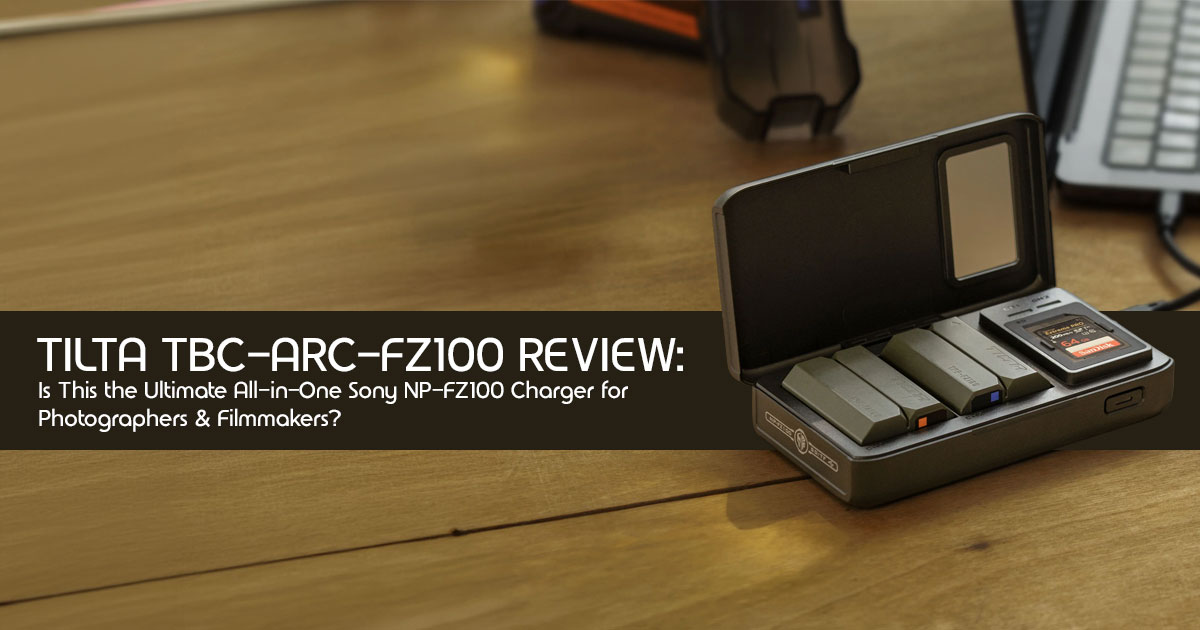
The Tilta All-In-One Recharge Companion (Model: TBC-ARC-FZ100) is designed to reduce that clutter. Created by Tilta with filmmaker Peter Lindgren under the PRMGR brand, it combines a Sony NP-FZ100 battery charger, SD and microSD card reader, battery storage case, and USB-C power bank into one compact unit.
Click here to buy from Amazon
It’s a simple idea, but the real question is whether it can replace the individual accessories many photographers and filmmakers already trust. Does it charge batteries reliably? Are the transfer speeds fast enough? Is it practical for everyday use, or does it ask you to trade convenience for performance?
As technology experts with over 20 years of experience in hardware and application research and development, we assess products based on performance, build quality, durability, ease of use, and value for money.
Whether you shoot weddings, travel frequently with your camera, create videos for YouTube, fly drones, or use Sony’s NP-FZ100-powered cameras, this review will help you decide whether the Tilta PRMGR Recharge Companion is worth adding to your kit.
Our assessment is based on extensive research, hardware analysis, practical usability, and industry experience, with a focus on how the product performs in real shooting scenarios rather than marketing claims.
What is the Tilta TBC-ARC-FZ100 Recharge Companion?
At its core, this device is a compact dual-slot Sony NP-FZ100 battery charger that doubles as a high-speed UHS-II dual-slot card reader and storage case and an emergency camera battery power bank adapter.
Instead of carrying three separate accessories in your Sony mirrorless travel gear setup, this single 150-gram (0.33 lbs) block centralizes your workflow. It combines charging, card storage, and file transfers into a single compact device.
Core Specifications:
- Dimensions: Thinner and flatter than standard upright
- Weight: 150g (0.33 lbs) empty.
- Power Input: USB-C (Supports PD/QC up to 30W).
- Power Output: USB-C (18W PD maximum).
- Card Slots: 1 x SD (UHS-II), 1 x MicroSD / TF (UHS-II).
- Card Speeds: Up to 312 MB/s.
- Retail Price: $59 USD.
On paper, the specifications are solid, but specifications alone don’t tell the whole story. The real question is how well this accessory performs during everyday use.
Design and Build Quality: Designed for Creators on the Go
Unlike many generic travel chargers, this one was developed with direct input from filmmaker and YouTube creator Peter Lindgren, whose real-world experience helped shape the design.
Instead of a vertical design where batteries stick out and can get knocked loose, Tilta went with a flat, horizontal layout. It slides into a backpack pocket about as easily as a portable SSD, making it an excellent all-in-one charging case for Sony cameras when packing light is a priority.
The casing is made of high-quality plastic with a clean matte-black finish. Inside, a secure magnetic lid keeps everything enclosed. Under the lid, you find two dedicated slots for NP-FZ100 batteries, slots for SD and microSD cards, and a dedicated, molded cutout specifically to act as secure UHS-II SD card reader storage.
This keeps spare cards organized, protected, and easy to access while you’re on the move. You can keep a blank spare card or a fully shot SD card protected inside the rugged shell instead of letting loose cards rattle around your bag.
Real-World Performance: Charging Speeds & Technical Realities
To understand if this is a viable Sony NP-FZ100 USB-C travel charger for professional workflows, we have to look past the marketing and analyze how it performs under load.
Click here to buy from Amazon
Dual Battery Charging
The unit supports fast charging Sony FZ100 batteries simultaneously over USB-C. But the speed depends entirely on the power source you plug it into:
- 5V USB Source: Outputs 8.4V at 1000mA (single battery) or 500mA (two batteries). Charging from a standard 5V USB source is noticeably slower than using a USB-C PD charger.
- 9V/12V PD Charger (Quick Charge/Power Delivery): Outputs 4V at 1500mA for both slots simultaneously.
If you use an 18W or 30W USB-C PD wall block or a robust power bank, you can charge two completely flat NP-FZ100 batteries to 100% in roughly 2 to 2.5 hours. That is competitive with many USB-C dual chargers currently available.
The Two-Pin Limitation (What They Don’t Tell You)
Here is the most critical technical detail we discovered in our research, which was highlighted in the professional Tilta TBC-ARC-FZ100 review by NewsShooter: the charging bays only feature two metal contact pins.
Official Sony NP-FZ100 batteries include four contact pins. Chargers that support full battery communication can use these additional contacts to read information such as battery status, temperature, and other diagnostic data, depending on the charger design. Some smart chargers also use this information to optimize charging behavior.
- Monitor precise cell temperature during fast charging.
- Read exact battery health and degradation metrics.
- Dynamically adjust voltage curves to extend battery lifespan.
Because the Tilta companion uses a basic two-pin layout, it has no smart communication capabilities.
It safely charges the batteries by applying a standard voltage, but it cannot monitor thermals or diagnostic health. It is a basic charger that does not communicate with the battery’s internal electronics.
Our Critical Workflow Safety Tip: Because the charger lacks thermal monitoring and the batteries are packed close together inside a tight plastic compartment, we recommend leaving the lid open during charging to help reduce heat buildup. Fast charging naturally generates heat. Leaving the lid open allows that heat to dissipate more easily during charging.
High-Speed UHS-II Card Reader Performance
If you regularly record high-bitrate 4K footage, you know how much time a slow card reader can waste.
The built-in card reader in this device supports both SD and MicroSD cards at UHS-II speeds (up to 312 MB/s).
What does this look like in the real world?
In independent speed testing, the card reader fully saturated a professional Panasonic 128GB UHS-II card, achieving steady read speeds of around 250 MB/s to 270 MB/s. In our assessment, the card reader performs on par with many standalone USB-C UHS-II readers.
Key Reader Features:
- Dual Read Support: You can insert an SD card and a microSD card at the same time, and your laptop will read both cards simultaneously.
- Simultaneous Charging & Data Transfer: You can plug the companion into your laptop’s USB-C port to offload your footage while the unit simultaneously trickle-charges the camera batteries inside. This saves space when you’re working from a hotel room or temporary workspace.
Our Critique: If your workflow revolves around Sony cameras that use NP-FZ100 batteries, this charger makes sense. However, many users of the FX3, FX30, and a7S III also rely on CFexpress Type A cards, which limits the usefulness of the microSD slot. We believe it would have been far more useful if Tilta offered a version with a CFexpress Type A slot instead of a MicroSD slot. If you shoot exclusively on CFexpress Type A, you will still need to pack a separate reader.
Emergency 18W USB-C PD Power Bank Mode
One of the most useful features of the Tilta All-In-One Recharge Companion is that it doesn’t just put power into your batteries—it can pull power out of them.
If you are on location and your phone, wireless lav transmitter, or camera monitor is running out of juice, this device acts as an emergency 18W USB-C PD power bank utilizing your existing camera battery cells.
How to use Sony FZ100 battery as power bank:
- Insert one or two charged NP-FZ100 batteries into the slots slots.
- Plug your phone or accessory into the USB-C port.
- Press and hold the front battery level button for 3 seconds.
- The LEDs will shift, and the device will begin outputting up to 18W PD Power (5V 2A / 9V 2A).
While 18W is not enough to power a laptop, it is fast enough to rapidly charge a smartphone, an iPad, or a wireless microphone receiver while shooting in the field. This saves you from carrying a dedicated 10,000mAh travel power bank when you already have several high-capacity camera batteries in your bag, making it a practical way to get extra use from the NP-FZ100 batteries you’re already carrying.
Click here to buy from Amazon
Head-to-Head Comparison: Finding the Best Charging Companion
To give you the best buying advice, we must look at how Tilta stacks up against the competition. Let’s look at the data:
| Feature | Tilta TBC-ARC-FZ100 | Llano 4-in-1 Case | PGYTECH CreateMate | Nitecore USN4 Pro |
|---|---|---|---|---|
| Retail Price | $59.00 | Approximately $99.00 | Approximately $39.95 | Approximately $29.95 |
| Sony NP-FZ100 Charging | Yes (supports up to 30W USB-C input) | Yes, with fast USB PD/QC charging support. | No battery charging capability. | Yes, with intelligent dual-battery charging. |
| Emergency Power Bank | Yes, delivers up to 18W USB-C output using an installed NP-FZ100 battery. | Yes, powered by its built-in 10,400mAh internal battery. | No | No |
| Memory Card Reader | UHS-II (up to 312 MB/s) | UHS-II (up to 312 MB/s) | UHS-II (up to 312 MB/s) | No integrated card reader. |
| Battery Health Diagnostics | No; uses a basic 2-pin battery connection without health reporting. | Yes, with an LCD showing battery percentage and status. | Not applicable. | Yes, including comprehensive charging and safety monitoring. |
| Weight (Empty) | 150g (0.33 lb) | Heavier because of its integrated battery pack. | 133g (0.29 lb) | Ultra-light pocket-sized charger. |
| Best Suited For | Minimalist travel creators wanting charging, storage, card reading, and emergency power in one device. | Photographers and filmmakers working off-grid who need extended backup power. | Creators looking for a rugged media storage and card management solution. | Users who prioritize advanced battery charging and diagnostics over storage features. |
Analysis: Tilta vs. Competitors
Tilta vs Llano NP-FZ100 battery charger
The Llano 4-in-1 is aimed at people who need off-grid charging, while the Tilta focuses on reducing the number of accessories in your bag. Llano includes an actual 10,400mAh lithium-ion battery permanently sealed inside the charging case. This allows you to recharge camera batteries even when external power isn’t available.
However, this internal battery makes the Llano bulky, heavy, and expensive (around $99). The Tilta vs Llano NP-FZ100 battery charger decision comes down to weight: Tilta is much flatter, weighs half as much, and costs far less ($59). Tilta cleverly uses your existing NP-FZ100 batteries as the power bank, keeping the travel kit incredibly lightweight.
Tilta vs. PGYTECH CreateMate
The PGYTECH CreateMate is a fantastic, rugged, water-resistant card holder and high-speed reader. But it has one massive limitation: it cannot charge your batteries. If you buy the CreateMate, you still have to carry a separate charger. The Tilta combines both functions into a single case for just $20 more.
Tilta vs. Nitecore USN4 Pro
If you want to protect your expensive OEM Sony batteries and monitor their health, the Nitecore is the gold standard. It uses a smart 4-pin connection to show exact mAh capacity, internal resistance, and battery temperature. However, the Nitecore is just a plastic charging dock—it has no card readers, no storage, and cannot charge external devices.
Pros and Cons: A Balanced Assessment
Pros:
- Space-Saving Design: Eliminates a separate card reader, power bank, and battery storage box from your kit.
- True UHS-II Speeds: Speeds up to 312 MB/s make offloading massive 4K video files fast and painless.
- Slim, Easy-to-Pack Design: The flat, horizontal design packs incredibly well into tight gear pockets.
- Pass-Through Workflow: You can transfer footage to a laptop while simultaneously charging your batteries.
- Good Value: At $59, it offers good value compared to buying a separate UHS-II reader and dual battery charger.
Cons:
- No Smart Charging Diagnostics: The 2-pin contact design lacks temperature monitoring and battery health readings.
- No CFexpress Type A Reader: The microSD slot is less useful for professional Sony cinema shooters who use CFexpress Type A.
- Thermal Buildup: We recommend leaving the lid open during charging to help reduce heat
Who Should Buy the Tilta Recharge Companion?
Our practical buying advice is simple:
Buy it if:
- You travel with your camera often and want to carry fewer accessories.
- You use UHS-II SD cards and want one device for charging batteries and transferring files.
- You’d rather use your spare camera batteries to charge small devices instead of packing another power bank.
Skip it if:
- Your workflow is built around CFexpress Type A cards.
- You are highly protective of your battery lifespans and prefer a “smart” diagnostic charger (like the Nitecore USN4 Pro) to monitor cell health and precise temperatures.
Pricing, Availability, and Where to Buy
The Tilta rechargeable companion FZ100 price is officially set at $59.00 USD. It is widely available and represents a reasonably priced addition to any camera kit.
If you are ready to declutter your gear bag and streamline your travel workflow, you can check the latest prices and purchasing options here:
Buy on Amazon (Worldwide):
- Tilta All-In-One Recharge Companion (Sony NP-FZ100): If you shoot in the US or want international shipping, check the latest price and customer reviews on Amazon Worldwide.
Buy on Amazon (India):
- Tilta All-In-One Recharge Companion: If you are sourcing gear in India, check the current price, localized delivery times, and local offers on Amazon India.
Final Verdict: The Space-Saving King
The Tilta TBC-ARC-FZ100 delivers exactly what it promises: fewer accessories, less clutter, and a simpler travel kit. Instead of asking creators to carry separate chargers, card readers, battery cases, and power banks, it combines them into a single device that is compact, practical, and easy to pack.
Like any product, it has a few compromises. We would have liked to see 4-pin battery communication for more accurate charging information, and a CFexpress Type A card reader would have made it even more useful for many Sony users. Even so, those limitations are unlikely to matter if your priority is carrying fewer accessories while keeping your workflow simple.
At around $59, the Tilta PRMGR Recharge Companion delivers good value if you regularly travel or shoot on location. The combination of a dual NP-FZ100 charger, UHS-II SD card reader, battery storage, and emergency USB-C power bank makes it one of the most practical accessories you can add to your camera kit.
If you have questions about this product or want help deciding whether it’s the right choice for your setup, leave a comment below. We’d be happy to help. If you found this review useful, follow us for more in-depth hardware reviews, buying guides, and practical advice to help you choose the right gear for your workflow.
***Disclaimer***
This blog post reflects our research, analysis, and opinions based on available product information, user feedback, and industry knowledge. It should not be taken as the official position of any brand, manufacturer, or company mentioned here. While we aim to keep information accurate and up to date, product details, pricing, and availability can change. We recommend double-checking important details before making a purchase.
Some links in this article may be affiliate links. If you choose to buy through these links, we may earn a small commission at no extra cost to you. This helps support our work and allows us to keep publishing in-depth, unbiased reviews. Our recommendations are never influenced by affiliate partnerships.
Comments shared by readers reflect their own views and not ours. We are not responsible for outcomes resulting from the use of information on this site. Please seek professional advice where appropriate.
All product names, logos, and brands mentioned are the property of their respective owners. These names are used for identification and informational purposes only and do not imply endorsement.