
Introduction
Buying a laptop should be straightforward, but the processor choice often makes it confusing.
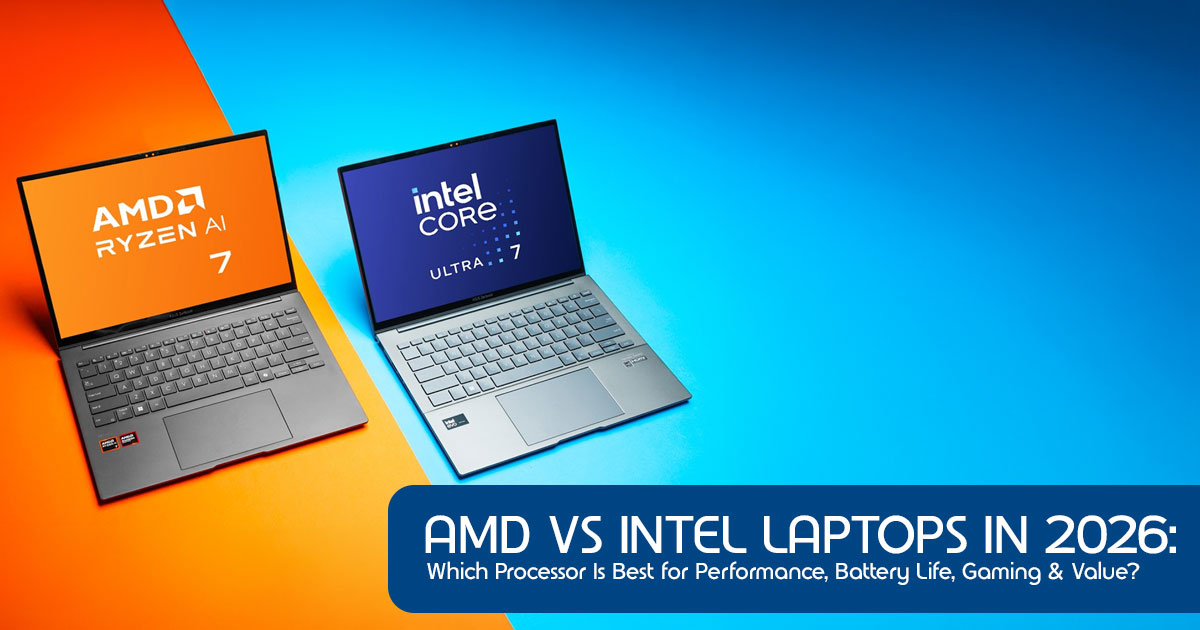
One laptop features an AMD Ryzen processor, while another comes with an Intel Core Ultra chip. On paper, both promise excellent performance, long battery life, and modern AI features. That makes the decision harder, not easier.
Instead of asking, “Which brand is better?” ask yourself a different question:
Which laptop gives me the best experience for the way I actually use it?
The answer depends on far more than the processor. Many buyers focus on the logo and overlook the rest of the hardware. In reality, the overall experience is shaped by the combination of the processor, display, RAM, SSD, cooling system, battery capacity, graphics, weight, build quality, and price. A well-balanced laptop often feels faster, runs cooler, lasts longer on a charge, and offers better value than a machine with a more powerful processor but weaker supporting hardware.
That shift in thinking can help you avoid an expensive mistake. The processor is important, but it is only one part of the picture. Looking at the complete laptop—not just the chip inside—will usually lead to a better purchase.
Whether you’re a student taking classes, a professional handling everyday work, a content creator editing photos or videos, a programmer compiling code, a business user, or a casual gamer, this guide explains the differences in clear, practical language. By the end, you’ll know which option best matches your workload, budget, and long-term needs.
As technology experts with more than 20 years of experience in hardware and application research and development, we assess every product from the perspective of real ownership. We look beyond marketing claims and benchmark numbers to evaluate real-world performance, durability, and value for money. Our recommendations are built on extensive research, detailed component analysis, hands-on usability, and industry experience, helping you choose the right laptop whether your priority is budget, performance, battery life, reliability, or long-term value.
Quick Answer: AMD vs Intel Laptops in Simple Terms
For most buyers, the choice comes down to this:
| Buyer Priority | Better Fit |
|---|---|
| Best Value for Money | AMD Ryzen laptop, thanks to its excellent performance-to-price ratio in most budget and mid-range segments. |
| Strong Multitasking | AMD Ryzen or Ryzen AI laptop, offering excellent multi-core performance for productivity and content creation. |
| Thin-and-Light Premium Laptop | Intel Core Ultra laptop, with a wide selection of premium ultrabooks featuring excellent efficiency, displays, and battery life. |
| AI-Focused Windows Laptop | Choose between Intel Core Ultra and AMD Ryzen AI based on the laptop’s price, features, cooling, and overall configuration rather than the processor alone. |
| Casual Gaming Without a Dedicated GPU | An AMD Ryzen laptop with Radeon integrated graphics is usually the better choice for higher frame rates in modern games. |
| Gaming with an RTX GPU | Prioritize the graphics card first, then choose the processor. GPU performance has the greatest impact on gaming. |
| Business Laptop Availability | Intel Core Ultra laptops generally offer the widest range of enterprise and commercial models. |
| Student Laptop on a Budget | Choose an AMD Ryzen 5 or Intel Core i5 laptop with the best combination of 16GB RAM, a 512GB SSD, and a quality display. |
Bottom line:
AMD and Intel laptop processors now perform closely enough that choosing a laptop by processor brand alone is no longer the smartest approach. Focus on the complete laptop—its RAM, SSD, display, battery, cooling, and overall value—not just the processor inside.
AMD vs Intel Laptop Processors: What Buyers Are Actually Comparing
When people search for AMD Ryzen vs Intel Core, they usually compare processor names like:
- AMD Ryzen 5 vs Intel Core i5
- AMD Ryzen 7 vs Intel Core i7
- AMD Ryzen AI vs Intel Core Ultra
- Ryzen AI laptop vs Intel Core Ultra laptop
But these names only tell part of the story.
A well-cooled Ryzen 5 laptop can feel faster than a poorly cooled Core i7 laptop.
A laptop with 16GB RAM will feel smoother than one with 8GB, even if both have similar processors.
A gaming laptop with a stronger GPU will beat a faster CPU in most games.
The processor is only part of the equation. The laptop’s cooling system, power limits, memory configuration, and overall design determine how well that processor performs in real-world use.
For example, a laptop with an AMD Ryzen 5, 16GB RAM, and an excellent cooling system can easily provide a smoother everyday experience than a poorly configured Intel Core i7 laptop with only 8GB RAM and limited cooling. Looking at the full specification always gives a clearer picture than comparing processor names alone.
AMD Ryzen vs Intel Core: Easy Processor Family Overview
| Processor Family | Common Laptop Type | Best For |
|---|---|---|
| AMD Ryzen 3 | Entry-level laptops | Web browsing, online learning, office documents, and everyday computing. |
| Intel Core i3 | Entry-level laptops | Basic productivity, office applications, video streaming, and web browsing. |
| AMD Ryzen 5 | Budget to mid-range laptops | Students, office professionals, multitasking, and mainstream productivity. |
| Intel Core i5 | Budget to mid-range laptops | Students, office users, business professionals, and everyday multitasking. |
| AMD Ryzen 7 | Upper mid-range laptops | Content creators, multitaskers, light video editing, and productivity workloads. |
| Intel Core i7 | Upper mid-range laptops | Professionals, business users, software development, and demanding productivity tasks. |
| AMD Ryzen AI | Next-generation AI laptops | AI-enhanced workloads, advanced multitasking, content creation, and Copilot+ PC features on supported models. |
| Intel Core Ultra | Premium AI laptops | AI acceleration, excellent power efficiency, premium ultrabooks, and modern Windows laptops. |
| AMD Ryzen 9 | High-performance laptops | Professional video editing, 3D rendering, software development, and other demanding workloads. |
| Intel Core Ultra 9 / Core i9 | Premium performance laptops | Power users, creators, engineers, gamers, and high-end workstation-class laptops. |
For most readers, the best value lies in AMD Ryzen 5, Intel Core i5, AMD Ryzen 7, or Intel Core Ultra 5/7 laptops.
If these processor names seem confusing, don’t worry. The next sections explain where each one performs best in everyday use, gaming, content creation, and professional workloads.
AMD vs Intel Laptops: Full Comparison Table
| Category | AMD Ryzen Laptop | Intel Core / Core Ultra Laptop |
|---|---|---|
| Everyday Performance | Very strong for web browsing, office work, streaming, and general productivity. | Very strong, delivering fast responsiveness across everyday computing tasks. |
| Multitasking | Often offers excellent multi-core performance and value for the price. | Excellent in well-equipped models with sufficient RAM and efficient cooling. |
| Battery Life | Excellent on efficient Ryzen models, especially those built on newer architectures. | Significantly improved with Intel Core Ultra processors, making them highly competitive. |
| AI Features | Available on Ryzen AI laptops with dedicated NPUs for AI-accelerated workloads. | A major focus of Intel Core Ultra laptops, featuring integrated NPUs and Copilot+ readiness on supported models. |
| Integrated Graphics | Radeon integrated graphics generally deliver excellent performance for everyday gaming and creative applications. | Intel Arc integrated graphics in Core Ultra laptops have improved significantly and now compete closely with AMD Radeon graphics for light gaming, content creation, and daily workloads. |
| Gaming | Excellent value, particularly with Radeon integrated graphics or laptops equipped with NVIDIA GeForce RTX GPUs. | Performs exceptionally well when paired with a dedicated GPU, with many premium gaming laptop options available. |
| Content Creation | Strong multi-core performance makes Ryzen laptops well suited for video editing, rendering, and creative workloads. | Excellent software compatibility and consistently strong performance across professional creative applications. |
| Business Laptops | Good selection, although enterprise-focused models may be less common in some markets. | Broader availability across commercial and enterprise laptop lineups from major manufacturers. |
| Value for Money | Frequently offers better hardware specifications for the same budget. | Excellent options in premium, ultrabook, and business-class laptops with advanced features. |
| Best For | Students, creators, gamers, and budget-conscious buyers looking for outstanding performance per dollar. | Professionals, business users, and premium laptop buyers seeking advanced features, AI capabilities, and enterprise support. |
Note: For Integrated Graphics, actual performance still varies depending on the processor model and the laptop’s cooling and power settings.
Real-World Performance: AMD Ryzen vs Intel Core Is Closer Than Ever
For daily use, most modern laptops feel fast.
Benchmark scores can be useful for comparing processors, but they don’t always reflect how fast a laptop feels during everyday use. Good cooling, enough RAM, and a fast SSD often make a bigger difference.
Tasks like:
- Opening browser tabs
- Working in Google Docs or Microsoft Office
- Streaming video
- Attending video calls
- Managing emails
- Light photo editing
- Running study apps
- Using web-based tools
will run smoothly on both AMD Ryzen vs Intel Core laptops, as long as the laptop has enough RAM and SSD storage.
What matters more than the processor name? For everyday use, buyers should prioritize:
- 16GB RAM instead of 8GB
- 512GB SSD instead of 256GB
- Good display quality
- Decent keyboard and trackpad
- Battery capacity
- Cooling design
- Weight and portability
A laptop with a modern AMD Ryzen 5 and 16GB RAM can be a better daily machine than an older Intel Core i7 laptop with 8GB RAM and weak cooling.
Before you buy:
If the work is mostly browsing, office apps, online classes, streaming, and video calls, buy the laptop with the better overall package — not just the bigger processor number.
AMD vs Intel Laptop Battery Life: The Answer Is Not One-Size-Fits-All
Battery life is one of the biggest reasons buyers compare AMD vs Intel laptops.
A few years ago, many buyers picked AMD because efficient Ryzen laptops often delivered strong battery results. Newer Intel Core Ultra laptop models have changed the conversation. Intel has significantly improved power efficiency with its recent Intel Core Ultra processors, particularly in well-designed thin-and-light laptops. Actual battery life, however, still depends heavily on the laptop’s battery capacity, display, cooling system, and manufacturer tuning.
Here’s what most spec sheets don’t tell you:
Two laptops with the same processor can deliver very different battery life because battery capacity, display technology, firmware tuning, and manufacturer power settings all play a major role.
Battery life depends on:
- Processor efficiency
- Battery size
- Display type
- Screen resolution
- Brightness level
- Refresh rate
- Background apps
- Cooling design
- Power mode
- Whether the laptop has a dedicated GPU
A 14-inch laptop with a large battery and efficient display may last much longer than a 16-inch OLED model with the same processor.
Which is better for battery?
| Use Case | Better Choice |
| Thin-and-light office laptop | New Intel Core Ultra laptop or efficient AMD Ryzen laptop |
| Student laptop | Either, if battery size and reviews are good |
| Creator laptop | Check real battery reviews; performance models drain faster |
| Gaming laptop | Do not expect all-day battery from either brand |
| Travel laptop | Prioritize battery capacity, weight, and efficient processor |
Buying recommendation:
For AMD vs Intel laptop battery life, do not trust processor brand alone. Check battery size, display type, and real user feedback before buying.
Intel Core Ultra vs Ryzen AI: What AI Laptop Buyers Should Know
AI laptops are becoming more common. That means buyers now see terms like:
- AI laptop
- Copilot+ PC
- NPU
- TOPS
- Ryzen AI laptop
- Intel Core Ultra laptop
These terms sound technical, but the idea is simple.
An NPU, or Neural Processing Unit, helps run certain AI tasks more efficiently on the laptop. Instead of using only the CPU or GPU, supported AI features can run on dedicated AI hardware.
What does this mean for buyers?
A laptop with an NPU can help accelerate several AI-powered features while improving efficiency for supported workloads. These include:
- Background blur in video calls
- Noise reduction
- Live captions
- AI image tools
- Local AI features
- Better power efficiency for supported AI tasks
Keep in mind that many AI features also depend on software support, Windows updates, and application compatibility. As software evolves, AI capabilities may improve even though the hardware remains the same.
Should every buyer pay extra for an AI laptop?
Not always.
A Ryzen AI laptop or Intel Core Ultra laptop makes sense if:
- The laptop will be used for several years
- AI features in Windows matter
- Video calls, productivity, and creative tools are part of daily use
- The price difference is reasonable
- The laptop also has good RAM, SSD, display, and battery
It may not be necessary if:
- The laptop is only for basic browsing
- Budget is tight
- A non-AI laptop offers much better value
- The model has weak RAM or storage
Buying advice:
When comparing Intel Core Ultra vs Ryzen AI, do not buy only for AI branding. Buy it if the full laptop is strong.
Gaming: AMD vs Intel Gaming Laptop Buyers Should Focus on the GPU First
Many buyers ask: “Is AMD or Intel better for gaming laptops?”
Here’s the simple answer:
The graphics card matters more than the processor in most gaming laptops.
A laptop with an RTX 4060 or RTX 5060-class GPU will usually beat a laptop with a weaker GPU, even if the weaker-GPU laptop has a slightly faster processor.
What matters for gaming laptops?
- Dedicated GPU model
- GPU wattage
- Cooling system
- Display refresh rate
- RAM configuration
- SSD speed and size
- Thermals under load
- Processor tier
When AMD can make sense for gaming
An AMD Ryzen laptop can be a strong gaming choice when:
- It offers better GPU specs for the same price
- It includes strong Radeon integrated graphics
- It gives better value in the same budget
- It has good cooling and enough RAM
When Intel can make sense for gaming
An Intel Core Ultra laptop or Intel-based gaming laptop can make sense when:
- It has a stronger dedicated GPU
- The laptop has better cooling
- The model offers better display and build quality
- The price difference is small
- The buyer uses Intel-optimized workflows outside gaming
Bottom line:
For AMD vs Intel gaming laptop decisions, compare the GPU first. Then compare CPU, cooling, display, and price.
Integrated Graphics: Radeon vs Intel Arc
Not every laptop has a dedicated GPU. Many thin laptops use integrated graphics. That matters for:
- Casual gaming
- Light video editing
- External display use
- Streaming
- Creative apps
- Smooth visual performance
AMD Ryzen laptops often perform well here because Radeon integrated graphics have been a major strength. Newer Intel Core Ultra laptop models with Intel Arc graphics have also improved
significantly.
Who should care about integrated graphics?
Integrated graphics matter if:
- The laptop does not have NVIDIA RTX graphics
- Casual gaming is planned
- Light editing is required
- The laptop will connect to monitors
- The buyer wants better graphics without gaming-laptop weight
For buyers who only browse, stream, and use office apps, integrated graphics should not be the deciding factor.
Content Creation: Best Laptop Processor for Editing, Design, and Multitasking
Creators need more than processor branding.
For video editing, design work, coding, and rendering, the laptop should have:
- Strong CPU performance
- 16GB RAM minimum
- 32GB RAM for heavier projects
- Fast SSD
- Good cooling
- Accurate display
- Dedicated GPU for serious editing or 3D work
AMD for creators
An AMD Ryzen laptop can be a strong fit for creators who want:
- Good multi-core performance
- Strong value
- Capable integrated graphics in many models
- More RAM or SSD for the same budget in some configurations
Intel for creators
An Intel Core Ultra laptop can be a good fit for creators who want:
- Strong productivity performance
- Good software compatibility
- AI features in supported apps
- Premium laptop options
- Strong availability across brands
Quick tip:
For content creation, the best laptop processor is only one part of the setup. RAM, GPU, cooling, and display quality matter just as much.
Students: AMD or Intel Laptop for Students?
Students need reliability, battery life, portability, and value. They usually do not need the most expensive processor.
The best student laptop is often the one that has:
- AMD Ryzen 5 or Intel Core i5
- 16GB RAM
- 512GB SSD
- Good battery life
- Lightweight design
- Comfortable keyboard
- Durable build
- Reasonable price
Choose AMD for students if:
- The AMD Ryzen laptop gives better RAM or SSD for the same price
- Battery reviews are good
- The laptop is used for coding, multitasking, or light creative work
- Value matters most
Intel makes more sense when:
- The Intel Core i5 laptop or Intel Core Ultra laptop has better battery life
- The laptop has better build quality
- The price is similar
- The student needs business-style reliability or broad model availability
Our recommendation:
For AMD or Intel laptop for students, do not overspend on the processor. Spend smartly on RAM, SSD, battery, and build quality.
Professionals and Business Users: Why Intel Still Has a Strong Place
Business buyers often choose Intel because many enterprise laptops, office notebooks, and premium productivity machines ship with Intel processors.
That does not mean AMD is weak. It means Intel often has wider availability in business-focused models.
An Intel Core Ultra laptop can be a good choice for:
- Office professionals
- Consultants
- Managers
- Business travelers
- Users who need premium thin-and-light laptops
- Buyers who prefer broader service and model availability
AMD is usually the better choice when:
- Better specs are available at the same price
- Multitasking matters
- The user wants strong value
- The chosen model has good build quality and battery
Key takeaway:
Business buyers should compare warranty, keyboard, webcam, ports, battery life, and service support along with the processor.
Common Laptop Buying Mistakes
Many buyers spend too much time comparing processor names and miss the features that have a bigger impact on everyday use. Before you buy, avoid these common mistakes:
- Choosing 8GB RAM when 16GB is a better long-term investment.
- Paying extra for a faster processor while settling for a poor-quality display.
- Ignoring the laptop’s cooling system, which affects sustained performance.
- Buying an AI laptop without checking whether you’ll actually use its AI features.
- Focusing on the processor in a gaming laptop instead of the GPU, which usually has the biggest impact on gaming performance.
What Matters More Than AMD vs Intel Laptop Processors
This is the part many buying guides skip.
Two laptops with the same processor can feel completely different. Why?
Because laptop makers control power limits, cooling, display choice, battery size, and memory configuration.
Before buying, check these specs first:
| Feature | Why It Matters |
|---|---|
| RAM | 16GB is the recommended minimum for smooth multitasking and long-term usability. |
| SSD Storage | 512GB SSD provides enough space for Windows, applications, games, and everyday files. |
| Display | A high-quality display improves the overall experience for work, entertainment, and content creation. Even a fast laptop feels less premium with a poor screen. |
| Battery Capacity | A larger battery generally delivers longer runtime, especially during travel and remote work. |
| Cooling System | Efficient cooling helps maintain higher performance during extended workloads and prevents thermal throttling. |
| Weight | A lightweight laptop is easier to carry, making it ideal for students, professionals, and frequent travelers. |
| Ports | Ensure the laptop has the connectivity you need for external displays, storage devices, chargers, and other accessories. |
| Graphics (GPU) | A dedicated GPU is essential for gaming, 3D rendering, video editing, AI workloads, and other graphics-intensive tasks. |
| Warranty | A longer warranty and reliable after-sales support provide better protection for your investment over time. |
Strong buying advice:
Never buy a laptop only because it says Ryzen 7, Core i7, Ryzen AI, or Core Ultra. Buy the configuration that makes sense as a complete machine.
Ryzen 5 vs Intel Core i5 Laptop: Which Should Most Buyers Choose?
For most people, this is the most practical comparison.
A Ryzen 5 vs Intel Core i5 laptop decision usually appears in budget and mid-range laptops.
Choose Ryzen 5 if:
- It gives better RAM and SSD for the price
- Multitasking is important
- Radeon graphics are useful
- The model has good battery reviews
Choose Core i5 if:
- The laptop has better build quality
- Battery life is better in that model
- The price is similar
- The laptop is from a preferred business or productivity series
Best answer:
In the Ryzen 5 vs Intel Core i5 laptop range, buy the laptop with 16GB RAM, 512GB SSD, better display, and stronger battery life.
Ryzen 7 vs Intel Core i7 Laptop: Better for Power Users?
A Ryzen 7 vs Intel Core i7 laptop comparison matters for heavier users. This includes:
- Developers
- Editors
- Designers
- Heavy multitaskers
- Spreadsheet users
- Students in technical fields
- Professionals who keep many apps open
Choose Ryzen 7 if:
- Multi-core performance matters
- Price-to-performance is better
- The laptop includes strong integrated graphics
- The same budget gets more RAM or SSD
Choose Core i7 / Core Ultra 7 if:
- The laptop is better built
- Battery life is stronger
- Business features matter
- AI features are important
- Software compatibility is a priority
Best answer:
For Ryzen 7 vs Intel Core i7 laptop, compare the exact laptop model, not only the processor tier.
Pros and Cons of AMD Ryzen Laptops
| Pros | Cons |
|---|---|
| Excellent value for money, often offering stronger specifications at the same price. | Some premium Ryzen laptop models may have limited availability depending on the region. |
| Delivers strong multitasking performance for everyday work, productivity, and content creation. | Battery life varies significantly based on the laptop’s cooling system, display, and battery capacity. |
| Integrated Radeon graphics generally provide excellent gaming and graphics performance without a dedicated GPU. | Enterprise and business-focused Ryzen laptop options are not as widely available as Intel-based models. |
| Competitive performance for students, professionals, and creators across a wide range of workloads. | Some budget Ryzen laptops may compromise on display quality, build materials, or upgradeability to reduce costs. |
| An excellent choice for budget-conscious buyers seeking high performance per dollar. | AMD’s processor naming across different Ryzen generations can sometimes be confusing when comparing models. |
Pros and Cons of Intel Core Ultra Laptops
| Pros | Cons |
|---|---|
| Available across a wide range of laptop brands, price segments, and form factors. | Premium Intel-powered laptops often carry a higher price than comparable alternatives. |
| Excellent presence in business and enterprise laptops with strong commercial support. | A Core Ultra processor alone does not guarantee better overall performance, as cooling, RAM, and GPU also matter. |
| Newer Intel Core Ultra processors deliver significantly improved battery efficiency. | Some entry-level Intel laptops reduce costs by using less RAM, slower storage, or lower-quality displays. |
| Well-positioned for AI-powered workloads with dedicated NPUs in Core Ultra processors. | Many AI features depend on software support and operating system updates. |
| Strong productivity performance for office work, multitasking, coding, and content creation. | Integrated graphics performance varies considerably between Intel processor generations and individual laptop designs. |
Best Buying Recommendations by User Type
| Buyer Type | Recommended Choice | Why |
|---|---|---|
| Students | AMD Ryzen 5 or Intel Core i5 laptop | Offers the best balance of affordability, everyday performance, and battery life for studying and daily tasks. |
| Office Users | Intel Core Ultra laptop or AMD Ryzen 5/7 | Excellent for multitasking, office applications, video conferencing, and productivity workloads. |
| Budget Buyers | AMD Ryzen laptop | AMD-powered laptops often provide better specifications and integrated graphics at the same price point. |
| Premium Laptop Buyers | Intel Core Ultra laptop or a premium Ryzen AI laptop | Premium models typically include higher-quality displays, longer battery life, superior build quality, and advanced AI capabilities. |
| Casual Gamers | AMD Ryzen laptop with Radeon integrated graphics | AMD’s integrated Radeon GPUs generally deliver stronger gaming performance without requiring a dedicated graphics card. |
| Serious Gamers | Choose the laptop with the best dedicated GPU | For modern games, graphics performance has a much greater impact than the choice between AMD and Intel processors. |
| Content Creators | AMD Ryzen 7, Ryzen AI, or Intel Core Ultra 7 | Performance depends on the complete system, including CPU, GPU, RAM, storage, cooling, and display quality. |
| Business Users | Intel Core Ultra laptop | Widely available in enterprise-focused designs with advanced security, manageability, and commercial support. |
| Long-Term Buyers | Ryzen AI laptop or Intel Core Ultra laptop | These platforms are better prepared for upcoming AI-powered Windows features and future software optimizations. |
FAQs About AMD vs Intel Laptops
Is AMD better than Intel for laptops?
Not always. AMD Ryzen laptops often offer strong value, multitasking, and integrated graphics. Intel Core Ultra laptops are strong in premium thin-and-light designs, business models, and AI-ready Windows laptops. The better choice depends on the exact laptop.
Which is better, AMD Ryzen vs Intel Core?
For everyday use, both are excellent. AMD Ryzen vs Intel Core becomes important when comparing battery life, gaming, creative work, AI features, and price. Buyers should compare full laptop specifications, not only processor names.
Is Intel Core Ultra vs Ryzen AI important?
Yes, if the buyer wants an AI laptop or long-term Windows device. Both Intel Core Ultra vs Ryzen AI platforms support modern AI features, but performance and value depend on the specific laptop model.
Are AMD Ryzen laptops good for students?
Yes. AMD Ryzen laptops are often strong choices for students because they can offer good performance, battery life, and value. A Ryzen 5 laptop with 16GB RAM and 512GB SSD is a practical student option.
Are Intel Core Ultra laptops worth buying?
Yes, if the laptop has strong overall specs. An Intel Core Ultra laptop can be worth buying for professionals, business users, students, and buyers who want AI features, premium design, and better efficiency.
Which is better for gaming, AMD or Intel?
For gaming laptops, the GPU matters more than the processor. In an AMD vs Intel gaming laptop comparison, choose the laptop with the better dedicated GPU, stronger cooling, and better display.
By now, you should have a clearer picture of what really matters when choosing between AMD and Intel laptops. In most cases, the right decision comes down to the complete package rather than the processor alone.
Final Verdict: AMD vs Intel Laptops — Which One Should You Buy?
There is no single winner in AMD vs Intel laptops. There is only the right laptop for the right buyer.
Choose an AMD Ryzen laptop if value, multitasking, integrated graphics, and price-to-performance matter most.
Choose an Intel Core Ultra laptop if premium design, business availability, AI-ready features, and strong thin-and-light options matter more.
Choose a Ryzen AI laptop or Intel Core Ultra laptop if the device will be used for several years and AI features are part of the buying decision.
For gaming, do not start with AMD vs Intel laptop processors. Start with the GPU, cooling, and display.
The smartest purchase is not the laptop with the biggest processor name. It is the laptop with the best balance of performance, battery life, RAM, SSD, display, cooling, warranty, and price.
Check Latest Laptop Deals on Amazon Worldwide
If readers are comparing AMD vs Intel laptops, the best next step is to check live prices. Laptop deals change often, and the better choice can depend on discounts.
Recommended search options:
- Check AMD Ryzen laptops on Amazon Worldwide
- Check Intel Core Ultra laptops on Amazon Worldwide
- Check Ryzen AI laptops on Amazon Worldwide
- Check gaming laptops on Amazon Worldwide
Buying tip: Compare the final price, RAM, SSD, display, battery size, and GPU before choosing.
Check Latest Laptop Deals on Amazon India
For Indian buyers, price gaps between AMD Ryzen laptops and Intel Core laptops can change during sales. Always compare current offers before deciding.
Recommended search options:
- Check AMD Ryzen laptops on Amazon India
- Check Intel Core Ultra laptops on Amazon India
- Check Ryzen AI laptops on Amazon India
- Check Best Laptops Under ₹60,000 on Amazon India
- Check gaming laptops on Amazon India
Buying tip: For most students and office users, a laptop with 16GB RAM, 512GB SSD, and a modern AMD Ryzen 5 or Intel Core i5 laptop is the safest value pick.
What Do You Think?
Still unsure which laptop to buy? Leave a comment with your budget, intended use, and the models you’re considering. We’ll help you choose the option that offers the best value for your money.
If this guide helped you, follow us for more in-depth laptop reviews, hardware comparisons, buying guides, and practical technology advice designed to help you spend wisely and avoid costly mistakes.
***Disclaimer***
This blog post reflects our research, analysis, and opinions based on available product information, user feedback, and industry knowledge. It should not be taken as the official position of any brand, manufacturer, or company mentioned here. While we aim to keep information accurate and up to date, product details, pricing, and availability can change. We recommend double-checking important details before making a purchase.
Some links in this article may be affiliate links. If you choose to buy through these links, we may earn a small commission at no extra cost to you. This helps support our work and allows us to keep publishing in-depth, unbiased reviews. Our recommendations are never influenced by affiliate partnerships.
Comments shared by readers reflect their own views and not ours. We are not responsible for outcomes resulting from the use of information on this site. Please seek professional advice where appropriate.
All product names, logos, and brands mentioned are the property of their respective owners. These names are used for identification and informational purposes only and do not imply endorsement.