
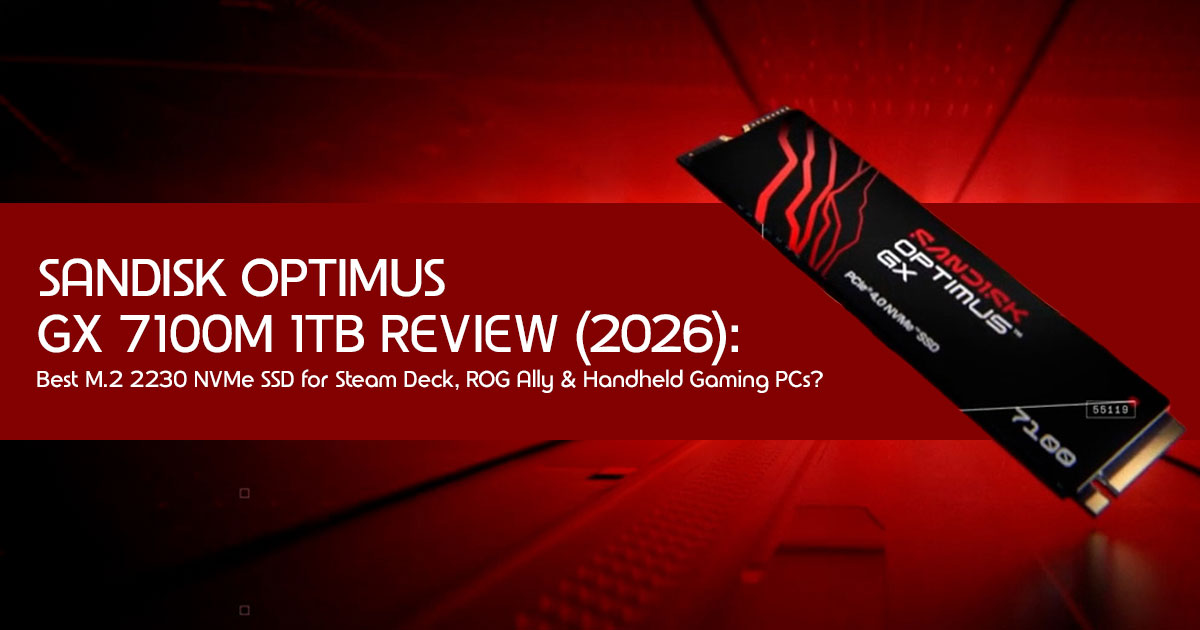
The SanDisk Optimus GX 7100M 1TB stands out as the best TLC-based M.2 2230 NVMe SSD for handheld gaming PCs in 2026. It delivers up to 7,250 MB/s sequential read speeds, uses more durable TLC NAND instead of the QLC NAND found in many competing drives, and offers an impressive 600 TBW endurance—nearly three times higher than the Crucial P310.
If you own a Steam Deck, ASUS ROG Ally, MSI Claw, or a thin laptop with an M.2 2230 slot, this is one of the strongest storage upgrades currently available.
But speed isn’t the only reason this SSD deserves attention.
For years, anyone shopping for a M.2 2230 NVMe SSD had to make compromises. Compact drives often meant lower endurance, slower sustained performance, or cheaper flash memory. Many manufacturers chose QLC NAND to reduce costs, leaving users to trade long-term reliability for extra storage.
Click here to buy SanDisk Optimus GX 7100M
The SanDisk Optimus GX 7100M takes a different approach.
Despite being no bigger than a postage stamp, it challenges the long-held assumption that compact SSDs must sacrifice either performance or endurance. On paper, its specifications are impressive. The real question is whether those numbers translate into a better experience once the drive is inside your system.
That’s exactly what this review aims to answer.
Drawing on more than 20 years of experience in hardware and application research and development, we evaluate products through the lens of real-world performance, durability, reliability, and long-term value. Our goal is simple: help you choose the right product, whether you’re looking for the best budget, performance, reliability, or long-term investment in a storage upgrade.
Whether you’re a PC gamer, Steam Deck enthusiast, ROG Ally owner, content creator, professional, or someone who simply wants faster and more dependable storage, this review is written with your needs in mind.
Rather than repeating marketing claims, we carefully examined the official specifications, independent benchmark results, hardware teardowns, and long-term user experiences from trusted reviewers and owners. We did not purchase this SSD or perform our own laboratory testing, and we won’t suggest otherwise. Every conclusion in this review is based on extensive research, component analysis, real-world usability, and industry expertise.
If you’re wondering whether the SanDisk Optimus GX 7100M 1TB is worth your money, read on. Some of its biggest advantages aren’t immediately obvious—and they could make all the difference when choosing your next 2230 NVMe SSD.
What Is the SanDisk Optimus GX 7100M? (And Why the Name Suddenly Changed)
If the SanDisk Optimus name sounds unfamiliar, you’re not alone.
The story begins in early 2025, when Western Digital separated its businesses. The hard drive division remained with Western Digital, while the flash storage business—including SSDs, microSD cards, and other memory products—became part of SanDisk.
Then, at CES 2026, SanDisk introduced another major change. It retired the well-known WD_BLACK and WD Blue SSD brands and brought its consumer SSD lineup under a single new family: SanDisk Optimus.
For long-time PC builders and gamers, the rebranding was unexpected. Many wondered whether these were entirely new products or simply familiar SSDs with different names.
The good news is that the underlying product lineup remains easy to understand. Here’s how the previous Western Digital SSD brands compare with the new SanDisk Optimus family:
| Previous WD Product Name | New SanDisk Optimus Branding |
|---|---|
| WD_BLACK SN8100 | SanDisk Optimus GX PRO 8100 |
| WD_BLACK SN850X | SanDisk Optimus GX PRO 850X |
| WD_BLACK SN7100 | SanDisk Optimus GX 7100 |
| WD Blue SN5100 | SanDisk Optimus 5100 |
| New handheld SSD (no direct WD predecessor) | SanDisk Optimus GX 7100M |
So where does the GX 7100M fit?
Think of it this way. The Optimus GX 7100 is the standard 2280 desktop-and-laptop drive.
The Optimus GX 7100M is its compact 2230 sibling, built specifically for handhelds and ultra-thin laptops. It delivers the same performance and uses the same TLC NAND as its larger counterpart.
For most buyers: If you saw a great deal on a WD_BLACK SN7100 and now you’re staring at an “Optimus GX 7100” wondering if it’s the same thing — yes, it is. New sticker. Same drive. Don’t let the rebrand trick you into overthinking it.
SanDisk Optimus GX 7100M 1TB: Specs at a Glance
Here’s the full picture in one clean table.
| Specification | SanDisk Optimus GX 7100M (1TB) |
|---|---|
| Model Number | SDSP71100TAT |
| Capacity | 1TB (also available in a 2TB variant). |
| Interface | PCIe 4.0 ×4 with NVMe 2.0 support. |
| Form Factor | M.2 2230 (22 × 30 × 2.38 mm), designed for handheld gaming PCs and ultra-compact laptops. |
| Weight | 2.8 g |
| Controller | SanDisk Polaris 3, a 4-channel DRAM-less controller optimized for efficiency. |
| NAND Flash | SanDisk BiCS8 TLC 3D CBA NAND for high endurance and consistent performance. |
| SLC Cache | Dynamic nCache 4.0 technology to accelerate burst write performance. |
| Sequential Read Speed | Up to 7,250 MB/s. |
| Sequential Write Speed | Up to 6,900 MB/s. |
| Random Read / Write | Up to 1.0 million IOPS read and 1.3 million IOPS write. |
| Cache | Host Memory Buffer (HMB), utilizing approximately 64 MB of system memory. |
| Endurance | 600 TBW (Terabytes Written), suitable for demanding gaming and productivity workloads. |
| MTTF | 1.75 million hours. |
| Active Power Consumption | 3.5 W during reads and 3.8 W during writes. |
| Security | TCG Pyrite 2.01 security support. |
| Software Bundle | SanDisk Dashboard for drive management and Acronis True Image for backup and cloning. |
| Warranty | 5-year limited warranty. |
Those are strong numbers for something this small. But specs only matter if they change how the drive feels. So let’s talk about what each one actually does for you.
Design and Build Quality: Small Enough to Fit Anywhere
The M.2 2230 form factor is the whole point of this drive.
“2230” just means 22 mm wide and 30 mm long. Compare that to the standard M.2 2280 drive in most desktops, which is 80 mm long. The 7100M is less than half the length.
Here’s why the smaller size matters.
Because handhelds and thin laptops don’t have room for a full-size drive. A Steam Deck, an ROG Ally, an MSI Claw, and many Microsoft Surface and Dell laptops only accept an M.2 2230 NVMe SSD. A normal 2280 drive physically won’t fit.
In practice: If your device has a 2230 slot, the 7100M drops right in. No adapters, no modifications, no guesswork.
A few build details worth knowing:
- Single-sided Every chip sits on one side. That keeps it slim and lets a laptop’s thermal pad press flat against it — a real plus in tight chassis.
- No mounting screw in the Most laptops already have one in the spare slot, but check before you start.
- No 2280 adapter Want to use it in a desktop? You’ll need to buy a cheap 2230-to-2280 adapter separately.
One honest limitation: because it’s a 2230 drive, maximum capacity is currently 2TB. If you want 4TB or more, you’ll need the full-size Optimus GX 7100 instead.
Real-World Performance: How Fast Is It, Really?
On paper, SanDisk rates the 1TB model at 7,250 MB/s reads and 6,900 MB/s writes. Those are near the ceiling of what PCIe 4.0 can deliver.
Do real drives hit those numbers? Mostly, yes.
Published CrystalDiskMark results from multiple reviewers consistently report sequential read speeds of around 7,100–7,150 MB/s and 6,820 MB/s writes — within a hair of the box claims. That’s better than most rivals manage.
Sequential speeds look impressive, but random performance has a much bigger impact on how fast a PC feels during everyday use.
Random 4K Speed Is What Games Actually Feel
Sequential speed (the big 7,250 MB/s figure) is great for copying huge files. But game load times and OS booting mostly depend on random 4K performance — lots of tiny reads scattered everywhere.
Here, the 7100M performs exceptionally well where it matters most. Published benchmark results report around 101 MB/s on the demanding Q1T1 random-read test. For a DRAM-less drive, that’s excellent. It’s the reason games launch fast and Windows feels snappy.
The takeaway: Don’t just chase the biggest sequential number on the box. The 7100M’s strong random performance is what makes it feel quick day to day — and it keeps up with drives that cost more.
DRAM-Less and HMB: The Big Worry, Answered
The biggest concern buyers usually have is whether a DRAM-less SSD can keep up.
The Optimus GX 7100M is DRAM-less. It has no dedicated cache chip. Instead it uses Host Memory Buffer (HMB), which borrows about 64 MB of your system RAM to store its mapping table.
A few years ago, “DRAM-less” meant “slow and choppy.” That’s no longer true.
Bottom line:
- For gaming, booting, and everyday use, the difference from a DRAM-equipped SSD is basically invisible.
- Where it can show up: very large, sustained writes — say, dumping hundreds of gigabytes of 4K video in one go. The nCache 4.0 SLC cache absorbs the first burst, then speeds drop once it fills.
- The cache also shrinks as the drive fills up, so keeping some free space helps it stay quick.
Our assessment: If you’re a gamer or a general user, don’t let “DRAM-less” scare you off. If you move huge files every single day for work, a DRAM-equipped SSD is the better tool — but that’s not what this 2230 drive is for.
nCache 4.0: The Turbo Button
SanDisk’s nCache 4.0 uses a slice of the fast NAND as a pseudo-SLC cache. It’s what lets the drive hit its headline speeds on short bursts. It’s dynamic — it grows when the drive is empty and shrinks when it’s full. Practical tip: leave 10–15% free space and the drive stays at its best.
Thermals and Power Efficiency: Cool Running, Longer Battery
High-performance SSDs often generate significant heat, but the Optimus GX 7100M keeps temperatures impressively well under control.
The Polaris 3 controller keeps power consumption impressively low—at most about 3.5 W while reading and 3.8 W while writing. Independent reviewers and published benchmark results consistently show the drive staying below 50°C during sustained workloads without requiring a heatsink.
For everyday use:
- No heatsink Perfect for handhelds and thin laptops with zero cooling room.
- Better battery Lower power draw means your Steam Deck or ROG Ally squeezes more play time per charge.
- No thermal throttling The drive holds its speed instead of slowing down to cool off.
This is one of the most overlooked advantages of the Optimus GX 7100M. A lot of fast 2230 drives get hot enough to make a handheld’s Wi-Fi flaky or trigger throttling. The 7100M runs cool enough that we’d call it one of the safest upgrades for a compact machine.
Software, Security, and Warranty
SanDisk backs the drive with solid support:
- SanDisk Dashboard (Windows). Monitor drive health, update firmware, run M.A.R.T. tests, and tweak settings like TRIM and write-cache.
- Acronis True Image for Clone your old drive to the new one — a big help if you’re nervous about migrating your games and OS.
- TCG Pyrite 01 security. Basic drive protection for managed or business devices.
- 5-year limited warranty plus a 600 TBW endurance rating and 75 million-hour MTTF.
One important note about security: there’s no full hardware encryption suite here (no TCG Opal). For most home and gaming users that’s a non-issue. For IT-managed fleets that need encrypted drives, it’s worth knowing.
For long-term use: The 600 TBW rating is the headline. That’s enough to write over 300 GB every single day for five years before you’d hit the limit. For a gaming drive, that’s effectively “buy it and forget it” durability.
Click here to buy SanDisk Optimus GX 7100M
SanDisk Optimus GX 7100M vs Crucial P310: The Head-to-Head
This is the comparison that matters most. The Crucial P310 has been the default M.2 2230 NVMe SSD recommendation for a while. So how does the 7100M stack up?
| Feature | SanDisk Optimus GX 7100M | Crucial P310 |
|---|---|---|
| NAND Flash | TLC NAND for higher endurance and sustained performance. | QLC NAND, prioritizing lower cost over long-term endurance. |
| Sequential Read Speed | Up to 7,250 MB/s | Up to 7,100 MB/s |
| Sequential Write Speed | Up to 6,900 MB/s | Up to 6,000 MB/s |
| Random Write Performance | Up to 1.3 million IOPS | Up to 1.2 million IOPS |
| Endurance (1TB Model) | 600 TBW, making it a better choice for heavy workloads and long-term reliability. | 220 TBW, suitable for everyday use but significantly lower than the SanDisk drive. |
| Controller | SanDisk Polaris 3 | Phison E27T |
| Warranty | 5-year limited warranty | 5-year limited warranty |
The 7100M outperforms the Crucial P310 in most areas that matter to long-term users, particularly endurance, sustained write performance, and TLC NAND reliability.
The big one is NAND type. TLC is tougher and holds its speed better during long writes. QLC is cheaper but wears faster and slows down more once its cache runs out. Then there’s endurance: 600 TBW versus 220 TBW is a nearly 3x gap.
Here’s what that means: The Crucial P310 is often cheaper, and it’s still a fine drive. But if you plan to keep this SSD for years, write a lot of data, or just want the more durable flash, the Optimus GX 7100M is the smarter long-term buy.
(One market note: Micron has been pulling back its consumer Crucial line to focus on AI memory, which has pushed prices around. Check live pricing on both before you decide.)
SanDisk Optimus GX 7100M vs WD_BLACK SN770M: The Upgrade Story
A lot of handheld owners already know the WD_BLACK SN770M — it was the go-to 2230 drive before this. Here’s how the new drive compares to the old favorite.
| Feature | SanDisk Optimus GX 7100M | WD_BLACK SN770M |
|---|---|---|
| Sequential Read Speed | Up to 7,250 MB/s | Up to 5,150 MB/s |
| NAND Flash | TLC NAND for higher endurance and consistent performance. | TLC NAND offering reliable performance and durability. |
| Interface | PCIe 4.0 ×4 with NVMe 2.0 support. | PCIe 4.0 ×4 with NVMe support. |
| Form Factor | M.2 2230, ideal for handheld gaming PCs and compact laptops. | M.2 2230, designed for the same class of compact devices. |
The 7100M is roughly 40% faster on reads while keeping the same TLC NAND. It’s the clear successor.
For long-term use: If you were shopping for an SN770M, buy the Optimus GX 7100M instead. It’s the same idea, noticeably faster, and it’s the drive SanDisk will keep supporting going forward.
Optimus GX 7100 vs GX 7100M: Which One Do You Need?
Same family, two sizes. Here’s how to choose.
| Feature | SanDisk Optimus GX 7100 | SanDisk Optimus GX 7100M |
|---|---|---|
| Form Factor | M.2 2280 standard desktop and laptop SSD. | M.2 2230 compact SSD designed for handhelds and ultra-portable devices. |
| Maximum Capacity | Available in capacities of up to 4TB. | Available in capacities of up to 2TB. |
| Sequential Performance | Up to 7,250 MB/s read and 6,900 MB/s write. | Up to 7,250 MB/s read and 6,900 MB/s write. |
| Best Suited For | Desktop PCs, PlayStation 5, and full-size laptops that support the M.2 2280 form factor. | Steam Deck, ROG Ally, MSI Claw, Microsoft Surface, Dell XPS, and other thin laptops requiring an M.2 2230 SSD. |
What this means for the buyer: Got a 2230 slot (Steam Deck, ROG Ally, handheld, thin laptop)? Get the 7100M. Got a normal desktop, a PS5, or a full-size laptop and want up to 4TB? Get the standard GX 7100.
Pros and Cons
Let’s keep it balanced.
| Pros | Cons |
|---|---|
| Delivers up to 7,250 MB/s, making it one of the fastest TLC-based M.2 2230 NVMe SSDs currently available. | Costs more than budget-oriented alternatives such as the Crucial P310 (QLC). |
| High-quality TLC NAND with an endurance rating of 600 TBW, offering excellent long-term reliability. | Does not include a 2230-to-2280 adapter for broader device compatibility. |
| Runs exceptionally cool during heavy workloads, typically staying below 50°C without requiring a heatsink. | Lacks TCG Opal hardware encryption, limiting its appeal for enterprise deployments. |
| Power-efficient design helps maximize battery life in handheld gaming PCs and compact laptops. | A mounting screw is not included in the retail package. |
| Single-sided PCB design fits devices with limited internal space, including the Steam Deck and ultrathin laptops. | Maximum capacity is currently limited to 2TB. |
| Includes a 5-year limited warranty along with SanDisk Dashboard software and Acronis True Image support. | Market pricing remains volatile, so availability and value can fluctuate. |
| Noticeably faster than the previous-generation WD_BLACK SN770M in both sequential and random performance. | DRAM-less architecture means sustained write performance can decline once the SLC cache is exhausted. |
Who Should Buy the SanDisk Optimus GX 7100M 1TB?
Not every drive is for everyone. Here’s our honest buying guide.
| If You Are… | Should You Buy It? | Why |
|---|---|---|
| A Steam Deck owner | ✔ Yes | The M.2 2230 form factor fits perfectly, while the TLC NAND, efficient thermals, and strong endurance make it an excellent handheld upgrade. |
| An ROG Ally or MSI Claw user | ✔ Yes | Its PCIe 4.0 interface allows compatible handheld gaming PCs to take advantage of sequential read speeds of up to 7,250 MB/s. |
| A thin-and-light laptop or Microsoft Surface upgrader | ✔ Yes | Its slim, single-sided M.2 2230 design and power-efficient operation make it ideal for compact laptops. |
| A gamer looking for faster game loading times | ✔ Yes | Excellent random 4K performance delivers quicker game launches, faster asset streaming, and a more responsive gaming experience. |
| A budget-conscious buyer | △ Maybe | If long-term endurance isn’t your priority, the more affordable SanDisk P310 (QLC) may provide better overall value. |
| A video editor transferring large files every day | △ Consider a DRAM-equipped SSD | While burst performance is excellent, sustained write speeds may decrease once the SLC cache is exhausted. |
| A desktop PC or PlayStation 5 builder | ✖ Choose the Optimus GX 7100 (2280) | Desktop systems and the PS5 require the larger M.2 2280 form factor and benefit from capacities of up to 4TB. |
| An IT administrator requiring enterprise encryption | ✖ Look for another SSD | The drive does not support TCG Opal hardware encryption, making it less suitable for enterprise fleet deployments. |
Our bottom line: For handheld and thin-laptop gamers, this is the drive to beat in 2026.
Pricing and Value: Is It Worth the Money?
Price is where things become more interesting.
At launch, the official MSRP was around $415, although real-world retail pricing has often been significantly lower depending on region, retailer, and availability. We’ve frequently seen the drive selling in the $229–$240 range.
Why the gap? A global NAND memory shortage (driven by AI demand) has made SSD prices swing hard. A drive can jump $50 in a week.
Here’s why this matters:
- Never pay full MSRP for this Buy it when it’s selling close to its typical street price.
- Track it for a few Set a price alert and strike when it dips.
- Compare against the P310 on the same The value gap shrinks and shifts constantly.
At around $230, the 7100M is a strong value for a TLC drive with this much endurance. Near $415, it’s overpriced and we’d wait.
Where it’s available: You’ll find it on Amazon, Newegg, Micro Center, B&H, and Best Buy in the US. Availability in India is still ramping up, so check the current listing before assuming it’s in stock.
Frequently Asked Questions
Is the SanDisk Optimus GX 7100M good?
Yes. It’s among the strongest M.2 2230 NVMe SSDs available, with 7,250 MB/s reads, TLC NAND, and 600 TBW endurance — a clear step up from the QLC-based Crucial P310.
Does the Optimus GX 7100M fit the Steam Deck?
Yes. The Steam Deck (LCD and OLED) uses an M.2 2230 slot, which is exactly this drive’s size. Note the Deck’s slot is PCIe 3.0, so top speeds are capped — but you still gain capacity, cooler thermals, and tougher flash.
Is the Optimus GX 7100M the same as the WD_BLACK SN7100?
Effectively, yes. SanDisk rebranded its WD_BLACK and WD Blue SSDs to “Optimus” at CES 2026. The Optimus GX 7100 replaces the WD_BLACK SN7100, and the 7100M is the compact 2230 version. They share the same architecture and technology, although the 7100M is the compact
M.2 2230 version designed for handhelds and ultra-thin laptops.
Is the Optimus GX 7100M DRAM-less, and does that matter?
Yes, it’s DRAM-less and uses Host Memory Buffer (HMB). For gaming and daily use the difference is invisible. It only slows during very large, sustained file transfers — not a concern for most buyers.
Does the Optimus GX 7100M need a heatsink?
No. Independent reviewers and published benchmark results consistently show the drive staying below 50°C during sustained workloads, even without a heatsink.
Optimus GX 7100M vs Crucial P310 — which is better?
The SanDisk Optimus GX 7100M delivers higher endurance and better sustained write performance (TLC, 600 TBW, 6,900 MB/s writes) versus the P310’s QLC, 220 TBW, 6,000 MB/s writes.
The P310 is often cheaper. Choose the 7100M for longevity, the P310 to save money today.
How much storage is 1TB for gaming?
Roughly 10 to 15 modern AAA games, depending on size. If your library is bigger, consider the 2TB version.
What’s the warranty and endurance?
A 5-year limited warranty, 600 TBW endurance for the 1TB model (1,200 TBW for 2TB), and a 1.75 million-hour MTTF.
Is the SanDisk Optimus GX 7100M worth buying in 2026?
Yes. For users who need a fast, reliable M.2 2230 NVMe SSD for devices like the Steam Deck, ASUS ROG Ally, MSI Claw, or compatible laptops, the SanDisk Optimus GX 7100M is one of the strongest choices available in 2026. Its TLC NAND, 600 TBW endurance, and excellent power efficiency make it a compelling long-term upgrade.
Click here to buy SanDisk Optimus GX 7100M
Final Verdict
Here’s the bottom line.
The SanDisk Optimus GX 7100M 1TB removes many of the compromises traditionally associated with compact M.2 2230 NVMe SSDs. It delivers excellent performance, remains power-efficient, manages heat well, and, most importantly, uses TLC NAND instead of the QLC NAND found in many competing drives. With a 600 TBW endurance rating, it offers almost three times the write endurance of the Crucial P310, making it one of the most durable options in its class.
If you’re looking for the best TLC-based M.2 2230 NVMe SSD for a Steam Deck, ASUS ROG Ally, MSI Claw, or a compatible thin-and-light laptop, the SanDisk Optimus GX 7100M 1TB is our top recommendation for 2026. It combines 7,250 MB/s sequential read speeds, 600 TBW endurance, and a 5-year limited warranty into a package that’s built for both performance and long-term reliability.
No product is perfect. The drive is currently available in capacities of up to 2TB, it doesn’t offer full hardware encryption, and the retail package typically doesn’t include an M.2 mounting screw or an adapter. Pricing can also vary considerably depending on the retailer and region.
Even with those minor drawbacks, this SSD stands out as one of the smartest upgrades you can make if your device supports the M.2 2230 form factor.
Our advice is straightforward: buy it when it’s selling close to its typical street price.
Key Highlights:
- Best TLC-based 2 2230 NVMe SSD for 2026
- Up to 7,250 MB/s read / 6,900 MB/s write
- 600 TBW endurance
- Ideal for Steam Deck, ASUS ROG Ally, MSI Claw
- Runs cool and is power efficient
- Maximum capacity: 2TB
Where to Buy the SanDisk Optimus GX 7100M 1TB
At the time of writing, direct Amazon US and Amazon India listings for the SanDisk Optimus GX 7100M 1TB (Model: SDSP71100TAT) are either unavailable or not consistently listed. Availability is expected to improve over time, but stock remains limited in many regions.
This specific M.2 2230 PCIe 4.0 NVMe SSD is currently easier to find through SanDisk’s official store and a few authorized retailers.
Official Manufacturer
- SanDisk Official Product Page (US / Global) — SanDisk Optimus GX 7100M NVMe SSD (1TB)
- SanDisk Official Product Page (Asia Pacific / Regional) — SanDisk Optimus GX 7100M (1TB)
Authorized Retailer
Before placing your order, verify that you’re purchasing the correct model number: SDSP71100TAT (1TB). Since retailers may carry multiple capacities and similar-looking models, confirming the model number helps ensure you receive the exact drive reviewed in this article.
If Amazon listings become available in your region later, it’s still worth comparing prices before buying, as promotions and discounts can change frequently.
***Disclaimer***
This blog post reflects our research, analysis, and opinions based on available product information, user feedback, and industry knowledge. It should not be taken as the official position of any brand, manufacturer, or company mentioned here. While we aim to keep information accurate and up to date, product details, pricing, and availability can change. We recommend double-checking important details before making a purchase.
Some links in this article may be affiliate links. If you choose to buy through these links, we may earn a small commission at no extra cost to you. This helps support our work and allows us to keep publishing in-depth, unbiased reviews. Our recommendations are never influenced by affiliate partnerships.
Comments shared by readers reflect their own views and not ours. We are not responsible for outcomes resulting from the use of information on this site. Please seek professional advice where appropriate.
All product names, logos, and brands mentioned are the property of their respective owners. These names are used for identification and informational purposes only and do not imply endorsement.