
For years, faster GPUs have been the center of every conversation about AI performance. That is starting to change. As AI models grow larger and demand more data, storage has become one of the biggest performance bottlenecks inside modern data centers. Simply adding more High Bandwidth Memory (HBM) is not always practical because of cost, availability, and physical limitations. That is exactly the problem the KIOXIA GP1 Series aims to solve.
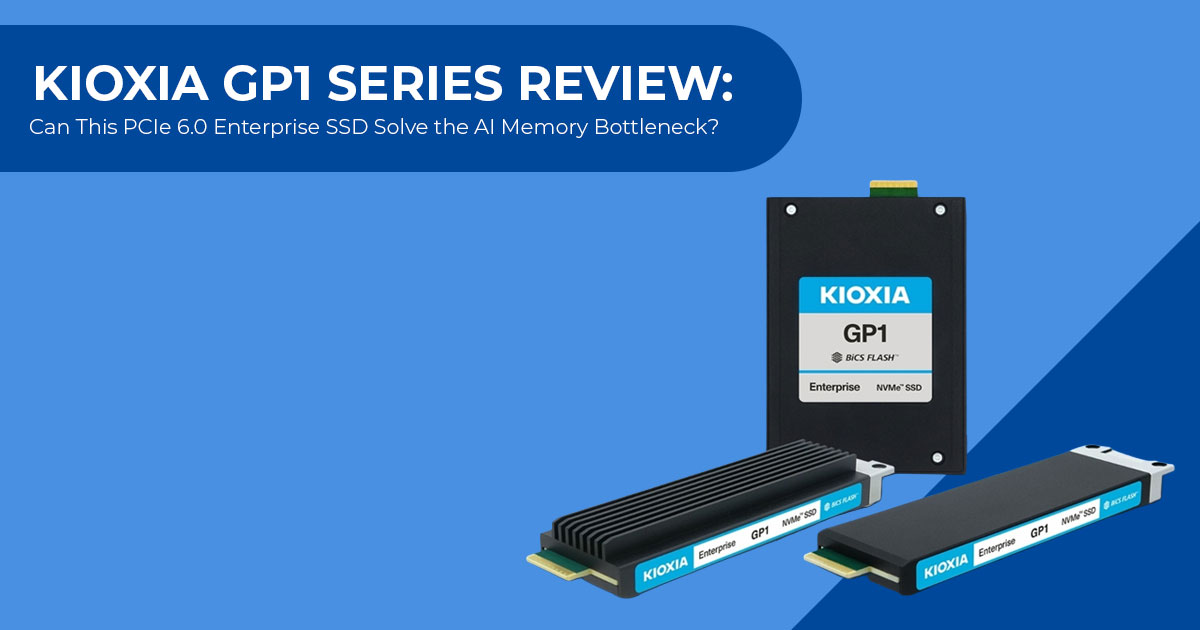
The KIOXIA GP1 Series is not a consumer NVMe SSD, and it is not a replacement for GPU memory. Instead, it is an upcoming PCIe 6.0 enterprise SSD designed to serve as an ultra-low-latency flash tier for AI servers.
Click here to buy from Amazon
Powered by XL-FLASH Generation 2, it is built to keep more AI data close to GPU compute, helping reduce delays for workloads such as AI inference, retrieval-augmented generation (RAG), and long-context AI models. KIOXIA rates the drive at up to 10 million random-read IOPS with 512-byte transfers, but that figure reflects a specialized storage benchmark rather than a promise of universal AI performance gains. What makes GP1 interesting isn’t just the benchmark number. It’s the way KIOXIA is rethinking enterprise AI storage.
As technology experts with over 20 years of experience in hardware and application research and development, we evaluate every product based on real-world performance, durability, and value for money. Whether you are an AI infrastructure engineer, data-center architect, enterprise IT leader, cloud provider, or a business investing in next-generation GPU infrastructure, our recommendations are built on extensive research, component-level analysis, practical deployment scenarios, and industry expertise—not marketing claims.
In this review, we’ll look beyond the headline specifications to explain what the KIOXIA GP1 Series actually brings to enterprise AI, where it fits within today’s rapidly evolving enterprise AI storage landscape, and whether it has the potential to become a meaningful advantage for organizations building the next generation of intelligent computing.
Quick verdict: KIOXIA GP1 Series is a purpose-built enterprise AI SSD for organizations that need extremely high small-block random-read performance and a lower-cost flash tier within the GPU memory hierarchy. Buyers should treat the 10M random-read IOPS figure as an engineering target that needs platform-specific validation, not as a retail SSD benchmark.
Editorial research note
This article is an independent editorial analysis based on KIOXIA’s announced GP1 specifications and current AI storage architecture trends. It is not based on hands-on testing of the product. Any performance figures or capabilities described as planned, targeted, or claimed reflect information released by KIOXIA and should be verified against final product documentation and independent third-party testing before making any purchasing or deployment decisions.
KIOXIA GP1 Series at a glance
Before we look at the specifications in detail, it’s worth understanding the problem GP1 is trying to solve. Once you see where today’s AI servers struggle, the design choices behind GP1 make much more sense.
| Specification | Announced Detail | What It Means for Buyers |
| Product | KIOXIA GP1 Series | A new family of enterprise drives, not a desktop product line. |
| Interface | PCIe 6.0 and NVMe 2.2 | Designed for next-generation server platforms; existing consumer PCs cannot provide its intended operating environment or full performance. |
| Flash Memory | Second-generation XL-FLASH | Low-latency flash technology designed for much faster random access than capacity-focused TLC SSDs. |
| Claimed Read Performance | Up to 10 million random-read IOPS | Relevant when software issues numerous small reads simultaneously, as can occur with GPU-oriented AI data access. |
| Test Granularity | 512-byte random reads | A small I/O size that better reflects fine-grained lookup patterns than standard 4KB SSD marketing figures. |
| Form Factors | E1.S 9.5mm / 15mm and E3.S | Intended for dense enterprise servers and storage systems. |
| Cooling | Air cooling across form factors; cold-plate liquid cooling on selected E1.S 9.5mm and E3.S versions | Rack design, airflow, and cooling hardware remain important purchasing considerations. |
| Endurance | Up to 50 DWPD reported for the announced drive | Suitable for write-intensive enterprise environments, subject to final model specifications. |
| Availability | Evaluation samples planned for select customers by the end of 2026 | No consumer retail launch or public street price has been confirmed. |
IOPS, endurance, capacity, and thermal behavior depend on the final model, host system, firmware, queue depth, drivers, and workload. Verify the final data sheet before procurement.
Why the AI memory wall matters more than headline SSD speed
Modern AI servers place their fastest memory directly beside the GPU. That memory is HBM, and it is extremely fast. It is also costly, limited in capacity, and physically constrained by the accelerator package.
The underlying challenge is surprisingly simple. Larger models, longer context windows, vector lookups, and growing key-value caches need more data to be available quickly. Adding more HBM is not always practical. Pulling every request from a normal storage layer can leave expensive GPUs waiting for data.
That gap is the AI memory wall. The proposed role of flash as an extension of the memory hierarchy is to add a storage tier that is slower than HBM but materially more responsive than conventional capacity-first SSD storage. In plain terms, GP1 aims to create a middle layer:
- HBM for the data that must be closest to GPU compute.
- GPU-accessible data on low-latency flash for a larger active dataset.
- Conventional enterprise SSDs, network storage, or object storage for broader capacity.
This does not turn NAND flash into DRAM. Latency, software design, PCIe topology, and data placement still matter. But it can reduce how much expensive HBM is needed by keeping more active data on a much faster flash tier.
What makes the KIOXIA GP1 AI SSD different
10 million random-read IOPS targets a different problem
Most SSD comparisons focus on sequential read speed: how quickly a drive can move a large file from one place to another. That is useful for media workflows and bulk data loading. It does not explain how well a drive handles millions of tiny, unrelated requests.
At its simplest, IOPS (input/output operations per second) measures how many storage requests a drive can process every second. In an AI storage context, high small-block random-read IOPS can matter when a system needs frequent access to small pieces of data such as embeddings, indexes, metadata, or cache entries.
The GP1’s stated 512-byte random read figure is significant because it prioritizes responsiveness for fine-grained access. A drive that looks strong in 4 KB or sequential tests may not behave the same way with 512-byte operations. Buyers should ask vendors for benchmark results that match their own request size, queue depth, read/write mix, and software stack.
XL-FLASH generation 2 prioritizes latency and I/O
KIOXIA’s XL-FLASH generation 2 is positioned as a low-latency flash technology. The GP1 uses it to favor high IOPS and finer-grained access over the highest possible capacity per drive.
That difference matters because these drives are designed for very different jobs. A conventional TLC NAND enterprise SSD often offers more capacity per dollar and remains the right choice for large model repositories, data lakes, backups, or broad AI data staging. GP1 is aimed at a smaller but more demanding role: frequently accessed data that must reach the compute side with less delay.
PCIe 6.0 NVMe SSD support prepares it for newer server designs
The announced PCIe 6.0 NVMe SSD interface fits the direction of modern AI servers, where storage, switches, CPUs, DPUs, and GPUs need to exchange much more data. The interface alone does not guarantee a workload will achieve the claimed IOPS. Server platform support, PCIe switch design, firmware maturity, operating-system drivers, and application integration all influence real results.
For this reason, GP1 should be evaluated as a platform component, not purchased as an isolated SSD upgrade.
Does GPU direct access mean the SSD becomes GPU memory?
No. GPU-initiated storage access is a better way to describe what is happening. It allows the GPU to reach storage with less CPU involvement, but it does not turn the SSD into GPU memory.
KIOXIA connects GP1 with the NVIDIA Storage-Next direction, which focuses on storage optimized for GPU-initiated AI workloads. The practical benefit depends on the complete platform: accelerator generation, PCIe fabric, storage software, caching policy, and whether the application can issue enough parallel work to use the drive effectively.
A careful procurement question is therefore not “Does GP1 replace HBM?” It is:
Which part of our active dataset can live on a lower-cost flash tier without reducing inference throughput or response-time targets?
That question leads to a more useful proof of concept than comparing top-line IOPS figures alone.
Click here to buy from Amazon
Real-world performance: what we can and cannot conclude
There are no independent retail-style test results to use for the final GP1 product at the time of writing. KIOXIA’s 10 million IOPS is an announced maximum random-read performance figure, measured at 512-byte granularity. Treat it as a manufacturer claim until independent testing confirms the results.
A serious evaluation should measure:
- Tail latency, not only average A few slow requests can matter in serving workloads.
- Read performance at the exact I/O size used by the application.
- Performance during mixed reads and writes, not only a read-only peak.
- Sustained behavior after the drive has been filled and placed under load.
- GPU utilization and end-to-end tokens per second, queries per second, or job completion time.
- Energy used per unit of useful AI work.
- Cooling stability in the intended S or E3.S chassis.
Important limitation: Higher IOPS alone won’t automatically make AI models train or respond faster. If the workload is compute-bound, network-bound, or limited by HBM capacity in another way, the gain may be small. GP1 has the strongest case where storage access is demonstrably a bottleneck.
KIOXIA GP1 vs conventional enterprise SSDs
| Buyer Need | KIOXIA GP1 Series | Conventional TLC Enterprise NVMe SSD |
| Primary Purpose | AI storage architecture and GPU-oriented, small-block access | General enterprise capacity, databases, virtualization, and broad data storage |
| Core Strength | Extreme small-block random-read IOPS and lower-latency flash | Capacity, cost efficiency, and mature deployment options |
| Memory Type Focus | Second-generation XL-FLASH | Usually TLC NAND |
| Best Workload Fit | GPU-accessible working data, fine-grained AI lookups, and specialized inference tiers | Model repositories, bulk data, large datasets, backups, and general server storage |
| Platform Requirement | Next-generation AI server with suitable PCIe connectivity, software, and cooling | Broad server compatibility, depending on generation and form factor |
| Buying Status | Evaluation-stage product | Widely available in numerous capacity and endurance options |
This isn’t about choosing one drive over another. Most AI servers will benefit from using both, with GP1 handling latency-sensitive workloads while capacity-oriented TLC SSDs store larger datasets.
Competitor context: GP1 vs Samsung PM1763 and other PCIe 6.0 storage
Competition in the PCIe 6.0 enterprise SSD market is moving quickly, with vendors such as Samsung, Micron, Solidigm, and other enterprise storage vendors working on storage designed for AI infrastructure. Samsung’s PM1763, for example, is positioned for next-generation AI infrastructure and GPU-initiated storage access.
Reported figures place it below GP1’s announced 10M 512-byte random-read IOPS claim on a per-drive basis, but it has a different design point and market status. The right comparison must include capacity, endurance, qualification status, power, software support, and the specific server platform.
| Consideration | KIOXIA GP1 Series | Samsung PM1763 / Mainstream PCIe 6.0 Enterprise SSDs |
| Main Positioning | Ultra-high-IOPS SSD and a flash tier that extends the GPU memory hierarchy | High-performance enterprise storage for AI and data-center platforms |
| Key Performance Message | Up to 10 million random-read IOPS with 512-byte transfers | Performance varies by model, host configuration, and workload |
| Flash Approach | XL-FLASH low-latency flash | Vendor-specific enterprise NAND architecture |
| Buyer Question | Can it improve the hot-data tier for our GPU workloads? | Does it meet our capacity, throughput, procurement, and qualification requirements? |
| Procurement Maturity | Samples planned for selected customers | Check current vendor availability and approved-server lists |
Do not choose a drive based only on a single IOPS headline. Ask for application-level trials. A drive optimized for high IOPS may be the better fit for a small-object lookup layer, while a higher-capacity TLC drive may provide better value for model checkpoints, large training files, and data retention.
Who should consider the KIOXIA GP1 Series
GP1 may be worth evaluating for
- AI infrastructure teams working with GPU-accessible memory constraints.
- Organizations serving long-context inference workloads where caches and retrieval data grow quickly.
- HPC and AI teams that have measured storage-related GPU idle time.
- Server vendors and cloud providers preparing PCIe 0 GPU platforms.
- Teams that can run a controlled proof of concept and tune storage placement in software
GP1 is not the right purchase for
- Desktop PCs, workstations, PlayStation upgrades, or gaming systems.
- Buyers looking for an ordinary PCIe 0 SSD for file copies.
- Small deployments without compatible enterprise hardware.
- Teams that have not established storage as the source of their AI bottleneck.
- Buyers who need a retail drive today.
Buying advice: how to evaluate a high IOPS SSD for AI
Before placing an enterprise order, use this checklist:
- Confirm the Profile GPU utilization, storage latency, cache misses, and end-to-end application throughput.
- Match the Request 512-byte, 4 KB, and mixed-workload figures at realistic queue depths—not only a best-case peak.
- Check the hardware Confirm CPU, GPU, PCIe switch, backplane, E1.S/E3.S bay, and cooling compatibility.
- Review software A GPU-initiated AI workload needs compatible I/O paths and appropriate data-placement software.
- Price the full Include server upgrades, power, cooling, qualification, support, and operational risk.
- Run a proof of Compare GPU utilization, tail latency, throughput, and cost per useful result against a capacity-oriented SSD tier.
- Do not rely on future Check the final production data sheet; evaluation hardware and shipping models can differ.
Pros and limitations
| Strengths | Limitations and Cautions |
| The claimed 10 million random-read IOPS targets a relevant 512-byte AI access pattern. | No independent production-hardware benchmarks are available yet. |
| Second-generation XL-FLASH targets low-latency, high-IOPS storage rather than general-purpose capacity. | It is not a replacement for HBM or DRAM. |
| PCIe 6.0 and enterprise form factors suit emerging GPU-server designs. | It requires specialized, compatible infrastructure and software. |
| The design addresses the cost and capacity pressure surrounding HBM memory extension. | Pricing, capacity options, and broad production availability remain unconfirmed. |
| Cooling options are suitable for dense AI servers. | The target audience is enterprise procurement teams, not retail buyers. |
KIOXIA GP1 pricing and availability
KIOXIA has not announced public GP1 pricing, full capacity options, or a general retail release date. The announced plan is to provide evaluation samples to selected customers by the end of 2026.
That makes the appropriate next action different from a normal SSD purchase. Enterprise buyers should contact KIOXIA or an approved server/storage integrator to discuss qualification, sample access, platform compatibility,and support terms. Consumers should not expect the KIOXIA GP1 SSD to appear as a normal Amazon upgrade drive in the near term.
Click here to buy from Amazon
Frequently asked questions about KIOXIA GP1
What is the KIOXIA GP1 Series?
KIOXIA GP1 Series is an announced family of PCIe 6.0 NVMe SSDs for AI infrastructure. It uses XL-FLASH generation 2 to deliver very high small-block random-read performance and serve as a flash-based extension tier for GPU-accessible data.
How many IOPS does the KIOXIA GP1 SSD deliver?
KIOXIA states that GP1 can reach up to 10 million random-read IOPS at a 512-byte transfer size. Actual results will depend on the final drive, server, software, cooling, and workload conditions.
Does GP1 replace High Bandwidth Memory (HBM)?
No. HBM remains much closer to the GPU and serves a different role. GP1 is intended to extend the memory hierarchy with a lower-cost flash tier for data that does not need to reside entirely in HBM.
Is the GP1 a consumer or gaming SSD?
No. KIOXIA GP1 uses enterprise E1.S and E3.S form factors and targets AI and high-performance computing infrastructure. It is not intended as a typical M.2 gaming or laptop SSD.
When can buyers purchase the GP1?
KIOXIA has said it expects to offer evaluation samples to selected customers by the end of 2026. Public pricing and broad retail availability have not been announced.
Can existing AI servers use the GP1 Series?
Not necessarily. GP1 is designed for next-generation enterprise platforms supporting PCIe 6.0, compatible E1.S or E3.S form factors, appropriate cooling, and software optimized for GPU-initiated storage access. Organizations should verify hardware compatibility before planning a deployment.
Final verdict: Is the KIOXIA GP1 Series worth buying?
KIOXIA GP1 Series is worth evaluating—not blindly buying—when AI performance data shows that small, random storage reads are limiting a GPU deployment. Its planned combination of PCIe 6.0, XL-FLASH generation 2, and up to 10 million random-read IOPS addresses a real infrastructure problem: creating a faster, lower-cost flash tier beneath HBM in the AI memory hierarchy.
For most buyers, a mature TLC enterprise SSD remains the practical purchase. For AI infrastructure teams with compatible next-generation servers and a measured storage bottleneck, GP1 deserves a proof of concept once evaluation units are available. The deciding evidence should be application-level results, not a peak IOPS number.
Check current availability and offers
Amazon Worldwide
KIOXIA GP1 Series is not confirmed as a retail Amazon product. If a verified listing appears, check the exact model, seller, server compatibility, warranty, capacity, and current price before ordering. For available KIOXIA SSD options, use the latest Amazon Worldwide listings below.
Check current KIOXIA SSD offers on Amazon Worldwide
Amazon India
KIOXIA GP1 Series is not confirmed for Amazon India retail availability. Before buying any KIOXIA SSD, confirm that the model is an appropriate client or enterprise drive for the intended system; GP1-class E1.S and E3.S hardware is not a standard laptop or desktop upgrade.
Check current KIOXIA SSD offers on Amazon India
If you found this analysis helpful, we’d love to hear your thoughts. Do you think enterprise SSDs like the KIOXIA GP1 Series could change the way AI infrastructure is built? Share your thoughts in the comments below—we’d love to hear how you see enterprise AI storage evolving.
Follow us for more in-depth hardware reviews, AI infrastructure analysis, and enterprise technology insights. If you have any questions about the KIOXIA GP1 Series, PCIe 6.0 SSDs, or AI storage in general, leave a comment—we’re happy to help.
***Disclaimer***
This blog post reflects our research, analysis, and opinions based on available product information, user feedback, and industry knowledge. It should not be taken as the official position of any brand, manufacturer, or company mentioned here. We make every effort to keep this guide accurate, but product specifications, pricing, and availability may change after publication. Always verify the latest specifications, pricing, compatibility, and availability before making a purchasing decision.
Some links in this article may be affiliate links. If you choose to buy through these links, we may earn a small commission at no extra cost to you. This helps support our work and allows us to keep publishing in-depth, unbiased reviews. Affiliate partnerships never influence our recommendations.
Opinions expressed by readers are their own and do not necessarily reflect ours. We are not responsible for outcomes resulting from the use of information on this site. Please seek professional advice where appropriate.
All product names, logos, and brands mentioned are the property of their respective owners. These names are used for identification and informational purposes only and do not imply endorsement.