
The verdict before the physics
If you read nothing else: match the tube to the heat in the room, not to the heat inside the case.
|
Conditional Buy: PETG Rigid, Easy Mode |
Best Rigid Pick: PMMA / Acrylic
Rigid, Showpiece |
Flexible Pick: EPDM Soft, Low-Maintenance |
| Best for cooler, controlled loops where the maker’s temperature guidance can be maintained. Use compatible inserts where recommended, avoid damaged or reused tube ends, and monitor coolant temperature. | A strong choice for clear hardline runs. Corsair rates its XT Hardline tubing for coolant up to 60°C; that is a tubing limit, not a guarantee that every loop component is safe at the same temperature. Harder to cut and bend than PETG. | Watercool rates its HEATKILLER EPDM tubing from −30°C to 110°C and describes it as plasticizer-free. Check the temperature limits of the rest of the loop. Matte black tubing hides the coolant and gives up the rigid-tube look. |
VERIFIED checked against a manufacturer spec page REPORTED widely documented by builders, not an official rating ESTIMATE our arithmetic, not a measurement
Choosing between PETG and acrylic tubing affects how a custom water – cooled PC is built, maintained and operated. The main differences are ease of installation, product – specific temperature limits, rigidity and how carefully the tube ends must be prepared.
For PC builders in India, room temperature matters because coolant in a conventional radiator loop generally runs above ambient. A room that reaches 35–40°C can leave less temperature headroom than one held at 20–22°C. The actual coolant temperature depends on the loop and workload, so measure it rather than relying on room temperature alone.
Product specifications can change by model and revision, so check the manufacturer’s current documentation before buying.
The short answer: PETG is often easier to cut and bend, while PMMA offers rigid, clear hardline runs and may have a higher product-specific temperature limit. EPDM is the flexible option. None is automatically best for every build; choose by the exact product rating, coolant temperature, fitting compatibility and installation quality.
Whether you’re building your first custom water-cooling loop, upgrading a gaming PC or assembling a workstation, this guide compares PETG, PMMA acrylic and EPDM across temperature limits, installation, fittings, maintenance and cost. It also explains how warm room conditions can affect the operating margin for Indian builds.
HOW THIS WAS RESEARCHED / This guide compares manufacturer-published product specifications with general material information. No destructive testing was conducted for this article. Reports of deformation or leaks are identified as builder reports, not laboratory results or universal failure thresholds. Temperature estimates are calculations based on the stated room temperature and an assumed water-to-ambient delta.
The four materials, in plain terms
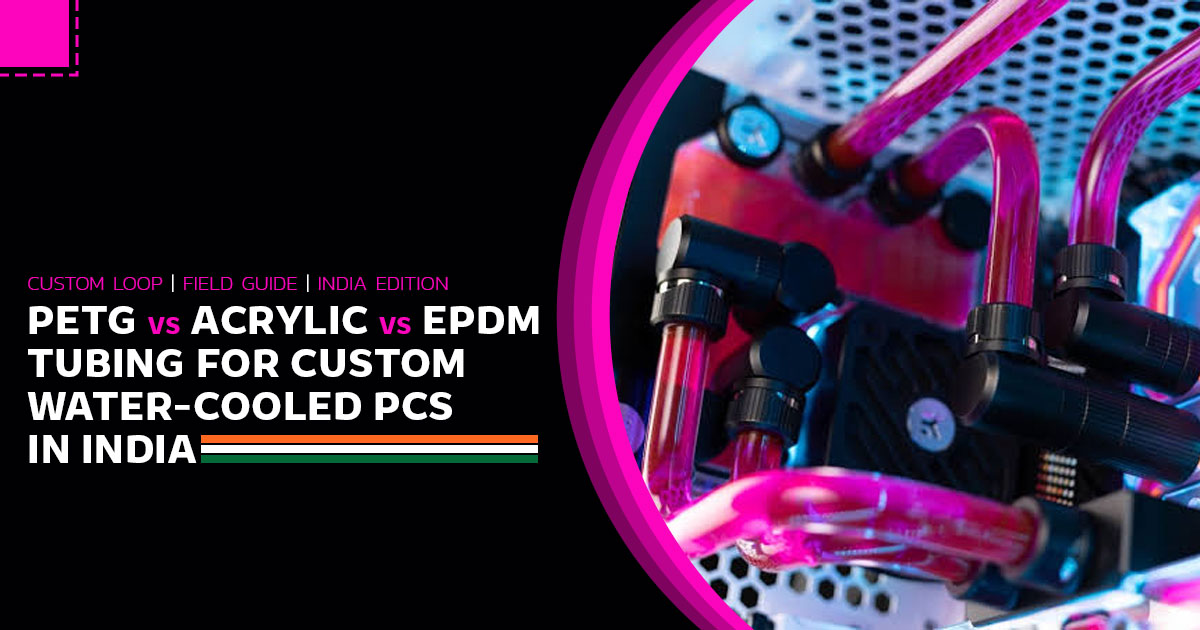
Custom loops use two main tubing styles: rigid hardline and flexible soft tubing. PETG and PMMA (acrylic) are common hardline choices; EPDM and PVC are common soft-tubing options. Each has different trade-offs in heat tolerance, installation and maintenance.
MATERIAL AT A GLANCE
| Material | Family | What It Is | The One Thing to Remember |
| PETG | Rigid | Glycol-modified polyester used for rigid tubing; heating and bending depend on the tube grade and the maker’s instructions. | Easy to work with; can deform under sustained heat and fitting pressure. Follow the exact product guidance. |
| MMA (acrylic) | Rigid | Glass-clear thermoplastic, cut with a fine-toothed saw. | Clear and rigid; product-specific heat limits may exceed those of some PETG tubes, but cutting and bending need care. |
| EPDM | Soft | Synthetic rubber originally used for automotive coolant hoses. | Flexible synthetic rubber. Watercool describes its HEATKILLER hose as plasticizer-free; check the exact hose and all loop-component ratings. |
| PVC | Soft | Flexible clear hose; formulations vary by product, and some PVC hoses use plasticizers. | Flexible and easy to route. Formulations vary; check the manufacturer’s material and coolant-compatibility guidance. |
The number that matters is not the one on the datasheet
Glass-transition temperature (Tg) is not the only figure to consider. Some PETG datasheets list Tg around 80–85°C, but the value depends on the polymer grade. A tubing product’s own technical data takes priority over a generic material range.
Heat-deflection temperature is another grade- and test-dependent measure of how a polymer behaves under load. Figures around 68–70°C may appear for some PETG grades, but they should not be presented as universal values for every tube. Inside a compression fitting, the tube is held against an O-ring under sustained pressure, so temperature, time, wall thickness and fitting design all matter.
Creep: why failures happen at the ends
Thermoplastics can deform slowly under sustained load, including below their glass-transition temperature. Builders have reported deformation near tube ends where compression fittings apply pressure. The severity depends on the tubing grade, wall thickness, fitting design, coolant temperature and time under load.
The temperature at which PETG deformation begins is not a universal rating. EK warns that its PETG tubing can deform when a loop runs constantly at elevated temperatures, particularly above 40°C. Builder reports describe deformation and leaks, but they do not establish one threshold for every tube. Treat 40°C as a conservative caution point for the cited guidance, not a laboratory failure limit.
When PETG deforms under fitting pressure, the affected area may be hidden inside the fitting, where it is harder to inspect.
COMMON MISCONCEPTION / A tubing rating of 60°C means every joint and component can operate safely at 55°C.
FACT / Alphacool lists a −20°C to +60°C working range for its Eisrohr PETG tubing. That is the stated range for this product, not a guarantee that every fitting, seal, pump, block or coolant is suitable for the same temperature. Follow the exact tubing and fitting makers' guidance and monitor coolant temperature.
04 How room temperature affects coolant temperature
Coolant in a conventional radiator loop will generally settle above room temperature. The difference between room air and coolant is the water-to-ambient delta. For a dual-360mm-radiator loop cooling a CPU and high-end GPU, a 10–15°C delta at full load is an estimate, not a guarantee. Fan speed, radiator area, case airflow, component power and radiator design all affect the result.
The following figures are illustrative calculations using a +12°C water-to-ambient delta, not measured results or predictions for every build.
ILLUSTRATIVE COOLANT TEMPERATURES BY ROOM CONDITION (ASSUMING A +12°C DELTA)
| Scenario | Room Air | Estimated Coolant (+12°C) | PETG Guidance | PMMA / EPDM Guidance |
| Cooler Test-Bench Room | 21°C | ~33°C | Check product guidance | Check each component’s rating |
| Indian Room, AC at 24°C | 24–25°C | 36–37°C | Check product guidance | Check each component’s rating |
| Warm Day, No AC | 30–32°C | 42–44°C | Higher caution; monitor coolant | Check each component’s rating |
| Peak Summer, No AC | 36–42°C | 48–54°C | Do not assume suitability; monitor coolant | Check each component’s rating |
Long workloads give the coolant more time to approach a steady operating temperature. An overnight render or AI training job can keep a loop under load for hours. Dust-clogged filters and restricted airflow may also raise coolant temperature and reduce the operating margin available to tubing and other components.
Material by material: what you actually get
THE COSTLY ASSUMPTION

“My PC is in an air-conditioned room” is usually true for the hours you are awake in it. It is rarely true for the overnight render, the power cut, or the afternoon the AC was off because nobody was home. Size the tube for the worst hour, not the average one.
PETG rigid tubing BYKSKI · ALPHACOOL EISROHR
PETG is often easier to cut and bend than PMMA, which can make it approachable for a first hardline build. Results depend on the tube grade, wall thickness, bending tool and technique. Follow the manufacturer’s heating instructions, and do not assume PETG will withstand impacts that would crack acrylic.
| Strengths | Limitations |
| Easier to cut and bend than PMMA with suitable tools. | Risk of deformation under sustained heat and fitting pressure. |
| Lower forming temperature than PMMA for many products. | Requires coolant-temperature monitoring in hot rooms. |
| Can be more forgiving during handling than acrylic. | Damaged tube ends may seal less reliably. |
| Common sizes are available from several PC-cooling brands; check local stock. | Softer surface can pick up scratches and haze. |
| Temperature guidance: Follow the exact tube maker’s temperature guidance. | |
PMMA / acrylic rigid tubing CORSAIR HYDRO X XT HARDLINE
Corsair lists a maximum coolant temperature of 60°C for its XT Hardline tubing. The estimated 48–54°C range in the hottest scenario below is under that product limit, but this does not establish a safe operating temperature for the entire loop. Check the pump, reservoir, seals, blocks and coolant ratings too. PMMA offers clear optics and rigid runs, but cutting, chamfering and bending require care to avoid chips, bubbles or fractures.
| Strengths | Limitations |
| Rated to 60°C coolant temperature; check headroom at high loads. | Must be sawed, not scored and snapped. |
| Rigid walls resist fitting-pressure deformation better than PETG. | Narrow bending window; mistakes can require a new tube. |
| Clear optics. | No flex; accurate measuring and cutting matter. |
| Same OD may fit existing fittings if the fitting maker confirms compatibility. | Costs may be higher per metre. |
EPDM soft tubing WATERCOOL HEATKILLER
Watercool lists its HEATKILLER EPDM tubing from −30°C to 110°C and describes it as plasticizer-free. Its product pages list 60 Shore A for the 16/10mm version and 70 Shore A for the 13/10mm version. EPDM is flexible and can help with routing; whether a block can be moved without draining depends on the loop layout and available slack. The hose rating does not set the limit for the complete loop.
| Strengths | Limitations |
| Rated −30°C to 110°C for the hose itself. | Matte black on this model; coolant is not visible. |
| Watercool describes this hose as plasticizer-free. | No rigid, straight-line hardline appearance. |
| Flexible wall helps with tight routing. | Fittings must match the tube dimensions and fitting type. |
| May allow easier component access, depending on loop layout. | Availability in India may depend on imports. |
The 575-watt problem
NVIDIA lists the RTX 5090 at 575W total graphics power and recommends a 1,000W system power supply. A CPU that draws 150–250W adds to the system’s potential heat load, though actual power use varies by workload and settings. GPU power is not the same as the heat load handled by the loop; estimate the loop’s load from the components actually cooled and their expected power use.
The coolant temperature in a loop is usually fairly uniform, though it rises as it passes through heat sources and falls across radiators. The temperature difference around the loop depends on flow rate and component load, so do not assume that one fitting is always the hottest point. Monitor coolant temperature and leave headroom below the limits specified for every component.
THE PRACTICAL UP SHOT/For an RTX 5090 - class GPU in a hot Indian room, do not choose PETG based on a generic 60°C figure alone. PMMA is the rigid, clear option; EPDM is the flexible option. If you use PETG, follow the tube maker's guidance and use inserts only when the manufacturer recommends them for that exact tube-and-fitting combination. Inserts do not replace temperature monitoring or checking every component's limits.
Fittings, tube sizes and why OD matters
Hardline fittings are sized to the tube’s outer diameter (OD), such as 12, 13, 14 or 16mm. Soft-tubing fittings generally need tubing with the specified inner and outer diameters, such as 10/16mm or 10/13mm. A half-inch tube is 12.7mm, not 13mm; do not assume it will seal in a fitting designed for 13mm tubing. Follow the fitting manufacturer’s stated dimensions and tolerances.
Bykski’s G1/4 hardline compression fittings are designed for specific tube outer diameters. If you plan to replace PETG with PMMA, check the exact fitting model and its stated tube-size compatibility before reusing the fittings.
Reusing old tube: the ₹2,500 question
Reusing pre-bent PETG across builds can save material and bending time, but inspect the tube ends closely. Marks, scratches, distortion or damage where the O-rings sit can compromise the seal. Do not reuse tubing that is deformed, scratched at the sealing surface or no longer fits securely; follow the tube and fitting manufacturers’ guidance.
The cost of replacement tubing is small compared with the potential cost of a coolant leak near expensive hardware. If the tube ends show wear or deformation, replace them rather than relying on a questionable seal.
Which one is yours
1 Flagship gaming or AI workstation — 500W+ GPU, RTX 5090 class
Choose EPDM 16/10 if you prefer flexible tubing and easier maintenance; whether you can move or remove a block without draining the loop depends on the layout and available slack. Choose PMMA if you want rigid, clear runs. For a high-power build, avoid relying on PETG unless its temperature limits, fitting compatibility and any manufacturer-recommended inserts are addressed.
2 First hardline build — under 400W total, air-conditioned room
PETG with compatible internal inserts can be a workable option for a first hardline build if coolant temperatures remain within the tubing maker’s guidance. Actual temperatures depend on the CPU and GPU, radiator capacity, fan settings, case airflow and room temperature. Add a coolant-temperature sensor and set a warning threshold based on the tubing and component limits.
3 Already own Bykski fittings, want to eliminate the warp risk
Swap the tube and keep the fittings only if the fitting manufacturer confirms compatibility with PMMA of the same outer diameter. Acrylic can reduce the risk of heat-related deformation associated with PETG, but it does not remove other leak risks such as poor cuts, damaged O-rings or incorrect assembly.
4 Small-form-factor or compact workstation
EPDM 13/10 can suit compact builds where flexible tubing and tight bends help with routing. Limited radiator area can raise coolant temperatures, so check the loop’s actual temperature and the limits of every component.
The comparison table
Product specification svary by SKU and pack size. Prices have been omitted where the exact current listing could not be matched confidently. Check the manufacturer and retailer page before buying .
| Product | Material | Tube Size | Pack | Temperature Rating |
| Corsair XT Hardline 12mm | PMMA | 10mm ID / 12mm OD; check exact SKU | Check SKU/pack | Up to 60°C coolant (maker rating) |
| Watercool EPDM 16/10 | EPDM | 10mm ID / 16mm OD | Check SKU/pack | −30°C to 110°C (hose rating) |
| Watercool EPDM 13/10 | EPDM | 10mm ID / 13mm OD | Check SKU/pack | −30°C to 110°C (hose rating) |
| Alphacool Eisrohr 13/10 (18513) | PETG | 10mm ID / 13mm OD | Verify pack | −20°C to +60°C (working range) |
| Alphacool Eisrohr 16/13 | PETG | 13mm ID / 16mm OD | Verify SKU/pack | Check exact product specification |
| Bykski PETG Tubing | PETG | Verify exact SKU and ID/OD | Varies by product | Check exact product specification |
| Bykski RGB Hardline Fittings | Brass and seals (verify materials) | Confirm supported OD from exact SKU | Confirm pack contents | Check exact fitting specification |
PRICE NOTE — CHECK THE EXACT SKU BEFORE BUYING / Prices for imported loop hardware vary by seller, pack size, shipping, taxes and availability. Prices are shown as “check live listing” where an exact current price could not be matched confidently to the same SKU and pack size. Confirm the exact product, dimensions, pack contents, temperature specification and delivered price before ordering.
Three rules before you fill the loop
NON - N E G O T I A B L E

Chamfer and deburr every cut edge. Use the tube maker's recommended tool and edge finish; a sharp or uneven edge can damage an O-ring during insertion and compromise the seal.
NON - N E G O T I A B L E

Measure the coolant, not just CPU temperature. An inline G1/4 coolant-temperature sensor can help control fans only if the motherboard or controller supports that sensor input and fan-control setup. CPU core temperature is not a substitute for coolant temperature when assessing tubing conditions.
NON - N E G O T I A B L E

Air-test before filling. Use a compatible leak tester and follow the pressure limits specified by the tester and loop-component manufacturers. A successful test can reveal leaks before coolant is added, but it does not confirm every collar is seated or guarantee against future leaks.
Where to buy
| Manufacturer Sites and Buying Links | ||
| Use manufacturer pages for specifications. Retailer links below are searches or storefronts, not confirmation of a specific SKU. Check model, tube dimensions, pack size, shipping and current price before buying. | ||
| Bykski | ||
| Corsair XT Hardline 12mm | Official product page | |
| Watercool EPDM | ||
| Alphacool / Eisrohr | Official manufacturer site | Alphacool Eisrohr — Amazon India |
Questions builders actually ask
| Why do builders warn about PETG in high-end Indian builds?
EK warns that its PETG tubing can deform when a loop runs at elevated temperatures, particularly above 40°C. Builder reports describe deformation and leaks, but the risk depends on tube grade, wall thickness, fitting design, load and duration. Treat 40°C as a caution point for that guidance, not a universal laboratory failure threshold. |
| Can I reuse PETG from my last build?
Avoid reusing tubing if the ends show wear, scratches, distortion or damage where the O-rings seal. Heat cycling alone does not prove every tube is unsafe, but damage or a poor fit reduces confidence in the seal. Replace questionable tubing. |
| What is the best tubing for an RTX 5090 loop?
PMMA is a strong option for rigid, clear runs; EPDM suits builders who prefer flexible routing. The 60°C figure applies to Corsair’s stated XT Hardline tubing limit, while 110°C is Watercool’s EPDM hose rating. Neither number overrides the lower limits of other loop components. |
| Will Bykski hardline fittings work with acrylic instead of PETG?
They may, but only if the exact fitting model is specified for the same tube outer diameter and is compatible with PMMA. Check the fitting maker’s guidance and match the OD exactly. |
| Does coolant temperature matter more than CPU temperature?
Coolant temperature is more relevant to tubing because the coolant contacts the tube. CPU temperature still matters for diagnosing cooling performance. Use a supported inline coolant sensor and set warnings below the limits specified for the tubing and other loop components. |
Have you used PETG, PMMA acrylic or EPDM in a custom water-cooled PC? Share the tube you chose, your coolant temperatures and what you learned from the build. If you’re still comparing options, leave your questions in the comments.
Follow us for more PC hardware comparisons, build guides and practical buying advice. If you have a question about tubing, fittings or coolant temperature, ask in the comments.
***Disclaimer***

This article is based on our research, analysis, available product information, user feedback, and industry knowledge. It is not an official statement from any brand or manufacturer mentioned in the article. Product specifications, prices, software features, and availability can change. We do our best to keep the information up to date, but please check the latest details with the manufacturer or retailer before making a purchase.

Some links in this article may be affiliate links. If you buy something through one of these links, we may earn a small commission at no extra cost to you. These commissions help support the site and our work. They do not affect how we assess or discuss products. Comments and opinions shared by readers belong to the people who post them and do not necessarily represent our views. Information on this site is provided for general purposes, and we cannot guarantee a particular result from using it. Where professional advice is needed, consult a qualified professional.

All product names, logos, and trademarks belong to their respective owners. We use them only to identify the products and companies discussed and do not imply endorsement or affiliation.