
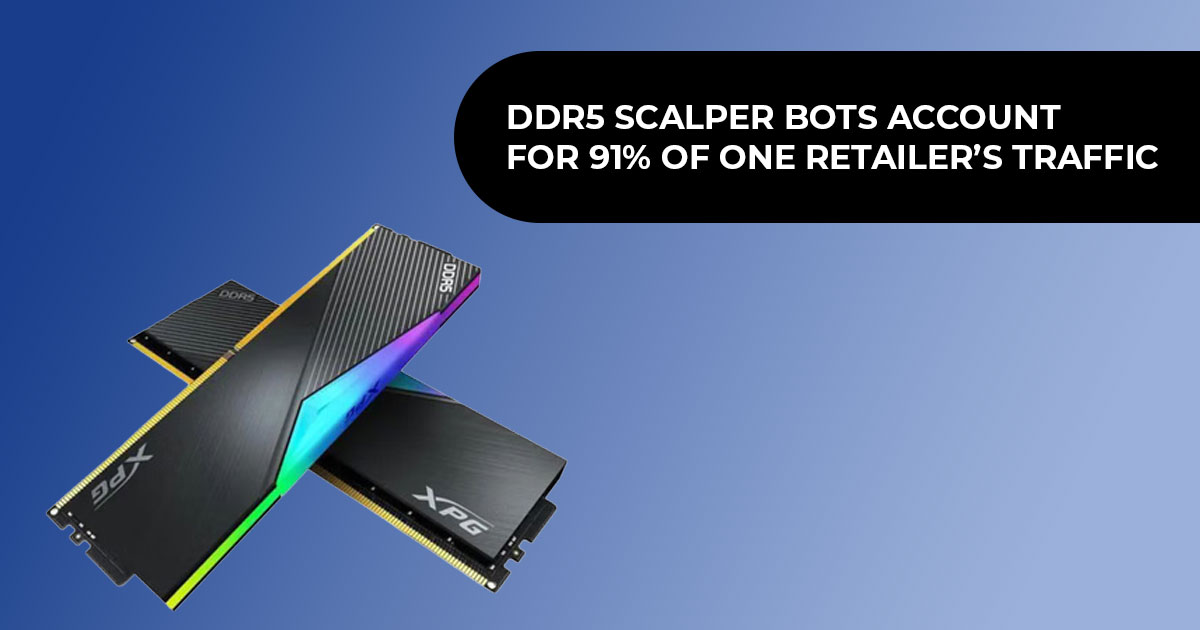
DDR5 Scalper Bots Take 91% of One Retailer’s Listing Traffic: What RAM Buyers Need to Know
The shortage and rising demand for DDR5 RAM are creating another problem for shoppers: automated bots are monitoring product listings far more heavily than ordinary buyers. According to VideoCardz, citing DataDome, automated bots accounted for 91% of the traffic reaching DDR5 product pages at one unnamed retailer. In simple terms, that works out to roughly 10 automated requests for every legitimate visit.
There is an important distinction here. The 91% figure refers to traffic or requests made to product pages. It does not mean bots purchased 91% of the available memory, nor does it represent every retailer selling DDR5 RAM. Still, the finding shows how heavily DDR5 listings at some retailers can be monitored by automated systems, which can make available stock harder for shoppers to find and buy.
For shoppers trying to find the right RAM without overpaying, this can make an already frustrating buying experience harder. Prices can change quickly, stock can disappear without warning, and the first listing you find may not be the best deal. Compare price, capacity, speed, timings, compatibility, warranty, and seller reputation before placing an order.
As technology experts with over 20 years of experience in hardware and application research and development, we carefully assess products based on real-world performance, durability, compatibility, and value for money. Our goal is to help PC builders, gamers, content creators, professionals, and everyday users find the right product for their needs, whether they are looking for budget-friendly, high-performance, reliable, or long-term hardware. Our recommendations are based on extensive research, component analysis, real-world usability, and industry expertise, so you can make a buying decision with confidence instead of simply choosing whatever happens to be in stock.
With DDR5 RAM prices and availability becoming harder to predict, understanding how automated monitoring affects product listings can help you compare prices and avoid paying more than you need to for the memory your system actually requires.
What the 91% DDR5 Traffic Figure Actually Measures
A product-page visit does not automatically become a sale. A request may be used to check whether a product is in stock, monitor a price, track a newly listed item, collect information, compare availability, or decide whether a resale opportunity exists.
The report does not establish the outcome of every request. It does not identify how many requests resulted in completed orders, nor does it quantify the amount of stock obtained by resellers.
The safest description is: Automated traffic represented 91% of the observed traffic reaching DDR5 product pages at one retailer. The finding indicates intensive monitoring, not 91% of completed purchases.
How Frequently Were DDR5 Listings Checked?
The earlier investigation referenced in the report recorded activity across 91 product listings. During one hour, approximately 50,000 requests were observed. Each listing received an average of about 551 requests in that sample, equating to a check roughly every 6.5 seconds.
In the broader investigation, DataDome also identified a scraping operation that generated more than 10 million requests before it was blocked. These figures show the scale of the observed activity and do not prove that every retailer experiences the same request volume.
How Do RAM Scalping Bots Monitor Product Pages?
The available report describes activity consistent with automated stock and price monitoring. A simplified process may look like this:
- An automated system identifies a DDR5 product page.
- It requests the page
- It looks for changes in availability or
- It passes information to the operator or another automated
- The operator may then decide whether to attempt a purchase or
The report also mentions cache-busting parameters, which can be used to request fresh page information instead of relying on a cached version. The source does not provide enough information to determine whether every observed system attempted checkout.
Which Products and Suppliers Were Targeted?
The reported activity was not limited to consumer gaming memory kits. The article says that DataDome observed automated traffic involving:
- DDR5 product listings
- Micron
- Apacer
- Other memory suppliers
- Amphenol
- TE Connectivity
- DDR5 socket and connector products
The presence of these names in the report does not mean that those companies operated the bots or that every product from those companies was affected. It indicates that the observed requests reached pages associated with memory products and related hardware components.
Why Are DDR5 Listings Attractive to Resellers?
RAM scalping generally becomes more attractive when a product has limited availability and buyers are willing to pay different prices across marketplaces. A monitoring system may identify newly available inventory, a temporarily lower price, a popular capacity, or a product unavailable elsewhere.
The supplied report links the activity with elevated DDR5 pricing and pressure on consumers. It does not prove that automated traffic is the sole cause of higher prices. Retail pricing can also reflect supply, demand, distribution, production decisions, shipping, seller fees, and regional availability.
DDR5 Bot Activity: Observed Traffic Versus Confirmed Purchases
| Question | What the Source Supports |
|---|---|
| Did one retailer record unusually high automated traffic? | Yes. The reported figure was 91% of traffic to DDR5 product pages. |
| Did bots make roughly ten requests for every legitimate visit? | Approximately. This is consistent with the reported 91% automated traffic figure. |
| Did bots purchase 91% of the retailer’s DDR5 stock? | No such conclusion is established by the source. The 91% figure refers to traffic, not the proportion of DDR5 inventory purchased by bots. |
| Does the 91% figure apply to every DDR5 retailer? | No. The reported data concerns one unnamed retailer and should not be generalized to the entire DDR5 market. |
| Were DDR5 listings checked at short intervals? | Yes. An earlier sample reportedly recorded automated checks at approximately every 6.5 seconds. |
What Should Buyers Check Before Purchasing DDR5 RAM?
The supplied report does not specify individual RAM models or configurations. It also does not provide a verified current price for a particular kit. Buyers should evaluate the actual listing rather than relying only on a headline such as DDR5-6000 or 32GB DDR5.
Check Compatibility First
Confirm the memory requirements for the intended computer. Use the motherboard and processor documentation to verify supported memory type, capacity, and operating profiles. Do not assume that every DDR5 kit will operate at the same speed or settings in every system.
Compare the Complete Cost
Use the final delivered price, including product price, shipping, taxes, import charges where applicable, and any optional protection plans.
Review the Seller
For marketplace listings, check seller identity, seller history, product condition, warranty information, return policy, fulfilment method, and estimated delivery date.
Compare More Than One Retailer
The 91% statistic concerns one unnamed retailer. It does not establish that every store has the same level of automated traffic. Checking several sellers can reveal normal price differences, third-party markups, warranty terms, alternative capacities, and delivery options.
Avoid Buying Solely Because Stock Appears Briefly
Short-lived availability can create pressure to purchase without checking compatibility or seller details. A memory kit that cannot be returned or does not suit the system may cost more than the initial price suggests.
Does the Report Prove That DDR5 Prices Are Controlled by Bots?
No. The report supports a narrower conclusion: automated systems were responsible for a very large share of observed traffic to DDR5 product pages at one retailer.
- It does not prove that bots bought most of the inventory
- It does not prove that all retailers experience the same traffic pattern
- It does not prove that bots caused the entire DDR5 price increase
- It does not prove that every high-priced listing came from a scalper
- It does not prove that human shoppers had no opportunity to purchase
How This Differs From a Standard Stock Alert
| Standard Shopper Approach | Automated Monitoring Approach |
|---|---|
| Occasional manual visits to individual product pages | Repeated scheduled requests to check listings automatically |
| Relies on human interpretation to identify meaningful changes | Uses programmatic checks to detect changes to monitored pages |
| Typically responds more slowly when prices, availability, or page details change | Can provide faster detection when a monitored page changes |
| Practical monitoring is usually limited to a small number of products | Can potentially monitor many product listings simultaneously |
Limitations of the DDR5 Scalper-Bot Finding
The retailer is unnamed
Readers cannot compare its traffic with a known store.
The sample is not the whole market
The result concerns one retailer’s DDR5 pages.
Requests are not orders
A page request does not confirm a purchase or resale.
The complete methodology for the 91% figure is not included
The supplied report does not provide a full methodology or the sampling period used to calculate the 91% figure.
DataDome has a commercial role
DataDome operates in bot detection and mitigation, so its role should be disclosed when presenting these findings. The reported figures should therefore be treated as source-specific observations, not as a measure of the entire DDR5 market.
Frequently Asked Questions About DDR5 Scalper Bots
What percentage of traffic came from DDR5 bots?
The reported figure was 91% of traffic reaching DDR5 product pages at one unnamed retailer.
Does 91% bot traffic mean bots bought 91% of the RAM?
No. The figure measures product-page traffic, not completed orders or stock obtained by bots.
How often were some DDR5 listings checked?
An earlier sample recorded listing checks approximately every 6.5 seconds.
How many requests did the earlier scraping operation generate?
More than 10 million requests before DataDome blocked the operation.
How can buyers avoid overpaying for DDR5 RAM?
Compare multiple retailers, verify compatibility, check the seller and warranty, review the total delivered price, and avoid extreme markups.
Final Assessment: What the Report Means for RAM Buyers
The reported 91% DDR5 bot traffic is best understood as a measure of automated activity on one retailer’s product pages, not as a measure of purchases or stock taken by bots.
It shows that some DDR5 listings were being monitored far more heavily by automated systems than by human visitors. The evidence does not establish that bots purchased most of the available DDR5 memory or that every retailer faces the same situation.
For shoppers, the sensible response is to compare retailers, verify system compatibility, review seller and warranty details, and distinguish a current listing price from a normal market price.
Check Current DDR5 RAM Listings
Amazon US
Readers in the United States can check current DDR5 RAM listings on Amazon US and review the configuration, seller, warranty, return policy, delivery cost, and final price before ordering.
View current DDR5 RAM listings on Amazon US
Amazon India
Readers in India can check current DDR5 RAM listings on Amazon India and confirm the regional price, seller information, warranty coverage, delivery terms, and compatibility with the intended system.
View current DDR5 RAM listings on Amazon India
Affiliate disclosure: If affiliate links are added, the publication may earn a commission from qualifying purchases. Prices, stock, sellers, delivery terms, and warranty conditions can change. Verify the final listing before placing an order.
What do you think about the growing role of scalper bots in the DDR5 market? Have you faced a situation where a RAM kit went out of stock before you could buy it, or are you unsure about which DDR5 RAM is right for your PC? Share your experience or questions in the comments—we’d be happy to hear from you and help clear up any doubts.
If you find our hardware research, buying guides, and product analysis useful, follow us for more practical advice, honest comparisons, and updates that can help you make smarter technology purchases.
***Disclaimer***
This blog post reflects our research, analysis, and opinions based on available product information, user feedback, and industry knowledge. It should not be taken as the official position of any brand, manufacturer, or company mentioned here. We make every effort to keep this guide accurate, but product specifications, pricing, and availability may change after publication. We recommend double-checking important details before making a purchase.
Some links in this article may be affiliate links. If you choose to buy through these links, we may earn a small commission at no extra cost to you. This helps support our work and allows us to keep publishing in-depth, unbiased reviews. Affiliate partnerships never influence our recommendations.
Opinions expressed by readers are their own and do not necessarily reflect ours. We are not responsible for outcomes resulting from the use of information on this site. Please seek professional advice where appropriate.
All product names, logos, and brands mentioned are the property of their respective owners. These names are used for identification and informational purposes only and do not imply endorsement.