
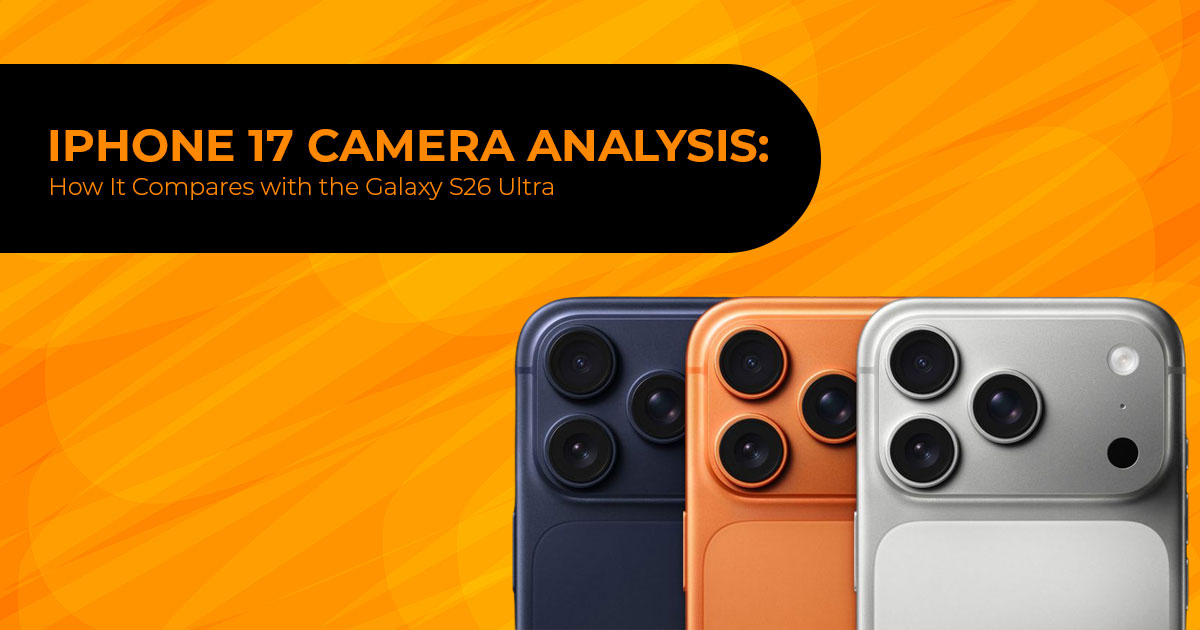
Can a dual-camera phone compete with the camera system of a $1,299 flagship with four cameras?
DxOMark has not published a camera score for the iPhone 17. Its current DxOMark listing covers display testing, so this analysis compares the iPhone 17 camera hardware and features with the Samsung Galaxy S26 Ultra and other flagships.
We have more than 20 years of experience in hardware and application research and development, so we look beyond specifications and benchmark numbers. We focus on real-world performance, build quality, reliability, usability, and value for money. This analysis is aimed at smartphone buyers, photography users, and people deciding between a standard iPhone and a premium flagship. Our recommendations are based on extensive research, component analysis, real-world usability, and industry expertise.
We do not run our own independent camera laboratory. Instead, we use DxOMark’s published test results where available, examine the camera hardware and sensor setup, and assess how those choices are likely to affect everyday photography.
Here, we break down the iPhone 17 camera hardware and features, explain what is known from published testing, and look at where its dual-camera system performs well and where its hardware differs from more expensive flagship phones. We also compare its camera hardware, image capabilities, and value with premium competitors.
1. Product Overview: What Changed from the iPhone 16
The Apple iPhone 17 brings a new 48MP Ultra Wide camera and an 18MP Center Stage front camera. DxOMark has not published a camera score for the iPhone 17, so there is no verified benchmark-point improvement to report
| Generational Comparison | Apple iPhone 16 (2024 Base) | Apple iPhone 17 (Current Base) | Engineering Difference |
|---|---|---|---|
| DxOMark Camera Score | 147 points | Not published | No verified camera score is currently available for the iPhone 17. |
| Ultra-Wide Resolution | 12MP | 48MP | The iPhone 17 provides 4× the native pixel count for its ultra-wide camera. |
| Front Camera Hardware | 12MP TrueDepth (23mm) | 18MP Center Stage | Higher resolution with wider and more flexible framing on the iPhone 17. |
| Video Capability | 4K Dolby Vision up to 60 fps | 4K Dolby Vision up to 60 fps | The iPhone 17 additionally offers ultra-stabilized front-camera video. |
Key Hardware Changes:
- Upgraded 48 MP Ultra Wide Camera: The iPhone 17 moves from a 12 MP Ultra Wide camera on the iPhone 16 to a 48 MP Fusion Ultra Wide camera, giving the phone much higher native pixel count for wide-angle and macro shots.
- Main Camera and Image Processing: The 48 MP Fusion Main camera uses a 26mm equivalent f/1.6 lens with sensor-shift optical image stabilization. Apple also lists next-generation Photographic Styles, Deep Fusion, Smart HDR, and the Photonic Engine as part of the camera system.
- Redesigned 18 MP Front Camera: The 18 MP Center Stage front camera supports wider framing, Center Stage for photos and video calls, and ultra-stabilized video.
2. Key Features and Sensor Specifications
Understanding how the iPhone 17 camera system compares with the Samsung Galaxy S26 Ultra starts with the hardware in each phone:
| Sensor Module | Physical Hardware Specifications | Primary User Benefit | Practical Limitation |
|---|---|---|---|
| Primary Wide Camera | 48MP Fusion, f/1.6 aperture, 26mm focal length, OIS | 48MP main camera with both 24MP and 48MP capture options for balancing image quality and file size. | Uses a smaller sensor than the one found in the iPhone 17 Pro; difficult-light performance also depends heavily on image processing and lens quality. |
| Ultra Wide Camera | 48MP, f/2.2 aperture, 13mm focal length, 120° field of view | High-resolution 48MP ultra-wide capture with a 13mm focal length and expansive 120° field of view. | The fixed aperture limits creative depth-of-field control. |
| 2× Optical-Quality Telephoto | 12MP optical-quality 2× Telephoto derived from the 48MP main camera | Provides approximately 52mm-equivalent framing without requiring a separate telephoto camera. | Beyond 2× zoom, longer-range magnification relies on digital zoom and computational processing rather than a dedicated telephoto camera. |
| Center Stage Front Camera | 18MP, f/1.9 aperture | Supports wider group-selfie framing and Center Stage functionality for photos and video calls. | Low-light performance has not been independently measured in this article. |
3. Real-World Imaging Analysis
Still Photography: Color Processing and Autofocus
Based on the camera hardware and Apple’s published features, three areas stand out:
- Color and Processing: Apple lists Photographic Styles, Deep Fusion, Smart HDR, and the Photonic Engine. These features are intended to improve color, detail, and exposure, but this article does not present independent lab measurements for the iPhone 17.
- Autofocus: The main camera uses Focus Pixels for autofocus, while the 18 MP Center Stage camera also supports autofocus with Focus Pixels.
- Video: The iPhone 17 supports Dolby Vision video up to 4K at 60 fps, along with ultra-stabilized video on the front camera.
Video Performance: Key Features
The iPhone 17 supports 4K Dolby Vision video at up to 60 fps and includes ultra-stabilized video on the front camera. These are Apple-stated capabilities, not an independent DxOMark score.
| Video Feature | Apple iPhone 17 Support | Practical Meaning |
|---|---|---|
| Dolby Vision Video | Up to 4K at 60 fps | Enables high-dynamic-range video capture with improved highlights, shadows, and color reproduction. |
| Front-Camera Stabilization | Ultra-stabilized video | Helps reduce camera shake when recording handheld videos using the front-facing camera. |
| Front-Camera Autofocus | Focus Pixels autofocus | Helps keep faces sharp and properly focused during video calls, selfies, and front-camera recordings. |
| Dual Capture | Supported | Allows simultaneous recording with the front and rear cameras, useful for reactions, interviews, and vlogging. |
4. Hardware Limitations to Consider
The Apple iPhone 17 camera system has some clear hardware limits compared with Pro and Ultra models:
| Hardware Limitation | Technical Cause | Real-World Impact for the Photographer |
|---|---|---|
| No Dedicated Telephoto Camera | The iPhone 17 uses its main camera to provide a 2× optical-quality telephoto view. | Long-range subjects offer less framing flexibility compared with smartphones equipped with a dedicated telephoto lens. |
| Smaller Main Sensor Than Pro Models | The main camera uses a smaller image sensor than the iPhone 17 Pro. | A smaller sensor can capture less light than a larger sensor when other imaging conditions are comparable. |
| Fixed f/1.6 Aperture | The main camera uses a fixed f/1.6 aperture. | There is no variable-aperture control for optically adjusting depth of field or controlling the amount of light entering through the aperture. |
5. Direct Competitor Comparison
The table compares the camera hardware, available DxOMark scores, and official launch prices of four smartphones.
| Specification / Metric | Apple iPhone 17 (Standard) | Samsung Galaxy S26 Ultra | Apple iPhone 16 Pro | Apple iPhone 17 Pro |
|---|---|---|---|---|
| DxOMark Camera Score | Not published | 157 points | 157 points | 168 points |
| Global Leaderboard Rank | — | 18th place | 18th place | 3rd place |
| Main Camera Sensor | 48MP (f/1.6) | 200MP (f/1.4, 1/1.3″) | 48MP (f/1.78, 1/1.28″) | 48MP (f/1.78) |
| Ultra-Wide Camera | 48MP (f/2.2, 13mm) | 50MP (f/1.9, 13mm) | 48MP (f/2.2, 13mm) | 48MP (f/2.2, 13mm) |
| Telephoto Hardware | No dedicated telephoto; 2× optical-quality zoom from the main camera | 5× optical (50MP) + 3× optical (10MP) | 5× optical (12MP) | 4× optical (48MP) + 8× optical-quality |
| DxOMark Video Sub-Score | Not published | 153 points | 159 points | 172 points |
| Official Launch MSRP | $799 USD / ₹82,900 INR | $1,299 USD / ₹1,39,999 INR | $999 USD / ₹1,19,900 INR | $1,099 USD / ₹1,34,900 INR |
Note: DxOMark has updated its camera testing methodology over time. Results from its older V5 camera protocol are not directly compatible with the newer V6 protocol, so these scores should be treated as reference points rather than a strict ranking between generations.
6. Price Comparison
Price is one part of the comparison, but the iPhone 17 does not have a published DxOMark camera score. The table below compares official launch prices with the available camera scores, without assigning a cost-per-point value.
| Device Model | Official Launch MSRP (USD) | DxOMark Camera Score | Value Note |
|---|---|---|---|
| Apple iPhone 17 (Base) | $799 | Not published | No published DxOMark camera score. |
| Apple iPhone 16 Pro | $999 (Launch) | 157 Points | Older Pro model with a published DxOMark camera score. |
| Apple iPhone 17 Pro | $1,099 | 168 Points | Higher-end camera system with a dedicated telephoto camera. |
| Samsung Galaxy S26 Ultra | $1,299 | 157 Points | Higher launch price with dedicated 3× and 5× telephoto cameras. |
The Samsung Galaxy S26 Ultra launched at $1,299 in the US, while the Apple iPhone 17 launched at $799. The iPhone 17 is cheaper, but its camera performance cannot be directly ranked against the S26 Ultra using a DxOMark score that has not been published.
7. Strengths and Limitations
| Choose the Apple iPhone 17 If: | Choose the Samsung Galaxy S26 Ultra If: |
|---|---|
| ✔ You want a lower starting price within the iOS ecosystem | ✔ Long-range optical zoom is essential |
| ✔ Video capture, vlogging, and reels are high priorities | ✔ You want dedicated 3x and 5x telephoto cameras |
| ✔ You want a simple point-and-shoot camera experience | ✔ You want advanced manual camera controls and long-range shooting |
| ✔ You prefer a lighter, more compact smartphone | ✔ You use the integrated S Pen for productivity |
| ✔ You are invested in Apple’s iOS ecosystem | ✔ You prefer Android multitasking and greater file-system control |
- Select the Apple iPhone 17 if: You prioritize video capture, family candid photography, social media content creation, and a lower entry price within the iOS ecosystem.
- Select the Samsung Galaxy S26 Ultra if: You frequently photograph stadium concerts, wildlife, or distant subjects where dedicated 3x and 5x telephoto cameras are useful, or you want advanced manual RAW controls and stylus productivity.
- Select the Apple iPhone 17 Pro if: You want Apple’s higher-end video features, a dedicated 4x tetraprism telephoto camera, 8x optical-quality zoom, and ProRAW
9. Frequently Asked Questions
Does the Apple iPhone 17 have an official DxOMark camera score?
No camera score is currently published for the Apple iPhone 17. DxOMark’s current iPhone 17 listing reports a display score rather than a camera score.
Why is the base iPhone 17 not directly tied with the Samsung Galaxy S26 Ultra in DxOMark?
The Samsung Galaxy S26 Ultra has a published DxOMark camera score of 157 points. The iPhone 17 does not have a published camera score, so there is no verified DxOMark tie between the two phones.
How much better is the iPhone 17 camera compared to the iPhone 16?
The iPhone 17 has a major hardware upgrade in its Ultra Wide camera, moving from 12 MP to 48 MP. It also adds an 18 MP Center Stage front camera. Without a published DxOMark camera score for the iPhone 17, however, we cannot claim a specific benchmark-point improvement over the iPhone 16.
Does the Apple iPhone 17 feature optical zoom?
The Apple iPhone 17 does not have a dedicated telephoto camera. It provides a 2x optical-quality telephoto view from the 48 MP main camera. It does not have a separate telephoto camera for longer-range zoom like the Apple iPhone 17 Pro or Samsung Galaxy S26 Ultra.
10. Editorial Verdict
The Apple iPhone 17 camera system packs a 48 MP main camera, a 48 MP Ultra Wide camera, an 18 MP Center Stage front camera, and strong video features into the standard iPhone. Its main limitation is the lack of a dedicated telephoto camera for longer-range shooting.
If you shoot wildlife, concerts, or distant subjects, the Samsung Galaxy S26 Ultra or Apple iPhone 17 Pro is the better choice because both offer dedicated telephoto hardware. For everyday photos, social content, and video, the standard Apple iPhone 17 offers a capable camera setup at a lower starting price.
11. Check Current Pricing and Availability
If you are planning to purchase or upgrade, check current pricing, trade-in valuations, and carrier promotions via the regional links below:
| Retail Market / Region | Recommended Device Listings | Available Programs & Promotions |
|---|---|---|
| Amazon United States (USD) | • Check Apple iPhone 17 Price (Renewed) & Options on Amazon US
• View Samsung Galaxy S26 Ultra Deals on Amazon US |
Unlocked configurations, carrier financing, and official trade-in credit options |
| Amazon India (INR) | • Check Apple iPhone 17 Offers on Amazon India
• View Samsung Galaxy S26 Ultra on Amazon India |
Official manufacturer warranty, No-Cost EMI, and eligible instant bank discount offers |
Have a question about the iPhone 17 camera or its DxOMark testing? Leave a comment below. If you have doubts about the camera hardware, image quality, or how it compares with another phone, ask us and we’ll address it. Follow us for more practical smartphone reviews, comparisons, and buying advice.
***Disclaimer***
This blog post reflects our research, analysis, and opinions based on available product information, user feedback, and industry knowledge. It should not be taken as the official position of any brand, manufacturer, or company mentioned here. We make every effort to keep this guide accurate, but product specifications, pricing, and availability may change after publication. We recommend double-checking important details before making a purchase.
Some links in this article may be affiliate links. If you choose to buy through these links, we may earn a small commission at no extra cost to you. This helps support our work and allows us to keep publishing in-depth, unbiased reviews. Affiliate partnerships never influence our recommendations.
Opinions expressed by readers are their own and do not necessarily reflect ours. We are not responsible for outcomes resulting from the use of information on this site. Please seek professional advice where appropriate.
All product names, logos, and brands mentioned are the property of their respective owners. These names are used for identification and informational purposes only and do not imply endorsement.