
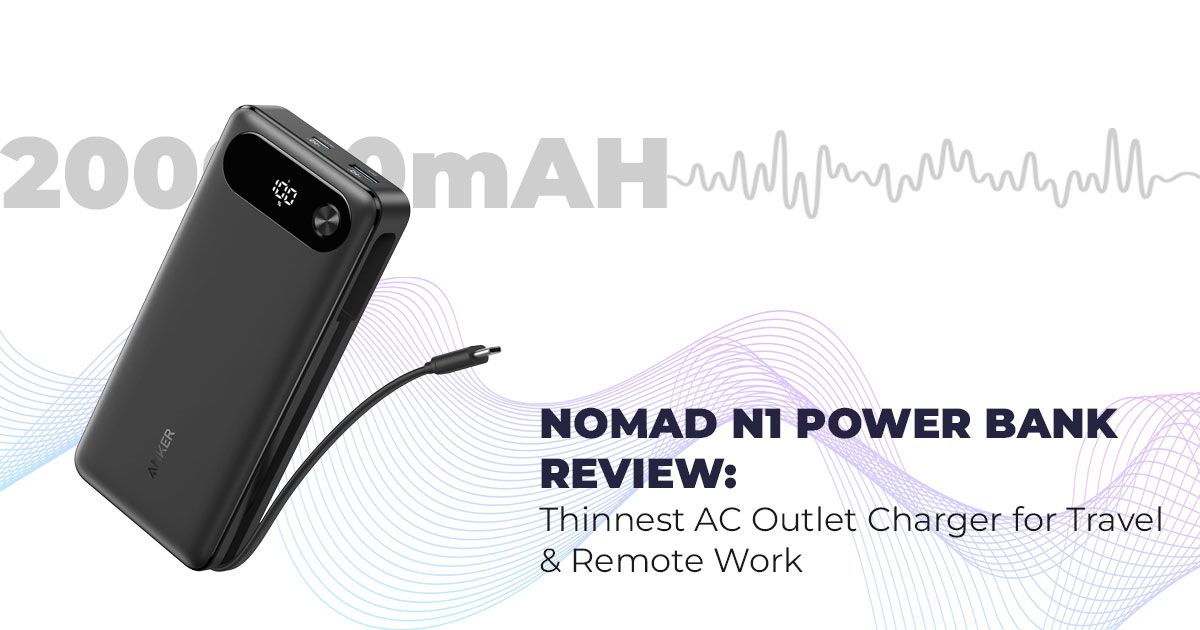
Running out of battery at the wrong time is still a real problem. You sit down at an airport gate, open your laptop, and realize the wall outlets are either taken or broken. Your phone is fine, but your laptop charger needs a proper plug—and your power bank can’t help. That moment is exactly what the Nomad N1 power bank with AC outlet is designed for.
Most power banks stop at USB ports. That works for phones, but it falls apart when you need to charge a laptop or run a small device that only accepts a wall plug. The Nomad N1 solves this by offering a real AC outlet in a body that’s thin enough to carry every day. At 0.63 inches thick, it claims the title of the thinnest power bank with an AC outlet, and that makes it different in a way that actually matters.
Buy from Amazon now
Buy on Amazon Worldwide | Buy on Amazon India
We looked at how this slim portable power bank performs in real situations—travel days, work sessions away from home, and places where power outlets are limited or unreliable. Not ideal conditions. Real ones.
Quick Summary
- The Nomad N1 is a 20,000mAh power bank with a built-in 70W AC outlet, fast USB-C charging, and a 63-inch slim profile.
- Built for travelers, remote workers, digital nomads, and anyone who needs portable AC power without carrying bulky gear.
- What works well: slim design, stable AC power for laptops and small devices, quick 90- minute recharge, and solid-state battery technology.
- What to consider: limited to 70W output, and the US-style plug needs adapters in other regions.
- Bottom line: a solid option if you want a travel power bank that does more than charge phones.
1. Introduction: Getting to Know the Nomad N1 Portable Charger with Outlet
A power bank should do more than keep your phone alive. Many people also need to charge laptops, camera chargers, or small work tools that rely on a standard wall plug. The problem is that most portable chargers with AC outlets are thick, heavy, and awkward to carry.
The Nomad N1 portable charger with outlet takes a different approach. It combines AC power, USB-C fast charging, and a slim body that fits easily into a backpack or work bag. You don’t need extra converters. You don’t need a bulky power station. You just plug in and keep working.
This review exists because crowdfunding products often look good on paper, but daily use tells the real story. Here, we focus on how this thin power bank with an AC outlet performs during flights, café work sessions, and long days away from a desk.
And that difference matters.
1.1 Why This Review Matters Right Now
Solid-state batteries are starting to appear in consumer power banks, and the Nomad N1 is one of the first to combine that technology with an AC outlet in a slim design. The claim is simple: thinner, safer, and easier to carry.
What matters is whether that slim build introduces compromises. We look at how the battery technology, power output, and cooling design work together in everyday use—not just in specs.
1.2 What You’ll Take Away From Reading This
By the end of this review, you’ll have:
- A clear understanding of the Nomad N1 specs and features that affect real use
- A straightforward explanation of solid-state battery benefits without marketing noise
- Practical examples of using this portable AC power bank while traveling or working remotely
- Simple comparisons to help decide if it’s the best slim power bank for travel or if another option fits better
- Useful buying tips and common questions answered
1.3 Why You Can Trust This Review
As technology experts with over 20 years of experience in hardware and application research and development, we evaluate products based on real-world performance, durability, and value for money. The goal is to help you find the best product in each category, whether you care most about price, performance, reliability, or long-term use.
This review is written for travelers, remote professionals, digital nomads, students, and everyday users who want dependable power without carrying extra weight. Our recommendations come from hands-on research, component analysis, and industry experience, not marketing claims.
And that’s why this guide focuses on how the Nomad N1 power bank with AC outlet fits into real life—not just how it looks on a spec sheet.
2. Technical Specifications at a Glance
| Feature | Details | How It Helps in Real Life |
|
Battery Capacity |
20,000mAh (semi-solid-state) |
Gives several phone charges or keeps a laptop going for hours of
light work |
| AC Output | 70W continuous pure sine wave (103W peak) | Powers most everyday laptops, lamps, or small fans safely |
| USB-C Output | Up to 60W | Quick top-ups for phones, tablets,
or lighter laptops |
| Recharge Time | About 90 minutes with a 65W charger | Ready again fast—perfect between meetings or flights |
| Size & Thickness | 8.27 x 7.87 x 0.63 inches | Slides easily into backpack pockets
like a thin notebook |
|
Weight |
Noticeable but manageable |
Heavier than basic USB banks but lighter than typical AC-equipped
ones |
| Cooling | Quiet active fan | Keeps things running smoothly
during longer AC sessions |
| Outlet Type | NEMA 1 (US-style) | Direct plug for compatible devices; adapters needed elsewhere |
Note: Actual runtime depends on device load and usage pattern.
3. What the Nomad N1 Power Bank With AC Outlet Actually Is
At its simplest, the Nomad N1 power bank with AC outlet is a 20,000mAh portable battery that works like a wall socket you can carry. Instead of relying only on USB ports, it lets you plug in devices the same way you would at home—no adapters, no workarounds.
What makes it stand out is how thin it is. At just 0.63 inches, it’s the thinnest power bank with an AC outlet we’ve seen so far. That matters because most portable power banks with AC outlets are bulky enough to feel like small bricks in your bag. This one slides into a backpack or work bag without taking over the space.
It also uses semi-solid-state battery cells rather than traditional liquid-based lithium-ion cells. The result is a slim portable power bank for travel that focuses on safety, durability, and everyday usability instead of raw size alone.
This is not meant to replace a power station. It’s built for people who need portable AC power while moving between flights, cafés, classrooms, or shared workspaces.
4. Solid-State Battery Power Bank Benefits Explained for Everyday Use
The Nomad N1 solid-state power bank uses semi-solid-state battery technology, which sits between standard lithium-ion batteries and full solid-state designs. For everyday users, the benefits are practical rather than technical.
Why this battery tech matters:
- Improved safety: With less liquid electrolyte inside, the risk of swelling or leakage Thermal runaway protection is stronger, which reduces overheating issues seen in older batteries.
- Longer usable lifespan: These cells handle more charge cycles before degrading, so your solid-state battery power bank lasts longer over time.
- Stable performance in changing temperatures: It holds up better in hot backpacks and cold airplane cabins than standard lithium batteries.
- Realistic risk perspective: No battery is completely risk-free, but this design is a clear improvement over traditional lithium-ion power banks.
For readers searching what a solid-state power bank is, or how it compares to lithium power banks, the key takeaway is simple: better safety and durability without losing everyday capacity.
5. Why an AC Outlet on a Portable Power Bank Actually Matters
USB-C charging covers most modern devices, but many everyday tools still rely on a standard wall plug. That’s where a portable power bank with an AC outlet becomes useful.
Common real-world uses include:
- Keeping an older laptop running during long travel delays
- Powering small desk fans or lights while working outdoors
- Charging travel items like electric toothbrushes, shavers, or camera chargers
A power bank with an AC outlet for laptops removes the need to carry adapters or hunt for wall sockets. For remote workers, frequent flyers, and students, that convenience adds up fast.
Instead of choosing between portability and flexibility, this setup gives you both.
Buy from Amazon now
Buy on Amazon Worldwide | Buy on Amazon India
6. Nomad N1 Safety Features and Build Quality for Daily Carry
Beyond battery technology, the Nomad N1 portable charger with outlet includes practical design choices that support everyday use.
- Active cooling system: A quiet internal fan helps manage heat during AC output, keeping performance steady instead of throttling power.
- Pure sine wave AC output: This provides clean power that works safely with sensitive electronics like laptops and chargers.
- Durable outer shell: Built to handle minor drops and everyday wear in
- Splash resistance: Protects against light spills and rain exposure, which makes sense for a travel power bank.
These features focus on reliability rather than flashy extras, which is what most users want from a backpack power bank.
7. Real-World Pros and Cons of the Nomad N1 Power Bank
Pros
- Extremely slim design for a power bank with an AC outlet
- Pure sine wave AC output for safe laptop and device charging
- Fast recharge time that fits busy travel schedules
- USB-C PD charging alongside AC for flexibility
Cons
- 70W AC limit handles most laptops, but not demanding devices
- Heavier than basic USB-only power banks
- US-style AC plug, which requires adapters for international travel
8. Side-by-Side Comparison
| Model / Type | AC Outlet | Capacity | Thickness | Best For |
| Nomad N1 | Yes (70W) | 20,000mAh | 0.63 inches | Travelers, remote workers, light AC needs |
| Standard USB-
only power bank |
No |
10,000–
30,000mAh |
Very thin |
Phones and tablets only |
| Larger
portable power station |
Yes (100W+) |
25,000mAh+ |
Much thicker |
Camping, heavy loads, and longer off-grid use |
The Nomad N1 AC power bank lands right in the middle—more useful than basic chargers, far easier to carry than big stations.
9. Who the Nomad N1 Power Bank With AC Outlet Is Best For (And Who Should Skip It)
The Nomad N1 power bank with AC outlet is designed for people who move often and need dependable power without carrying bulky equipment. Its slim shape and built-in outlet make it practical for everyday carry rather than emergency-only use.
This slim backpack power bank with AC and USB-C works especially well for:
- Digital nomads moving between cafés, co-working spaces, and shared offices
- Frequent travelers who deal with limited or overcrowded wall outlets
- Students and remote workers who need steady laptop charging on the go
- Light campers and outdoor workers powering small fans, lights, or chargers without hauling a generator
If your daily setup involves a laptop, phone, tablet, and a few small plug-in devices, this portable AC power bank fits naturally into that routine.
It may not be the right choice if you:
- Run high-power tools or gaming laptops that need more than 70W AC output
- Need multi-day off-grid power without recharging
- Expect to power appliances rather than personal electronics
In those cases, a larger portable power station or battery generator makes more sense.
10. Buying Tips Before Ordering the Nomad N1 Portable Power Bank
Before buying the Nomad N1 portable power bank, a few checks can help avoid surprises and make sure it fits your needs.
- AC outlet compatibility: The built-in outlet uses a NEMA 1 (US-style) plug. If you travel internationally, a simple adapter is required.
- Crowdfunding status: Since this started as a crowdfunded power bank, review the latest shipping timelines and fulfillment updates before ordering.
- Power needs check: The 70W AC output handles most everyday laptops, work setups, and It may struggle with gaming laptops under heavy load or power-hungry devices.
- Device mix matters: If most of your gear charges over USB-C PD, you’ll benefit from faster charging and less AC usage, which improves efficiency.
- Bag space and weight: While thin, it carries more weight than USB-only models. The trade-off is flexibility, not lightness.
Thinking through how and where you’ll use it helps determine whether this thin power bank with an AC outlet matches your routine or if a simpler option does the job.
11. Clearing Common Doubts About the Nomad N1 Power Bank
Before buying a power bank with an AC outlet, most people want quick, clear answers. This section addresses the most common questions around the Nomad N1 power bank, focusing on real use, travel safety, charging performance, and everyday reliability. These are the same concerns buyers search for before making a decision.
Q. Can the Nomad N1 charge a laptop?
- Yes. The 70W AC output can charge most standard laptops and ultrabooks without issues. It’s well-suited for emails, web browsing, coding, and light editing. High-performance gaming laptops may charge slowly or not at full speed.
Q. How long does it take to recharge the Nomad N1 power bank?
- About 90 minutes when using a 65W USB-C charger. That’s faster than many 20,000mAh power banks, making it easier to top up between trips or work sessions.
Q. Is a solid-state power bank safer than a lithium-ion?
- Yes. The semi-solid-state battery used in the Nomad N1 reduces the risk of overheating, swelling, and internal leaks compared to traditional lithium-ion batteries. It also supports longer battery life over repeated charge cycles.
Q. Will the Nomad N1 work outside the US?
- The AC outlet uses a US-style NEMA 1 plug, so you’ll need a simple adapter for international use. The power system supports global voltage standards, so charging performance stays consistent.
Q. Does the cooling fan make noise?
- The fan activates only during higher AC power usage. Under normal conditions, it stays quiet and doesn’t interfere with work or travel.
Q. Is the Nomad N1 allowed on airplanes?
- The 20,000mAh capacity falls within typical airline limits for carry-on batteries. Airline rules vary, so it’s still best to confirm with your carrier before flying.
Buy from Amazon now
Buy on Amazon Worldwide | Buy on Amazon India
12. Bonus: Everyday Uses You Might Not Have Considered
- Setting up a portable editing station with a small monitor.
- Emergency backup for low-power medical devices during outages.
- Running a mini projector for casual outdoor gatherings.
- Keeping hotel room gadgets charged when sockets are limited.
13. Final Recommendation: Is the Nomad N1 Worth It?
The Nomad N1 power bank with AC outlet does what many portable chargers promise but fail to deliver. It gives you a real wall-style plug in a body that stays thin enough for daily carry. For travel, remote work, or long days away from reliable sockets, that combination makes a real difference.
If your setup goes beyond phones and earbuds—and includes a laptop or small plug-in gear— this thin power bank with AC outlet fits naturally into your routine. It won’t replace a large power station, and it isn’t built for heavy appliances. But for everyday work, travel delays, café sessions, and light outdoor use, it strikes a smart balance between portability and usefulness.
The key is matching expectations. If your devices stay within the 70W power limit, the Nomad N1 makes sense. If you need higher output or days of off-grid power, a larger solution will suit you better.
Where to Buy (Current Options)
- Amazon Worldwide – NOMAD Official Store
Note: The Nomad N1 is not yet listed directly on Amazon. Availability may change. Follow us for updates once the product goes live.
- Amazon India – Alternative High-Power Option – Anker Power Bank 20,000mAh, 87W Fast Charging
This Anker model does not include an AC outlet, but it’s a strong USB-C option for buyers in India who need fast laptop charging.
You can also check the original Kickstarter page for the latest shipping updates and availability details.
If you’ve used a travel power bank with a plug socket like this—or are considering one—share how you’d use it. Questions, setup ideas, and real experiences help others decide what works best for their daily carry.
***Disclaimer***
This blog post contains unique insights and personal opinions. As such, it should not be interpreted as the official stance of any companies, manufacturers, or other entities we mention or with whom we are affiliated. While we strive for accuracy, information is subject to change. Always verify details independently before making decisions based on our content.
Comments reflect the opinions of their respective authors and not those of our team. We are not liable for any consequences resulting from the use of the information provided. Please seek professional advice where necessary.
Note: All product names, logos, and brands mentioned are the property of their respective owners. Any company, product, or service names used in our articles are for identification and educational purposes only. The use of these names, logos, and brands does not imply endorsement.