
The Problem This Product Actually Solves
Every home has the same problem. Reminders are buried inside phones. To-do lists are scattered across different apps. Household chores exist only in one person’s memory. The result? Missed tasks, forgotten appointments, and a refrigerator covered with paper notes, shopping lists, school notices, and magnets that quickly turn into clutter.
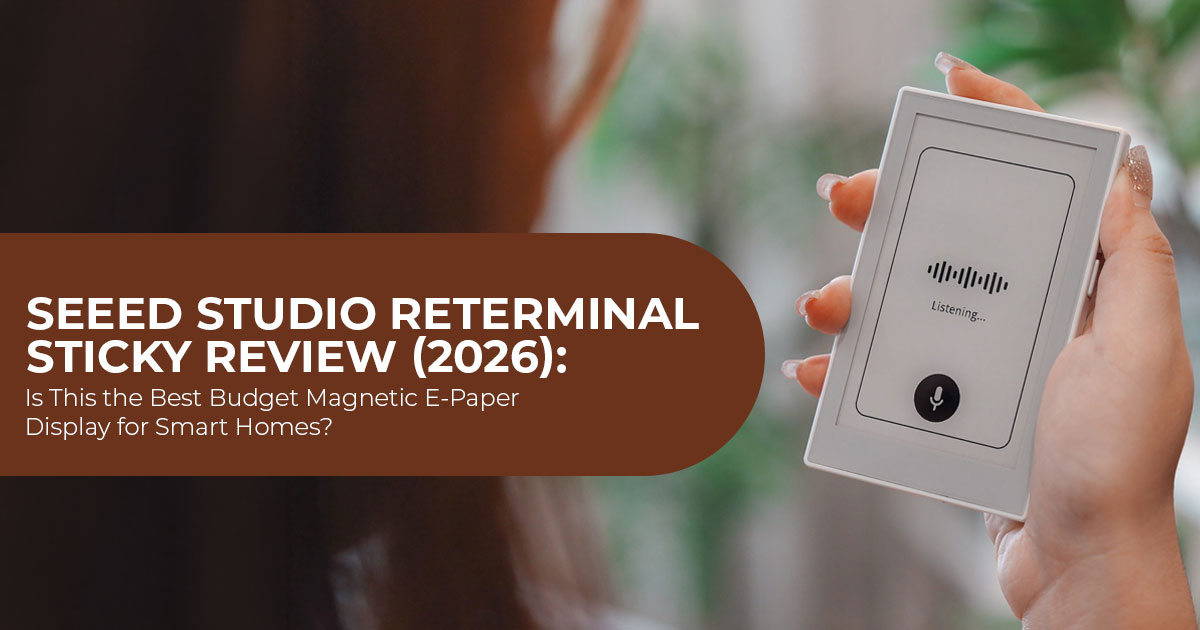
The Seeed Studio reTerminal Sticky aims to fix that in a surprisingly simple way. Instead of adding another app to your phone, it puts important information where everyone can see it. This compact 3.97-inch e-paper display attaches to any metal surface using a built-in magnet—no glue, no drilling, no permanent installation. Whether it’s your family’s weekly schedule, a grocery list, daily reminders, or a smart home dashboard, the information stays visible all day without draining much power.
Priced at $49.90, the reTerminal Sticky opened for pre-orders in late July 2026. According to Seeed Studio, shipments are expected to begin from its China warehouse around September 15, 2026.
But does it actually make everyday life easier, or is it just another smart gadget that looks interesting for a week before ending up in a drawer?
As technology experts with over 20 years of experience in hardware and application research and development, we evaluate every product based on real-world usability, build quality, durability, performance, and long-term value for money. Our goal is simple: help you find the best products in every category, whether your priority is budget, performance, reliability, or years of dependable use. If you’re a smart home enthusiast, busy parent, professional working from home, maker, developer, student, or simply someone looking for a cleaner way to organize daily life, this review is written with your needs in mind. Our recommendations are based on extensive research, component analysis, published technical information, real-world usability principles, and industry expertise—not marketing claims.
One important note before we begin. We have not received a review unit, and we won’t pretend that we have. This reTerminal Sticky review is based on the official specifications, public hands-on impressions from people who tested pre-production units, and our own experience evaluating e-paper displays, embedded hardware, and smart home devices over many years. Whenever a statement comes from official information or third-party hands-on testing, we make that clear. That approach keeps this review transparent, balanced, and trustworthy, while helping you decide whether the Seeed Studio reTerminal Sticky is the right purchase—or one you should skip.
What Is the reTerminal Sticky? (Product Overview)
The reTerminal Sticky is a compact magnetic e-paper display from Seeed Studio — the same company behind the reTerminal line of single-board computers and e-paper terminals. This new model targets homes rather than factories.
The name is the first thing that confuses people. “Sticky” suggests adhesive. It does not use adhesive. The back carries a built-in magnet, and the box includes a separate magnetic mounting ring for non-metal surfaces. On a metal surface — a refrigerator, a fuse box, a filing cabinet — you simply place it. No tools, no glue, no permanent damage.
What can it do? It can serve as a family message board, weather display, smart home dashboard, or even a pocket e-reader with custom firmware.
It is small: 106 × 65.5 × 7.3 mm, roughly the footprint of a thick smartphone, and it weighs 70 grams. The screen is a 3.97-inch e-ink display with an 800 × 480 resolution, touch input, and four shades of gray. There is no backlight, so it draws power only when the screen changes.
reTerminal Sticky Specs at a Glance
| Parameter | Value |
| Manufacturer | Seeed Studio |
| Product | reTerminal Sticky (SKU 100056818) |
| Display | 3.97-inch touchscreen e-paper display |
| Resolution | 800 × 480 (~235 PPI, four shades of gray) |
| Processor | ESP32-S3R8 |
| Memory | 32MB flash + microSD support (up to 32GB) |
| Battery | 750mAh lithium battery (Seeed estimate: about one week typically; months in Battery Saver Mode) |
| Charging | USB-C |
| Wireless | 2.4GHz Wi-Fi, Bluetooth 5.0 (BLE) |
| Sensors | Microphone, temperature and humidity sensor, 6-axis IMU |
| Audio / Buttons | Buzzer; power, up, and down buttons |
| Mounting | Built-in magnet + magnetic mounting ring |
| Size / Weight | 106 × 65.5 × 7.3mm / 70g |
| Voice AI Languages | English, Simplified Chinese |
| Price | $49.90 |
| Availability | Preorder; expected to ship around September 15, 2026 |
| Certifications | CE, FCC, RoHS, TELEC |
The table answers the reTerminal Sticky specs questions. The rest of this review explains what those numbers mean when the device is on your wall.
Design and Build Quality
At 106 × 65.5 × 7.3 mm and 70 g, this is a genuinely pocketable device. It will spend most of its life on a fridge or hallway wall, but it’s still compact enough to carry anywhere.
Early hands-on reports describe the build as serviceable rather than premium. The chassis is light plastic, and people who used pre-release units said it feels inexpensive in the hand. That is expected at
$50, and we would rather state it plainly than bury it. The one design choice that draws real criticism is the glossy cover glass, which picks up glare under kitchen lights and near windows. A matte finish would suit a family screen better; a matte screen protector fixes it if glare bothers you.
The edges carry three physical buttons — power, up, and down — for navigation, media control, and page turns. Inside, there is a buzzer for audible alerts, a microphone for voice input, and a temperature and humidity sensor. None of this hardware is groundbreaking. It is a sensible, minimal layout for a device whose main job is showing information.
Display: A 3.97-Inch E-Paper Panel That Prefers Daylight
The display is the product. A 3.97-inch e-ink display at 800 × 480 pixels works out to roughly 235 pixels per inch with four shades of gray. Based on the display specifications and early hands-on reports, text appears sharp, with good contrast for a monochrome e-paper panel.
What matters more is what kind of screen it is. E-paper reflects ambient light the way paper does. There is no backlight, which produces four practical consequences:
- The screen stays readable in bright rooms and direct sunlight.
- It consumes almost no power while showing a static image.
- It cannot glow in the Without a lamp, you will not read it at night.
- Screen refreshes are slow compared with Animations are not its job.
For a fridge display, this is close to ideal. The fridge does not need video. It needs information that stays visible all day without draining a battery. An e-ink display is the only screen technology built for that.
The touchscreen is one of the strongest advantages at this price. The base TRMNL has no touchscreen at all; you configure it from a phone or a web dashboard. The reTerminal Sticky lets you tap through notes and simple controls directly. Dismissing a reminder or switching from the clock to the weather takes one finger. On a wall-mounted screen, that convenience matters more than the spec sheet suggests.
The honest limitation remains the glossy glass. For a device meant to sit under kitchen lighting, glare is a real consideration, and it is the most common complaint in early reports. It is not a dealbreaker, but it is the first thing to test if you buy one.
Performance and Hardware: Built for One Job
Underneath, the Sticky runs on an ESP32-S3 microcontroller — the S3R8 variant specifically. This is not a computer. It is a display controller, and it is the same chip class used across the ESP32 e-paper display ecosystem.
Here’s what those specifications mean in everyday use:
- Booting and screen refreshes are quick enough for notes and dashboards, not for video.
- The 32 MB of flash holds firmware and small apps. Photos and e-books go on a microSD card, supported up to 32 GB.
- The 6-axis IMU can detect movement and orientation, allowing the device to support motion-aware features and Home Assistant integrations.
The hardware limits are straightforward: no cellular modem, no 5 GHz Wi-Fi, no color, no frontlight. Each is a trade-off, not a flaw, at this price.
One point of confusion worth clearing up: “remote control.” The device has no SIM slot. When the product page says you can manage it while you are miles away, it means you use the app on your phone over the internet, and the Sticky receives the update through home Wi-Fi via the cloud. The device itself is Wi-Fi-only, and the remote path depends on your phone having a connection.
Battery Life: Where E-Paper Wins
The reTerminal Sticky packs a 750 mAh lithium battery that recharges through USB-C.
Battery life is the strongest argument for this product category. Under normal use — a few screen updates a day and occasional touch interaction — Seeed estimates roughly one week of battery life under typical usage. According to Seeed, Battery Saver Mode can extend battery life to several months, depending on usage.
Compare that with a tablet or an old smartphone used as a dashboard. A smart home display you charge once a week is a different product from one you charge every day.
Real-world battery life will vary with firmware, refresh frequency, and Wi-Fi use. If you flash ESPHome and push updates every few minutes, expect the battery to drain faster. If the device sits on the fridge showing one note all week, a week-plus per charge is realistic. For budget-conscious buyers, that’s a real advantage. The low-power e-paper display lets the reTerminal Sticky stay useful without becoming another device that needs constant charging.
Connectivity: 2.4 GHz Wi-Fi and Bluetooth 5.0
The Sticky connects over 2.4 GHz Wi-Fi and Bluetooth 5.0. Setup runs through the Seeedash app: you bind the device over Bluetooth, then walk it through Wi-Fi provisioning.
Notes for buyers:
- 4 GHz only. If your network is 5 GHz-only or your router hides the 2.4 GHz band, plan for it.
- Bluetooth 0 handles nearby setup and lightweight interactions.
- There is no Ethernet and no USB host This is a Wi-Fi-first device.
For a smart home dashboard in a typical household, 2.4 GHz Wi-Fi is sufficient. The data it carries is tiny, and the e-paper refresh rate means the network is idle most of the time.
Software: The Seeedash App and a Surprisingly Open Ecosystem
The Seeedash App
Content is managed with the Seeedash app on iOS and Android. It is the control center for the whole device. From the phone you can:
- Push notes, to-do lists, weather, clock styles, and photos to the screen.
- Install and reorder small apps: Notes, Todo, Weather, Clock, Album, and SenseCraft HMI.
- Check device status — online, sleep, or offline — in real time.
- Add content remotely through the cloud while away from home.
- Generate notes, to-dos, or images by voice.
Voice input is the headline feature, so it deserves an honest look. Press the microphone button, speak, and the device transcribes the note onto the screen. It currently works in English and Simplified Chinese only. Seeed says support for additional languages is planned, although no release date has been announced. If your household does not use one of those two languages, this feature is not for you yet — buy the device for its other strengths, not for voice.
The Maker Side
This is where the reTerminal Sticky becomes more than a digital note board. It accepts custom firmware, and the ecosystem is unusually open at $50:
- CrossPoint Reader turns it into a pocket e-reader with EPUB support, custom fonts, and progress syncing.
- TRMNL BYOD brings the TRMNL dashboard ecosystem — a large community plugin ecosystem — to Seeed’s hardware.
- ESPHome and OpenDisplay connect it to Home Assistant as a Home Assistant e-paper display panel, including room-by-room light control.
For makers, this makes the reTerminal Sticky one of the cheapest ways into a Home Assistant display with touch. The base TRMNL costs more than twice as much and has no touchscreen.
For everyone else, the pre-installed firmware works out of the box. You do not need to know what flashing is to use it as a family note board.
Real-World Performance: What Early Reports Actually Say
We have not held a unit, and we have said so. What we can share is what early hands-on reports — several of them unusually candid for launch coverage — have surfaced:
- Early users report occasional software rough edges, particularly during initial setup and navigation, which is not unusual for a first-generation product.
- The plastic chassis feels functional rather than premium, which is consistent with the device’s budget price.
- The glossy screen shows glare in bright conditions.
- The core use cases — fridge notes, weather, to-do lists, photo rotation — work as
None of the early reports describe the device as fundamentally flawed. They describe a budget product with real capabilities and rough edges. That is the honest picture, and it matches the price.
The bottom line: Buy it for its strengths, not for features it was never designed to offer. It will not replace a tablet. It is not a media screen. It is a calm, always-on message board that also happens to be hackable.
Pros and Cons
| Pros | Cons |
| Very low price for a touchscreen e-paper display | No frontlight; difficult to read in the dark |
| Magnetic mounting — no tools or adhesive required | Glossy screen can produce glare under lights |
| Works with Home Assistant, ESPHome, TRMNL, and CrossPoint | Voice AI supports only English and Simplified Chinese |
| Seeed-estimated one-week battery life; months in battery-saver mode | Supports only 2.4GHz Wi-Fi |
| Touchscreen at a price where rivals often skip it | Only 32MB of flash storage; microSD card needed for media |
| Open and flashable firmware ecosystem | Early software has been reported as quirky |
| Compact and pocketable design | Monochrome display with no color support |
Comparison: reTerminal Sticky vs TRMNL and Other Alternatives
Not every e-paper display targets the same audience. Some focus on smart home dashboards, while others are built for simple reminders or reading. Here’s how the reTerminal Sticky compares with its closest alternatives.
The question we expect most often is reTerminal Sticky vs TRMNL. They occupy the same niche — open, customizable e-paper smart displays — but they are different products at different prices.
| Feature | reTerminal Sticky | TRMNL X | SwitchBot Home Dashboard |
| Price | $49.90 | ~$139–$219 | ~$80–$100 (estimated) |
| Screen | 3.97″ monochrome e-paper, 800×480 | 10.3″ monochrome e-ink, 1872×1404 | E-ink, weather and calendar focus |
| Touch | Yes | No | No |
| Battery | 750mAh (Seeed estimate: about one week) | 5000mAh (2–6 months) | Long battery life (e-ink based) |
| Ecosystem | Seeedash, Home Assistant, TRMNL BYOD, CrossPoint | Open-source plugin marketplace with hundreds of integrations | Matter, Apple Home |
| Best For | Budget fridge or family display and makers | Large central dashboard | Plug-and-play consumers |
TRMNL (base model, about $139): one of the best-known open-source e-paper smart displays. It has a bigger plugin ecosystem and more polished software, but no touch and a much higher price. The Sticky can run TRMNL-style dashboards through TRMNL BYOD, which closes most of the gap for budget buyers.
SwitchBot Home Dashboard: a consumer-focused E Ink smart display with Matter support for Apple Home and Google Home. It is easier for non-technical households, but it is locked to SwitchBot’s app and less friendly to makers.
Seeed’s own reTerminal E family: for bigger screens, the reTerminal E1001 (7.5-inch monochrome, around $79) and the color models serve as home dashboards. The Sticky is the budget, fridge-sized entry point in the same family.
Dedicated e-readers (Kindle, Boox): if reading is your only use case, buy a dedicated e-reader. The Sticky’s e-reader mode is a bonus, not a replacement.
Inkplate 10: a 9.7-inch Home Assistant e-paper display for people who want a larger always-on dashboard without TRMNL pricing. The base model has no touch.
The bottom line from this comparison: the Sticky wins on price, touch, and magnetic mounting. It loses on screen size, ecosystem maturity, and raw battery capacity. Choose based on your wall space and your budget, not on brand loyalty.
Who Should Buy the reTerminal Sticky?
Buy it if:
- You want a family reminder screen or family message board on the fridge without spending more than $100.
- You run Home Assistant and want a cheap Home Assistant display with touch.
- You are a maker looking for an ESP32 e-paper display you can flash with your own path.
- You want a low-power digital photo frame that rotates family notes.
- You want a pocket e-reader as a secondary device, not your main materials.
Skip it if:
- You need This is monochrome.
- You need a large dashboard readable from across the Buy a bigger panel.
- You need Matter or Apple Home out of the The Sticky is Wi-Fi and Bluetooth only, with Home Assistant as the integration path.
- Your household does not use English or Chinese for voice
- You want a premium hardware At $50, you get $50 materials.
FAQ
What is the reTerminal Sticky?
It is a $49.90 magnetic e-paper display from Seeed Studio — a 3.97-inch touchscreen for family notes, weather, to-do lists, smart home control, and e-reading.
How much does the reTerminal Sticky cost?
$49.90 on the Seeed Studio store (roughly $50). China shipments begin around September 15, 2026.
Does the reTerminal Sticky work with Home Assistant?
Yes. Through ESPHome or OpenDisplay firmware, it connects to Home Assistant as a display and control panel.
Can you read e-books on it?
Yes, with CrossPoint Reader firmware. It handles EPUB and other formats. Treat it as a secondary e-reader, not a Kindle replacement.
How long does the reTerminal Sticky battery last?
About a week per charge under normal use, and months in Battery Saver Mode. Actual results depend on refresh frequency and firmware.
Is the display color?
No. It is a monochrome e-paper display with four shades of gray.
Does the reTerminal Sticky use adhesive?
No. The name is misleading — it mounts with a built-in magnet, plus a magnetic ring for non-metal surfaces.
Which languages does voice input support?
English and Simplified Chinese. According to Seeed Studio, support for additional languages is planned, although no timeline has been announced.
Where should you buy the reTerminal Sticky?
The Seeed Studio store now (pre-order). Amazon US and Amazon India after launch — links are above.
Pricing and Availability
The reTerminal Sticky price is $49.90 on the Seeed Studio store. Pre-orders are open now, with availability around September 15, 2026 from the China warehouse. Seeed’s store shows the US and EU warehouses with a “Notify Me” option at the time of writing, so regional stock may land later than the first China shipments.
Box contents: the device, a USB-C cable, and the magnetic mounting ring. Where to buy:
- Seeed Studio store — the official channel for pre-orders and currently the only guaranteed source.
- Amazon US and Amazon India — check availability; listings often appear around or after the launch ship date, and marketplace prices can differ from MSRP.
Final Verdict
The reTerminal Sticky is not a perfect device. The glossy screen, the missing frontlight, the two-language voice AI, and the v1.0 software keep it from being a universal recommendation.
At $49.90, it is one of the most affordable touch-enabled e-paper smart displays currently available. It combines magnetic mounting, touch controls, approximately one week of battery life, and an open firmware ecosystem supporting Home Assistant, TRMNL, and CrossPoint.
For families who want notes off their phones and onto the wall, and for makers who want a cheap ESP32 e-paper display to modify, the Sticky earns its place. For everyone else, the comparison table above settles the question.
Our recommendation: If the features match your needs, the reTerminal Sticky is worth considering. If you’re still unsure, waiting for independent production-unit reviews is the safest approach. Either way, the reTerminal Sticky stands out as one of the most interesting budget e-paper devices announced in 2026.
Where to Buy the reTerminal Sticky
Amazon Worldwide
If you are in the United States and prefer Amazon fulfillment, check the reTerminal Sticky listing for current pricing and delivery estimates. Prices on Amazon fluctuate, and marketplace listings sometimes carry different stock than Seeed’s own store, so compare both before you order.
Bookmark this to check the current reTerminal Sticky price on Amazon Worldwide — see today's price, offers, and delivery options.
Amazon India
For readers in India, the reTerminal Sticky may take a few weeks to reach Amazon India after the global launch. When the listing goes live, check it for import-inclusive pricing, delivery windows, and any launch offers. If it is not listed yet, the Seeed Studio store remains the fastest pre-order path.
Bookmark this to check the current reTerminal Sticky price on Amazon India — see today's price, offers, and delivery options.
Whichever channel you use, the product to look for is the Seeed Studio reTerminal Sticky (SKU 100056818). If it stays near $50, it is the easiest recommendation in this category.
Analysis based on the official Seeed Studio spec sheet, launch coverage, and public hands-on reports available as of July 31, 2026. We have not tested a production unit; treat early performance claims as preliminary until post-launch reviews arrive.
***Disclaimer***
This blog post reflects our research, analysis, and opinions based on available product information, user feedback, and industry knowledge. It should not be taken as the official position of any brand, manufacturer, or company mentioned here. We make every effort to keep this guide accurate, but product specifications, pricing, and availability may change after publication. We recommend double-checking important details before making a purchase.
Some links in this article may be affiliate links. If you choose to buy through these links, we may earn a small commission at no extra cost to you. This helps support our work and allows us to keep publishing in-depth, unbiased reviews. Affiliate partnerships never influence our recommendations.
Opinions expressed by readers are their own and do not necessarily reflect ours. We are not responsible for outcomes resulting from the use of information on this site. Please seek professional advice where appropriate.
All product names, logos, and brands mentioned are the property of their respective owners. These names are used for identification and informational purposes only and do not imply endorsement.