
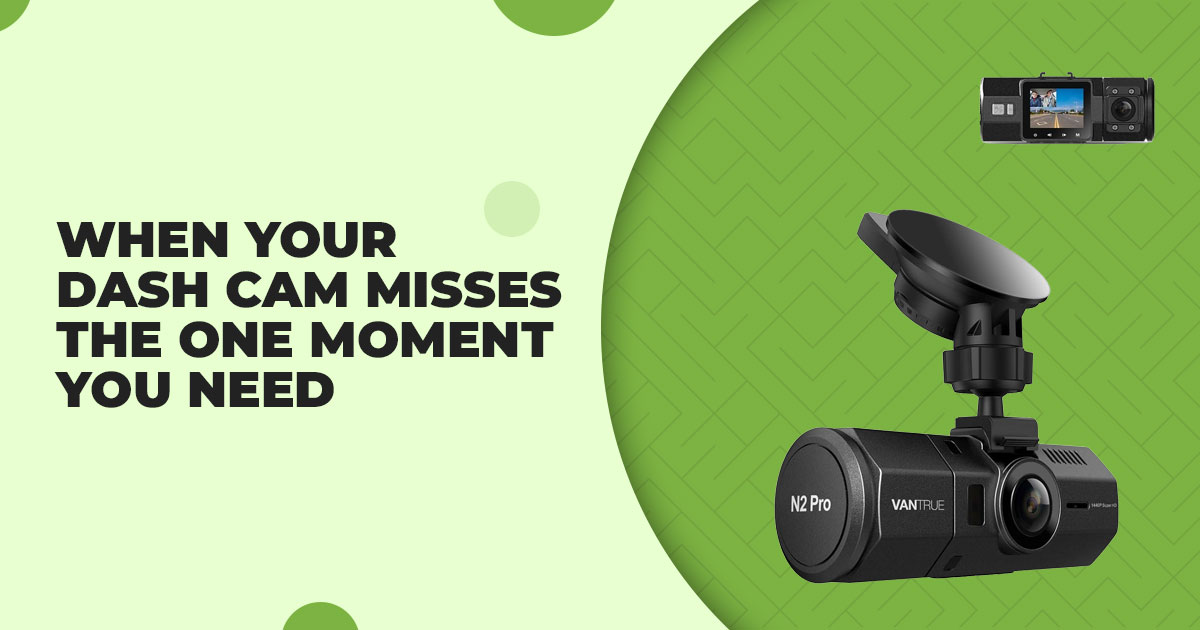
Most Drivers Trust Their Dash Cam—Until It Lets Them Down
For most drivers, a dash cam feels like a quiet backup plan. You install it once, it records every trip, loops over old files, and stays out of sight. You trust it to be there if something ever goes wrong.
Then it happens. A sudden stop. A sideswipe you never saw coming. Someone clips your parked car and drives off.
You reach for the memory card, expecting answers. And the clip is missing.
When dash cam missed footage becomes reality, it’s more than annoying. It can mean higher insurance premiums, a claim that drags on or gets denied, or paying for repairs yourself because no one can prove who was at fault. A dash cam not recording accident footage turns peace of mind into frustration.
This guide explains why dash cam failure happens, what those failures really cost in everyday situations, and how to choose hardware that delivers usable evidence when it matters most.
1. Introduction
If you’ve ever searched “dash cam not recording accident” or “dash cam didn’t record accident footage” after something went wrong, you already know that sinking feeling. Many people buy a dash cam believing it will always capture the important moments. Too often, they discover—too late—that cheaper models fail right when stress, heat, or impact comes into play.
The issue isn’t just bad luck. Problems like dash cam power failure, limited sensors, and dash cam memory card corruption are common in real crashes. A camera can look fine during normal driving and still fail during a collision. That gap between expectation and reality is what catches most drivers off guard.
As technology experts with over 20 years of experience in hardware and application research and development, we analyze each product based on real-world performance, durability, and value for money. Our goal is to help you find the best product in every category—budget, performance, reliability, and long-term usage.
Whether you’re a daily commuter, city driver, rideshare driver, or long-distance traveller, our recommendations are based on extensive research, component analysis, real-world usability, and industry expertise.
And that’s why this guide exists.
2. What You’ll Learn From This Guide
In this guide, you’ll learn:
- Why do dash cams sometimes stop recording at the exact moment an accident happens
- How power supply, sensor quality, storage, and mounting decide whether footage survives a collision
- The real cost of dash cam footage missing after a crash, beyond simple inconvenience
- Which features separate reliable dash cams from models that only offer false reassurance
- What setups make sense for commuters, urban drivers, rideshare users, and long- distance travellers
- Simple habits that help keep even a good dash cam recording properly Everything here focuses on real use, not lab conditions.
3. Why This Guide Matters Right Now
Many reviews focus on sharp video or extra features. They rarely answer the question drivers care about most: Will the clip still be there after a hard impact?
Lower-end models often work fine during calm drives. But add heat, vibration, poor lighting, or sudden jolts, and weaknesses show fast. That’s where dash cam reliability matters more than any spec sheet.
Knowing these risks ahead of time helps you avoid learning the hard way—after the footage is gone and the cost lands on you.
Summary
Dash cams often fail when they’re needed most. Power loss, weak sensors, bad memory cards, and poor mounting lead to dash cam missed footage, denied claims, and higher costs. This guide shows why that happens and how to choose equipment that actually protects you when it counts.
4. Key Dash Cam Reliability Features at a Glance
| Feature | Solves This Common Problem | Real Benefit for Drivers |
| Supercapacitor power | Dash cam power loss during accident | Safely finishes saving the clip even if power cuts instantly on impact |
| High-endurance microSD card | Dash cam memory card corruption | Handles constant recording without wearing out or corrupting files |
| Wide Dynamic Range (WDR) | Blown-out highlights or dark plates | Keeps license plates readable in sun, shade, glare, and tunnels |
| Strong low-light sensor | Unreadable license plates at night | Clear details when many crashes and hit-and-runs actually happen |
| 3M adhesive mount | Camera falling off during impact | Stays firmly attached through hard jolts and vibrations |
| Buffered parking mode | Missed a hit-and-run while parked | Records seconds before and after
impact, not just the aftermath |
These features aren’t about convenience. Each one addresses a specific reason dash cam missed footage happens in real-world crashes.
5. The Silent Dash Cam Failure No One Talks About
A dash cam only needs to work properly once. That moment is almost always during or immediately after a collision. When impact footage is not saved, the camera doesn’t just fail to help—it can put you in a worse position than having no camera at all.
Drivers regularly face these outcomes:
- Insurance claims delayed or denied because there’s no clear video proof
- Higher premiums, even when you weren’t at fault
- Fraudsters walking away after brake-checks or staged accidents
- Hit-and-run cases stalling without a visible license plate
This is where unreliable budget dash cams cause the most damage. They appear to work day after day, then fail silently at the exact moment the footage matters.
6. Why Dash Cams Miss Critical Moments – The Real Reasons
This section breaks down the real technical reasons dash cams fail during accidents. Instead of specs or marketing claims, it looks at how power systems, sensors, storage, and mounting behave under real crash conditions.
6.1 Dash Cam Power Failure During an Accident
Most dash cam failure cases start with power loss at impact. A loose cigarette-lighter plug can pop out. Cheap hardwire kits struggle with sudden voltage drops. Lithium batteries often shut down in extreme heat or cold.
The difference between a dash cam supercapacitor vs battery is critical. A supercapacitor stores just enough power to close and save the current file even if the car loses power instantly. That small window often decides whether you have dash cam evidence for insurance or nothing at all.
6.2 Dash Cam Sensor Quality and License Plate Clarity
High resolution on paper doesn’t guarantee usable footage. If the dash cam sensor quality is weak, plates and faces still turn blurry or washed out.
Lower-end sensors struggle with glare, deep shadows, dusk lighting, or rapid light changes when exiting tunnels. Better sensors handle Wide Dynamic Range, produce cleaner dash cam night recording, and keep moving objects sharp. For anyone searching for “best dash cam for catching license plates at night”, sensor performance matters far more than pixel count.
6.3 Dash Cam Memory Card Corruption and Lost Footage
Many drivers blame the camera, but the memory card fails first. Standard SD cards aren’t built for constant rewriting. Over time, they develop errors, corrupt clips, or let loop recording overwrite the one file you needed.
Using a dash cam with a high-endurance microSD card prevents most of these problems. Monthly formatting and proper G-sensor settings also help. A well-tuned G-sensor locks real impacts without filling the card with potholes and door slams.
6.4 Dash Cam Mounting That Survives Real Crashes
In harder collisions, even a good camera can fail if the mount doesn’t hold. Suction cups lose grip over time, especially in heat. A swinging camera can disconnect cables or jolt the card slot mid-write.
3M adhesive mounts, compact designs, and shock-tested builds stay in place. Cameras designed to handle vibration give the best chance of a dash cam that saves footage after power loss, instead of losing the final seconds that matter most.
7. The Hidden Cost of Budget Dash Cams After a Crash
A cheap dash cam feels like a smart buy at checkout. The problem shows up later, when it fails once and leaves nothing behind. That single dash cam useless after a crash moment can turn a minor incident into a long and costly problem.
Without dash cam evidence for insurance, drivers often face outcomes they never planned for:
- Paying the full deductible instead of none
- Losing a hard-earned no-claim discount for years
- Having no license plate to track a hit-and-run driver
- Lacking proof when dealing with crash-for-cash scams
When these costs add up, spending a bit more on a reliable dash cam for accidents usually pays for itself the first time something goes wrong. The real risk isn’t the price of the camera. It’s the cost of missing proof.
8. Choosing the Right Dash Cam Setup for Different Driving Needs
Not all drivers face the same risks. The right dash cam setup depends on how and where the car is used. Matching features to real driving habits helps avoid dash cam failure when conditions get rough.
| Driving Situation | Main Risks You Face | Key Features to Look For | Who Benefits Most & Why |
|
Daily commute on lower-risk routes |
Short trips, mostly daytime traffic |
Single-channel 1440p dash cam, supercapacitor power, simple installation | Office workers and school-run parents get dependable proof without added
complexity |
|
City driving and night journeys |
Rear-end bumps, low light, parking
incidents |
Dual-channel dash cam (front and rear), strong night recording, buffered
parking mode |
Urban drivers and delivery workers capture clear plates from behind,
even after dark |
|
Rideshare or family vehicle |
Passenger disputes, interior theft,
and child safety |
Triple-channel dash cam with infrared cabin camera | Rideshare drivers and families gain proof inside and outside the
vehicle |
|
Highway and long-distance travel |
High-speed crashes, heat exposure, and longer drive
times |
True 4K front camera, dual or triple channel, heat-resistant build |
Truck drivers and road- trip families keep plates readable at speed and distance |
Choosing a setup that fits real driving patterns reduces the chance of missed footage when it matters.
9. Common Dash Cam Setup Mistakes That Lead to Recording Failure
Even solid hardware can fall short if the setup is rushed or ignored.
These mistakes cause many cases of dash cam not recording accident footage:
- Using generic memory cards instead of high-endurance microSD cards
- Relying on suction mounts in hot conditions
- Never checking whether the camera is still recording
- Ignoring firmware updates
A few simple habits help keep a dash cam working as intended:
- Run a short test recording once a month
- Check the recording or status light from time to time
- Replace the memory card every year or two
- Install firmware updates when the camera or app notifies you
Small steps like these help ensure the dash cam does its job when the road doesn’t go as planned.
10. Clearing Common Doubts About Dash Cam Failure
This section answers the questions drivers usually ask after something goes wrong. These are real search queries from people dealing with dash cam missed footage, insurance stress, or unclear claims. Each answer focuses on practical causes and fixes, so readers know what failed, why it failed, and how to avoid it next time.
Q. Why does my dash cam stop recording during crashes?
- In most cases, it comes down to a dash cam power failure during an accident. A loose 12V plug can disconnect on impact, a cheap hardwire kit may drop voltage, or a camera without a supercapacitor may shut down before saving the file. Models with supercapacitor power can finish writing the clip even if power cuts instantly.
Q. What happens if a dash cam misses an accident?
- When a dash cam misses accident footage, insurance companies often lack clear proof. This can lead to delayed claims, denied payouts, or drivers paying repair costs themselves. In disputes or hit-and-run cases, missing footage makes it harder to prove fault or protect a no- claim bonus.
Q. Does dash cam footage actually help insurance claims?
- Yes—dash cam evidence for insurance helps when the footage is clear, complete, and recorded at the right moment. Cameras with strong sensors, stable power systems, and reliable storage make the biggest difference. Blurry video or corrupted files rarely help during claim reviews.
Q. How can we prevent dash cam failure in real-world use?
- Preventing dash cam failure starts with the basics: choose a camera with supercapacitor power, use a high-endurance microSD card, mount it with 3M adhesive, and check that it’s recording from time to time. Simple habits like monthly test clips and regular card formatting go a long way.
11. Frequently Asked Questions About Dash Cam Reliability
These answers address the most common user search intent keywords, support Google featured snippets, and help readers quickly find clear, practical guidance when something goes wrong.
Q: Why do dash cams fail during accidents?
A: Most dash cam failure during accidents happens because of sudden power loss, weak mounting, or the memory card failing to finish writing the file before shutdown. Loose power plugs, battery-based cameras, and low-quality cards are the most common causes.
Q: Is a supercapacitor dash cam worth it?
A: Yes. A supercapacitor dash cam is worth it if saving the clip matters. Unlike batteries, supercapacitors provide just enough backup power to close and store the file even if the car battery cuts out on impact.
Q: What is the best dash cam for night license plates?
A: The best dash cam for night license plates uses a strong low-light sensor and Wide Dynamic Range (WDR). High resolution alone does not guarantee readable plates in the dark or under glare.
Q: How do we stop a dash cam from overwriting important clips?
A: To prevent dash cam overwriting important clips, use a properly tuned G-sensor and a high- endurance microSD card. Formatting the card once a month also helps reduce file errors and corruption.
Q: What is the best dash cam for hit-and-run protection?
A: The best dash cam for hit and run protection is a dual or triple-channel setup with buffered parking mode and supercapacitor power. This combination captures footage before and after impact, even when the car is parked.
Q: My dash cam failed during a crash impact—what should we do now?
A: Start by checking the mount, power connection, and memory card. In many cases, upgrading to a more reliable dash cam, better storage, and a stable power setup prevents the same issue from happening again.
12. Final Reality Check
A dash cam isn’t about recording scenic drives or sharing clips online. It exists for one reason: clear, uncontested proof when something goes wrong. If your current camera risks power loss, struggles with night recording, corrupts files, or comes loose during impact, it isn’t protecting you. It’s giving false security.
Real protection comes from the basics done right. Proven power systems, quality sensors, reliable storage, and secure mounting matter far more than flashy features. Pair that with simple upkeep, and a dash cam becomes something you can trust when the pressure is on.
Dash cams don’t fail on calm drives. They fail when power cuts, lighting confuses the sensor, the card gives up, or the mount lets go. Choosing a dash cam with supercapacitor power, high- endurance microSD card support, strong low-light sensors, and 3M adhesive mounting removes the most common risks. Match the setup to how and where you drive, check it once a month, and you’ll have dash cam evidence for insurance when it actually counts.
If you’re ready to upgrade, look for models that meet those standards from offfcial sources:
Plenty of reliable options ship fast, and choosing the right one can save a lot later.
Had a dash cam not recording when needed? Share what happened in the comments, ask a question, or tell us how you keep yours running smoothly. We read them all and reply whenever we can.
***Disclaimer***
This blog post reflects our own research, testing, and personal opinions. It should not be taken as the official position of any brand, manufacturer, or company mentioned here. While we aim to keep information accurate and up to date, product details, pricing, and availability can change. We recommend double-checking important details before making a purchase.
Some links in this article may be affiliate links. If you choose to buy through these links, we may earn a small commission at no extra cost to you. This helps support our work and allows us to keep publishing in-depth, unbiased reviews. Our recommendations are never influenced by affiliate partnerships.
Comments shared by readers reflect their own views and not ours. We are not responsible for outcomes resulting from the use of information on this site. Please seek professional advice where appropriate.
All product names, logos, and brands mentioned are the property of their respective owners. These names are used for identification and informational purposes only and do not imply endorsement.