
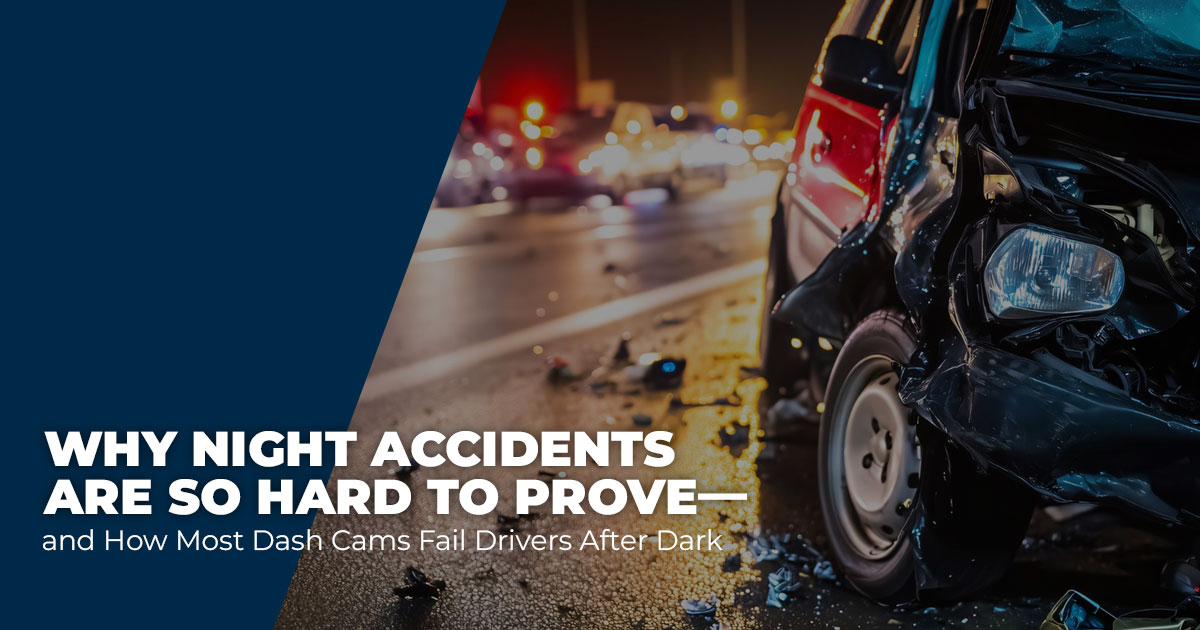
Nighttime crashes often drag on for months because lighting is poor, details vanish into shadows, and people remember events differently when they’re shaken. A dash cam for night driving that works fine during the day can become useless after dark. When that happens, drivers end up facing shared fault, longer disputes, or higher premiums—not because they were wrong, but because they couldn’t prove they were right.
This guide focuses on what actually matters: getting low-light dash cam footage that insurance adjusters accept without pushback. Clear night-time dash cam recording can show who caused the crash, capture a fleeing plate in a hit-and-run at night, or prove safe following distance when the other driver tells a different story. That kind of clarity changes outcomes.
1. Introduction
Most dash cam reviews talk about storage size, screen resolution, or app features. That misses the real issue. The real problem shows up at night, when many cameras fail at the exact moment proof matters most.
After reviewing hundreds of real-world claims, the same pattern appears again and again. Cameras that seem fine on paper produce dash cam footage too dark at night or night dash cam footage blurry from motion and headlight glare. The camera recorded something, but not enough to help.
The goal here is straightforward: help drivers choose a dash cam with night vision that delivers proof-quality dash cam footage on poorly lit roads. This matters for daily commuters on dark streets, rideshare drivers working late hours, and anyone who spends time on highways after sunset. The right setup can prevent months of stress later.
As technology experts with over 20 years of experience in hardware and application research and development, we evaluate products based on real-world performance, durability, and value for money. Our goal is to help readers find the best option for budget, performance, reliability, and long-term use. These recommendations are grounded in component analysis, real driving conditions, and industry experience, not spec sheets.
And that difference matters when evidence is on the line.
For drivers who already know night footage is their weak spot, starting with a trusted source helps narrow the field quickly. Official brand stores make it easier to compare models built for low-light performance without guessing specs or authenticity.
- View Vantrue Dash Cams on the Official US Store
- Explore Vantrue Dash Cams on the Official India Store
- View Vantrue Valentine’s Deals (US Readers)
2. Why This Review Is Essential
Many buyers only discover the problem after an accident, when their dash cam video is not clear enough for insurance. At that stage, the damage is already done.
Night accidents are hard to prove because night driving visibility problems destroy context. Shadows hide movement. Headlights overwhelm sensors. Motion blur erases license plates. This review explains why that happens and what separates dependable dash cam low-light performance from cameras that only work in ideal conditions.
The aim is to help readers avoid common mistakes and choose a dash cam that actually works at night, when claims are hardest to resolve.
3. What You Will Learn From This Review
- Why night driving visibility problems undermine accident evidence
- How headlight glare reduction and high dynamic range night recording affect fault decisions
- Why do some cameras succeed at license plate capture at night while others fail
- Real scenarios involving commuters, highway drivers, rideshare workers, and urban night traffic
- Clear tier-based comparisons focused on dash cam evidence for insurance
- Setup errors that lead to dash cam footage too dark at night
- Direct answers to common buyer concerns around night vision dash cam comparison
Quick Summary: A dependable night vision dash cam isn’t about extra features. It’s about night driving video clarity when liability depends on it.
4. The Moment Everything Goes Wrong After Dark
You’re driving home on a quiet road with few streetlights. A car comes up fast behind you. Then comes the impact. No witnesses. Just noise, shock, and confusion.
The collision lasts seconds. The aftermath can last months.
Without a dash cam for night accidents, stories start to conflict, and fault often gets split. Memory fills in gaps created by darkness and stress. A dependable dash cam for proving fault at night removes that uncertainty by showing vehicle position, signal use, braking, and sudden movement. When the footage is clear, the story stops changing.
5. Why Night Accidents Break Most Evidence
Night crashes fail on evidence long before they fail on facts. This section explains why darkness creates gaps that many cameras cannot handle.
5.1 Darkness Changes What Cameras Can Prove
Night driving is not just daytime with less light. Roads are uneven, with bright headlights, deep shadows, reflections, and glare all happening at once. Human eyes adapt. Many camera sensors do not.
This is where low-light recording challenges appear. A camera that looks sharp at noon may produce dash cam footage too dark at night or washed-out frames the moment headlights enter the scene. Important details disappear, even though the camera is still recording.
5.2 What Actually Ruins Night Footage
Across real-world claims, the same problems show up again and again:
- Heavy grain that makes license plates or faces unreadable
- Motion blur that turns moving vehicles into streaks
- Oncoming headlight glare that wipes out large parts of the frame
- Poor contrast that hides pedestrians, cyclists, or lane edges
Any one of these issues can lead to insurance rejected dash cam footage, even when video exists.
Key takeaway: the biggest risk is owning a dash cam that records but cannot protect liability because the night-time dash cam recording is unusable.
6. The Real Risk: Evidence That Looks Fine but Isn’t
Many drivers assume that any recording will help. In practice, dash cam video not clear enough for insurance is often labeled inconclusive.
Blurry plates, flared headlights, or unclear spacing do more than fail to help. They can weaken a strong claim by introducing doubt. Adjusters and insurers rely on clarity, not intention.
The goal isn’t just recording video. It’s producing footage that insurers can actually use.
7. How Focus, Sensor, and Light Intake Decide Liability
Night footage succeeds or fails based on small technical limits that matter far more after dark. This section explains where things break down.
7.1 When Footage Seems Clear but Still Fails
Slight softness can make license plates unreadable beyond short distances. Wide lenses without proper correction distort distance perception in night footage, turning safe gaps into what looks like tailgating.
Real scenario: a nighttime rear-end collision on a city street. The front camera captures the impact, but headlight flare and soft focus hide the true following distance. The claim stalls for weeks despite a clear fault.
This is how usable-looking footage becomes questionable evidence.
7.2 The Hidden Focus Traps
Some problems stay invisible until after an incident:
- Dashboard reflections pulling focus inward
- Focus locked incorrectly during installation
- Sensors overwhelmed by extreme contrast from headlights and streetlights These issues appear most often at night and rarely show up during quick daytime
8. How Night Vision Affects Fault Decisions
Night vision is not just about brightness. It shapes how fault is judged and how quickly claims resolve.
8.1 Proving Negligence After Dark
Strong dash cam night vision captures red-light violations, unsafe passes, and lane drift in low visibility. These moments often decide fault when witnesses are absent.
8.2 Ending Back-and-Forth Disputes
Why night accidents are hard to prove comes down to missing details. A clean dash cam recording for insurance claims at night serves as an impartial record that limits arguments and reduces delays.
When the footage is clear, disputes lose traction.
8.3 Pedestrians, Cyclists, and Visibility Gaps
Dark clothing and sudden movement complicate fault decisions involving pedestrians or cyclists. Clear pedestrian visibility at night shows timing, positioning, and reaction distance, which directly affects liability.
8.4 Admissibility and Settlement Strength
Dark or blurry clips are easy to dismiss. Proof-quality dash cam footage shortens claim timelines, strengthens settlement positions, and increases the chance of a fair outcome.
When night footage is clear, liability becomes harder to dispute.
9. What Actually Matters in a Reliable Dash Cam for Night Driving
Not all dash cams are built to handle darkness. This section breaks down the features that directly affect night driving video clarity and determines whether footage helps or hurts during an insurance claim. These aren’t extras. They’re the difference between recording an incident and proving it.
9.1 Low-Light Sensor Performance and Dash Cam Night Vision
The sensor is the foundation of dash cam night vision. Larger, light-sensitive sensors capture more detail in dark conditions, which reduces grain and preserves sharp edges.
Strong low-light sensor performance helps cameras:
- Retain detail on poorly lit roads
- Capture license plates without heavy noise
- Maintain clarity when streetlights are sparse
When the sensor can’t gather enough light, the result is often dash cam footage too dark at night, even if the camera records in high resolution.
9.2 Wide Aperture Lenses and Light Intake at Night
A wider lens aperture allows more light to reach the sensor. This matters most when driving on unlit roads or highways.
A wide aperture dash cam improves:
- License plate capture at night
- Subject separation in shadows
- Exposure balance without slowing shutter speed
Without enough light intake, cameras compensate by boosting sensitivity, which leads to noise and motion blur.
9.3 High Dynamic Range Night Recording and Headlight Glare Control
Night scenes often contain extreme contrast. Bright headlights sit next to deep darkness. High dynamic range night recording allows a camera to handle both at once.
Effective headlight glare reduction:
- Preserves road detail without washing out highlights
- Keeps vehicles visible during oncoming traffic
- Prevents frame-wide flare during sudden light changes
Cameras without strong HDR tend to lose half the scene when headlights enter the frame, which limits dash cam evidence for insurance.
9.4 Stable Focus and Motion Clarity in Night Footage
Focus issues matter more at night than during the day. Small errors can make plates unreadable or distort spacing between vehicles.
A dash cam with stable focus for night driving:
- Keeps moving vehicles sharp
- Preserves distance perception in night footage
- Avoids focus shifts caused by reflections or glare
Unstable focus often produces footage that looks acceptable at first glance but fails under review.
9.5 Why These Features Decide Dash Cam Liability Protection
Each of these elements works together. A strong sensor without glare control still fails. A wide aperture without stable focus still blurs motion.
When all four align, the result is dash cam liability protection that insurers can rely on. The footage holds detail, shows positioning, and stands up to scrutiny without explanation.
That’s what turns a dash cam from a recording device into proof.
10. Choosing the Right Dash Cam Setup for Night Proof
By this point, one thing should be clear: night performance isn’t fixed by specs alone. The setup determines whether the footage settles a claim or creates more questions. This section exists to help readers stop guessing and choose a configuration that actually protects them at night.
10.1 Front-Only vs Front-and-Rear Dash Cam for Night Accidents
A front-only dash cam looks appealing because it’s simpler. But in real night claims, it often leaves gaps.
Rear impacts happen more often in low visibility. Brake lights blend into darkness. Sudden stops get disputed. And in hit-and-run cases, the fleeing vehicle is usually behind you.
A front-and-rear dash cam for night accidents solves these problems by:
- Capturing rear-end collisions clearly
- Showing lane changes and closing distance
- Recording plates during a hit-and-run at night, when headlights briefly light the rear view
Choose front-and-rear if:
You drive in traffic, park on the street, or worry about rear-end liability.
Skip front-only if:
You want coverage that holds up when the other driver leaves the scene.
This is one of the easiest upgrades that meaningfully improves dash cam evidence for insurance.
10.2 Single-Channel vs Multi-Channel Dash Cam Setup
Single-channel cameras focus on the road ahead. Multi-channel setups add rear or cabin views for context.
A multi-channel dash cam for night driving helps when:
- The sequence of events matters, not just the impact
- Passengers or sudden interior movement affect fault
- You drive rideshare or transport people regularly
Cabin footage doesn’t matter for everyone. But for rideshare drivers, it often settles disputes quickly by showing what
happened inside the vehicle before braking or swerving.
Choose multi-channel if:
You carry passengers or want the full incident context.
Skip extra channels if:
You only drive solo and want the simplest setup possible.
11. Comparing Dash Cam Night Performance Across Tiers
Not all dash cams fail equally at night. Price tiers exist for a reason—but not the one marketing suggests. This section explains where spending more actually protects you, and where it doesn’t.
11.1 Entry-Level vs Mid-Range vs Proof-Grade Dash Cam Night Vision
All dash cams record video. Only some deliver usable proof at night.
- Entry-level dash cams record incidents but struggle with motion blur night footage and noise. Plates smear. Headlights wash out detail.
- Mid-range dash cams handle glare better, but license plate capture at night still fails at
- Proof-grade dash cams maintain clarity under motion, glare, and uneven Plates stay readable. Spacing looks accurate.
This gap shows up during claims, not during unboxing.
If footage needs explanation, it’s already weaker than it should be.
11.2 When Paying More for a Dash Cam Actually Reduces Risk
Paying more only helps when it improves the quality of core evidence.
Worth paying for:
- Strong low-light sensor performance
- Reliable high dynamic range night recording
- Stable focus that preserves motion clarity
Not worth paying for:
- Extra cloud storage
- Fancy apps
- Features that don’t improve dash cam liability protection
Clear footage settles claims. Features do not.
11.3 Night Dash Cam Tier Comparison for Insurance Use
|
Tier |
License Plate Capture at Night
(30–50 mph) |
Headlight Glare Handling |
Motion Clarity |
Insurance Usefulness |
| Entry- Level | Poor – blur and noise dominate | Frequent washout | Heavy smearing | Often rejected as inconclusive |
| Mid-
Range |
Fair – readable
close or stopped |
Manageable but
still flares |
Moderate blur | Helps but leaves
disputes open |
| Proof- Grade | Excellent – clear at realistic
distances |
Balanced exposure |
Sharp at speed |
Regularly accepted and
decisive |
This is why some claims close quickly and others drag on.
Decision Moment: What We’d Choose
If night driving is common, we’d choose a front-and-rear, proof-grade setup every time. It removes doubt, shortens claims, and protects against the situations that cause the most disputes.
If budget limits apply, a solid mid-range option still helps—but only with the understanding that fast night motion and distant plates may remain unclear.
Quick Verdict
- Choose front-and-rear if night accidents or hit-and-runs worry you
- Choose proof-grade if insurance acceptance matters more than extra features
- Skip entry-level if you expect night footage to protect liability
- Fallback option: mid-range works if you mainly drive slower city roads
By the time footage matters, the decision is already locked in. The right setup makes sure it works in your favor.
If you want, the next step can map specific night-driving profiles to recommended setups, or close with a final buyer checklist that removes any remaining doubt.
At this point, the difference between recording video and producing usable night evidence should be clear. If you’re leaning toward a setup built for real-world claims—not just daytime demos—looking at official listings helps avoid outdated models or spec confusion.
- View Vantrue Dash Cams on the Official US Store
- Explore Vantrue Dash Cams on the Official India Store
- View Vantrue Valentine’s Deals (US Readers)
12. Common Buyer Questions That Lead to Better Dash Cam Decisions
By this stage, most readers aren’t asking “what is a dash cam.” They’re asking which option avoids regret. This section answers the questions that matter most when choosing a dash cam for night driving—the ones that directly affect claims, fault, and outcomes.
12.1 Which Dash Cam Setup Best Catches a Hit-and-Run at Night?
A proof-grade dual-channel dash cam with strong low-light sensor performance offers the best chance. In many night incidents, the rear camera captures the clearest license plate as headlights briefly illuminate the fleeing vehicle.
Choose this if: hit-and-runs are a real concern or you park on dark streets. Rear coverage often matters more than higher resolution alone.
12.2 What Dash Cam Footage Do Insurers Accept Most After Dark?
Insurers respond best to clean, detailed dash cam footage accepted by insurance at night—video that shows plates, spacing, and movement without explanation.
Footage from larger sensors with controlled glare and stable focus holds up better during review. Dark, noisy clips tend to be labeled inconclusive, even when they show the impact.
12.3 Do Compact Dash Cams or Larger-Sensor Models Handle Night Driving Better?
In low light, larger-sensor dash cams consistently win. They produce better night driving video clarity, lower noise, and clearer motion than compact builds that rely on software to compensate for lack of light.
Smaller cameras can work during the day. At night, sensor size matters more than design.
12.4 Which Dash Cam Options Focus on Evidence Over Extras?
Proof-grade dash cams built around imaging quality focus on what matters: clarity, contrast, and motion accuracy. They skip features that look appealing but don’t improve dash cam evidence for insurance.
When the goal is liability protection, fewer features and stronger footage is the safer trade.
13. Matching Dash Cam Setups to Real Night-Driving Scenarios
Different drivers face different risks after dark. This section helps readers match a setup to how they actually drive, not how marketing suggests they should.
- Daily night commuters on suburban roads
A mid-range front-and-rear dash cam handles common rear-end collisions and stop-sign disputes in low light without overcomplication. - Highway drivers after dark
A proof-grade dash cam for night highway driving is essential. Higher speeds demand better motion clarity and license plate capture at night at realistic distances. - Rideshare drivers working late shifts
A multi-channel dash cam with strong interior night vision protects against both road incidents and passenger disputes. - Urban stop-and-go traffic
Strong dash cam glare handling matters most here. Constant headlights, brake lights, and reflections can overwhelm weaker cameras. - Poorly lit residential streets
Dash cams with the largest low-light sensors perform best on dash cam for low-visibility roads, pulling detail from near darkness where others fail.
Each group faces different night risks. The right setup matches those conditions instead of trying to cover everything poorly.
14. Practical Dash Cam Setup Tips That Keep Night Footage Usable
Even strong hardware can fail with a poor setup. These steps help protect night-time dash cam recording quality in daily use.
- Mount high and centered to reduce dashboard reflections
- Clean the lens weekly since night footage amplifies smudges
- Angle slightly downward to prioritize license plates over sky glare
- Test recording at night during setup, not just during the day
- Add a polarizing filter if headlight glare remains an issue
These small adjustments often decide whether the footage helps or hurts when reviewed.
Quick Takeaway
Clear night footage doesn’t happen by accident. The right setup, matched to real driving conditions and installed with care, turns a dash cam into usable proof.
15. Clearing Common Doubts About Dash Cams for Night Driving
By the time most people reach this point, they’re not looking for features—they’re trying to clear hesitation. These are the questions drivers ask right before making a decision about a dash cam for night driving, especially when insurance evidence and liability are on the line. Clear answers here remove doubt and help readers move forward with confidence.
Q. Why do most dash cams fail at night?
- Most dash cams fail because small sensors and narrow apertures can’t gather enough light in dark conditions. To compensate, the camera boosts sensitivity, which introduces noise, motion blur, and headlight flare. The result is often dash cam footage too dark at night or video that looks recorded but lacks usable detail.
Q. Can a dash cam clearly capture license plates at night?
- Yes—but only certain models can. Proof-grade dash cams with strong low-light sensor performance, wide apertures, and proper processing can achieve license plate capture at night at realistic speeds and distances. Entry-level cameras usually fail once vehicles are moving.
Q. Do dash cam videos actually help insurance claims at night?
- They do when the footage meets review standards. Dash cam footage accepted by insurance at night must be clear, detailed, and show positioning and movement without explanation. When that bar is met, claims tend to resolve faster and with fewer disputes.
Q. What makes one dash cam better for night driving than another?
- The difference comes down to imaging fundamentals. Sensor size, aperture, and processing that deliver real night driving video clarity matter far more than resolution numbers or app features. Cameras built around imaging quality outperform feature-heavy models in low light.
16. Frequently Asked Questions About Dash Cams for Night Driving
These questions come up when readers are close to choosing a dash cam for night accidents and want to avoid wasting money. The answers below focus on real-world results—what works, what fails, and what insurers actually accept.
Q. Need a dash cam for night accidents—will a budget model work?
- A budget model will record video, but it often produces dash cam footage too dark at night or blurry license plates. In real claims, this type of footage is frequently dismissed by insurers as inconclusive.
Q. How important is headlight glare reduction for night driving?
- It’s critical. Poor dash cam glare handling can wash out the frame when oncoming traffic passes, hiding vehicles, lane markings, or pedestrians at the exact moment fault needs to be shown.
Q. Should we choose a front-only or dual-channel dash cam for night driving?
- Dual-channel dash cams offer much stronger protection. Rear coverage improves evidence in rear-end crashes and provides better dash cam for hit-and-run at night protection, where fleeing vehicles are often behind you.
Q. How far can a good dash cam read license plates after dark?
- Proof-grade dash cams typically manage clear license plate capture at night at about 30 to 50 feet under real driving conditions, including moderate speeds and uneven lighting.
Q. Is higher resolution always better for low-light dash cam footage?
- Not always. Strong low-light dash cam footage processing, sensor size, and aperture matter more than raw resolution. More pixels don’t help if the sensor can’t gather enough light.
Q. Why does our current dash cam footage look blurry at night?
- The most common cause is motion blur night footage from a slow shutter speed or a weak sensor. This is typical of lower-cost dash cams that struggle to balance light and movement after dark.
17. Final Takeaway: Real Protection Comes From Real Night Performance
Night accidents don’t get decided by what drivers remember. They get decided by what the footage actually shows.
A reliable night vision dash cam gives you dash cam liability protection when visibility is poor, and stories start to shift. It shows positioning, movement, and timing clearly enough that fault doesn’t turn into debate.
That’s why the choice matters. Pick based on proven dash cam low-light performance, not feature lists or marketing claims. If the night-time dash cam recording can’t clearly show what happened, it hasn’t done its job—no matter how sharp it looks during the day.
For drivers who want dependable night footage built for real-world claims, these offfcial stores are a safe place to start:
- View Vantrue Dash Cams on the Official US Store
- Explore Vantrue Dash Cams on the Official India Store
- View Vantrue Valentine’s Deals (US Readers)
And if you’re still weighing options, that’s normal. Drop your night driving experiences, questions, or setup challenges in the comments. We’re happy to help you sort through choices or fine-tune a setup, so your footage holds up when it matters most.
Night protection comes from clarity, not promises. Choose a dash cam that proves what happened after dark—and lets you move on without second-guessing.
Before you go, we’d love to hear from you.
If you’ve dealt with a night-time accident, struggled with unclear dash cam footage, or figured out a setup that finally worked after dark, share your experience in the comments. Real stories help other drivers avoid the same mistakes.
Have doubts about your current dash cam, night footage quality, or setup? Ask away. We’re happy to help you think it through before it turns into a problem during a claim.
And if this article helped clear things up, pass it along to friends, family, or colleagues who drive at night, commute long hours, or rely on dash cams for protection. The right information at the right time can save someone months of stress later.
***Disclaimer***
This blog post reflects our own research, testing, and personal opinions. It should not be taken as the official position of any brand, manufacturer, or company mentioned here. While we aim to keep information accurate and up to date, product details, pricing, and availability can change. We recommend double-checking important details before making a purchase.
Some links in this article may be affiliate links. If you choose to buy through these links, we may earn a small commission at no extra cost to you. This helps support our work and allows us to keep publishing in-depth, unbiased reviews. Our recommendations are never influenced by affiliate partnerships.
Comments shared by readers reflect their own views and not ours. We are not responsible for outcomes resulting from the use of information on this site. Please seek professional advice where appropriate.
All product names, logos, and brands mentioned are the property of their respective owners. These names are used for identification and informational purposes only and do not imply endorsement.