
⚡ QUICK VERDICT

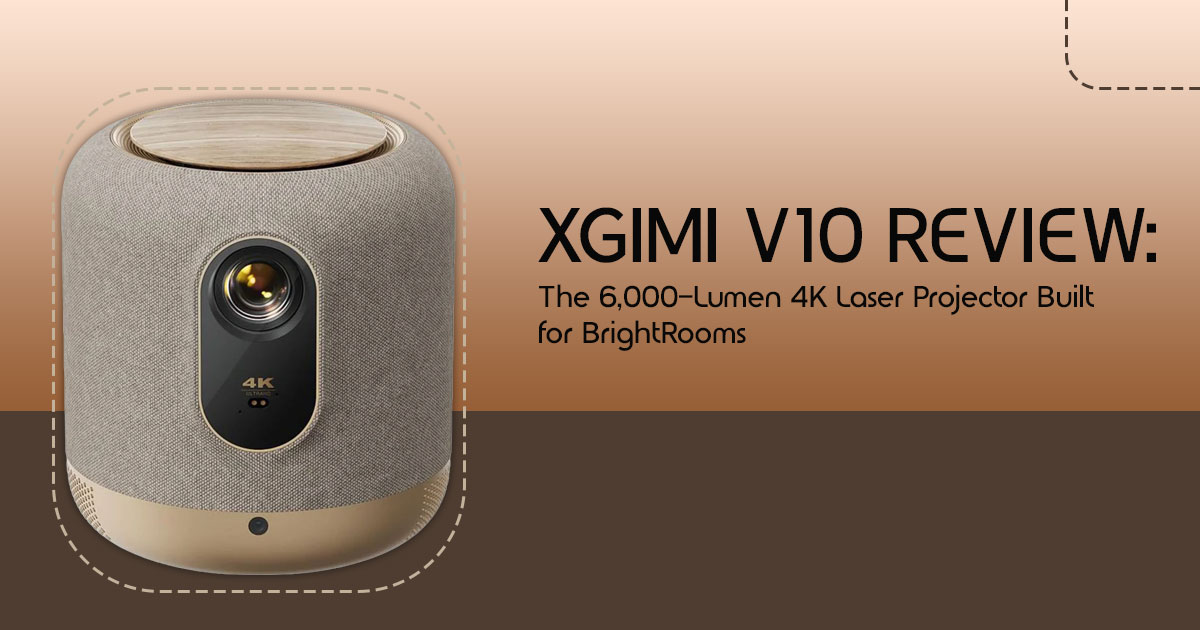
The Xgimi V10 is a genuinely impressive 6,000 CVIA lumen 4K laser projector built to solve one of the biggest challenges in projection technology: ambient light performance. Based on its published specifications, the V10 looks like one of the most promising options for buyers searching for the best 4K laser projector for bright living rooms in 2026. If you want a TV replacement projector that can still look good in a bright room, the V10 is worth a closer look.
D At a Glance: Xgimi V10 Key Specifications
Everything you need to know before diving into the full analysis.
| Specification | Xgimi V10 Detail |
| Resolution | 4K UHD (DLP Pixel-Shifting Technology) |
| Brightness | 6,000 CVIA Lumens |
| Light Source | Laser (20,000–30,000 hr lifespan) |
| HDR Support | Dolby Vision + HDR10+ |
| Max Projection Size | 300 inches |
| Optical Zoom | Yes — flexible placement, no quality loss |
| Operating System | GMUI 6.0 |
| Ideal Screen Pairing | Ambient Light Rejecting (ALR) Screen |
| Best Use Case | Bright Living Room / TV Replacement |
| Throw Type | Standard Throw (approx. 8–10 ft for 100″) |
1. What the Xgimi V10 Actually Is — Plain Breakdown
In a market saturated with overpromising spec sheets, the Xgimi V10 4K laser projector stands out for a simple reason: it is engineered around a real-world problem. Most projectors look stunning in a pitch-black demo room. The V10 is designed for real-world living spaces — your bright living room, sunlit den, or open-plan apartment.
Core Technologies Explained
- 4K DLP Architecture: Digital Light Processing chip optimized for a sharp, pixel-dense image through advanced pixel-shifting technology — delivering the 8.3 million pixel count that defines 4K UHD.
- Laser Light Source: No bulb replacements, no slow warm-ups. The laser light engine maintains consistent brightness over a 20,000–30,000 hour lifespan — a fundamental advantage over lamp-based projectors.
- Optical Zoom: Adjust image size without repositioning the projector — critical for rooms that aren’t perfectly shaped and for getting the right fit without sacrificing image quality.
- Dolby Vision + HDR10+: Dual HDR standards deliver dynamic contrast, wider color volume, and highlights that look genuinely lifelike with compatible streaming content.
- 300-Inch Projection: The V10 supports projection sizes up to 300 inches, though optimal brightness and image quality are likely achieved at smaller screen sizes.
- GMUI 0 OS: A built-in smart platform with access to major streaming apps, eliminating the need for a separate streaming stick or media player for everyday use.
Its mix of laser brightness, flexible setup, and large-screen capability makes it especially appealing for living room movie nights and everyday home entertainment.
2. The Brightness Myth Most Buyers Fall For
Raw lumen numbers are among the most misunderstood marketing figures in the projector industry. Before you compare specifications, you need to understand what those numbers actually mean in your home.
The 4-Layer Brightness Reality Test
A framework for understanding true ambient-light performance.
Layer 1 — Marketing Lumens: Decoding CVIA vs. ANSI vs. ISO
ANSI lumens (American National Standards Institute) is the most reliable and consistent benchmark used in the US market. CVIA lumens (China Video Industry Association) can yield higher reported figures for the same projector. The V10’s 6,000 CVIA lumens represents a genuinely high-brightness device — but it is not directly equivalent to 6,000 ANSI lumens. That said, even accounting for the measurement gap, this projector is exceptionally bright for its category, making it a strong contender for bright-room viewing.
Layer 2 — Calibrated Brightness: What Cinema Mode Actually Delivers
Here is what manufacturers rarely advertise: peak lumen figures are achieved in “Dynamic” or “Bright” modes that sacrifice color accuracy for raw output. Switch to a properly calibrated “Cinema” or “Filmmaker” mode — the one you actually want for movies — and brightness drops significantly. This is normal and expected. The real question is how much brightness remains in accurate mode, and whether it’s sufficient for your room’s lighting conditions.
Layer 3 — Ambient Light Survival: Why Sunlight Destroys Perceived Contrast
Projectors display images using reflected light. When sunlight enters your room, it brightens the dark areas of the image, crushing the contrast ratio and washing out colors. A projector rated at 1,500 ANSI lumens can look completely washed out at 2 PM on a sunny afternoon. The V10’s ultra-high brightness is a direct architectural response to this exact problem — it aims to maintain enough contrast and saturation even under direct ambient light.
Layer 4 — Screen Pairing: ALR Screens Change Everything
The most overlooked upgrade for any projector setup: the screen itself. Ambient Light Rejecting (ALR) screens use angular optical coatings to reflect projector light toward viewers while absorbing overhead or side- angle light. Paired with the V10’s high brightness, an ALR screen can double your perceived contrast and color saturation in a bright room. For the best daytime viewing experience, an ALR screen is strongly recommended. For many buyers, this is the difference between a standard projector and one that still looks good during daytime viewing.
🏈 Real-World Scenario: Sunday Football at 2 PM

Sun is streaming through your windows. The game is on. You refuse to draw the blinds on a beautiful day. This is exactly the scenario a TV replacement projector must conquer. With 6,000 CVIA lumens and a quality ALR screen, the Xgimi V10 is designed to deliver a watchable, engaging image under these conditions — a feat that would leave most conventional projectors looking grey and washed out.
3. Xgimi V10 Pros & Cons — Honest Assessment
No product is perfect. Here is a balanced, accurate breakdown of where the V10 excels and where it asks for compromise.
| ✅ PROS — What the V10 Gets Right | ⚠️ CONS — Where to Temper Expectations |
| ✓ 6,000 CVIA lumens — exceptional daylight viewing | ✗ Moderate black levels — can’t match OLED |
| ✓ Laser light source — 20,000–30,000 hr lifespan | ✗ CVIA lumens ≠ ANSI lumens — brightness needs context |
| ✓ 4K DLP with Dolby Vision + HDR10+ support | ✗ Fan noise at max brightness modes |
| ✓ Optical zoom for flexible room placement | ✗ Not designed for frequent portability |
| ✓ 300-inch maximum projection capability | ✗ Competitive esports latency not confirmed |
| ✓ GMUI 6.0 smart OS — built-in streaming hub | ✗ Netflix support varies by region/model |
| ✓ Quick on/off — no lamp warm-up needed | ✗ Requires ALR screen for optimal daytime performance |
| ✓ Highly immersive large-screen gaming experience for casual and cinematic gameplay | ✗ Higher power consumption than LED TVs |
4. Can the Xgimi V10 Replace Your TV? The Honest Scorecard
The “TV replacement projector” category has exploded in popularity over the last few years, especially among buyers looking for a living room projector that feels easier to live with day to day. It also works well for people who want a large-screen setup without needing to darken the room every time they watch something.
Here is an objective scorecard based on the V10’s verified specifications and design intent.
| Category | V10 Performance | Expert Analysis |
| Daytime Visibility | ★★★★★ High | 6,000 CVIA lumens + laser light source dominate bright rooms — especially with an ALR screen |
| Black Levels | ★★★☆☆ Moderate | DLP projectors generally cannot match OLED TVs for deep black levels |
| Gaming Responsiveness | ★★★★☆ Good | Projectors in this category often target lower input lag, though official latency measurements for the V10 are still pending |
| Ease of Setup | ★★★★★ Strong | Optical zoom + auto-alignment make installation flexible across room layouts |
| Streaming Convenience | ★★★★★ Strong | GMUI 6.0 OS delivers a smart, self-contained hub for all major streaming apps |
| Apartment Friendliness | ★★★☆☆ Medium | Brightness is a big plus; fan noise and space needs may challenge smaller rooms |
How It Compares to Other Display Technologies
- Large OLED TVs: In the laser projector vs OLED debate, OLED TVs still lead in black levels and dark-room contrast. The V10 fights back with sheer screen size and a far more cinematic viewing experience for large spaces.
- Mini-LED TVs: Mini-LEDs are very bright and bright-room capable. They offer a traditional TV experience. The V10 wins on sheer image scale; Mini-LEDs win on black levels and plug-and-play simplicity.
- UST Laser TVs: Ultra Short Throw projectors (like Hisense’s Laser TV line) sit inches from the wall and bundle ALR screens. The V10 requires more throw distance but offers more placement flexibility and a larger maximum image.
5. Native 4K vs. Pixel-Shifting — The Truth Non-Technical Buyers Need
One of the most persistent debates in the projector world: is pixel-shifting 4K “real” 4K? Here is the honest, nuanced answer that removes the marketing confusion.
How Pixel-Shift Technology Actually Works
True native 4K DLP chips are found almost exclusively in professional cinema projectors costing tens of thousands of dollars. Consumer-market projectors use high-speed pixel-shifting: a lower-resolution chip (often 1080p) shifts its pixels diagonally by a sub-pixel distance multiple times per frame. Done fast enough, the result is 8.3 million distinct pixels on screen — which meets the Consumer Technology Association’s official definition of 4K UHD.
🔍 Is Pixel-Shifting "Fake 4K"?

No — and calling it that is a misleading oversimplification. The Xgimi V10 meets the 4K UHD standard. At typical seating distances — 1.5 to 2x the screen diagonal — the human eye cannot reliably distinguish high-quality pixel-shifted 4K from native 4K. Sharpness perception is more influenced by lens quality, image processing, and source content than by the pixel-shifting method itself.
6. Setup Guide for Real Homes — Practical Advice
Getting the most from the V10 requires more than just pointing it at a wall. Here is what actually matters.
Beginner Setup Walkthrough
- Throw Distance: For a 100-inch screen, expect approximately 8–10 feet between projector and Optical zoom provides adjustment flexibility within your room.
- Ceiling Mount vs. Shelf: Ceiling mounts offer a clean, permanent installation. Shelf placement is better for flexibility or occasional outdoor Both work — choose based on your room aesthetics and portability needs.
- Screen Selection: A high-quality ALR screen with 8–1.0 gain is the recommended pairing for bright- room use. Do not underestimate this upgrade — the screen has as much impact as the projector itself.
- Room Lighting: The V10 handles ambient light well, but dimming or blackout curtains during critical viewing will still improve black levels and Full daylight mode is for casual viewing; cinematic mode is for controlled light.
- Audio Pairing: Built-in speakers handle casual use. For a true home cinema experience, connect a soundbar or AV receiver via HDMI ARC or optical audio — the visual scale demands matching audio scale.
Common Setup Mistakes to Avoid
- Projecting onto white walls: Works, but drastically limits contrast and color An ALR screen is a worthwhile investment for serious users.
- Sitting too close: At viewing distances less than 5x the screen diagonal, pixel structure can become visible. Find your optimal distance.
- Ignoring fan noise in placement: Place the projector where airflow is unobstructed and where fan noise won’t interrupt quiet scenes or dialogue-heavy content.
- Wrong screen gain: Too high creates hotspotting (bright center, dark edges). Too low wastes the V10’s brightness advantage. Aim for 0.8–1.0 gain.
- Leaving HDR on default: HDR needs Confirm your source device and the V10 are both configured for HDR output, then fine-tune the projector’s HDR settings to your preference.
7. Gaming on the Xgimi V10 — Honest Performance Analysis
A big screen can transform your gaming experience — but serious gamers need to know the trade-offs before committing.
Xgimi V10 vs. Gaming TVs — Feature Comparison
| Feature | Xgimi V10 (Projector) | Gaming TV (OLED/Mini-LED) |
| Screen Size | Up to 300 inches — unmatched immersion | Large (up to 98″), but very expensive |
| Input Lag | Likely suitable for casual gaming, though full input lag testing is still pending | Excellent — often under 10ms |
| Refresh Rate (4K) | Likely 60Hz native; 120Hz at lower res | Commonly 4K @ 120Hz |
| VRR Support | Unconfirmed — less common on projectors | Standard on high-end models |
| HDR Gaming | Supported; ambient light affects impact | Exceptional — OLED especially |
| Black Levels | Moderate — DLP limitation | Excellent (OLED) / Very Good (Mini-LED) |
| Ambient Light | Strong — V10’s core strength | Excellent on Mini-LED, limited on OLED |
Gaming Use Case Breakdown
- PS5 & Xbox Series X: For players looking for a projector for PS5 or Xbox Series X, the V10 delivers a huge, immersive screen that feels far more cinematic than a traditional TV setup. The immersion of a 100–150 inch image is unmatched by any TV.
- Competitive FPS (Esports): A dedicated gaming monitor or TV with confirmed sub-10ms input lag and 4K 120Hz will still outperform. The V10 is not designed as a competitive esports display.
- Couch Co-op & Split-Screen: This is where the V10 shines Split-screen gaming on a 120- inch image gives each player more visible space than a 75-inch TV provides total.
- Cloud Gaming: Cloud services introduce their own Additional projector lag on top of network latency may be noticeable. Consider for casual cloud gaming only.
8. Real Ownership Trade-Offs Nobody Tells You
Full transparency is the foundation of a trustworthy review. Here are the ownership realities that go unmentioned in most projector marketing.
- Fan Noise: At maximum brightness, expect audible fan operation. This is a fundamental trade-off for high-lumen Placement and room acoustics matter — test in your space before finalizing position.
- Laser Lifespan & Gradual Dimming: The 20,000–30,000 hour laser lifespan is However, brightness gradually decreases over that lifespan. At the V10’s initial output level, this degradation will take many years to become meaningfully noticeable.
- Maintenance Reality: Unlike a TV, projectors benefit from periodic lens cleaning and vent dust removal. Not demanding, but not as maintenance-free as hanging a TV on a wall.
- Portability Limitations: The V10 is a high-performance installation projector, not a portable Moving it room-to-room regularly is impractical. Plan your permanent placement before purchasing.
- Power Consumption: Running at full brightness will consume more electricity than a typical LED A modest but real ongoing operating cost — worth considering for heavy daily users.
- Netflix Regional Availability: Netflix licensing for built-in apps can vary by region and Verify US Netflix support for your specific V10 unit before assuming it is included.
9. Xgimi V10 vs. Competition — Which Projector Is Right for You?
Different buyers have different priorities. This matrix helps you find the right match based on your actual use case.
| Buyer Type | Best Choice | Why This Projector Wins |
| 🎬 Movie Enthusiast | Epson LS Series | Superior black levels, color accuracy, and calibrated cinema picture quality |
| ☀️ Bright-Room User | Xgimi V10 ✓ | Ultra-high 6,000 CVIA lumen brightness + daylight viewing = living room champion |
| 🎮 Gamer | JMGO N1 Ultra | Optimized input lag + high refresh rates built for PS5/Xbox Series X demands |
| 📺 UST Setup | Hisense Laser TV | Sits inches from the wall, bundled ALR screen — true plug-and-play TV replacement |
| 💰 Budget Premium | Dangbei Mars Pro | Strong 4K laser performance at an accessible entry price point |
10. Should You Buy the Xgimi V10? Our Verdict
✅ Best For — Buy If You Are…
- A bright-room viewer who wants to watch TV, movies, and sports during the day without sacrificing image quality
- A sports fan who wants a massive, immersive viewing experience that a 75-inch TV simply cannot replicate
- A casual or couch gamer who prioritizes screen scale and visual immersion over competitive esports precision
- An apartment dweller where a large TV would dominate the room and the V10’s footprint offers a better space trade-off
- A large-screen enthusiast who wants 100–150+ inch projection without the $30,000+ price tag of commercial displays
⚠️ Consider Alternatives If You…
- Demand OLED black levels and primarily watch content in a fully light-controlled home theater room
- Are highly sensitive to fan noise and need absolute silence during quiet scenes or dialogue
- Require ultra-low esports input lag for competitive online gaming where milliseconds matter
- Insist on true native 4K and will not accept pixel-shifting technology regardless of the real-world visual outcome
Key Takeaways — What to Remember

6,000 CVIA lumens = exceptional daylight performance, especially with an ALR screen.
Pixel-shifted 4K meets the 4K UHD standard and looks indistinguishable at normal viewing distances.
Dolby Vision + HDR10+ delivers genuinely dynamic color and contrast with compatible content.
Optical zoom and GMUI 0 OS make setup and daily use genuinely convenient.
Black levels and competitive gaming latency are the legitimate limitations.
An ALR screen is not optional — it is the upgrade that unlocks the V10's full potential.
11. The Future of 4K Laser Projectors — What’s Coming Next
The V10 represents the current frontier, but the projector industry is evolving rapidly. Here is what to watch:
- Triple-Laser Systems (RGB Laser): Red, Green, and Blue laser light sources promise even wider color gamuts, higher brightness, and improved color accuracy.
- Higher Contrast Innovation: Manufacturers are developing better light processing and screen coatings to improve contrast in ambient light — the biggest remaining challenge for projectors.
- Gaming-First Projectors: Sub-10ms input lag at 4K resolution and confirmed VRR support are increasingly achievable. The gap between projectors and gaming TVs is narrowing.
- AI Image Processing: Dynamic AI-driven adjustments for brightness, contrast, and color based on content type and ambient conditions are already emerging in flagship models.
- Laser TV Convergence: The boundary between UST projectors and televisions continues to blur, with more integrated, living-room-native designs launching each year.
FAQ — Questions Real Buyers Ask
Is 6,000 lumens enough for daylight viewing?
Yes. 6,000 CVIA lumens is a very high brightness level for a home projector. Paired with a quality ALR screen,
the Xgimi V10 delivers a watchable, engaging image even in rooms with significant natural light.
What is the difference between CVIA and ANSI lumens?
ANSI lumens is the international standard used most widely in the US and is considered conservative and consistent. CVIA lumens can yield higher numbers for the same projector. The V10’s 6,000 CVIA rating reflects a genuinely bright projector — but compare carefully against ANSI-rated competitors.
Does the Xgimi V10 support Netflix?
The V10 runs GMUI 6.0 OS and supports major streaming apps. However, Netflix licensing varies by region and model. Always verify Netflix availability for your specific unit and region before purchasing.
Is optical zoom important on a projector?
Very. Optical zoom lets you adjust image size without physically moving the projector — preserving image quality and making it far easier to find your ideal setup in imperfectly shaped rooms.
Can a projector replace a 75-inch TV?
Absolutely — and then some. The V10 can project at 100, 150, or even 300 inches. A projector at 100 inches delivers more than 75% more screen area than a 75-inch TV — at a cost per inch that TVs at that scale cannot match.
What screen works best with the Xgimi V10?
For living rooms with ambient light, an Ambient Light Rejecting (ALR) screen with 0.8–1.0 gain is the optimal pairing. It is the single most impactful upgrade for daytime performance.
Are laser projectors better than OLED TVs?
It depends on your priorities. Laser projectors win on image scale, cost per inch, and eye comfort (reflected vs. emitted light). OLED TVs win on black levels and contrast in dark, controlled environments. Neither is universally better — they excel in different use cases.
Conclusion — Our Final Assessment
The Xgimi V10 4K laser projector is a genuine breakthrough in ambient light performance for home projection. Its 6,000 CVIA lumens, laser light source, Dolby Vision support, and optical zoom combine into a product that solves a practical problem for everyday households — especially those who want a large-screen experience without sacrificing their living room to darkness.
It will not match the inky blacks of an OLED, the sub-10ms lag of a dedicated gaming monitor, or the plug-and- play simplicity of a Mini-LED TV. But for sheer cinematic scale in a bright-room environment, the V10 is one of the strongest arguments for projector ownership that exists in 2026.
Our recommendation: If bright-room viewing and maximum screen size are your top priorities, the Xgimi V10 is an outstanding investment. Pair it with a quality ALR screen and a solid sound system, and you will have a home theater experience that no television — at any price — can match on sheer scale and immersion.
What Still Needs Independent Testing
While the V10 looks impressive on paper, a few important details still need real-world testing once retail units become widely available.
Here are the biggest things buyers should keep an eye on:
- Real ANSI lumen measurements compared to the advertised 6,000 CVIA rating
- Measured gaming input lag and responsiveness
- Fan noise levels during high-brightness operation
- Color accuracy after professional calibration
- HDR tone mapping performance with Dolby Vision content
- Netflix certification and app support across different regions
These details will give a much clearer picture of how the V10 performs outside controlled demo environments.
🛒 Ready to Experience the Xgimi V10?

Check the latest pricing, availability, and bundle deals below. We recommend purchasing from an authorized retailer to ensure full warranty coverage and regional software support. → Check Price & Availability
This review is based on publicly available specifications and manufacturer information. Specific performance metrics such as measured ANSI lumens, calibrated brightness, and input lag will be updated once retail unit testing data becomes available. Accuracy matters to us, and we don’t exaggerate claims or inflate results for clicks.
For those planning to buy, stay connected with us — Amazon purchase links, best deals, and availability updates will be added very soon.
***Disclaimer***
This blog post reflects our research, analysis, and opinions based on available product information, user feedback, and industry knowledge. It should not be taken as the official position of any brand, manufacturer, or company mentioned here. While we aim to keep information accurate and up to date, product details, pricing, and availability can change. We recommend double-checking important details before making a purchase.
Some links in this article may be affiliate links. If you choose to buy through these links, we may earn a small commission at no extra cost to you. This helps support our work and allows us to keep publishing in-depth, unbiased reviews. Our recommendations are never influenced by affiliate partnerships.
Comments shared by readers reflect their own views and not ours. We are not responsible for outcomes resulting from the use of information on this site. Please seek professional advice where appropriate.
All product names, logos, and brands mentioned are the property of their respective owners. These names are used for identification and informational purposes only and do not imply endorsement.