
Overview
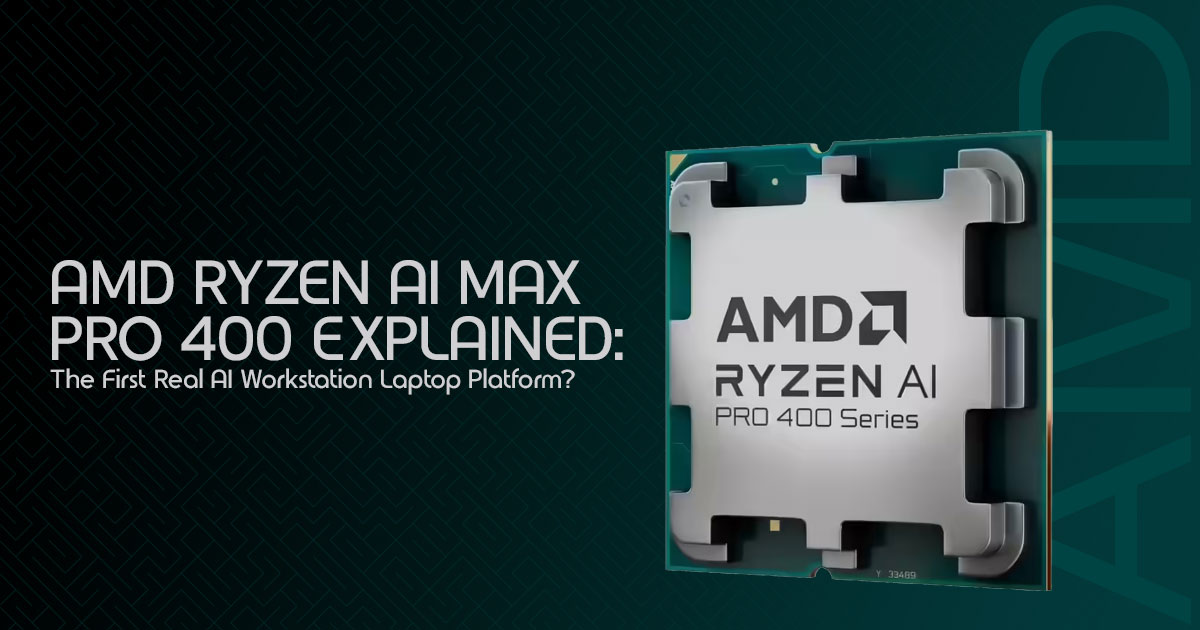
The AMD Ryzen AI Max Pro 400 is not a typical laptop processor focused only on gaming or office work. It’s built for people running local AI workloads, large language models, 3D rendering, and heavy creator software without depending on cloud servers. With massive unified memory support, upgraded Radeon 8065S graphics, and strong AI processing power, this chip could become one of the most important AI laptop processors of the next generation.
If you’re an AI developer, content creator, 3D artist, video editor, or someone searching for a serious AI workstation laptop or portable AI workstation, this is the kind of hardware worth paying attention to.
Introduction
Most laptops still hit the same wall when handling heavy AI tasks: they run out of memory long before they run out of processing power.
That’s the problem many AI developers, 3D artists, machine learning researchers, and video creators deal with every day. You can have a fast processor and powerful graphics, but once your workflow needs more memory for local AI models, Stable Diffusion, Blender scenes, or large datasets, performance drops hard. Suddenly the laptop that looked powerful on paper starts struggling.
The AMD Ryzen AI Max Pro 400 enters the market at a time when laptops are changing fast. This is no longer just about gaming frame rates or battery life comparisons. More users now want systems capable of running AI workloads locally, handling large language models, editing complex projects, and managing demanding workloads without relying completely on cloud platforms.
And that’s what makes this processor different.
Instead of focusing only on raw benchmark numbers, AMD appears to be targeting something bigger: a new wave of AI workstation laptops. With support for massive unified memory, upgraded Radeon 8065S integrated graphics, and hardware designed for modern AI applications, this chip could change how people think about mobile computing.
But specs alone never tell the full story.
Everyday performance matters more than marketing slides. Thermal limits matter. Software optimization matters. And most importantly, users want to know whether this hardware actually improves their workflow or simply adds more hype to the growing AI PC market.
That’s why long-term usability and real-world experience matter so much when evaluating products like this. Technical announcements often focus on numbers, while real buyers care about everyday performance, reliability, value, and whether the device can handle their actual workload six months later.
As technology experts with over 20 years of experience in hardware and application research and development, we deeply analyze each product based on real-world performance, durability, and value for money. Our goal is to help you find the best product in every category—budget, performance, reliability, and long-term usage. Whether you are an AI engineer, creator, developer, power user, or someone planning to buy a future-ready Ryzen AI laptop for local AI work, our recommendations are based on extensive research, component analysis, real-world usability, and industry expertise.
In this guide, we’ll break down:
- What makes the Ryzen AI Max Pro 400 different?
- How the Radeon 8065S performs
- Whether unified memory actually helps real AI workloads
- Who should buy this processor?
- And whether this could become one of the best portable AI workstation platforms available.
Technical Specifications at a Glance
| Feature | Ryzen AI Max+ PRO 495 | Ryzen AI Max PRO 490 | Ryzen AI Max PRO 485 |
| CPU Cores | 16 Zen 5 cores | 12 Zen 5 cores | 8 Zen 5 cores |
| GPU | Radeon 8065S (40 Compute Units) | Radeon 8050S (32 Compute Units) | Radeon 8050S (32 Compute Units) |
| NPU Performance | 55 TOPS | 50 TOPS | 50 TOPS |
| Maximum RAM | 192GB LPDDR5X | 192GB LPDDR5X | 192GB LPDDR5X |
| TDP | 45W – 120W | 45W – 120W | 45W – 120W |
1. What Is AMD Ryzen AI Max Pro 400?
The AMD Ryzen AI Max Pro 400 is built on the “Gorgon Halo” architecture. In simple terms, AMD took their best CPU cores (Zen 5), their most efficient graphics (RDNA 3.5), and a massive AI accelerator (XDNA 2) and integrated them into a single platform.
What this actually improves:
- Zen 5 Cores: This means your code compiles faster and your 100+ Chrome tabs won’t slow the system down.
- RDNA 5 Graphics: This handles the heavy lifting for video editing and 3D rendering.
- XDNA 2 NPU: This part is designed specifically for AI-related It handles background AI tasks like noise cancellation or image generation so your main processor doesn’t have to.
AMD is aiming this at the “Pro” market first. That means it’s built for enterprise security and stability. AMD is positioning this as a complete portable AI workstation laptop platform for developers, creators, and AI professionals.
2. The 192GB Unified Memory: The Killer Feature
This is where things get interesting. Most laptops run out of VRAM (video memory) long
before they run out of actual processing power. If you’ve ever tried to load a large AI model and saw a “CUDA Out of Memory” error, you already know how frustrating that can be.
The AMD Ryzen AI Max Pro 400 solves this with unified memory. Instead of having 8GB of VRAM for the GPU and 32GB for the system, the CPU, GPU, and AI engine can dynamically share the same memory pool.
Why this matters for local AI inference:
You can run a 70B parameter model like Llama 3 entirely on your laptop, which is a huge deal for anyone looking for a true large language model laptop. Usually, you’d need a $5,000 desktop with multiple GPUs to do that. Now, you can do it at a coffee shop.
Quick Verdict: If you work with LLMs or Stable Diffusion, the memory capacity alone makes this chip worth the price of admission.
3. Radeon 8065S: Replacing the Mid-Range GPU?
The Radeon 8065S is the integrated GPU inside the flagship 495 chip. AMD claims it can compete with mid-range dedicated cards.
- Gaming: Early expectations suggest performance could compete with some RTX 4060-class laptop GPUs in certain It should handle many modern games at 1440p comfortably with balanced settings.
- Rendering: In Blender or Unreal Engine, the massive memory pool is a huge advantage. You won’t get those annoying crashes on complex scenes.
Radeon 8065S vs. The Competition
| GPU | Type | VRAM Capacity | Best Use Case |
| Radeon 8065S | Integrated | Up to 160GB | Local LLM workloads, AI experimentation, and compact 3D workstations |
| RTX 4070 Mobile | Discrete | 8GB – 12GB | High-end gaming, ray tracing, and GPU-accelerated creator workloads |
| Apple M4 Max | Integrated | Up to 128GB | Professional video editing, macOS development, and creative production workflows |
4. Ryzen AI Max Pro 495 Max+ 395: The Real Difference
Is it just a refresh? Mostly, yes—but with one massive caveat. While the CPU and GPU clocks are only slightly higher (about 3-4% faster), the jump from 128GB to 192GB of memory support is a game-changer for professionals. If you’re just browsing the web, you won’t notice the difference. If you’re a developer, this can be the difference between a model running smoothly or failing to load at all.
5. Who Should Actually Buy This?
Don’t buy a Ryzen AI Max Pro 400 laptop just because it’s new. Buy it if you fit these categories:
- AI Developers: If you need an AI developer laptop for running Llama, Mistral, or Stable Diffusion locally, this platform makes much more sense than a standard gaming laptop.
- 3D Artists: You’re tired of VRAM limits in Blender or Octane.
- Software Engineers: You run heavy Docker containers and multiple VMs simultaneously.
Probably Not For You If: You just play Valorant and watch Netflix. You’re paying for a lot of specialized silicon you won’t use.
6. The Threat to Apple Silicon
Apple has owned the “unified memory” crown for years. The AMD Ryzen AI Max Pro 400 could become one of the strongest Windows-based alternatives to Apple Silicon for AI-focused mobile workloads.
While Apple’s M4 Max has faster memory bandwidth, AMD offers more total memory (192GB vs 128GB) and the flexibility of Windows and Linux. For many developers, that flexibility is worth more than a bit of extra bandwidth.
7. Everyday AI Workloads
Here is a practical example of how you’d actually use this chip. If you wanted to run a local LLM using llama.cpp, the AMD Ryzen AI Max Pro 400 makes it simple because of the memory overhead.
On a standard laptop, this would fail immediately. On this platform, these workloads become far more realistic on a portable system.
8. The Hidden Downsides
We have to be honest: this isn’t all perfect.
- Price: These will be Expect workstation-level pricing.
- Heat: 120W in a laptop is a Expect the fans to kick in during heavy AI tasks.
- Battery: Don’t expect MacBook-level battery life when you’re actually using the NPU or GPU.
9. Expected Laptops and Mini PCs
Look for announcements from HP, Lenovo, and ASUS in Q3 2026.
- What to look for: Make sure the laptop has a “Vapor Chamber” or high-end Good cooling will matter a lot with this chip.
- Mini PCs: There will likely be “AI Workstation” mini PCs that use this chip as a dedicated inference box.
10. Should You Wait?
Wait If: You are hitting memory limits today and need a portable solution for AI or 3D work. Buy Now If: You just need a solid gaming laptop. An RTX 4070 laptop today is already great for gaming.
11. Performance Leaks
Early PassMark leaks show the Ryzen AI Max Pro 495 is about 4% faster than the previous generation in multi-core tasks. It’s a decent improvement, but the real win is the 55 TOPS NPU and the faster 8533MT/s memory.
12. The Future of Edge AI
AMD’s strategy with the AMD Ryzen AI Max Pro 400 is about pushing more edge AI computing away from the cloud and onto local systems. It’s about privacy, speed, and making on-device AI practical for everyday professional work. By putting 192GB of memory in a laptop, they are making “Edge AI” a reality for professionals, not just a buzzword.
FAQs
What is the AMD Ryzen AI Max Pro 400?
It’s a high-end laptop chip designed for AI workstations, featuring up to 16 cores and 192GB of shared memory.
Can it run local LLMs?
Yes, it is specifically built for this. It can handle 70B+ parameter models that usually require desktop GPUs.
When does it launch?
Expect laptops to hit the market in Q3 2026.
Final Take
The AMD Ryzen AI Max PRO 400 series is not trying to be another mainstream laptop processor built only for gaming or office work. AMD is clearly targeting a different kind of user — people building, testing, training, and running advanced AI workloads locally.
For years, portable systems have struggled with one major limitation: memory. Powerful GPUs were available, but large AI models, complex 3D scenes, and heavy creator workflows quickly hit VRAM limits. That forced many users back to expensive cloud platforms or bulky desktop workstations.
AMD appears to be attacking that problem directly.
The company officially announced the Ryzen AI Max PRO 400 series, codenamed “Gorgon Halo,” as its next-generation platform for AI PCs, mobile workstations, and professional creator systems. While the lineup is now official, the hardware is not yet shipping to consumers. Systems powered by these processors are expected to launch in the third quarter of 2026 through OEM partners including HP and Lenovo.
Instead of launching a single processor, AMD introduced three enterprise-focused models within the family:
Ryzen AI Max PRO 4858-core / 16-thread32 Compute UnitsEnterprise AI platform
| Processor | CPU Configuration | Graphics | AI Engine |
| Ryzen AI Max+ PRO 495 | 16-core / 32-thread | Radeon 8065S with 40 RDNA 3.5 Compute Units | 55 TOPS NPU |
| Ryzen AI Max PRO 490 | 12-core / 24-thread | 32 Compute Units | AI-focused architecture |
But the biggest story is not the CPU cores.
It’s the memory architecture.
The Big Upgrade: Unified Memory
The defining feature of the new Ryzen AI Max PRO 400 series is its expanded unified memory support, which pushes far beyond what most modern laptops can handle.
| Attribute | Specification | Why It Matters |
| Max Unified Memory | Up to 192GB LPDDR5X-8533 | Massive capacity for AI workloads, creator applications, and multitasking |
| Allocated VRAM | Up to 160GB shared GPU memory | Far beyond typical mobile GPU VRAM limits |
| Local LLM Capacity | AMD claims the platform is capable of handling extremely large local AI models, including some 300B-parameter-class workloads under optimized conditions. | Designed for large local AI inference without cloud dependency |
This is a major jump over the older Ryzen AI 300 “Strix Halo” platform, which topped out at 128GB memory capacity.
And that changes the conversation completely.
For AI developers, machine learning researchers, 3D artists, video editors, and advanced creator workstation users, memory capacity often matters more than raw benchmark numbers. Large AI models can consume enormous amounts of VRAM, and most mobile GPUs simply run out of space.
AMD’s unified memory approach gives the integrated Radeon 8065S access to a huge shared memory pool, allowing workloads that were previously unrealistic on portable systems.
That makes this one of the most interesting developments in the growing AI creator laptop and local AI laptop market.
The first wave of systems will focus heavily on:
- commercial AI PCs
- portable AI workstations
- developer systems
- small-form-factor AI platforms
- enterprise-focused creator hardware
Consumer-focused non-PRO versions are expected later in the year. Still, buyers should keep expectations realistic.
Real-world thermals, software optimization, sustained power delivery, battery life, and OEM cooling designs will ultimately decide how successful these systems become. Specs alone never tell the full story.
But if AMD delivers strong practical performance, the Ryzen AI Max PRO 400 family could become one of the first serious Windows AI workstation alternatives for high-memory local AI computing.
And right now, there is simply nothing else in the Windows laptop space offering this combination of:
- massive unified memory,
- advanced integrated graphics,
- portable AI performance,
- and the ability to run large AI models locally.
Alternative Options Available Right Now
If you need a powerful high-memory creator laptop immediately, the Apple MacBook Pro 16-inch M3 Max remains one of the strongest alternatives currently available for AI workflows, video editing, and creator workloads.
Have questions about building a local AI setup, choosing the right AI workstation laptop, or deciding whether to wait for Ryzen AI Max PRO 400 systems? Drop a comment below and we’ll help you figure out the best setup for your workflow.
***Disclaimer***
This blog post reflects our research, analysis, and opinions based on available product information, user feedback, and industry knowledge. It should not be taken as the official position of any brand, manufacturer, or company mentioned here. While we aim to keep information accurate and up to date, product details, pricing, and availability can change. We recommend double-checking important details before making a purchase.
Some links in this article may be affiliate links. If you choose to buy through these links, we may earn a small commission at no extra cost to you. This helps support our work and allows us to keep publishing in-depth, unbiased reviews. Our recommendations are never influenced by affiliate partnerships.
Comments shared by readers reflect their own views and not ours. We are not responsible for outcomes resulting from the use of information on this site. Please seek professional advice where appropriate.
All product names, logos, and brands mentioned are the property of their respective owners. These names are used for identification and informational purposes only and do not imply endorsement.