
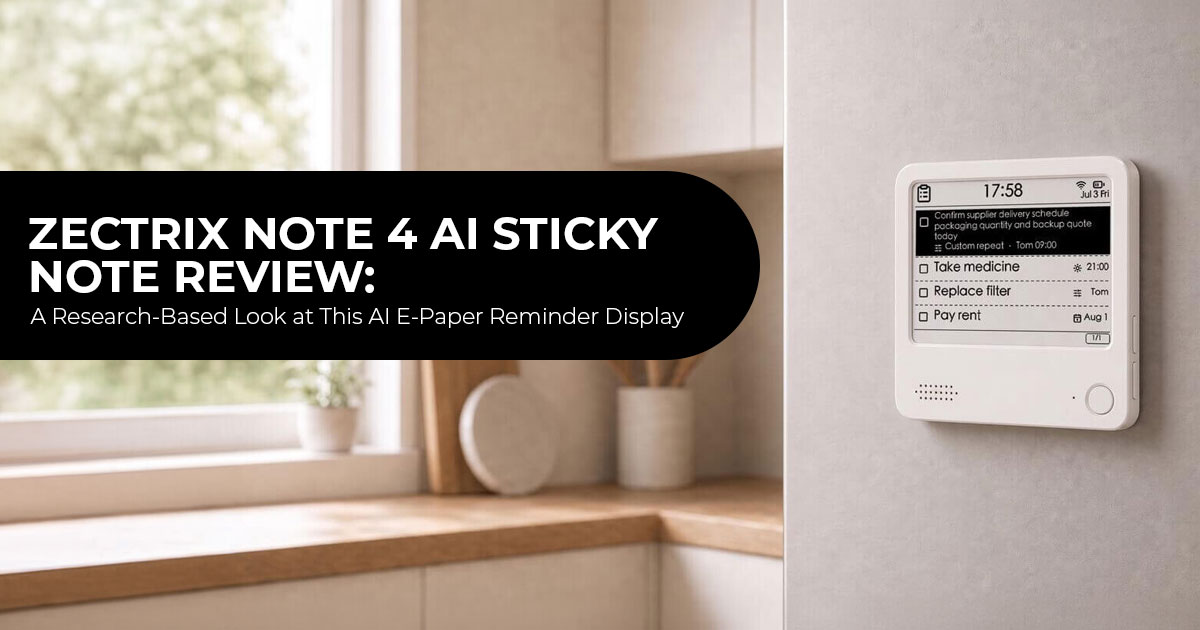
The ZECTRIX Note 4 AI Sticky Note is a compact AI e-paper display designed for people who want their reminders where they can actually see them. Instead of hiding tasks inside a phone, it turns spoken reminders into visible notes on a 4.2-inch e-paper screen. It can also display a weather clock, Pomodoro timer, images, and custom templates, while its magnetic back makes it easy to place on a refrigerator, whiteboard, or other metal surface.
The idea is simple: keep important reminders where you’ll actually notice them. Your phone can store hundreds of reminders, but those reminders are often buried among messages, social media and other notifications. The ZECTRIX Note 4 gives important tasks their own dedicated space, helping you keep a short list of things that matter without turning another screen into a source of distraction.
As technology experts with over 20 years of experience in hardware and application research and development, we deeply analyze each product based on real-world performance, durability, and value for money. Our goal is to help you find the best product in every category—budget, performance, reliability, and long-term usage. For students, home users, makers, developers, productivity-focused users, and anyone looking for a simple way to keep important reminders visible, our recommendations are based on extensive research, component analysis, real-world usability, and industry expertise.
There are some important limitations to consider before buying. At the time of our 16 August 2026 verification, the installed official firmware was reported as Chinese-only. ZECTRIX’s current product page says the multilingual consumer experience is still being refined, with a more complete experience planned through OTA updates by the end of September 2026. The device was also out of stock on Tindie, where the China-based seller had listed it at US$54.99, before shipping, taxes and possible import charges. ZECTRIX’s current official page now lists a planned launch price of US$59 and directs buyers to a waitlist.
Short Verdict
The ZECTRIX Note 4 AI Sticky Note brings together voice-to-text reminders, an e-paper display, magnetic mounting, and hardware that appeals to makers and ESP32 developers in a small package. Right now, it is a better fit for ESP32 users, makers, developers, and early adopters who are comfortable with the current software limitations than for international buyers who need polished English support from day one.
ZECTRIX Note 4 AI Sticky Note specifications
| Specification | Confirmed Detail | What It Means for the Buyer |
|---|---|---|
| Display | 4.2-inch monochrome E Ink | Designed for short lists, clocks, notifications, and simple dashboards rather than detailed documents. |
| Resolution | 400 × 300 pixels | Supports text and basic graphics, but limits how much information can remain legible on the compact 4.2-inch panel. |
| Refresh | Partial refresh supported | Individual screen changes may not require a slower full-screen refresh every time. |
| Processor | ESP32-S3 | A widely used embedded platform with an established ecosystem of development tools. |
| Memory | 8MB PSRAM; 16MB flash | Suitable for the intended firmware and lightweight embedded functions, but not general-purpose tablet workloads. |
| Wireless | 2.4GHz Wi-Fi; Bluetooth Low Energy 5.0 | Supports online services, synchronization, and device setup, but 5GHz Wi-Fi is not listed. |
| Audio | Microphone and speaker | Provides hardware for voice capture and sound output. |
| Other Hardware | NFC, physical buttons, status indicator, and an expansion interface | Provides direct physical controls plus an expansion interface for development and customization. |
| Battery | 2,000+ mAh rechargeable battery | The manufacturer claims up to approximately three months under a stated low-use test condition; actual runtime will vary with usage. |
| Port | USB Type-C | Supports charging and data communication; an official charging wattage is not published. |
| Mounting | Magnetic backplate | Allows the device to attach to compatible metal surfaces without requiring a permanent mounting bracket. |
| Dimensions | 97 × 97 × 8.75mm | Compact square enclosure; the official specification does not state whether these measurements include an optional stand. |
| Weight | Not published in the official sources reviewed | Buyers should avoid relying on unverified third-party weight estimates. |
| Listed Price | US$54.99 on Tindie | Listed price as of 16 August 2026, excluding shipping, taxes, and potential import charges. |
| Stock Status | Out of stock | Buyers should check current availability before comparing the final purchase cost. |
| Enclosure Material | ABS | Officially listed material used for the device enclosure. |
| Warranty | 12 months from device activation for product quality issues | Manufacturer-listed warranty period for qualifying product quality problems. |
What is the ZECTRIX Note 4 AI Sticky Note?
It is a small smart e-paper display designed for reminders and information that doesn’t change often. It is closer to a reusable digital note than a tablet or smart speaker with a screen.
The main workflow is simple:
- Press the physical voice
- Speak a task or
- The connected service processes the
- The resulting text appears on the e-paper
- The screen keeps that information visible until the next
This makes the device a voice reminder display rather than a full task-management computer. That matters. It can help keep a few important items visible, but the published information does not establish that it can replace a mature service such as Todoist, Google Calendar or Apple Reminders.
The product information also lists a weather clock, focus timer, handwritten notes created through the ZECTRIX app, image delivery and flexible templates. Those functions make it an ambient productivity display: information remains present in the background and requires only a quick glance.
How the voice-to-text reminder device could fit into daily routines
The device’s practical value depends less on processing power and more on where it is placed.
Kitchen and refrigerator reminders
A magnetic digital sticky note can keep shared tasks where household members already look. Examples include:
- replace a water filter;
- collect a prescription;
- prepare an item for school;
- note a delivery window;
- display a short shopping
This can be easier than relying on phone notifications, especially when several people need to see the same information. However, buyers should confirm whether the international software supports remote updates and shared workflows in the way they need.
Desk-based task display
On a desk, the device can act as a persistent to-do list display. It could show the next task, a clock or an e-paper Pomodoro timer without occupying a computer window.
The trade-off is simple: a 4.2-inch panel is better suited to the next few actions than an entire weekly schedule.
Entryway or workshop status board
The magnetic mounting and expansion interface may suit an entryway, workshop or equipment area. A developer could adapt the device as a custom e-paper dashboard, simple status board or sensor interface.
That flexibility should not be confused with no-code simplicity. Community firmware can require flashing tools, configuration and some familiarity with ESP32 development.
E-paper display: why it suits persistent reminders
An e-paper reminder display behaves differently from an LCD or OLED screen. A static e-paper image can remain visible without continuously powering the panel. Energy is still required when the content changes and when the device uses Wi-Fi, records audio or runs other electronics.
For the buyer, this produces three practical benefits:
- The content remains visible: a task does not disappear behind a lock
- The official specification states that the monochrome panel is clearly visible in sunlight.
- Cable-free placement becomes practical: low-frequency updates can help reduce power use compared with a continuously lit display.
There are also trade-offs:
- E-paper refreshes more slowly than phone
- Monochrome graphics have limited visual
- The screen is not suited to video or
- Battery life still depends on refresh frequency, wireless use and voice
The manufacturer lists a 2,000+ mAh battery and claims up to about three months of battery life under static-standby conditions with one synchronization per day. Actual runtime will vary with Wi-Fi activity, screen refreshes, voice use, screen content and battery condition.
Design and controls of the magnetic e-paper display
The device measures 97 × 97 × 8.75 mm. Its square format is intended for short lists and low-density information on a refrigerator, filing cabinet or desk.
Physical buttons handle voice confirmation and other functions. This can be useful on an e-paper device because button input remains predictable even when a display refresh takes time.
The hardware also includes:
- a microphone;
- a speaker;
- NFC;
- a status indicator;
- an expansion interface;
- a magnetic
These components broaden the device’s role beyond a basic note screen. For developers, the expansion interface provides a path for custom integrations. For general consumers, the more relevant features are the buttons, microphone, battery and magnet.
The official specification does not document touch or stylus input for the device. Buyers should not assume that “notes” means handwriting directly on the screen.
Performance expectations from the ESP32-S3
The ESP32-S3 is designed for embedded products rather than tablet-class applications. In this device, it is paired with 8 MB of PSRAM and 16 MB of flash storage.
That hardware should be considered in the context of its intended workload:
- rendering simple e-paper layouts;
- connecting to 4 GHz Wi-Fi;
- handling button input;
- capturing audio;
- communicating with online services;
- running compact firmware and custom
It isn’t built for smooth scrolling, complex multitasking or media playback. In this product category, reliable sleep, wake, network and refresh behavior matter more than benchmark scores.
Because we did not test a unit, we cannot confirm transcription accuracy, wake latency, refresh artifacts or wireless stability. These are areas where a future hands-on review would add more value than processor specifications alone.
Connectivity and cloud requirements
The device includes 2.4 GHz Wi-Fi and Bluetooth LE 5.0. The product listing states that its AI and online functions require network access and supported services.
This has several buying implications:
- The standard voice-to-text reminder workflow should not be treated as fully
- A stable 4 GHz network may be required for its main connected functions.
- Voice processing may involve an online
- Service availability and language support matter as much as the
The current official pages reviewed for this article do not explain audio retention, transcript storage or account deletion. Privacy-conscious buyers should ask ZECTRIX where voice data is processed, how long it is stored and whether cloud processing can be disabled.
Bluetooth support may assist with setup or local communication, but the listing does not provide enough detail to promise specific phone-sync behavior. The official page lists iOS and Android app support, but buyers should verify the current language support and feature availability before ordering.
Software is the main current limitation
At the time of our 16 August 2026 verification, the installed official firmware was reported as Chinese-only. ZECTRIX’s current product page says the multilingual consumer experience is still being refined, with a more complete experience planned through OTA updates by the end of September 2026.
This distinction changes the buying recommendation:
- Chinese-speaking buyers may be able to use the official experience
- International developers may use separate community
- Non-technical English-speaking buyers should wait for confirmed software availability and setup
The product listing also notes that open-source firmware may not include every function from the official consumer software. Installing alternative firmware may therefore exchange convenience for control.
Before buying, check four points:
- Is the English firmware publicly available?
- Does the ZECTRIX app support the buyer’s phone and required language?
- Which voice languages are supported?
- Do reminders continue to work if an online service changes?
For this product, those answers are more important than the storage capacity.
ZECTRIX Note 4 AI Sticky Note vs ZECTRIX Note 4C Development Board
According to ZECTRIX, the two models share the processor, battery, enclosure, interfaces and mechanical design, but their displays and software differ. The decision should be based on firmware scope and refresh behavior rather than color alone.
| Feature | ZECTRIX Note 4 AI Sticky Note | ZECTRIX Note 4C Development Board |
|---|---|---|
| Intended User | Consumers and makers | Developers with ESP32 experience |
| Display | 4.2-inch monochrome | 4.2-inch four-color display — black, white, red, and yellow |
| Resolution | 400 × 300 | 400 × 300 |
| Official Consumer Firmware | Included | Not included |
| Official Voice-Task Experience | Included, subject to network availability and supported languages | Not included |
| Software Approach | Official firmware plus separate community-developed options | Open reference firmware with support for custom development |
| Full-Screen Refresh | No specific full-refresh time published | Typically more than 10 seconds |
| Typical Manufacturer-Described Use | Reminders, clocks, timers, and notes | Static labels, photo cards, and occasional status displays |
The ZECTRIX Note 4C Development Board is not simply a color upgrade. Its official page describes it as a development device that does not include the consumer firmware or official voice-task experience supplied with the monochrome consumer model.
The four-color panel uses black, white, red and yellow. ZECTRIX states that a full-screen refresh typically takes more than ten seconds, making the model suitable for occasional status updates rather than rapid interaction.
ZECTRIX Note 4 AI Sticky Note vs Seeed Studio reTerminal Sticky
The Seeed Studio reTerminal Sticky is a directly relevant alternative because it is also a small, voice-enabled magnetic e-paper note display. The comparison below uses only details confirmed on the manufacturers’ current product pages.
| Feature | ZECTRIX Note 4 AI Sticky Note | Seeed Studio reTerminal Sticky |
|---|---|---|
| Display Size | 4.2 inches | 3.97 inches |
| Main Interaction | Physical voice/confirm button and side buttons | Capacitive touchscreen, voice input, and remote management through Seeedash |
| Magnetic Mounting | Magnetic backplate | Magnetic mounting stated on the product page |
| Software Position | Multilingual consumer experience is still being refined, with a more complete experience planned through an OTA update by the end of September 2026. | The Seeedash app forms part of the stated product workflow. |
| Current Listed Price | US$54.99 on Tindie, before shipping, taxes, and import charges | US$49.99 on Seeed Studio’s store, before shipping, taxes, and import charges |
| Availability on 16 August 2026 | Out of stock on Tindie | Pre-order; China-warehouse availability estimated for 15 September 2026 |
Which one is the better fit?
Consider the ZECTRIX Note 4 AI Sticky Note if its documented expansion interface, square 4.2-inch display and community-firmware options match the intended use, and if the current language limitations are acceptable.
Consider the Seeed Studio reTerminal Sticky if remote management through Seeedash is a priority. Its current listed price is US$5.00 lower, but delivered cost and regional availability can change the comparison.
Neither option should be chosen on price alone. For most buyers, supported language, app quality, data handling and firmware updates will determine long-term usefulness.
Strengths and limitations
| Strengths | Limitations |
|---|---|
| ✔ Dedicated distraction-free reminder device designed to keep tasks visible without relying on a phone or conventional display. | ✖ Official firmware was Chinese-only as of the verification date. |
| ✔ Voice capture reduces the need to manually type short tasks and reminders. | ✖ Main online functions require network access and compatible supported services. |
| ✔ Static e-paper content remains visible between refreshes without continuously powering the display. | ✖ Manufacturer claims up to approximately three months of battery life under a defined low-use test; actual runtime will vary with usage. |
| ✔ Magnetic mounting provides flexible placement on compatible surfaces. | ✖ No confirmed hands-on evidence is available here for voice transcription accuracy or long-term app stability. |
| ✔ ESP32-S3, an expansion interface, and community firmware support make the device appealing to makers and developers. | ✖ The compact 400 × 300 display is not well suited to dense schedules or large amounts of information. |
| ✔ Physical buttons are well suited to a simple, low-refresh e-paper interface. | ✖ Availability and shipping remained uncertain at the time of verification. |
Who should buy the ZECTRIX Note 4 AI Sticky Note?
The device may suit:
- ESP32 developers who want assembled e-paper hardware with separate open-source firmware options rather than a bare display board;
- Chinese-speaking users who can use the current official firmware;
- early adopters willing to monitor the English software release;
- households that want a magnetic reminder display for a refrigerator;
- desk users who prefer a small glanceable task dashboard;
- makers building an e-paper dashboard or status screen that updates
Who should wait or choose another device?
Consider waiting if:
- English support is essential today;
- a polished international app is required;
- voice processing must work offline;
- calendar and task-service integrations are essential;
- a touchscreen or stylus is required;
- verified battery runtime is a deciding factor;
- no firmware setup or troubleshooting is
A regular phone reminder app remains the simpler option for buyers who mainly need personal alerts. A dedicated e-paper device is more relevant when persistent physical visibility is the core requirement.
ZECTRIX Note 4 AI Sticky Note price and availability
The current listed price was US$54.99 on Tindie on 16 August 2026. This was the device price from a China-based seller, not a global delivered price. The listing marked the product out of stock and displayed conflicting US shipping messages, so buyers must verify shipping, taxes and import charges for their destination. ZECTRIX’s current official page now lists a planned launch price of US$59 and directs buyers to a waitlist.
Before placing an order, check:
- current stock;
- shipping to your destination country;
- import duties and taxes;
- return terms;
- English firmware status;
- app availability;
- first-batch eligibility for lifetime AI voice access;
- included enclosure and accessories
Buying advice: Compare any reseller offer with the US$54.99 Tindie listing and calculate the delivered price. Also compare current software support, returns and warranty terms with the Seeed Studio reTerminal Sticky and other smart e-paper displays. For first-batch buyers, ZECTRIX currently lists lifetime AI voice access for products shipped before October 2026.
Is the ZECTRIX Note 4 AI Sticky Note worth buying?
Based on the verified information, the device addresses a specific use case: moving short reminders from a phone to a persistent physical screen. Its microphone, magnetic backplate, 2,000+ mAh battery and ESP32-S3 platform support that function.
The main risk is software maturity. A reminder device depends on reliable language support, network services and setup tools. International buyers should therefore verify the English firmware and app before treating the product as ready for routine household use.
For makers, the hardware is easier to assess. An assembled enclosure, battery, audio hardware, wireless connectivity and an expansion interface can save time compared with building a similar low-power information display from separate parts.
Final verdict: The verified hardware is relevant to makers and early adopters who accept the current firmware limits. Non-technical international buyers have a clear reason to wait: English software was not yet confirmed as released, and the Tindie listing was out of stock at the time of writing.
Frequently asked questions about the ZECTRIX Note 4 AI Sticky Note
Does the ZECTRIX Note 4 AI Sticky Note work without Wi-Fi?
The e-paper screen can retain existing content without continuous display power, but the official listing says AI and online functions require network access and supported services. The standard voice-reminder workflow should not be considered fully offline.
Does the ZECTRIX Note 4 AI Sticky Note support English?
ZECTRIX’s current product page says the multilingual consumer experience is still being refined, with a more complete experience planned via OTA updates by the end of September 2026. Check the current product page before buying.
What is the ZECTRIX Note 4 AI Sticky Note battery life?
ZECTRIX lists a 2,000+ mAh rechargeable battery and claims up to about three months under static-standby conditions with one synchronization per day. Actual runtime will depend on Wi-Fi activity, voice use, screen refreshes, screen content and firmware behavior.
Can the ZECTRIX Note 4 AI Sticky Note attach to a refrigerator?
Yes. The device has a magnetic backplate intended for metal surfaces. Magnet strength and compatibility with a specific refrigerator finish were not independently tested for this article.
Is the ZECTRIX Note 4 AI Sticky Note open source?
ZECTRIX provides separate community/open-source firmware options. The official consumer firmware and every online feature should not automatically be assumed to be open source.
Can it show weather, clocks and timers?
The official listing includes a weather clock, Pomodoro timer, notes, images and custom templates among its supported functions.
Does it have a touchscreen?
The current official specification documents physical buttons but does not document a touchscreen. Buyers who require touch input should seek written confirmation from the seller.
What is the difference between ZECTRIX Note 4 AI Sticky Note and ZECTRIX Note 4C Development Board?
The ZECTRIX Note 4 AI Sticky Note uses a monochrome display and includes the official consumer voice-task experience. The ZECTRIX Note 4C Development Board uses a black, white, red and yellow display with open reference firmware, but it does not include the consumer firmware or official voice-task experience.
Check ZECTRIX Note 4 AI Sticky Note availability in the United States
The device combines a persistent e-paper screen, voice-task capture, magnetic mounting, and ESP32-S3 hardware. We did not verify an official Amazon US listing on 16 August 2026, so the link below is an availability search rather than a confirmed purchase listing.
Before ordering: confirm that the listing is for the ZECTRIX Note 4 AI Sticky Note, check the firmware language, compare the final delivered price, and review the seller’s return policy. An Amazon search link does not guarantee that an authorized listing is currently available.
We did not verify an official Amazon US listing as of 16 August 2026. It is a newly introduced, independent 4.2-inch e-paper smart display developed by ZecTrix Lab and sold through maker platforms such as Tindie, rather than major mainstream retail sites.
Check ZECTRIX Note 4 AI Sticky Note Availability in India
We did not verify an official Amazon India listing or an India-specific price on 16 August 2026. Indian buyers should confirm import charges, shipping time, warranty support, firmware language, and regional app compatibility before ordering.
Before ordering: check whether the seller provides local warranty support and whether the package includes official firmware that supports your preferred language. Availability on Amazon India may change as the product reaches more markets.
Have Questions About the ZECTRIX Note 4?
Have you tried the ZECTRIX Note 4 AI Sticky Note, or are you considering buying one? Share your thoughts or questions in the comments. If you have any doubts about the hardware, firmware, features, availability, or whether it is worth buying, ask us—we’ll be happy to help.
If you found this review useful, follow us for more honest product research, reviews, buying guides, and technology updates. Your questions and feedback also help us cover the products that matter most to our readers.
***Disclaimer***
This blog post reflects our research, analysis, and opinions based on available product information, user feedback, and industry knowledge. It should not be taken as the official position of any brand, manufacturer, or company mentioned here. We make every effort to keep this guide accurate, but product specifications, pricing, and availability may change after publication. We recommend double-checking important details before making a purchase.
Some links in this article may be affiliate links. If you choose to buy through these links, we may earn a small commission at no extra cost to you. This helps support our work and allows us to keep publishing in-depth, unbiased reviews. Affiliate partnerships never influence our recommendations.
Opinions expressed by readers are their own and do not necessarily reflect ours. We are not responsible for outcomes resulting from the use of information on this site. Please seek professional advice where appropriate.
All product names, logos, and brands mentioned are the property of their respective owners. These names are used for identification and informational purposes only and do not imply endorsement.